Galaxy Rasbora – Crisis in Question?
June 4th, 2007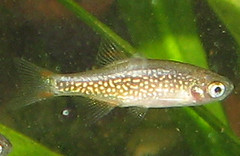 I just received my July 2007 issue of Tropical Fish Hobbyist this week, and was delighted to see that the cover article is about breeding the Celestial Pearl Danio, previously the Galaxy Rasbora. After all, I previously noted that this species, while just introduced to the hobby, is in danger of being over-fished and exterminated from its original habitat. Due to my own trouble breeding these guys, I eagerly looked inside to see what I was doing wrong. Apparently I missed the boat somewhere because they’re supposedly prolific egg scatterers, spawning almost daily in neutral to slightly alkaline water. But that wasn’t the thing that struck me.
While reading the article, I was startled to read that the Celestial Pearl Danio apparently isn’t really in such dire straights as originally reported. The article uses the following reasoning why the reported crisis is nothing more than rumor:
- Collecting aquarium fish benefits local people, so they won’t over-fish because then their livelihoods are affected.
- Normally, when supply diminishes, price goes up. However, the wholesale price for the Celestial Pearl Danio has continued to drop.
- The fish have been found to originate from more than one pond, as was originally suspected, and it’s unknown how much more widespread they may be through their region.
- Since they’re such prolific egg layers, even if the adults were all fished from a pond, the eggs would hatch, and they’d make a comeback.
While this sounds like great news, all of this logics appears to be author speculation, fueled by the stated belief that they don’t want the aquarium hobby to be blamed for the destitution of a species. I’m delighted if this news is true, but for me, it’s going to take more convincing before I recommend that everyone go out and buy this fish. At the very least, I would encourage any potential buyer to ask questions of their fish store owners about the origins of the fish in their tanks. If the Celestial Pearl Danio, is as prolific a breeder as claimed, then fish farms should soon have a captive breed supply, leaving the original habitat unaffected.
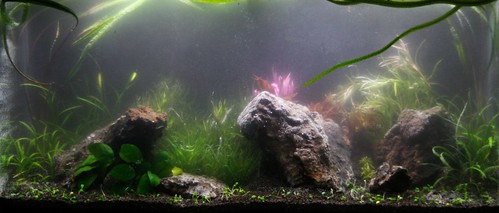
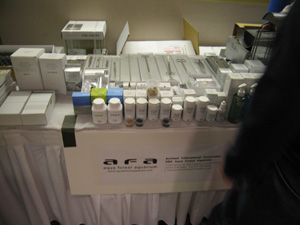 Day 2 of the AGA convention was a packed day of events. The Vendor room was always buzzing, mostly around Aqua Forest’s (left) table of ADA goods. They had everything from trimming tools, to supplements, substrate, and even a small-sized ADA tank.
 However, Troels Andersen, from Tropica, presented next about “Plants’ Acclimation to Life Under Water.” Troels gave a brief overview of some of the research he’s done at Tropica and during his graduate studies. Basically, he talked about the basic requirements most plants have in the aquarium. He offered up a few statements such that fertilizing your substrate is often more efficient than fertilizing the water column, saying that most plants will develop the roots necessary to find those nutrients, while keeping the elements out of the water column where algae can use them.
 Ricky Cain gave a short presentation of people and things that inspire him in the hobby. He listed a number of folks including Amano, Jeff Senske, Luis Navarro, Oliver Knott, and a number of other folks.
 Basically, various growers and scientists tell him what chemicals and proteins a particular plant needs, and he works to manufacture something that meets those needs. He described a number of chemical reactions that go on when a plant actually extracts a nutrient from the water column/substrate. For example, a rooted plant will release a weak acid from the roots into the substrate. This acid/chemical will solibolize iron, converting it from the ferric to the ferrous form, which can them be absorbed by the plant. Later in the presentation, someone tried to get him to talk a little bit about Excel’s algaecide properties, but in the funniest part of the talk, he already had a prepared statement from SeaChem’s CEO that was the usual legal EPA verbiage.
 The last speaker of the conference was Ole Pedersen, also from Tropica. Ole gave an interesting talk about “aquascapes in the natural world.” Basically, Ole showed a number of videos and pictures of various places across the world, from Denmark to Greenland; all of them contained underwater planted lakes or streams that where quite beautiful. He called these natural creations, “Natural Aquascapes.” Also, he gave a slightly different theory than Troels about how plants exist. Basically, he says the most plants in streams uptake nutrients from the water column, while plants in lakes uptake most of them from substrate. The reason, Ole states is that streams are high flowing, constant enriched by CO2 and nutrients from upstream, while lakes are mostly sedimentary, with few currents, leaving nutrient poor and CO2 poor environments. As far as the natural aquascape goes, the currents in streams shape the plants according to the flow of water, while lakes usually have less impressive aquascapes because there this shaping factor is usually missing.

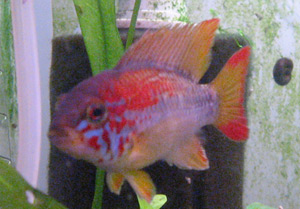
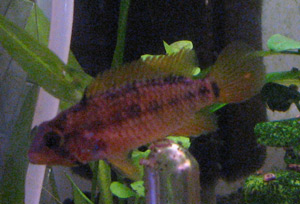
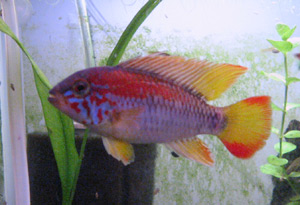 The apistogramma viejita are my prize pickup from the 2006 Catfish Convention. They were setup in “fish room 2,” which was occupied by a series of tank from a breeder in New Jersey. I was amazed by the size of the fish they had available, with both the male and female being full grown at time of purchase.