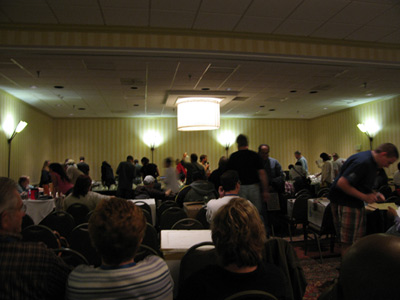
 Today was the first day of the All Aquarium 2006 Catfish Convention put on by the Potomac Valley Aquarium Society,
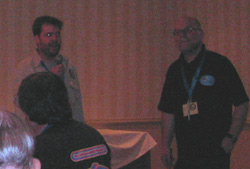
 a large local aquarium club. The program director is Andrew Blumhagen (left), who opened the convention by introducing to us hobbiest, and corydora expert, Ian Fuller (right), all the way from Great Britain.
Ian’s first, of two, presentations at this convention was largely about identifying corydoradine catfish. He presented a number of well drawn slides, such as the one below, showing in detail the growing number of problems in the

classification system of these fish. Basically, he demonstrated how two entirely different species can look too similar to differentiate when put side-by-side. His claim, is that you must know the exact locality to correctly identify the fish. Toward the end of his talk, he mentioned that the situation is only being exacerbated by human factors, such as deforestation, pollution, and dam construction. These factors are causing species to migrate out of their normal habitat, entering new environment. The changes in their environment are causing the fish to develop different color morphs, further complicating identification.
 The second speaker at the convention was Lee Finley, who gave a presentation focusing solely on how to feed your catfish the kind of food they would normally eat in the wild. Basically, catfish don’t just eat algae and detritus when in the wild. Depending on the species, they’ll eat wood, bark, algae,
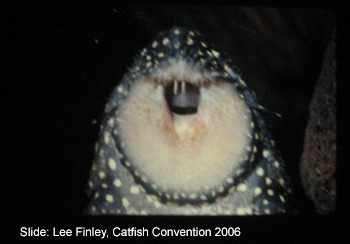 detritus, veggie matter, fish, insects, larvae, worms, the list goes on. His slide of the commonly known Vampire Pleco, or Rabbit Tooth Pleco, illustrated how specialized some of these catfish have become. These Plecos used their “two front teeth” to chisel away at wood, searching for inserts; much like a
 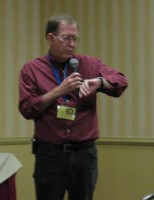 wood pecker would do in a forest. Unfortunately, Lee had to rush through his talk in order for everyone to make it to the much anticipated Italian dinner.
Finally, the last topic I was able to hear for the day was put on by Dinyar and Rusty Lalkaka. This father and son duo gave us a quick tour a number of interesting Asian catfishes. Even though Asian Catfish are only second to South American fish in terms of the diversification of both species and genus, few hobbiest know or keep them. One of the lone exceptions is probably the glass catfish, which are at every LFS in the world.
The last two topics were titled “Catfishes in the Classroom” and “Breeding Loricariids.” Unfortunately, I wasn’t able to stick around for those two, but I’m sure they were quite interesting. Stay tuned for more convention coverage from Day 2, tomorrow!