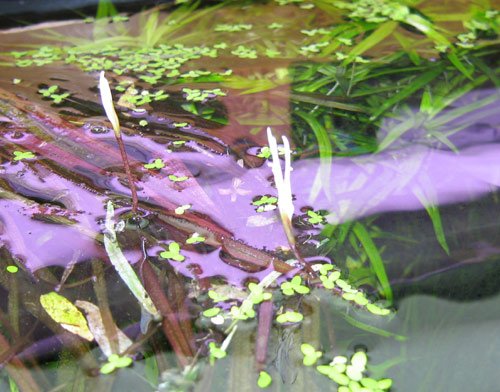
40G Tank: Stem Jungle!
November 29th, 2006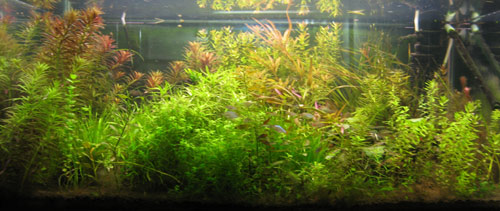
 Somehow, without me realizing it, my 40G tank has turned into more of a farm tank, than an aquascape. There’s a little bit of everything in this tank right now, most of it doing surprisingly well!
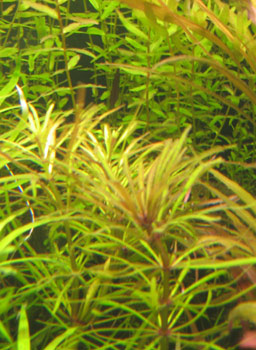
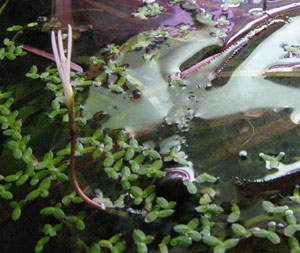
This is part of the problem when you have a tank with ADA aquasoil in it. You know that just about anything will grow in it! Therefore, when I see a plant I’m interested in trying, but don’t have room for in my normal aquascapes, where does it go? Well, of course, in the 40G, where the amazonia will keep it alive until I do find room for it! The only problem I ever have in this tank is occasional blue-green algae, when I don’t dose enough nitrates. As you can imagine, all of these stem plants suck up some nutrients! I’m currently only dosing SeaChem products in this tank because they work well, and don’t cost that much to maintain a 40G tank. I pretty much follow their recommended dosing chart as far as frequency of dosing goes, but I dose more than they recommend of everything. To the right is the pogostemon stellatus from Jeff in GWAPA (bigstick120 online) that’s waiting for the right aquascape to go in. The time will come soon I hope!
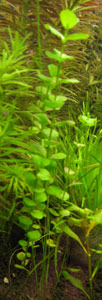
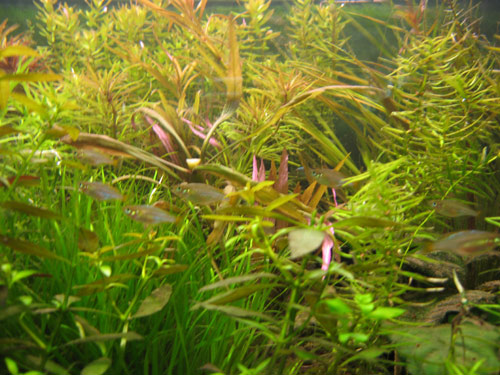
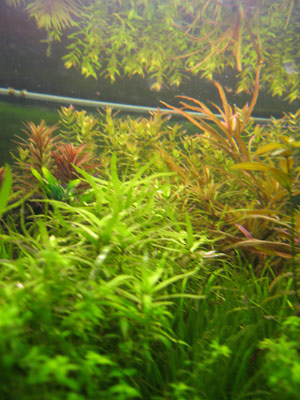 So what’s in here? I’ve got the usual plants, such as limnophilia aromatica, baby tears, didiplis diandra, stargrass, blyxa japonica, blyxa albertii, rotala magenta, and rotala pusilla.
A few more exotic ones like ludwigia cuba, ludwigia pantanal cuba, cyperus helferii, and rotala macrandra var. ‘green.’ Don’t forget pogostemon stellatus, and pogostemon stellatus ‘broad leaf.’
Not to mention a few ground-cover plants that are not getting near the light they require! Then, I have a few plants that I’ve collected locally, including creeping jenny, ludwigia palustrus, and an eleocharis species.
With all of these plants, I rarely see my beautiful apistogramma panduro fish that I love so much. Fortunately, the dwarf neon rainbowfish juveniles that I picked up at the catfish convention seem very much at home in this tank. They’re always racing around the tank, from end to end, darting in-between plants and rocks as they go. I think they like it in there!
 Erik Olson gave a short presentation about the future of the AGA at the concluding banquet. Afterwards, he led straight into the results for the 2006 AGA Aquascaping Contest. There were a number of great entries in this year’s contest, including a couple quite innovative ones that didn’t win anything. I have to say that I don’t necessarily agree with all of the awards, but that’s true with any contest. I did notice a dearth of quality U.S. entries, so I would like to encourage everyone in the U.S. to submit their tanks next year, regardless of the state of it. (I’m guilty of not submitting this year as well,
  so I’ll be the first to take my advice next year.)
 The final part of the banquet involved the IronMan Aquascaping Challenge between the two ADA store staffs in the U.S: Jeff Senske and his team verses the AquaForest team. There were limited rocks, manzanita wood, and plants to use. Right from the get go, the competitors, grabbed the hardscape materials that they wanted to use. Jeff decided to use more of a X pattern for his wood, and probably started on the short end of the stick with his hardscape due to a lack of materials up to the quality he’s used to. (If you don’t know, his rock and wood pile is supposed to be of legendary proportions down in Texas.)
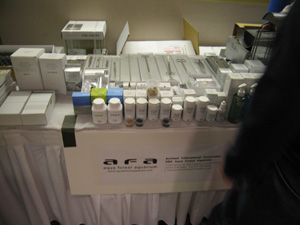 Day 2 of the AGA convention was a packed day of events. The Vendor room was always buzzing, mostly around Aqua Forest’s (left) table of ADA goods. They had everything from trimming tools, to supplements, substrate, and even a small-sized ADA tank.
 However, Troels Andersen, from Tropica, presented next about “Plants’ Acclimation to Life Under Water.” Troels gave a brief overview of some of the research he’s done at Tropica and during his graduate studies. Basically, he talked about the basic requirements most plants have in the aquarium. He offered up a few statements such that fertilizing your substrate is often more efficient than fertilizing the water column, saying that most plants will develop the roots necessary to find those nutrients, while keeping the elements out of the water column where algae can use them.
 Ricky Cain gave a short presentation of people and things that inspire him in the hobby. He listed a number of folks including Amano, Jeff Senske, Luis Navarro, Oliver Knott, and a number of other folks.
 Basically, various growers and scientists tell him what chemicals and proteins a particular plant needs, and he works to manufacture something that meets those needs. He described a number of chemical reactions that go on when a plant actually extracts a nutrient from the water column/substrate. For example, a rooted plant will release a weak acid from the roots into the substrate. This acid/chemical will solibolize iron, converting it from the ferric to the ferrous form, which can them be absorbed by the plant. Later in the presentation, someone tried to get him to talk a little bit about Excel’s algaecide properties, but in the funniest part of the talk, he already had a prepared statement from SeaChem’s CEO that was the usual legal EPA verbiage.
 The last speaker of the conference was Ole Pedersen, also from Tropica. Ole gave an interesting talk about “aquascapes in the natural world.” Basically, Ole showed a number of videos and pictures of various places across the world, from Denmark to Greenland; all of them contained underwater planted lakes or streams that where quite beautiful. He called these natural creations, “Natural Aquascapes.” Also, he gave a slightly different theory than Troels about how plants exist. Basically, he says the most plants in streams uptake nutrients from the water column, while plants in lakes uptake most of them from substrate. The reason, Ole states is that streams are high flowing, constant enriched by CO2 and nutrients from upstream, while lakes are mostly sedimentary, with few currents, leaving nutrient poor and CO2 poor environments. As far as the natural aquascape goes, the currents in streams shape the plants according to the flow of water, while lakes usually have less impressive aquascapes because there this shaping factor is usually missing.

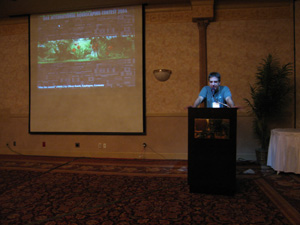 After many months of waiting, the 2006 Aquatic Gardeners’ Association Conference is underway after president, Erik Olson, welcomed all attendees. He introduced many of the speakers for the weekend conference, and asked several local clubs to come up to the podium to speak about their activities. There was a brief, unexpected intermission, when one of the folks, who will rename unnamed, fainted at the podium, and needed some time to readjust themselves to their surroundings.
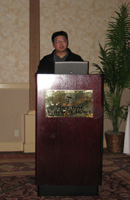 Eric Do gave the opening presentation about invertebrates. Eric is from the host club, the San Francisco Bay Area Aquatic Plant Society, and gave an excellent presentation with many very professional-like macro photos of shrimp, snails, crayfish, and even triops. He described how he uses the “drip-method” to acclimate all of his new arrivals, and recommended feeding them a number of prepared foods, veggies, with a new homemade food by a hobbist in Finland, being especially good. Eric covered pretty much any small shrimp in the hobby, including cherry reds, amano shrimp, cardinia sp. ‘red dragon’, green shrimp, bee shrimp, tiger shrimp, crystal reds, ghost shrimp, etc. The green shrimp were particularly interesting because the photos Eric showed demonstrated how they camouflaged themselves based on their environment. He also talked about how some of the more
 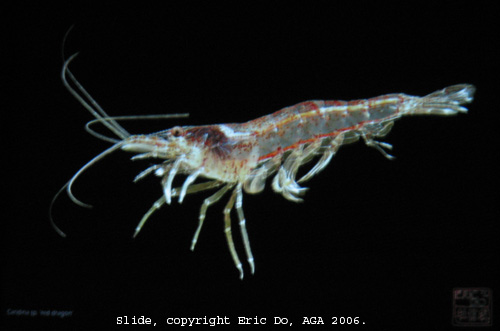 expensive shrimp are graded, using crystal reds as an example. Basically, the width and number of white bands on a crystal red define how “good” of a shrimp it is. He mentioned how folks in Asia are trying to selectively breed a crystal red shrimp that is entirely white, with all the white bands merging together.
 The second, and last, presentation for the evening was about Aquarium Photography by Jeff Senske of Aquarium Design Group, in Houston, Texas. Jeff is well-known in the aquarium community, and on the online forums, for pictures of his tanks. He wanted to briefly share a few of his tips and tricks to successfully shooting an aquarium. A few tips:
 We arrived at the Monterey Bay Aquarium around 9:00am this morning. They shuffled us into a large conference room, with coffee and pastries, and gave a short presentation about what is currently housed at the aquarium, and what is in the works for the next couple of years. The new Otter exhibit will feature a number of freshwater focused tanks, including at least one large planted tank.
 It’s amazing to see the scale on which they work. For example, look at these huge tubes of green water being culture to raise daphnia and of small invertebrates. There were at least 5 of these in a row.
 We moved to the roof to look down on their very impressive Kelp-forest. The Packard’s specially designed a plunger style pump to simulate waves inside of this tank. You can literally watch the top of the water oscillate up and foot by a difference of a foot every few seconds. The Kelp Forest itself is amazing. They have Kelp algae spanning over 2 stories tall. The tour guide mentioned that in the wild a Kelp stem can grow 14 inches every day. They get about half of that growth in captivity. During the day they pump in filtered seawater to keep it cleared. At night, they pump in raw seawater, bringing in all kinds of plankton and nutrients to sustain the inhabitants of this tank.
 They’re showing plants from Africa and Asia. The tanks themselves are all custom built acrylic tanks, with the largest one being about 4 foot by 3 foot by 3 foot. They use SeaChem Oynx Sand and gravel in the tank, with metal hallides floating above the tank. Of course, these are not the final tanks, or aquascapes, but tests to see what plants grow well in their conditions.
 At the last