Florida Trip – Around Miami (Day 4)

June 17th, 2007

We woke up Sunday, ready for a full day of collecting around the Miami around. In Miami, canals crisscross the entire area, allowing us plenty of accessible collecting spots via public boat ramps. In addition, due to the large population density, many non-native fishes have made their way (unfortunately for the habitat, fortunately for us) into the waterways. At our first stop, we found a boat ramp behind a fairly large shopping complex. Walking down the canal banks, we didn’t see a any signs of life outside of a few clumps of Hygrophila polysperma and Cabomba. There were more office chairs and discarded garbage in the canal then we saw fish.
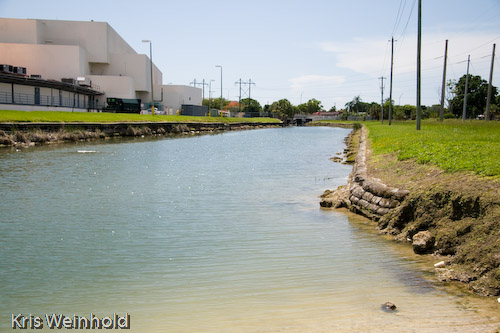
Canal in Miami

We decided to cast our nets into the polysperma anyways, and to our surprise, we found 4-5 small cichlids! There seemed to be two types present, 1 type with vertical bars that are probably juvenile Mayan cichlids, and the other, a much more colorful Jewel cichlid (shown below.) What was originally a very bleak looking habitat suddenly came to life. As we continually pull more of these cichlids from the water, we start to see some larger fish take interest in our activities. Peacock bass start coming in to feast as we startled the smaller fish from their protective plant mats. We continue netting fish for several hours, before deciding to grab some lunch and move on to our next location.
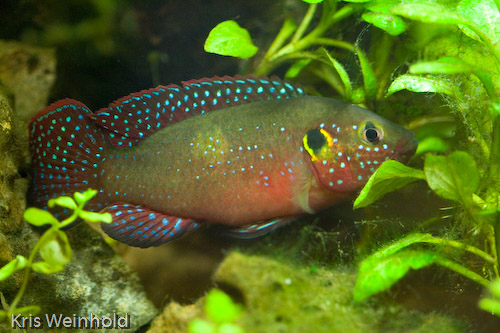
Jewel Cichlid

A few miles away, we located another canal system with public access to the waterways. Unfortunately, this dock was much more frequented by jet skis and motor boats, so we decided to investigate a more seclusive pond right next to the canal. A few of us are looking down in the pool, seeing the usual batch of mosquito fish swimming around, when a couple of plants take our eye. First, floating on the surface is a very frilly plant, that upon closer investigation is a carnivorous badderwort. Well, I have to try that one out, and while I’m gathering a few small fronds of that, I notice another plant with elongated brown and yellowish leaves. Immediately, I get excited that I had found a bed of crypts! So, I pull a couple out, and take them to Ghazanfar. “Nope, they’re not crypts,” he says, but instead appear to be some sort of an Aponogeton. In this pool, none of the Aponogeton are taller than7-8 inches. I’m really hoping that they intend to stay that height because every other species that I’ve tried tends to grow multiple feet in length.
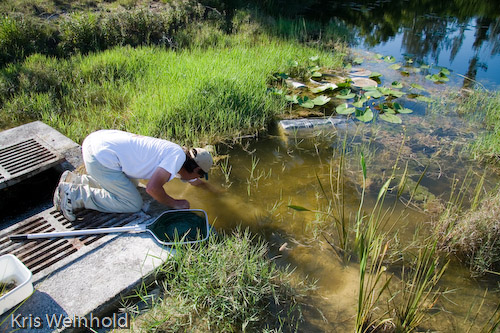
Investigating a pool

Meanwhile, a few other folks had started dipping their nets in the canal, now free of jet skiers. More great fish start showing up in our nets, including a very pretty variety of sunfish (shown below), some shiners/minnows with really nice red on their tails, two varieties of darters, and a new color strain of Jewel cichlids. The Jewels in this canal are much redder in coloration, while in the first canal, they were more turquoise. After being out under the sun for a number of hours, we all decided that it was time to cool off back at the hotel.
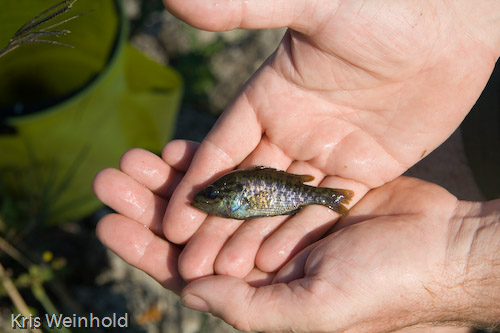
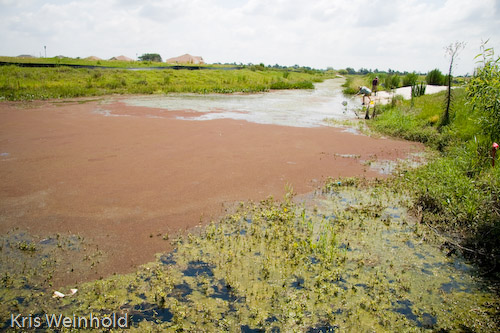
Sunfish in hand


Business Broker

Florida Trip – Day 3

June 14th, 2007

Day 3: Somewhere outside of Tampa

First Collection Site for the Day

We spent the night in Tampa on Friday, spending some time with Michael’s cousin, who treated us to some homemade ice cream. That provided exactly the fuel we needed to get up and going on Saturday, hitting lots of collection ditches across the state. Our first collection site happens to be outside of Tampa near where a few fish farms used to be located. Our thinking is this: where fish farms used to be, leftover exotic fish must have escaped via flooding or hurricane into the local waterways. We’re driving around and pass over a small stream-fed canal, where we come to a sudden stop to get out. As you can see above, it’s not the prettiest site, but as we’ll soon learn, sometimes the least promising looking pools can yield the best results.

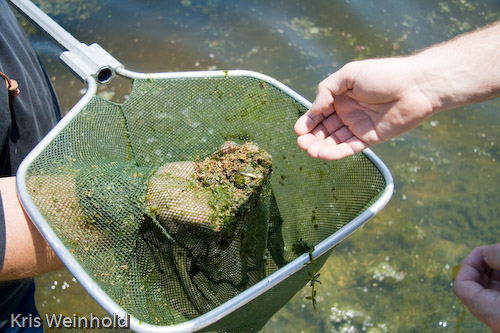
What's in the net this time?

We dip in our nets, and find a plethora of different species. Of course, we pull out more than our fair share of gambusias (mosquito fish), but we also end up with some blue-fin killies, Heterandria formosa, and grass shrimp. In addition to that, we see a very large gar and a group of bass and sunfish. All-in-all, a very nice catch on the fish side. Unfortunately, there weren’t many interesting plants to speak of. That will soon change.

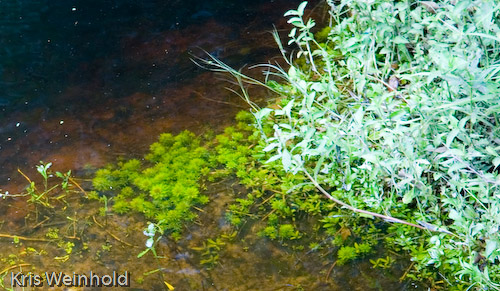
Parrots Feather

We get back in the car, head out toward Zolfo Springs, in the middle of the state, and along the way end up on a bridge overlooking the Little Manatee River. We look down at some beautiful patches of bright green plants along the edge of the river. Ghazanfar and I identify some of the plants as the common bacopa monnieri, hydrocotle, and hygrophilia polysperma, but one other plant is hard to identify from above. Of course, at the possibility that we might have discovered a new stem plant, we descend down the steep and heavily overgrown riverbank to take a closer look. What do we find? Well, the extremely exotic *cough* Parrot Feather. Nevertheless, we sample a few stems and head on our way.

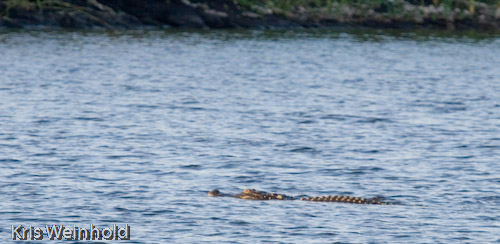
Gator!

Continuing to drive across the state, we see signs for Lake Okeechobee, spot a boat dock, and pull over. On a previous GWAPA trip, three years ago, our members pulled pounds of grass shrimp from vegetation along the banks of this very same canal. This time, not only was the water very low, but it was also completely free of any vegetation. We later learn that the state is treating the water with herbicide to try and contain some invasive species of plants. It seems that it’s killing more than just the invasive types. In any case, our stop was not totally uneventful because off in the distance, one of our members spot two humps, the head and back, of an alligator swimming down the channel. Check that one off my list — See an alligator in Florida, DONE!

Business Broker

Florida Trip – Ichetucknee River

June 13th, 2007

GWAPA recently organized a 6-day “field trip” down to Florida to collect plants, fish, and enjoy many of the various aquarium-related attractions the state has to offer. Five GWAPA members, including myself, piled into a few vehicles to make the trek down I-95. Over the next few blog posts, I intend to chronicle portions of our trip. I hope you enjoy reading this as much as we enjoyed the trip!

Day 1: A lot of Driving.

Day 2: Morning: Snorkeling the Ichetucknee River

Ichetucknee Springs State Park We arrive early in the morning, around 7:45am, just before the park opens at 8:00am. Ghazanfar had been recommended this excellent state park by a number of other aquarists who had snorkeled the river 3-4 years ago. We enter the park, and receive a number of instructions; Ghazanfar and I carry the gear to the first spring, while Michael and Rodney take their vehicles downstream to our stopping point. While we’re waiting for the others to return, Ghazanfar and I enter a small spring-fed pool to adjust our snorkeling equipment and ready ourselves for the next 3.5 hours of swimming. Even the small pool is amazing, showcasing at least 4-5 plant and fish species. Despite the relatively chilly water, we had a great time. Hydrocotle, Valesneria, and Ludwiga line the spring
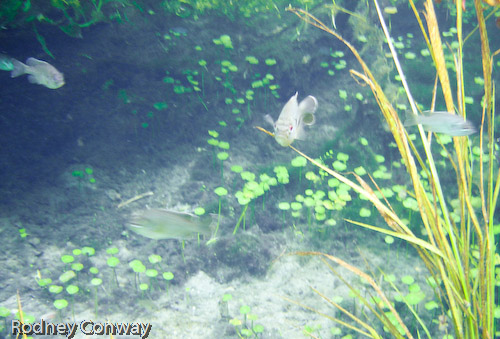
Hydrocotle, Valesneriam, Ludwigia, native mosses, and bacopa populate the floor of the spring. Various sunfish, catfish, and bass hang out in the cool, clear water. We’re able to see the spring push through a small cavern below us, sending small rocks circling in the water. Rodney and Michael arrive, and it’s time to head down the path to the actual river entrance.

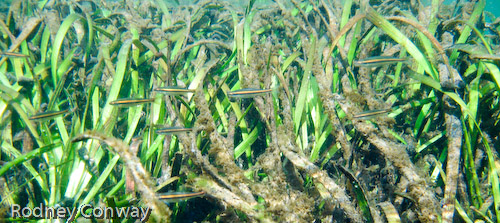
Copper line minnows swim among the Val

The river itself is covered from left to right (and often floor to surface) with 2-3 foot long Valesneria. In the main channel, larger fish swim in the open, while others often take refuge in still enclaves, protected from the current by masses of wood, limestone, and plant matter. As you swim toward the banks of the river, smaller fish, such as these shown above, swim in the hundreds among the grasses. I regret not being able to collect these fish, as collecting from state parks is illegal. Wouldn’t a group of these guys be fantastic in a large planted tank?

Over three exhausting, but exhilarating hours in the water, we make our way to the parking lot, readying ourselves for the real reason we came down to Florida – to collect and sample various fish and plants from around the state.

Day 2: Afternoon Collecting

Collecting Site #1

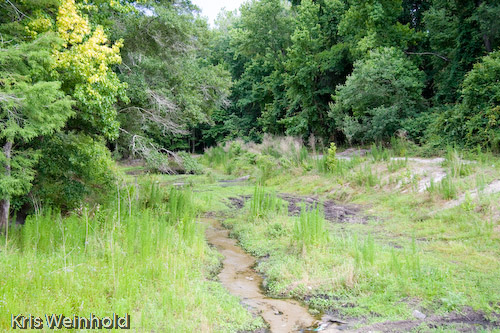
After getting our fish licenses, we head out on the road looking for small creeks, water-filled drainage ditches, and runoff ponds. One of the first places we came upon that fit this description is shown above. We found a few speckled mosquito fish, lots of hydrocotle and bacopa monnieri, but not much else. Nevertheless, we bagged a few sample plants and headed on our way. Now we knew what we had come from, so we were ready for the next few days of collecting.

Day 2: Evening Driftwood

Tom's Cypress

The next stop on our trip is Tom’s Cypress, a huge retailer of cypress wood, branches, and artisan goods. As you can see, they have a large selection of cypress knees. I selected a few unique-looking pieces of cypress, paid, and left satisfied with a great first day in Florida.

Business Broker

  Next Entries »