September 14th, 2007
I’ve been keeping Phyllanthus fluitans since I obtained it from the 2004 AGA convention’s silent auction in Washington, DC. This has been the nitrate sucker in my 54G, giving gradually increasing shade to my anubias and crypts in that tank. I say “gradually increasing shade” because at every water change I compost all but a handful of the floating plant, and by the next water change two weeks later it’s usually covering the water surface.

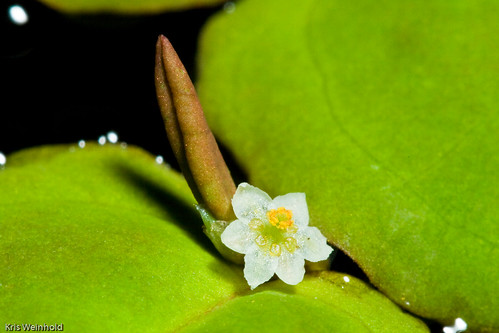
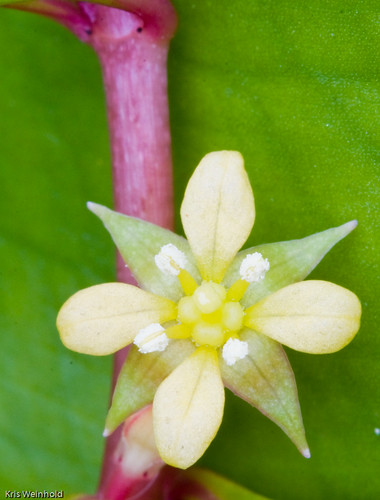
Ever since I started mixing 10,000K and 6400K bulbs over that tank, the Phyllanthus fluitans has started flowering. I decided to pull out my Kenko 68mm extension tubes with my 100mm macro lense to try and get a good close-up shot. This flower is only 1-2mm across in diameter.
Posted in Plant Profiles | 2 Comments »
September 12th, 2007
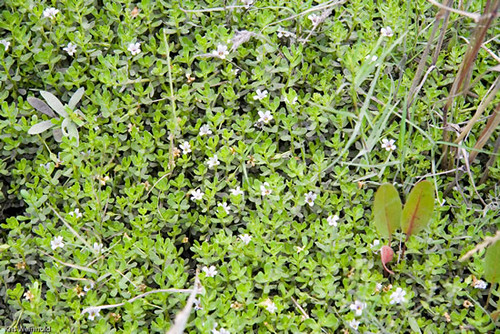
In June, when I went down to Florida with a few other GWAPA members, Bacopa monnieri was one of the plants that seemed to be everywhere, from the rest area drainage ditch when we entered the state, to the canals of Miami down south. Most of the time, we found it emersed and flowering like this picture below.
Despite its abundance, I honestly didn’t know I grabbed any until after I got my plants home, and found a single stem in among some of the other things I brought back. I decided to plant it, and see how it would turn out. A few months later, it bushed up very nicely, and is one of the few plants that I collected that I think I’ll try to incorporate into my next scape. It provides a really bright green color to the tank, which I like. Below is an isolated picture of a stem or two. I believe that Bacopa monnieri is quite common in hobby, but if you haven’t tried it yet, give it a whirl. It doesn’t seem to be a demanding plant, so it should do well in most planted tanks.
Posted in Florida, Plant Profiles | Comments Off on Bacopa monnieri from Florida
August 25th, 2007
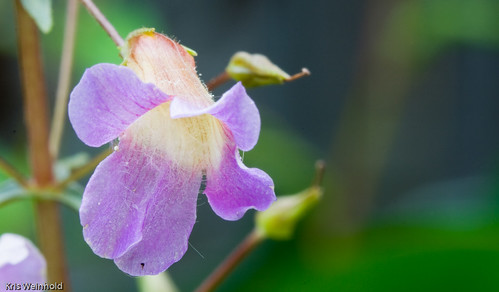
Along with the Ludwigia that’s flowering, my Limnophila aromatica has been flowering for almost a month now outside in my pond. Each stem sends out a number of flower buds at each node. Then, the buds open to reveal these pretty little purple flowers. The flowers themselves are only about 3/4″ long and about 1/3″ from petal to petal, with the tiny little hairs that you can see in the picture. I often see some of the smaller bees visiting these flowers.
Posted in Plant Profiles, Raised Brick Pond | Comments Off on Limnophila aromatica Flowers!
August 24th, 2007
While in Peru, the pond foliage has absolutely exploded in quantity. The frog bite has claimed 100% of the water surface, while what I think is Ludwigia brevipes is creeping along the edge of the pond. Much to my delight, it is also flowering with these pretty little yellow flowers.
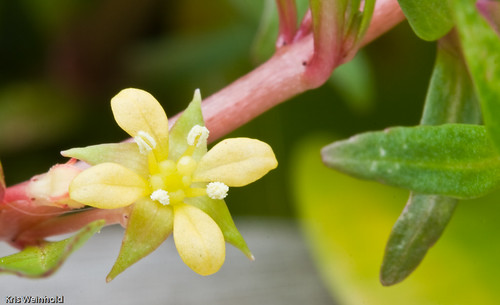
The flowers themselves seem quite delicate and don’t last more than a day or two, especially with the rain we’ve been having the past couple of days. To give you an idea, these flowers are probably smaller than a U.S. dime in size. I’ve never had a Ludwigia flower underwater, so I’m quite pleased to be able to see it emersed. I hope you enjoy the photos.
Posted in Plant Profiles, Raised Brick Pond | Comments Off on Ludwigia Flower in Pond
August 2nd, 2007
As I’ve mentioned this spring, I put frogbite out in my pond to help cover the water’s surface. An interesting thing happens out in the pond, that doesn’t usually happen inside in my aquariums — it gets huge! The roots burrow into the substrate, which when supply all the nutrients it needs to propel the leaves off of the water’s surface, and into the air. Usually, in the aquarium, the leaves have very little stem, and form a tight circular group at each node stretching across the surface. I’ve got stems that 4-5 inches long, standing upright with huge leaves on the end out in the pond.
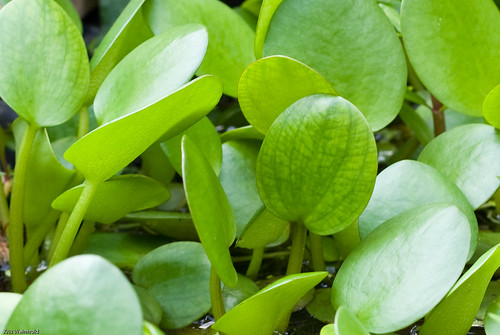
Also, on the water surface, the underside of the leaves has a bulbous growth near the stem. When out of the water, this seems to disappear somewhat. There are still leaves growing across the surface, but as they age, they appear to extend toward the sky.
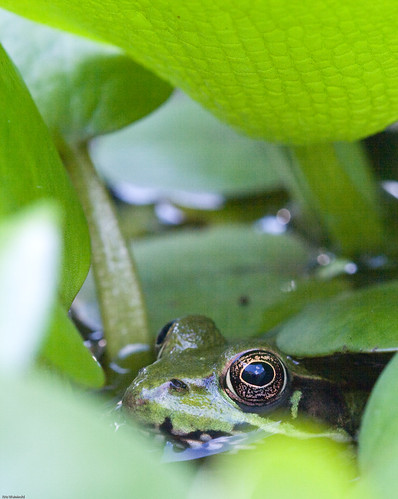
This, of course, doesn’t seem to bother our newest inhabitant shown below, as he uses them for cover. Unlike his larger bullfrog cousin who is commonly seen sitting on the pond’s edge, he is a smaller frog, much like the ones I used to catch and release when I was growing up.
Posted in Plant Profiles, Raised Brick Pond | Comments Off on Giant Frogbite
July 11th, 2007
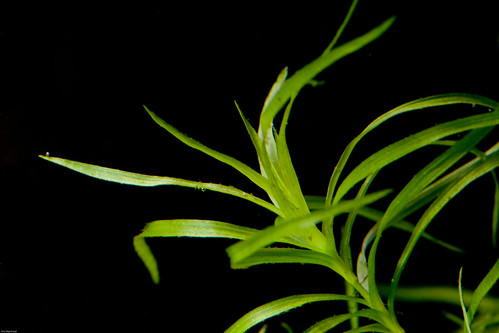
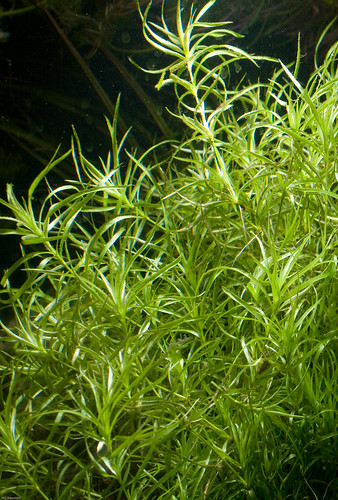 I bought a small number of stems of Eriocaulaceae sp. ‘Type 2’ at a GWAPA auction a few months ago. This Eriocaulaceae doesn’t look much like many of the other Eriocaulon (pipewort) species that are tearing through the hobby. While the plant looks like a regular stem plant, it really does seem to populate by a form of horizontal runner, where vertical stems grow from the base runner. That said, the plant does bush up quite nicely, and give a very similar effect to that of Stargrass (Hetheranthea zosterifolia), except that it doesn’t seem to grow as prolifically.
Because of its growth by runners, the plant doesn’t shoot to the water’s surface like most other stem plants, which is great for someone like me, who often tires of trimming. I do want to note that while I say that Eriocaulaceae sp. ‘Type 2’ extends by runners, it has most definitely not been as pervasive (invasive really) as something like Sagittaria or Vallisenaria that are known to start popping up all throughout your tank. The Eriocaulaceae runners all stay above the substrate.
If you can get your hands on this plant, I definitely would recommend experimenting with it, as it has lots of aquascaping potential.
Posted in Plant Profiles | 1 Comment »
June 6th, 2007
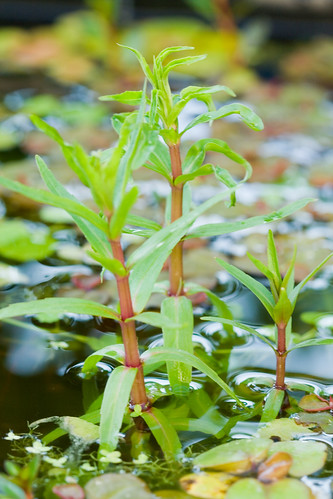 I recently planted some Pogostemon yatabeanus outside in my raised brick pond, and just as it often is in my 75G aquarium, it’s the fastest growing plant in my pond. So much so, that it’s grown right up out of the water. Of course, I did cheat a little bit by transplanting some stems that were already starting to grow emersed from my 75G, hence the deformed leaves, burnt by my light strip, but plenty of others have since grown up out of the water.
It’s interesting to see how, when emersed, the stem is a nice red color, where submersed it’s much more subdued. The leaves are much waxier above water, while below water, the stems tend to lie horizontal to the water’s surface, sending vertical side-shoots out of the water.
I have no doubt that before long, I’ll be posting about Pogostemon yatabeanus flowers!
Posted in Plant Profiles, Raised Brick Pond | Comments Off on Pogostemon Yatabeanus – Emersed Outside
February 27th, 2007
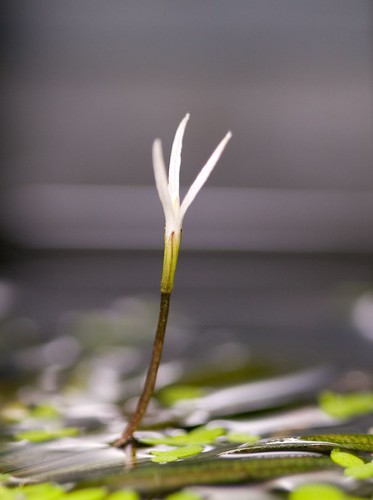 Previously, I’ve posted pictures of my Blyxa aubertii flower. Now, I’ve noticed that some of the Blyxa Japonica, that has been floating toward the top of the surface for some time, has also flowered! From my untrained eye, it’s quite difficult to tell any difference from the two flowers, but I suppose that why the two plants are so closely related.
In any case, it’s always nice to open up your aquarium hood, and see a pretty little flower waiting there for you.
What may be even more incredible is that this is flowering under 1.5 year old normal output flourescents that are being overdriven. I have a mix of 6500k and 10000k temperature bulbs. I’ve noticed in other tanks that 10000k bulbs have caused flowering, so I’m guessing that these bulbs are holding up okay, even though they’re being overpowered.
Posted in 40G Tank Log, Plant Profiles | 2 Comments »
February 6th, 2007
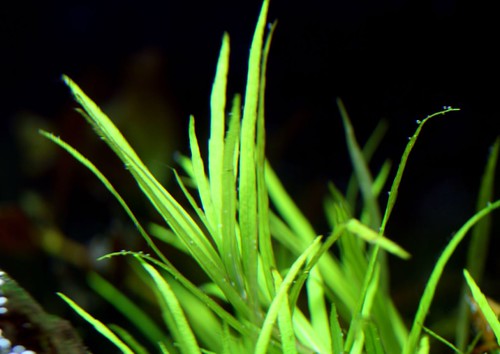
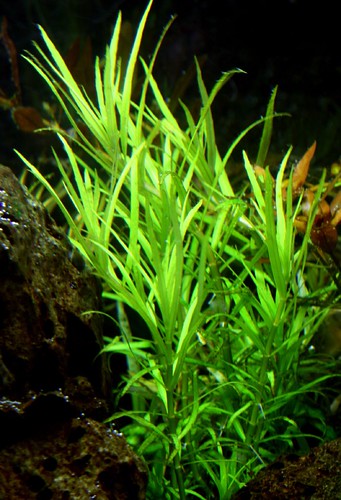 At the December GWAPA meeting, I was fortunate enough to obtain Pogostemon yatabeanus in the mini-auction that we have at every club meeting. P. yatabeanus is an Austrailian plant, from the same reknowned genus as Pogostemon stellatus, formerly Eusteralis stellatus. This particular species reminds me more of the broadleaf variety of P. stellatus, in that it’s a little bit larger of a plant, except that it stays a beautiful bright green instead of bronzing under bright light. It doesn’t seem to be particularly demanding if kept in your typical high-tech setup.
I currently have the plant in my 75G, planted in Soilmaster Select ‘Red’, with pressurized CO2, high-light, and regular dosing. In this environment, P. yatabeanus might be the fastest growing plant in the tank. Young stems stay rather slender with narrower leaves. Older stems can grow quite thick, with leaves that become longer and fatter, similar to how P. stellatus ‘broadleaf’ grows. When you trim P. yatabeanus and leave the lower portion in the substrate, 2-3 new stems start to grow out of the incision.
Due to this plant’s size, I don’t know if I’d recommend it for a smaller tank, but in a larger tank I think it’s the perfect ‘green’ companion to plants such as limnophilia aromatica, pogostemon stellatus ‘broadleaf’, etc… If you can get your hands on this plant, please give it a try.
Posted in 75G Tank Log, Plant Profiles | Comments Off on Pogostemon yatabeanus
February 2nd, 2007
I few months ago, I bought a plant from SCALES that was labeled “Rotala indica ‘Red’.” I believe this plant is probably the same thing as Rotala sp. ‘Colorata,’ but at least one GWAPA member believes this is the “real” rotala indica. Either way, this is a gorgeous stem plant that doesn’t need a ton of light to get some very vibrant red tones.
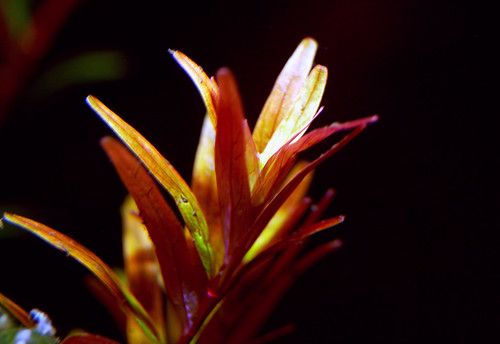
I’ve also noticed that this rotala will start to grow horizontally much more readily than many other rotala’s I’ve tried. As it does this, it sends up multiple vertical stems which can eventually be trimmed and replanted as their on stalk. The plant definitely takes off when CO2 is added, but it seems to grow, albeit much slower, without the added carbon injection. Right now I’m growing this using all SeaChem products in my 20L.
Posted in 20L Tank Log, Plant Profiles | Comments Off on Rotala indica ‘Red’