February 11th, 2008
I’ve largely neglected my 20H for some time. At first, I had 55W over this tank, and was constantly frustrated with algae problems. Eventually, I got sick of it, and went with a 15W fluorescent strip light over instead. Since then, the algae has been dying back, but I’ve been surprised by some of the plants that have hung on.
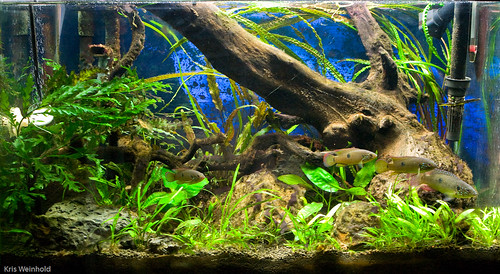
The Ranalisma rostrata has kept growing, albeit differently, the bolbitus has grown leaps and bounds, and my crypts have done just fine. Most surprising is the Eriocaulaceae sp. ‘Type 2? that’s continued to grow despite the awful light. Inspired by this, last weekend I pulled a few more crypts/anubias from my 54G corner tank, and filled in some of the gaps in the layout. The picture above is the result of that effort.
This isn’t a typical aquascape, but somehow it looks more natural to me then some of the others. The Jewels seem to be right at home with the plants. I’d love to hear any comments you might have on the scape.
Posted in 20G High Tank Log | 14 Comments »
September 21st, 2007
Ever since I setup this tank, I’ve been fighting terrible algae throughout. The wood constantly recovered itself with new hair and black brush algae. I would scrub it off with a toothbrush every couple of days, and back it would come.

I’ve had thread algae, staghorn, BGA, you name it in here. I’ve always been adding CO2, but it must not have been enough to thwart off the black brush algae. I finally resorted to chemicals, by overdosing Seachem Excel by several times the normal recommended amount. Combining that an extensive cleaning of both the glass and ornaments, and adding a hang-on Mag filter for more circulation I think the tide is finally turning. I’ve also added in more plants to out-compete the algae for nutrients. Hopefully I’ll soon be able to work on the aquascape without worrying about algae ruining everything.
Posted in 20G High Tank Log, Algae | 5 Comments »
September 7th, 2007
I noticed today that my adult jewel cichlids, collected in Florida, were acting more territorial than usual to their last set of offspring in the tank. Those young are now all 1-2 inches in length, and doing quite well. The adults, however, seem to have moved on, and are guarding a new patch of eggs.
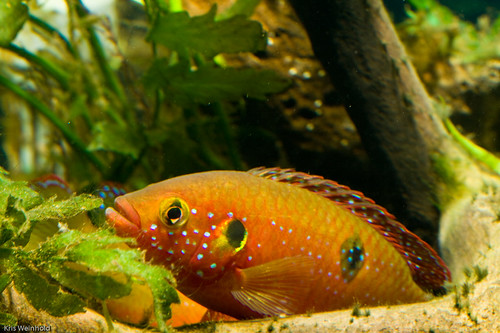
They’ve taken a new spot this time, occupying the left side of my 20G high tank, underneath a manzanita branch. There are eggs scattered on the underside of the manzanita branch, but mostly on the surface of the rock directly beneath that.
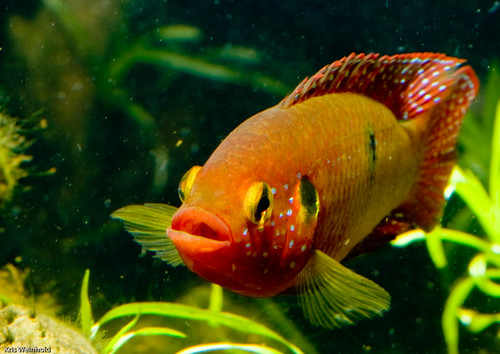
The parents take frequent turns guarding and fanning the eggs. I probably spent a collective hour watching them today, and their rotation is really only about 1-2 minutes before the one roaming the tank comes back to the nest, switching places with the other one. That said, the female does seem to spend more time guarding the nest while the male patrols, but not by too much.

I suppose this means that I ought to move the previous fry from this tank into their own dedicated one before the eggs hatch. If there are new free-swimming fry, I fear that the last batch will be eliminated by the parents.
Posted in 20G High Tank Log, Fish Fry | 1 Comment »
June 28th, 2007
I recently spent a long weekend at the beach, and when I returned home, two of the Jewel Cichlids that I had collected while in Florida had paired up, spawned, and were now rearing a some cloud of fry. Before I left, two of the four fish were obviously pairing up. They started showing magnificent coloration, guarded a cave under a large manzanita root, and were making life hell for the other two Jewels in the 20G high that they were in.

I spent the better part of 3 evenings before I left attempting to fish out the two other Jewel cichlids. I successfully netted one of them, and he now occupies a tank by himself. The other one was far too quick for me, but unfortunately, not quick enough for the pair, as when I returned, they had sealed the loner’s fate. Having the tank to themselves, the male and female take turns guarding their fry. But they still have no qualms leaving their babies when I feed them black worms, as they nearly jump from the water to snatch the worms.

It’s nearly impossible to count how many fry are present, but extrapolating from what I was able to count, I’d estimate that I have 100-150. If even half of that number survive, I’m going to be flooding the market with some very pretty Jewel Cichlids at CCA meetings later this year. So far, I’ve been relatively satisfied with their interactions with plants in the tank. A few sprigs of Blyxa japonica have been uprooted, but those were right next to their spawning site. Otherwise, they haven’t caused too much damage.

Posted in 20G High Tank Log, Fish Fry, Florida | 10 Comments »
May 11th, 2007
RIP apistogramma viejit |
As posted a couple days ago, I rescaped my 20G high tank with some fresh Amazonia aquasoil and manzanita wood. I’ve rescaped a number of tanks in the past with aquasoil, and I’ll usually add the soil, plant and scape the tank, fill with water, allow to cycle for a few hours, and then add in the fish. Most times, the filters are preexisting, or some of the plants/hardscape come from other tanks, so the biological filter should be largely pre-established. I’ve never had any problems with fish loss using this method.
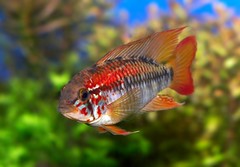
Now I’ve read and heard about other folks experiences about how new aquasoil temporarily causes the pH to crash. Since my methods above have always worked, I’ve never paid them much heed. True, the pH does drop, but never to an extreme degree that the fish couldn’t adjust to. So, with this 20G setup, I followed my same methodologies. I removed the apistogramma viejitas that were in there, placed them in a bucket with airstone, and proceeded with the change. A few hours after setup, I moved the apistogramma back into the tank. I was actually hoping that the pH would drop down a fair amount and induce spawning since I haven’t been able to get them to breed at a 6.5 CO2 induced pH. They seemed happy enough that night. Morning came, and they were still swimming around, not looking distressed. Then, I get home from work, and one is on the floor, and the other is upside-down in the tank. What changed?
Well, I’m not sure. This is the first tank I’ve setup with fresh wood in a long time. Is it possible that the tannins from the new manzanita dropped the pH further in conjunction with the aquasoil-induced drop? I don’t know. In any case, I think I’ll let my fish spend an extra day or two in an aerated/filtered bucket next time I redo a tank with aquasoil. Rest in peace apistogramma viejita.
Posted in 20G High Tank Log | 3 Comments »
