40G – New Aquascape

October 3rd, 2007

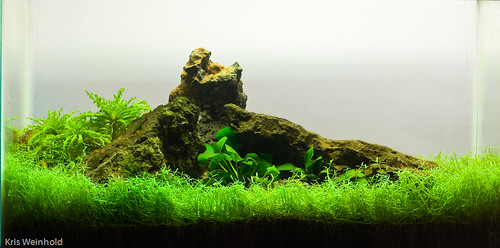
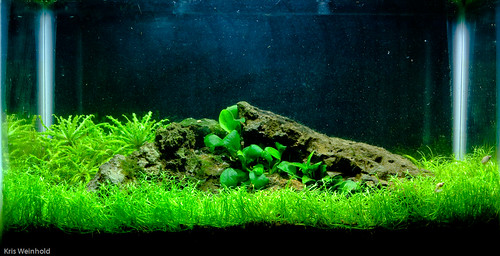
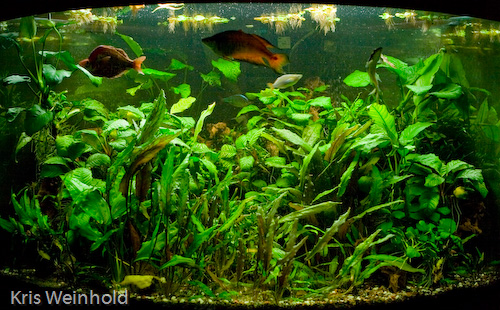
Last weekend I finally decided to rescape my 40G tank. It had once again become a mishmash of plants from various local collecting sites, and exotics from GWAPA meetings. Some Vallisneria americana that was a mere 4-6″ in the wild had sent out runners throughout the tank, and coiled its 2-4 foot long leaves across the surface. Plus, there were a bunch of fish in this tank that I wanted to pull out to their own tank in order to more easily get rid of them to another club member or local store.
40G

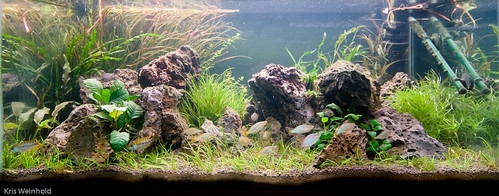
I wanted the new scape to be dominated by rock. The Apistogramma sp. ‘Rotpunkt’ need the extra caves to spawn and hide in, and in general, I just like rock scapes. This time, I tried to be conscious of how tall some of my foreground plants will become so that my rocks would be large enough to still stay visible with thick undergrowth. I moved my huge Blyxa aubertii from the right to the left back, with Micranthemum umbrosum next to that, some Ludwigia sp. ‘Guinea’ in the middle, a Potamegeton species from Florida, and then Hygrophila sp. ‘Sarawak’ in the back right. Various crypts line the left side, with anubias, Blyxa japonica, and Eriocaulaceae sp. ‘Type 2? making up the midground. Ranalisma rostrata makes up the entire foreground.

It has a long way to go to fill in, and I have a feeling that some of the background plants will come and go, but I’d love to hear what everyone’s first impressions are.
Business Broker

2.5G – Final Picture

September 27th, 2007

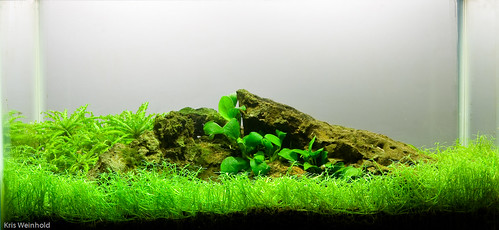
Well, here’s my final picture for GWAPA’s aquascaping contest. It’s pretty much the same as last time, except the anubias are slightly better positioned in front of the rock. I don’t know what other tanks I’m up against yet, so I’m not going to place any bets yet on its chances of winning.

2.5G Aquascape

After I tear down this aquascape, I think I might use this aquarium to start trying some of ADA’s other substrates. I have two small bags of their Malayan and Africana aquasoils. I can’t imagine that they’re too much different, but you never know. Comments welcome!

Business Broker

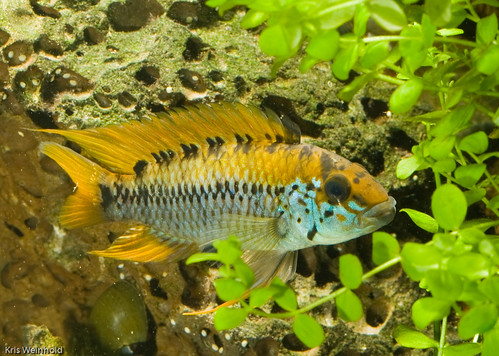
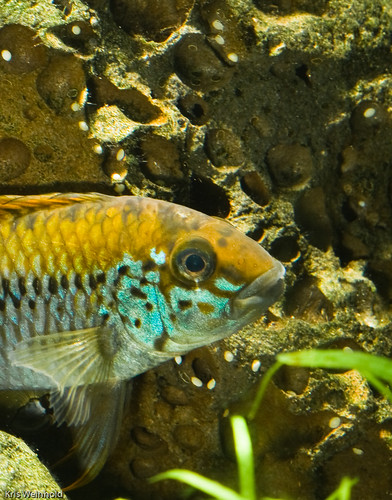
Apistogramma sp. ‘Rotpunkt’

September 25th, 2007

I have been keeping Apistogramma sp. ‘Rotpunkt’ for some time now. I originally received them from Rob in GWAPA, trading him my Apistogramma panduros for six juveniles. While not as flashy as the panduros, they’re still very attractive fish. Their specific taxonomy has yet to really be nailed down. Kullander has named one species formerly know as ‘Rotpunkt’ as Apistogramma alacrina, but it’s likely that this does not describe the most common color morph in the hobby. There are also other color morphs named A. sp. ‘Puerto Nariño’ and A. sp. ‘Schwarsaum’ that are likely just variations on A. sp. ‘Rotpunkt.’

Apistogramma sp. 'Rotpunkt' Male

The Rotpunkt are very timid fish in my experience. I’ve been trying to get semi-decent pictures of these fish for months, but every time I attempted to setup my photo gear, they spent the next hour toward the back of the tank out of view. I finally managed to take these shots last week after setting everything up, and occasionally revisiting the tank throughout the day to snap some pictures.

Apistogramma sp. 'Rotpunkt' Male

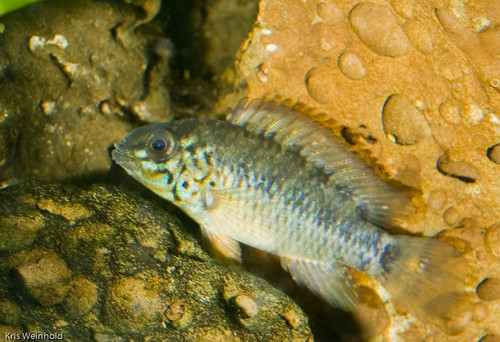
I have a couple of dominant males in the tank (shown above), and thus they have paired up with a few of the different females. I don’t know how many spawns I’ve had, but suffice to say that they don’t seem to be that picky about their breeding conditions. One of the juveniles (shown below) is just starting to color up. I suspect that he’ll probably keep this coloration for some time unless I move him from the tank to claim his own territory.

Apistogramma sp. 'Rotpunkt' Young Male
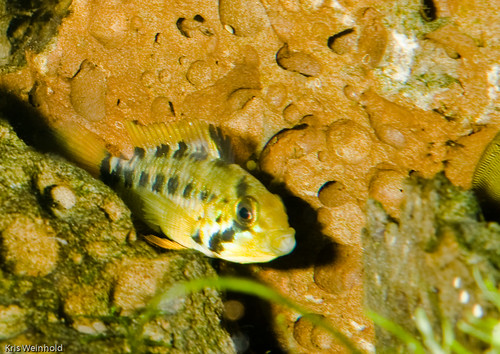
The females are attractive fish, having more black bars on their side than many of the apistogramma I have kept. When spawning, they become an absolutely stunning yellow. Just like the A. cacatuoides, they really seem to like the crevices provided by the porous mossy rock.

Apistogramma sp. 'Rotpunkt' Female

Business Broker

Algae Wars – 20 High

September 21st, 2007

Ever since I setup this tank, I’ve been fighting terrible algae throughout. The wood constantly recovered itself with new hair and black brush algae. I would scrub it off with a toothbrush every couple of days, and back it would come.

IMG_9177

I’ve had thread algae, staghorn, BGA, you name it in here. I’ve always been adding CO2, but it must not have been enough to thwart off the black brush algae. I finally resorted to chemicals, by overdosing Seachem Excel by several times the normal recommended amount. Combining that an extensive cleaning of both the glass and ornaments, and adding a hang-on Mag filter for more circulation I think the tide is finally turning. I’ve also added in more plants to out-compete the algae for nutrients. Hopefully I’ll soon be able to work on the aquascape without worrying about algae ruining everything.

Business Broker

Red Lizard Catfish

September 20th, 2007

The Red Lizard Catfish, or Hemiloricaria sp. ‘Red’ (L10a), is my new favorite catfish. It’s a whiptail catfish, but stays much smaller than your typical whiptail. This fish tops out around 4 inches in length, making them a wonderful catfish for all but the smallest of tanks. I bought three of these fish last fall at the Catfish Convention from a vendor out of Erie, PA.

Red Lizard Catfish

Native to the Rio Tocantins in Brazil, I thought that these fish would fit in nicely with my Apistogramma cacatuoides. They’re very active fish, constantly scurrying along the rocks, glass, and substrate looking for something to eat. They’re not aggressive at all, and the cichlids don’t seem to bother them, even when the cichlids are spawning. I’m really hoping that some vendors at AquaFest 2007 will have more of these so that I can stock several more in my tanks. I haven’t tried breeding them yet, but it has been done, so if I do get more, I may dedicate a small tank to that purpose.

Red Lizard Catfish

Business Broker

Apistogramma cacatuoides

September 19th, 2007

I’ve kept Apistogramma cacatuoides for some time now in my 75G tank. I started with a trio of the ‘triple red’ color morph. After a few successful spawns, my brilliant male died of seemingly unknown causes. My local fish store had just gotten in wild A. cacatuoides so I decided to try one with my ‘triple red’ females. Before long they spawned, and I now have a small breeding colony of at least 12-15 fish in my 75G community tank.

Apistogramma cacatuoides male

It’s really been fascinating to watch how the triple-red coloration has mixed with the wild male’s drab color. Some of the males, like the one above, only retain a tiny bit of orange on their dorsal fin. Others, have darker bodies, with more pronounced color in their dorsals. (below)

Apistogramma cacatuoides male
Then, some of them have orange blotches on their tail fins. It’s quite possible that this one below is actually a female, but you can see the coloration nevertheless.

Apistogramma cacatuoides male

The black and orange checkerboard pattern is starting to show up on this male’s tail fin, and there’s more orange on the dorsal fin, with slightly more color on the bottommost fins.

Apistogramma cacatuoides

Finally, I also have 1-2 nice specimens where the tail and dorsal fins are totally checkered with orange and black. This fish very much approximates the original male that I started with.

Apistogramma cacatuoides male

The females themselves are not ugly fish, but are very similar to other female apistogramma. I’m fortunate to constantly enjoy the breeding coloration of at least one pair of fish at any given time. I’m amazed by the small crevices these females fit themselves into in the rocks. They’ve located hollow areas in rocks that I never knew had hollow areas.

Apistogramma cacatuoides female

I’ve also found that these are not shy fish. Unlike some other apistos that I’ve kept, they come right up to the tank when I approach, and usually stare me down until I feed them. They’re not terribly aggressive fish, even when breeding. They’ll definitely try to defend their territory, but most of the time, I see 5-6 hanging around the same area. I’ve always liked dwarf cichlids because they give you the ability to keep colonies of a single species in a modest-sized aquarium. The behavior patterns definitely change in this situation, and that’s interesting to note.

Apistogramma cacatuoides female

If you haven’t kept cichlids before, Apistogramma cacatuoides is an excellent beginner cichlid. They’re easily obtained from most fish stores, will readily breed in most water, and exhibit all of the same behaviors that people love from cichlids.

Business Broker

2.5G – More Height!

September 10th, 2007

After the last set of pictures, with the help of a few honest individuals, I felt that the aquascape itself might be too flat. I contemplated adding some taller stems plants, but I didn’t think they would “bush up” enough in time for the October 1st deadline. So, the next best thing was to add more height with some rocks. So, that’s what I did. The rock composition on the left side previously was made up of three separate rocks. (Have I ever mentioned how much I love the fact that this California porous mossy rock lets you combine multiple rocks without obvious seams? I do!) So, I removed the back most two rocks, and replaced them with the larger rock you see in the picture. So, did I make the right decision?

2.5G - New Rock

Business Broker

Jewels – More Eggs

September 7th, 2007

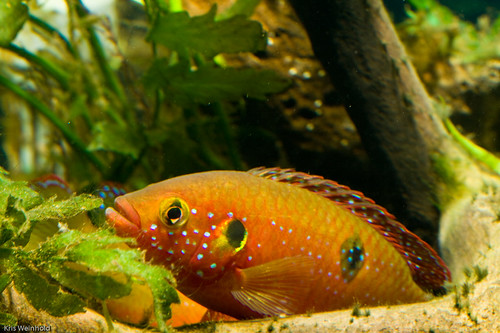
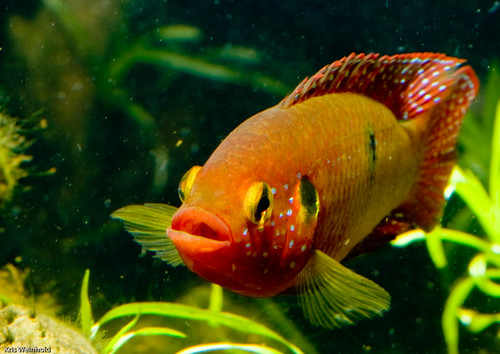
I noticed today that my adult jewel cichlids, collected in Florida, were acting more territorial than usual to their last set of offspring in the tank. Those young are now all 1-2 inches in length, and doing quite well. The adults, however, seem to have moved on, and are guarding a new patch of eggs.

Jewel Cichlid Guarding Eggs

They’ve taken a new spot this time, occupying the left side of my 20G high tank, underneath a manzanita branch. There are eggs scattered on the underside of the manzanita branch, but mostly on the surface of the rock directly beneath that.

Jewel Cichlid

The parents take frequent turns guarding and fanning the eggs. I probably spent a collective hour watching them today, and their rotation is really only about 1-2 minutes before the one roaming the tank comes back to the nest, switching places with the other one. That said, the female does seem to spend more time guarding the nest while the male patrols, but not by too much.

Jewel Cichlid

I suppose this means that I ought to move the previous fry from this tank into their own dedicated one before the eggs hatch. If there are new free-swimming fry, I fear that the last batch will be eliminated by the parents.

Business Broker

2.5G – September Update

September 6th, 2007

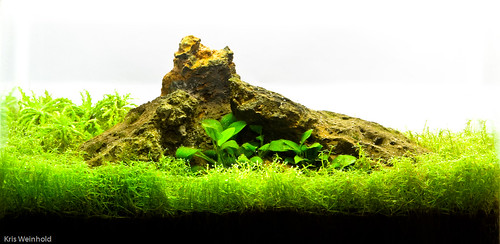
GWAPA is nearing the end of its 2.5G aquascaping contest with all entries due by October 1st. I’m cautiously pleased with how mine is progressing. I’ve added in some more anubias barteri var. ‘nana’ and anubias barteri var. ‘petite’ to the crevice between the rocks. I’ve been picking riccia fluitans from the crasula helmsii in the foreground. I’m not entirely sure how it got in there, but it seems to be doing well — too much so. You generally think that riccia is a bright green colored plant, but this crasula in the foreground puts it to shame; the riccia looks dark green in comparison. There’s also a little bit of fissidens sp. moss growing on a few of the rocks. Ideally, I’d like that to cover most of the rock’s surface, but unfortunately, I don’t think that’ll happen by October 1st.

2.5G - White Background

Since this is a photo contest, I’ve been experimenting with a couple different backgrounds for this tank. Here are two that I took a day apart, where the only difference is that one is a white background, and the other black. Comments welcome!

2.5G - 9/4/2007

Business Broker

54G – Updated Photo

August 30th, 2007

I wanted to post an updated picture of my 54G, anubias, java fern, and crypt tank. I’ve really let this tank go wild, partly because I like that look in some tanks, but largely because I’m gearing up to really downgrade the maintenance requirements for some of my tanks. That means that I’m going to go back to tanks that are largely free of stem plants requiring frequent trimming. So, at the past few GWAPA meetings, I’ve tried to stock up on crypts, and guess where they’ve been going to grow out?

54G - August 29th, 2007

The anubias in this tank may not be pristine, but they’re actually looking pretty good. I have four separate plants flowering right now, so that’s never a bad sign. Just as a reminder, this tank does not use CO2 (infact I run an airstone), and I only occasionally add a few milliliters of my own PMDD mix of trace, K, and P. I figure the fish provide enough N. Finally, it’s a corner, rounded front tank, so the pictures never truly reflect how it looks. The curve in the glass seems to distort the picture, removing a lot of the depth that’s in the tank. Comments are welcome.

Business Broker

« Previous Entries   Next Entries »