March 2nd, 2008
I just wanted to share a couple pictures I took of the Olive Nerite Snails in my 40G aquarium. As mentioned in last week’s algae writeup, these snails are fantastic organisms to have in your aquarium as algae eaters.

Here is a close-up shot of a Nerite Snail grazing on the glass. I imagine that this guy is scraping algae filaments from the glass that aren’t even visible to the naked eye.

Taken 100mm/2.8 with 68mm Kenko extension tubes
Here’s a little bit clearer shot of the snail’s mouth and foot. Their antennae constantly move back and forth over the ground in front of them, and sometimes appear to just flow with the current of the water.

Taken 100mm/2.8 with 68mm Kenko extension tubes
By keeping my nutrients balanced, and these snails in the tank, my tank is not algae free, but kept completely under control.
Posted in 40G Tank Log, Shrimp/Snails | 12 Comments »
March 1st, 2008
Over the past few days, I have noticed that my two females in the 40G have been bright yellow in coloration, and have remained very close to their caves. These are tell-tale signs that they’ve been spawning. It looks like the first female’s fry are now free swimming!

Right now, there is a sizable group of fry, with at least 20-30, but it could be even more. They move around so much, and they all look the same, that it’s near impossible to count. They spend most of the day grazing on tiny organisms and detritus throughout the tank, and especially on the porous mossy rock that contains all kinds of nooks and crannies for them to sort through.

Some of them even seem to take refuge in the small holes formed in the volcanic rock. I don’t plan on trying to remove the fry from the tank, so essentially it’s up to their parents and the cover of these rocks and plants to grow them up. I will, however, prepare a batch of baby brine shrimp for them this week to help them grow up big and strong.

Posted in 40G Tank Log, Fish Fry, Fish Profiles | 2 Comments »
February 29th, 2008
At the last GWAPA meeting, I gave a presentation called Algae in the Planted Aquarium. While preparing for the presentation, I had to gather a lot of information from a number of different sources on the Internet. I’ve decided to declare this week Algae Week, and share that gathered information by posting about two types of algae each day. This is the final installment featuring Hair/Thread Algae & Cladophora.
Hair/Thread Algae
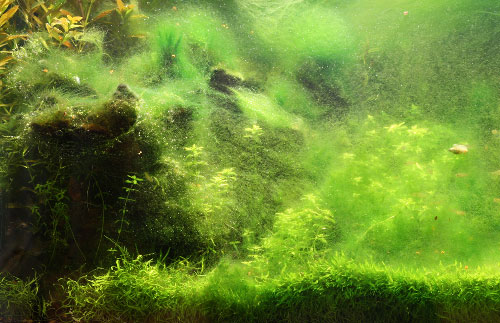
Hair/Thread Algae consists of long green filaments reaching as long as 30cm in length. It often mixes itself in among moss, and is sometimes grown purposely as an extra food supplement for tank inhabitants.
Cause:
- Excess iron levels – Concentrations >0.15ppm
Cure:
- Manual removal – Use toothbrush to remove as much as possible.
- Maintain proper water change schedule – weekly / bi-weekly changes.
- Rebalance Nutrients – Strive for the following nutrient levels: N (10-20ppm), P (0.5-2ppm), K (10-20ppm), Ca (10-30ppm), Mg (2-5ppm), Fe (.1ppm).
Cladophora
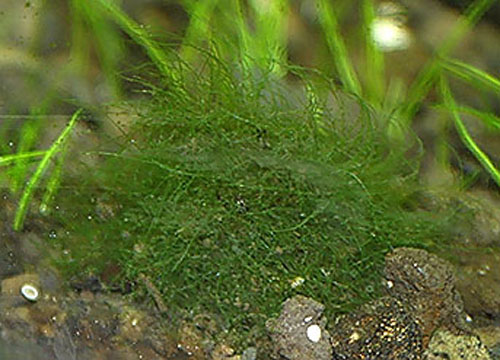
Cladophora is by far the toughest algae to remove from the aquarium. Forming green, tough, wool-like mats, it seems to favor intermingling itself into hairgrass, substrate, and hardscape items.
Causes:
- Marimo Balls – Being in the same family as these algae balls, they can sometimes introduce Cladophora to your aquarium.
- Healthy Conditions – Unfortunately, Cladophora seems to favor the same healthy water conditions that your plants require.
Cure:
- Manual removal – Use toothbrush/tweezers to remove as much as possible.
- Excel/H202 treatment – Use a syringe to spot treat problem areas.
- Luck – Very difficult to 100% remove.
Sources:
Aquatic Plant Central – Algae Finder
AquaticScape
Posted in Algae | 9 Comments »
February 28th, 2008
At the last GWAPA meeting, I gave a presentation called Algae in the Planted Aquarium. While preparing for the presentation, I had to gather a lot of information from a number of different sources on the Internet. I’ve decided to declare this week Algae Week, and share that gathered information by posting about two types of algae each day. This is the fourth installment featuring Green Dust & Fuzz Algae.
Green Dust Algae (GDA)
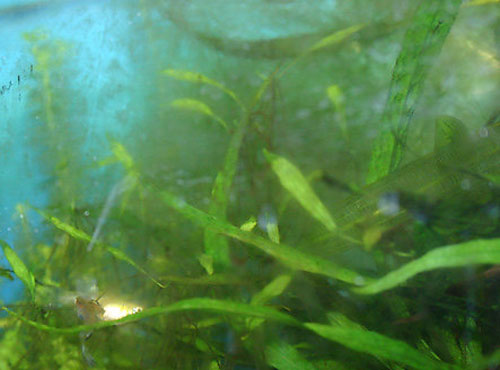
Green Dust Algae (GDA) is a “dusty” green film that appears on the surface of the glass. It’s caused by zoo-spores, and seems to avoid attaching to hardscape items or plant leaves.
Cause:
- Unfortunately, I haven’t been able to locate a concrete cause for GDA.
Cure:
- Leave alone – GDA appears to have a finite lifecycle, so that if you allow it to run full cycle without scraping it from the glass, it should harden, and fall off after roughly 21 days. After this time, scrap any remaining GDA from the glass, and do a thorough cleaning and water change.
- Nerite Snails – Nerite snails can help eat through some of the GDA on the glass, but the approach above will likely have to be undergone for full removal.
Fuzz Algae
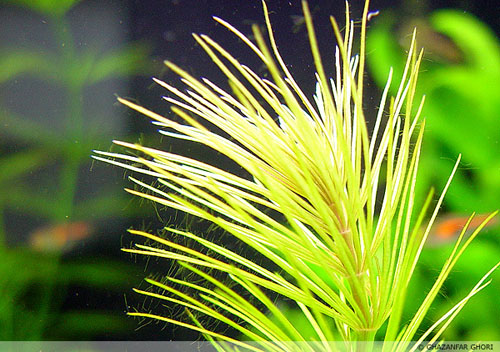
Fuzz algae often shows up on plant leaves giving their edges a slightly fuzzy appearance.
Causes:
- Nutrient Imbalance – Strive for the following nutrient levels: N (10-20ppm), P (0.5-2ppm), K (10-20ppm), Ca (10-30ppm), Mg (2-5ppm), Fe (.1ppm).
- Low CO2 – Strive for 20-30ppm concentration of CO2, as permitted by fauna.
Cure:
- Maintain proper nutrient/CO2 levels
- Algae Crew – Siamese Algae Eaters (SAE), Amano shrimp, Otocinclus, and Mollys are known to eat this algae.
Sources:
Aquatic Plant Central Thread
Aquatic Plant Central – Algae Finder
AquaticScape
Posted in Algae | 6 Comments »
February 27th, 2008
At the last GWAPA meeting, I gave a presentation called Algae in the Planted Aquarium. While preparing for the presentation, I had to gather a lot of information from a number of different sources on the Internet. I’ve decided to declare this week Algae Week, and share that gathered information by posting about two types of algae each day. This is the third installment featuring Brown (Diatoms) and Staghorn Algae.
Staghorn (Compsopogon sp.)
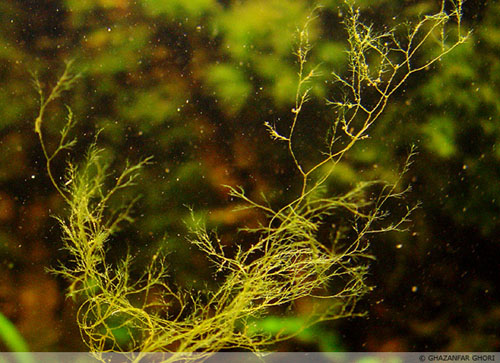
Staghorn algae is aptly named as its branching resembles the antlers of a stag’s horns. They are coarse, branching strands that commonly attach to plant leaves and equipment. The strands can appear white, grey, or green in coloration.
Causes:
- Nutrient Imbalance – Strive for the following nutrient levels: N (10-20ppm), P (0.5-2ppm), K (10-20ppm), Ca (10-30ppm), Mg (2-5ppm), Fe (.1ppm).
- Low CO2 – Strive for 20-30ppm concentration of CO2, as permitted by fauna.
Cures:
- Manual removal – Use toothbrush to remove as much as possible.
- Water change – Maintain weekly/bi-weekly water change schedule.
- Increase CO2 – This will stimulate plant growth, which should help the plants out-compete the algae for resources.
- Bleach treatment – Dip affected items/hardy plants into a bleach/water solution using a 1:20 ratio of bleach to water. Before putting them back into the tank, make sure the item is free of any bleach odor.
- Maintain proper macro (NPK) dosing scheme
Note:
- Most fish/inverts will not eat staghorn algae.
Brown Algae (Diatoms)
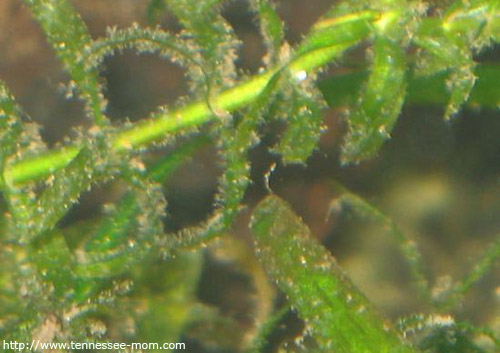
Brown Algae, or diatoms, often present themselves as a brown, muddy, muck that covers plant leaves and hardscape items. It is rare to be seen in a fully established aquarium.
Causes:
- Newly setup tank – Aquariums that have just been setup seem to be prone to diatom algae.
- Excess nutrients – Silica in particular appears to be a trigger. Contact your water utility company for a report detailing silica concentrations in your water supply.
- Possibly old bulbs – Sometimes, old bulbs can encourage the conditions for diatom algae.
Cure:
- Time – Allow it to use up the excess silica, and it will often disappear on its own.
- Manual removal – Siphon/scrape diatoms manually for quick removal.
- Algae Crew – Otocinclus and Nerite snails are fantastic at clearing a tank of diatoms. They help with other sorts of algae as well.
Sources:
Aquatic Plant Central – Algae Finder
AquaticScape
Posted in Algae | 5 Comments »


