Ted Judy on Pelvicachromis (CCA April 2007)

April 14th, 2007
April 2007 CCA Meeting
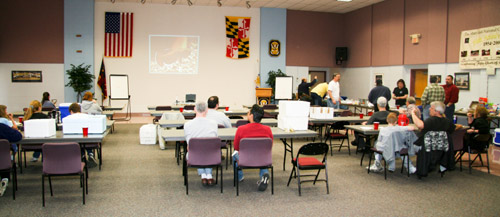
Milling around before the meeting

The Capital Cichlid Association’s April 2007 meeting featured a well-known dwarf cichlid expert, Ted Judy, from Colorado to speak about west African dwarf cichlids of the Pelvicachromis genus.

Pat opening CCA meeting
Pat shows off the new poster.

Before the meeting started, everyone was milling around, engaging in typical fish talk, and admiring the upcoming auction goods. Pat Kelly, CCA‘s president, opened the meeting by showing off a new club poster that is going to be spread around to the local stores to help advertise the clubs’ existence.

Then, Pat introduced Ted Judy, who had prepared an excellent presentation about the Pelvicachromis genus of west African cichlids. Ted opened his presentation with a brief overview of the cichlid family. Pelvicachromis is a very popular group of cichlids that have

Ted Judy at April 2007 CCA Meeting
Ted Judy

been in the hobby for a long time. The Pelvicachromis pulcher was first kept and bred in the 1960s, and gained widespread affection since it is a colorful fish, that is peaceful enough to be kept in a community setting. In general, Pelvicachromis can be easily sexed by looking at the ventral fin. A male will have a pointed ventral fin, with iridescent blue markings, while a female’s fins will be more rounded. All Pelvicachromis species are coastal fish, found only in freshwater streams/rivers within 100 miles of the ocean. Their habitat does not consist of much vegetation, so the substrate is quite silty/muddy. Therefore, the Pelvicachromis often sift the sand, feeding on decaying matter and invertebrates found in the sand. The pH of these streams is usually close to neutral, 7.0.

Based on Ted’s observations in the wild, he has come up with his own unique formula for feeding his Pelvicachromis. Since their diet consists of 70-80% vegetable matter, he tries to replicate this by mixing vegetable and spirulina flakes, with a small portion of protein-based flakes, such as “cichlid flakes” into one container. He then feeds his fish this combined flake mix, ground into small pieces so that it can be easily eaten. To rear fry, or prepare fish for spawning, he will mix in some brine shrimp, daphia, or grindle/white worms. He will also feed krill to bring out more color in a fish.

When seeking breeding pairs, Ted recommends buying a group of 6 fish, and putting them into a smallish 20G tank. Within a month, if a pair has formed, Ted removes all but the weakest other fish. He has found that by leaving one extra Krib in the tank, the pair has a target to “beat” on, which helps to strength the pair’s bond. Setting up the Krib’s breeding space is relatively straight forward; just add a few hollowed-out coconuts, with just enough space for the male to enter. He notes that pH affects the ratio of male and female fry produced. More acidic water produces more females, while alkaline water tends to create more males. Once the fry are free swimming, raise them on powdered flake food and brine shrimp, and make sure to do lots of water changes. Ted does a 20% water change everyday when first raising fry.

Ted then proceeded to discuss many different species and color morphs of Pelvicachromis, providing pictures of each. He did an excellent job giving geographic collection information for each species, as well as, the probability of finding each species domestically depending on political or logistical complications. Each species was accompanied by a slew of information that I recommend you research further on web:
Ted Judy’s profile on Cichlid Room
apistogramma.com


Business Broker

Franken Fish – Freak Show!

April 10th, 2007

Fish without an EyeSo often, all we tend to show off are our pristine looking aquariums, with algae-free leaves, and beautiful fish. I try and show those pictures (as few as they may be), but more than that, I like to share everything else along the way, even if it might be a little embarrassing or not quite perfect. Well, here is another such example. I decided to feature a few of my less-than-ideal fish today. I’m sure we’ve all had them. You get that perfect fish home from the fish store. You’re proud to show it off to your friends, and after a few years in your tank, you notice that once graceful fish has a spine that nears 90 degrees, and it just kind of hovers around the tank being unable to swim. Well, I have a couple of these situations.

Case 1: Blind Fish

Fish without an Eye

I don’t remember buying a fish without an eye, so this must have happened somewhere along the way. Presumably, the poor guy knocked his eye on a rock or piece of equipment, and wasn’t able to find it in time to have the ER sew it back on. Nevertheless, he’s an otherwise normal specimen that schools with the other fish, and seems happy.

Case 2: Siamese Endler

Siamese EndlerIt’s amazing how fast Endler’s breed. You start with a few pairs, and before you know it, you’re stuck with hundreds of these guys in your tanks. Mathematically speaking, you’re bound to see a few funny ones along the way. Well, here is the most bizarre one I’ve ever seen. This female was born perfectly healthy. As she grew up, I noticed a growth on the underside of her belly. As she continued to grow, so did the growth. Once it got larger, it was obvious that this wasn’t just a tumor of sorts, but another fish body altogether! Not only that, but there is an extra set of pelvic fins growing off of that body that she appears to be able to control. I’ve had her for at least 6 months, maybe a year, and she has shown no other abnormal behavior. Amazing!

Siamese Endler

So, I’ve shared some of my embarrassing fish. Please do the same via comments or email.

Business Broker

Rummy-nose Tetra

April 8th, 2007

I’ve been fairly busy lately, so besides some regular tank maintenance, I haven’t made any significant changes to my tanks. So, with that in mind, I just wanted to share a few photos I got of my Rummy-nose Tetras. These guys are usually pretty skittish in my tank, such that when I walk into the room, they all scatter into the far corners of the tank. I imagine this might have something to do with the fact that I’ve had my hands in their tank more often recently.

Rummynose Tetra
Rummy-nose Tetra – front angled shot at 100mm f/11.

Rummynose Tetra
Rummy-nose Tetra – side shot at 100mm f/11.

Business Broker

40G – One Week Later…

March 29th, 2007

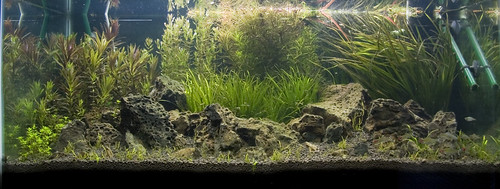
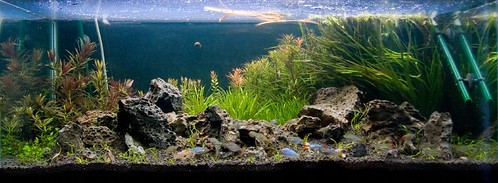
Take a look at these two photos, one taken today, the other was taken exactly one week ago. There’s no denying how spectacular this ADA Amazonia substrate is. Since I rescaped the tank about a week and a half ago, I have only dosed SeaChem Potassium once. So, the aquasoil, itself, has enough muster to make the Pogostemon stelleta, Rotala macrandra var. ‘green,’ and Limnophilia aromatica all shoot up like crazy, and all are in need of trimming. The baby tears in the lower left-hand corner has shown excellent growth, but it hasn’t started growing horizontally yet, like I’m hoping it will. It is soon time for me to replace some of the bulbs over this tank, so that may assist in that regard. Even though it’s not easy to see hear, the Utricularia graminfolia has started sending out new growth in the foreground, so it’s just a matter of time before it really kicks it into gear and takes off.

All in all, I have no qualms about my decision to soon rescaped my 20G with more fresh Aquasoil…

40G - 3-29-2007
Taken 03/29/2007

40G-03-22-2007
Taken 03/22/2007

Business Broker

GWAPA – March 2007 Meeting

March 25th, 2007

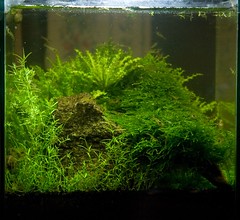
Sean Murphy's Nano CubeGWAPA’s March 2007 meeting was another great meeting, this one at Sean Murphy’s home. For a guy known for his Cryptocoryne expertise, he sure can put together an amazing aquascape. This nano-tank to the left, sits innocently on his kitchen counter, with only a desk lamp over top. The desk-lamp sports only a daylight compact-fluorescent spiral bulb. I didn’t measure it, but I believe it’s just an 8″ cube, but he’s made it look much bigger here. Nice work Sean! This tank aside, the rest of Sean’s tanks are all “crypt farms.”

The topic for this meeting was “Growing Aquatic Plants Emerged.” A meeting summary can be found on the GWAPA website.

I was excited about this meeting because I had lined up a trade with Rob to swap my Apistogramma panduros for a half dozen of his Apistogramma sp. ‘Rotpunkt.’ So far they’re settling into my 40G nicely, but are still too young to sex. I hope to post some pictures of them up here soon.

Besides this fish swap, there was a huge auction this month with just about any plant you can think of being auctioned — everything from java moss to sunset hygrophilia to any of the more exotic cultivars you can think of. I only came away with two items, but I’m excited about getting them going. My auction wins are Ludwigia sp. ‘Guinea’ and Bacopa sp. ‘Araguaia.’ I kept Ludwigia sp. ‘Guinea’ previously, but I think it got overgrown by Rotala macrandra var. ‘Green,’ and subsequently melted away. I haven’t kept many Bacopa’s because there’s something about their vertical stance that is unappealing to me, but I’m going to give this one a try nevertheless. Even if I don’t like the look, who can deny the minty smell of its leaves?

Business Broker

« Previous Entries   Next Entries »