January 9th, 2008
Bolbitis species have long been regarded as a low-light, undemanding plant, that survives in most aquariums. It’s a nice looking fern, adds a deep green to the tank, and can be attached to driftwood, or other hardscape materials. A couple months ago, a species of Bolbitis showed up at a GWAPA meeting that our club hadn’t seen before. This is what I’m calling Bolbitis sp., since I don’t know the proper name.
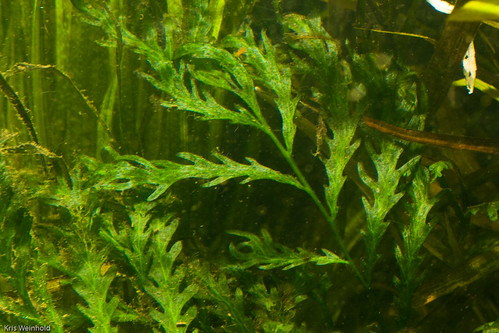
At first, we suspected that it was a terrestrial fern, but due to the quantity brought to auction, it was clear that it grow just fine underwater. It was sent to the club by a rainbowfish breeder and collector, who happened to order it from an order source. The leaf form has many more indentations than the usual type. I’ve been keeping it in my 75G aquarium, and growth has been quite slow, but it is growing nevertheless. If anyone can identify the species of this bolbitis, please leave a comment.
Posted in 75G Tank Log, Plant Profiles | 3 Comments »
January 7th, 2008
My new favorite accent in the 75G aquarium is Rotala macrandra, a beautiful, but delicate red stem plant. Notorious for being a more difficult plant to grow, I can understand its’ reputation. The plant doesn’t seem to have much of a problem growing, but if I go too long without a water change, I start to notice little holes in the leaves.
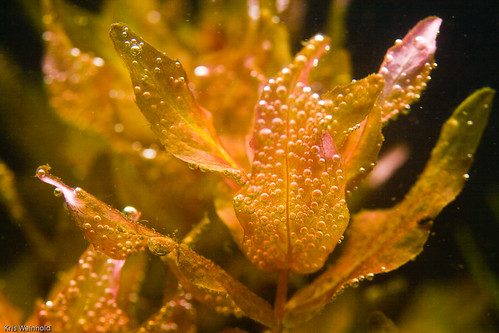
Additionally, leaves that reach the surface, appear to easily get holes, or fall apart, instead of converting to emersed growth. That may also be due to the heat from the light as they get rather close to them. Nevertheless, it is a gorgeous plant, with striking orange and red tones. I started with a single stem, and in just a month or two, I’ve now got a decent sized bush of R. macrandra. I’m hoping to grow it out even further, as I need more red in my 75G to offset the large number of green plants in there.
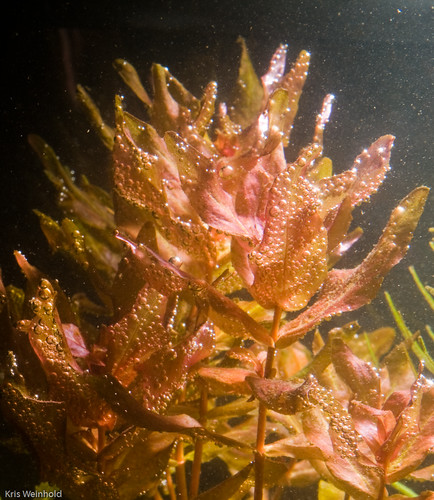
Fortunately, R. macrandra has been in the hobby for some time, so it often shows up in some of the more ambitious fish shops. It you have the chance to buy it, do. However, make sure that you have adequate lighting, CO2, and fertilizers, or the plant won’t stand a chance.
Posted in 75G Tank Log, Plant Profiles | 9 Comments »
January 1st, 2008
A couple of weeks ago, I got some shrimp from another GWAPA member, and in the bag, he sent along a nice new species of Hygrophila for me to try out. We don’t know the exact species name, but it’s being referred to as Hygrophila sp. ‘Low grow’, due to the way that it grows compared to some other Hygro’s.
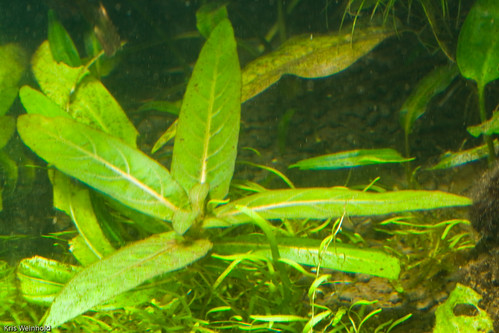
The plant seems to creep along the substrate, even in more high light conditions. I’ve grown the common Hygrophila polysperma in this same fashion before, but it requires constant trimming to maintain it low to the ground. This ‘Low grow’ does not appear to need the same. In addition, I’ve found it to be a much slower grower than other species of Hygrophilia which can be outright weeds if left unchecked. The leaves are larger than that of H. polysperma, and contain more pronounced (prettier) vains.
Due to the leave size, I may not use it in many of my aquascapes, but it might be perfect for some larger scapes. I’m going to wait to to let it further grow out before I fully decide that, however.
Posted in 75G Tank Log, Plant Profiles | 1 Comment »
December 29th, 2007
Here’s an updated picture of my 75G tank. As you can see, it has really started to fill in, and besides needing a trim, I’m pretty happy with how it’s looking. The Utricularia graminfolia in the foreground has started growing over and on top of itself, and the Ludwigia and Limnophilia aromatica on the left/middle have started to layer themselves and bush out quite nicely.
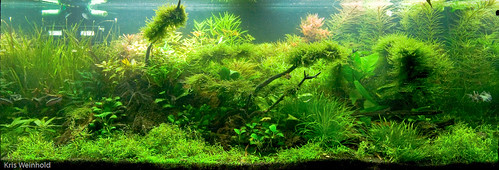
I’ve still got a little bit of black-brush-algae on some of the rocks and wood, but it’s being kept in check by my algae crew, and actually gives the tank a bit of a natural flare. (Or that’s the story I’m going with for now.) The Blyxa japonica looks as good as it ever has since I’ve been growing it, and the Blyxa aubertii is actually starting to look a tad nicer as well, since I moved it from my 40G. All-in-all, I’m looking forward to shaping this scape slightly with some trimming, and fine tuning, but the initial work is done. I’d love to hear your comments/critiques!
Posted in 75G Tank Log | 4 Comments »
December 22nd, 2007
It’s been awhile since I last showed a picture of my 40G tank. I’ve been trying to fight an algae problem in this tank by adding more circulation. I recently hooked up an old Fluval 304 canister filter that I had sitting in the basement. It did a good job for awhile, but just yesterday, I noticed that it had air-locked, and was not circulating any water. I have no idea why that happened, as I’m not injecting any CO2 into this filter — that still goes through the Eheim 2213 — but it happened nevertheless. Hopefully that won’t be a reoccurring situation.
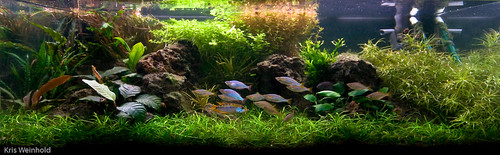
Additionally, I recently added Didiplis diandra and Rotala rotundifolia to the back, right-hand, corner, so that’s why it’s a bit bare back there in this picture. (It still hasn’t grown over-top of the rocks.) I need to trim the Rotala macrandra var. ‘green,’ but I’m very pleased with how orange it is getting, with nice bushy growth. I still can’t say enough nice things about the Eriocaulaceae sp. ‘Type 2’ as it doesn’t shoot to the water’s surface, regardless of whether I trim it or not. I love how it wraps around from the foreground to background, and can be trimmed to pretty much whatever mid-ground height I want it to stay at.
On a different note, I hope everyone has a safe and happy holiday! Cheers!
Posted in 40G Tank Log | Comments Off on 40G Scape – Holiday Update
December 17th, 2007
After much consideration, I finally decided upon this Pelvicachromis pulcher ‘Super Red’ pair to occupy the other side of my 75G from the Nannochromis nudiceps. These fish are a color variation of your common P. pulcher kribensis that are far redder than the normal variety.

Purchased from SCALES in Silver Spring, MD, I was informed that this pair had already spawned in store, yielding a small group of fry that were taken home by an employee. Already in my 75G, I witnessed plenty of fin flashing and body wiggling between the pair. Even weirder, I’ve seen the female display the same motions toward the male N. nudiceps. Clearly this female is both confused, and ready for motherhood!
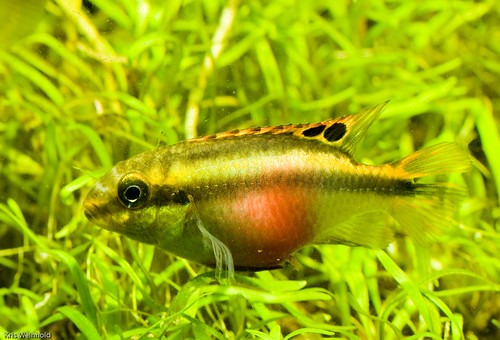
The female is by far the more beautiful fish of the pair. Her belly is a ripe red color, with some really nice spots on her fins. The yellow is also quite intense. The female kribensis has a very interesting body shape, as her belly seems slightly out of proportion from the rest of her. Hopefully I’ll be able to report a successful spawning sometime soon!
Posted in 75G Tank Log, Fish Profiles | 5 Comments »
December 16th, 2007
This weekend, I finally decided that both Hygrophilia sp. ‘Sarawak’ and the Potamegeton sp. from Florida were not working well in my aquascape. I wanted to add some smaller leafed stems, and happened to see Didiplis diandra and Rotala rotundifolia at a local fish store, so I bought a few stems of each. Ripping out the previous two plants ended up sending debris all throughout the tank, as you can see on the Anubias leafs below.
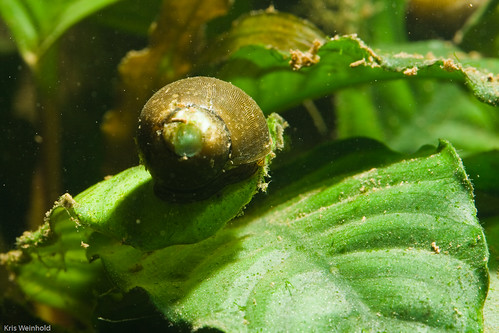
Speaking of the Anubias barteri ‘coffeefolia,’ it is growing quite nicely in the tank right now. It’s sending up new leaves rather frequently, and the Olive Nerite Snails, are doing their job keeping them largely free of spot algae. (If I could keep some hair algae out of this tank, that would be fantastic!)
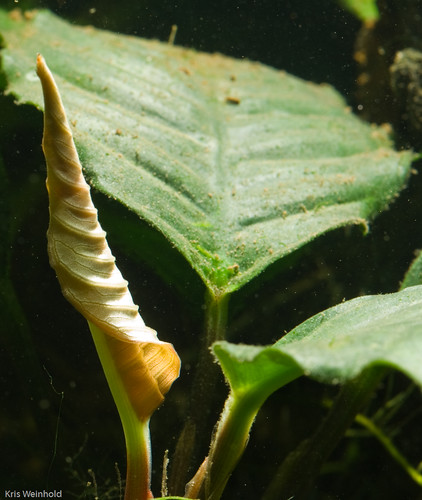
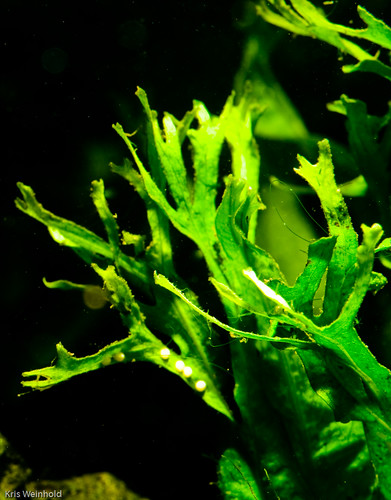
Additionally, probably about 3 months ago, I purchased a bag of Windelov’s Java Fern at a GWAPA auction. As soon as I stuck it in the tank, it completely melted. I’m glad to see that the rhizome did not die, as it’s finally sending up some new leaves, as shown below.
Any time I get around this particular tank with a camera, the fish either go perfectly still, or hiding in the back corners. Luckily, this time, I caught this group of Melanotaenia praecox hovering, watching me and my camera very closely. Every time the flash went off, this fish got a little bit spooked, so after 1-2 shots, I let them be.

Posted in 40G Tank Log | Comments Off on 40G: Odds and Ends
December 10th, 2007
I maintain my 54G corner tank in a very low-tech fashion; I don’t use CO2, and I allow Phyllanthus fluitans, or Red-Root Floater, to help suck up any excess nutrients. What that means is that after about a months time, the floater has completely covered the surface, shading out everything below.
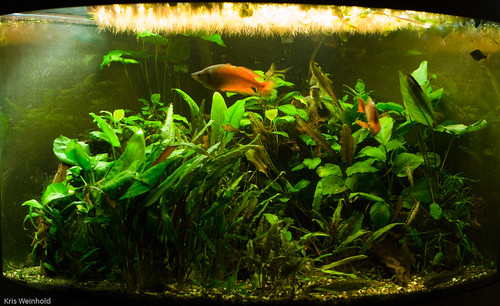
Look at how much darker the tank is above with the floater, verses below, without it, albeit, this is probably common sense. This tank is easy to forget about as it generally maintains itself, but it always reminds me to do a water change and remove some of the floaters when the tank is quite dark. It’s a nice visual cue.
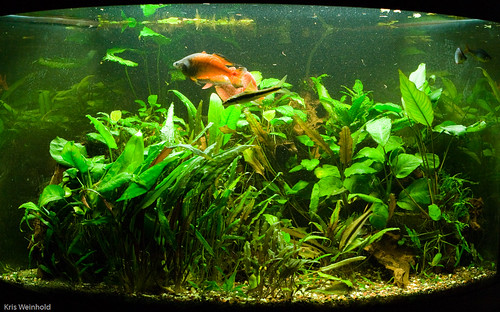
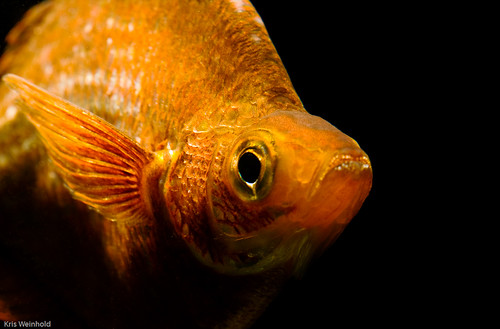
And just because he was out and about while I was taking the above pictures, here’s another picture of my Irian Red Rainbowfish (Glossolepis incisus).
Posted in 54G Tank Log | 2 Comments »
December 8th, 2007
The Utricularia graminifolia is starting to grow in in the 75G tank. It’s still not really that full, but you can start seeing some little leaves pop up from the aquasoil substrate. My theory is that this plant takes longer than others to get going because it requires a more mature tank with more microorganisms to get caught in its bladders. Of course, I can’t say that I’ve grown it predictably enough to have it fully understood at this point.
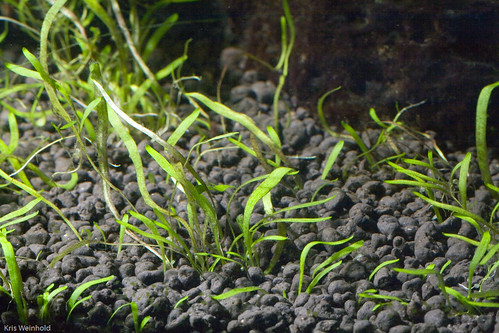
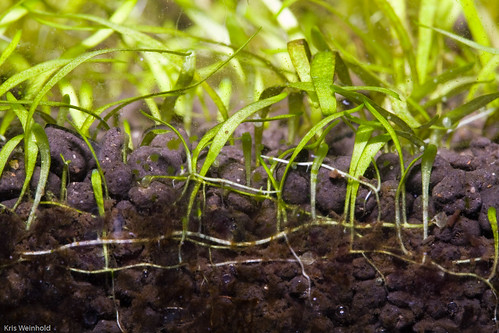
What I know is that that once I start seeing “trailers” like the ones below, that that plant is well on its way to filling in. I’ve also had a number of “trailers” growing up into the water column, making the foreground look too tall and shabby, but I’ve gradually cut those off and replanted them in the bare areas to try and get them going.
Additionally, the Nannochromis nudiceps seem to have gotten over their digging fascination, so they’re no longer pulling up, or covering up, the Utricularia graminifolia directly in front of their “underground lair.”
Posted in 75G Tank Log, Plant Profiles | Comments Off on Utricularia graminifolia
December 6th, 2007
After nearly 6 weeks in 20L, I finally returned my four Red Lizard Catfish, Hemiloricaria sp. ‘Red’ (L10a), to the 75G tank. I’ve been leaving them out for two reasons: I wanted the water chemistry in the 75G to stabilize, and I wanted the Utricularia graminfolia to get partially established before I reintroduced them to the tank.

These pale reddish catfish are quite lazy fish in my tanks. They spend a large deal of their time lounging on the substrate or hardscape. It would be fantastic if they actually ate some of the black-brush-algae they’re laying on in the pictures. Fortunately, the Amano shrimp are slowly mowing that down.

Despite their less-than-ideal appetite for algae, they stay small, and they’re colorful, so I enjoy having them in my tank. They’ve already seemed to settle back into their larger home. The 75G is quickly turning into a catfish tank with all of the corydoras, Ancistrus sp. L279, and these guys.
Posted in 75G Tank Log, Catfish | 1 Comment »