Olive Nerite Snail Shots

March 2nd, 2008

I just wanted to share a couple pictures I took of the Olive Nerite Snails in my 40G aquarium. As mentioned in last week’s algae writeup, these snails are fantastic organisms to have in your aquarium as algae eaters.

Olive Nerite Snail

Here is a close-up shot of a Nerite Snail grazing on the glass. I imagine that this guy is scraping algae filaments from the glass that aren’t even visible to the naked eye.

Olive Nerite Snail
Taken 100mm/2.8 with 68mm Kenko extension tubes

Here’s a little bit clearer shot of the snail’s mouth and foot. Their antennae constantly move back and forth over the ground in front of them, and sometimes appear to just flow with the current of the water.

Olive Nerite Snail
Taken 100mm/2.8 with 68mm Kenko extension tubes

By keeping my nutrients balanced, and these snails in the tank, my tank is not algae free, but kept completely under control.


Business Broker

Apistogramma sp. ‘Rotpunkt’ Fry

March 1st, 2008

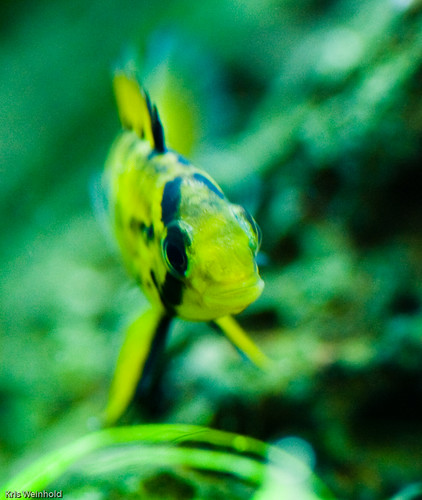
Over the past few days, I have noticed that my two females in the 40G have been bright yellow in coloration, and have remained very close to their caves. These are tell-tale signs that they’ve been spawning. It looks like the first female’s fry are now free swimming!

Apistogramma sp. 'Rotpunkt' Fry

Right now, there is a sizable group of fry, with at least 20-30, but it could be even more. They move around so much, and they all look the same, that it’s near impossible to count. They spend most of the day grazing on tiny organisms and detritus throughout the tank, and especially on the porous mossy rock that contains all kinds of nooks and crannies for them to sort through.

Apistogramma sp. 'Rotpunkt' Fry

Some of them even seem to take refuge in the small holes formed in the volcanic rock. I don’t plan on trying to remove the fry from the tank, so essentially it’s up to their parents and the cover of these rocks and plants to grow them up. I will, however, prepare a batch of baby brine shrimp for them this week to help them grow up big and strong.

Apistogramma sp. 'Rotpunkt' Fry

Business Broker

Catfish Like Zucchini

February 20th, 2008

For many catfish, specifically “suckerfish” like plecos, it’s often stated that you want to keep wood in your aquarium as it’s an integral part of their diet. It’s also true that they ought to be fed other vegetable matter, such as algae wafers, veggie-based pellets, and so on. Well, fresh, clean vegetables are also a cheap and much appreciated treat for these fish.

Chinese Algae/Zuchchini Eater

We had zucchini as part of our dinner last night, so rather than throwing the ends down the disposal, I cut the stalk off, and set aside 4 small circles of the squash for my catfish. Now, these vegetables were certified organic, so I was fairly confident that they would be pesticide free. In the summer we grow our own vegetables, so we know their source as well. If there’s any doubt, at the least do a thorough washing, and at the best, don’t throw them in your tank. Also, if they’ve been contaminated with any oils, butter, or seasonings, don’t put them in the aquarium.

Chinese Algae/Zuchchini Eater

The problem with fresh zucchini is that it floats. Placing the pieces in a small dish with a bit of water, I microwaved them for 4-5 minutes, or until they stopped floating. This boiling process breaks down the cellular walls, allowing them to become water logged. Alternatively, you can tie them down to a heavy object. The last step is to slice a couple notches in the rind of the squash. The reason being that the catfish eat out the soft core, and could potentially get the “ring of rind” caught around their bodies.

Chinese Algae/Zuchchini Eater

At first, when I dropped the cooled zucchini into the aquarium, none of the fish took much notice. I was surprised that the cories didn’t seem to care for it at all. Then, my chinese algae eater (CAE) found one of the pieces, and started going to town. Two other plecos (Ancistrus sp. L279) took notice and latched onto the same piece. A rigmarole of back-and-forth swapping of the vegetable pieces ensued for 20 minutes before I let them continue on for however long.

Chinese Algae/Zuchchini Eater

Even when not scraping the inner core of the zucchini, the CAE sat over top of one of the pieces, claiming it as his own. While this was going on in my 54G, Red Lizard Catfish and some cherry shrimp were devouring two pieces in my 75G tank. Over the next day or two, I’ll pull out the rind once all of the “good stuff” has been eaten.

Bottom line, if you’re chopping squash for dinner, set aside a couple rounds for your catfish — they’ll love you for it!

Business Broker

Microsorum sp.

February 16th, 2008

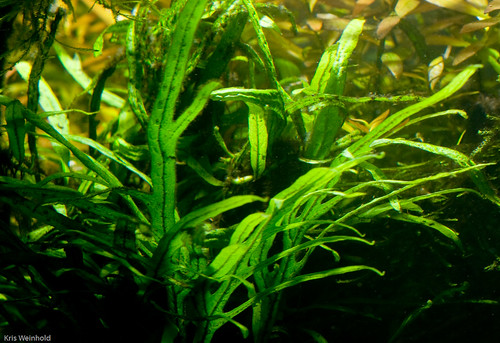
Last fall, two GWAPA members, Jim and Ghazanfar, traveled to Europe to attend the European Cryptocoryne Society’s (ECS) annual meeting. Armed with all of the proper phytosanitary documents, they were able to bring back a number of species of plants from the meeting. One of these plants is a currently unidentified Microsorum species that is quite different than any of the other Microsorum (Java Fern) species we’re currently keeping in the United States.

Microsorum sp.

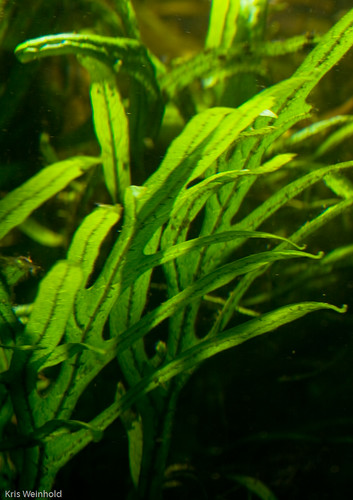
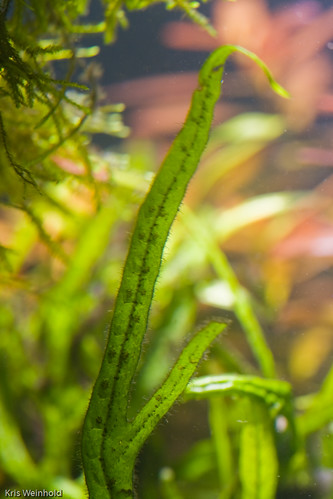
This particular specimen has a many more branches than your typical Java Fern. At first, we thought it might be the Tropica cultivar, Microsorum pteropus ‘Tropica’ ,but after comparing multiple pictures, that seems to have a fatter fern with my smaller saw-like edges coming off. The species Ghazanfar & Jim brought back looks much more like a hand with multiple fingers, or a trident’s staff, with narrower leaves.

Microsorum sp.

It grows just as quickly as your regular Java Fern, but unlike the Windelev variety, the irregular leaf shape appears to be present on plantlets forming on the end of leaves, in addition to new leaves from the rhizome. I think it’s a little bit prettier, as the narrower leaves bend down slightly, creating a cascading effect that you don’t usually get from a much more upright Microsorum pteropus.

Microsorum sp.

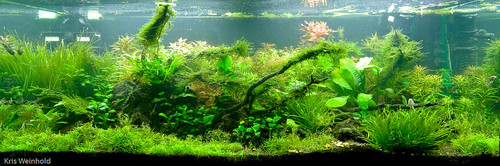
I’m hoping that eventually the folks in Europe will help us identify exactly what this fern is. But until then, I’m going to enjoy it as a centerpiece in my 75G aquascape. More info/pictures can be found on APC.

Business Broker

20H – Low Light Update

February 11th, 2008

I’ve largely neglected my 20H for some time. At first, I had 55W over this tank, and was constantly frustrated with algae problems. Eventually, I got sick of it, and went with a 15W fluorescent strip light over instead. Since then, the algae has been dying back, but I’ve been surprised by some of the plants that have hung on.

20H - 02/11/2008

The Ranalisma rostrata has kept growing, albeit differently, the bolbitus has grown leaps and bounds, and my crypts have done just fine. Most surprising is the Eriocaulaceae sp. ‘Type 2? that’s continued to grow despite the awful light. Inspired by this, last weekend I pulled a few more crypts/anubias from my 54G corner tank, and filled in some of the gaps in the layout. The picture above is the result of that effort.

This isn’t a typical aquascape, but somehow it looks more natural to me then some of the others. The Jewels seem to be right at home with the plants. I’d love to hear any comments you might have on the scape.

Business Broker

75G – February 2008 Update

February 5th, 2008

It’s been about a month since my last update on this tank. I recently pulled out a large number of plants for the GWAPA auction, harvesting plenty of Utricularia graminfolia in particular. I’m pleased that the tank is growing well, despite measuring 0ppm nitrates yesterday (prior to dosing more), but some parts are growing out of my favor. Largely, the Anubias heterophylla on the right side is getting a bit unwieldy.

75G - 02/04/2008

Also, the Pogostemon stellatus in the back right has gone in and out of looking great to looking like crap. So, I got some Ludwigia inclinata var. verticillata ‘Cuba’ and Eriocaulon sp. ‘Type 3’ at the last GWAPA auction that will hopefully replace the P. stellatus in the back right. My problem is that I haven’t found the best transition plant for the right mid ground. On the left, I have the Utricularia graminfolia in front, with Hygrophila sp. ‘Low Grow’ and Crypt. affinis behind that, stepping up to Blyxa aubertii. That’s a nice transition. On the right, it’s the Utricularia to Crypt. willisii to the stems. Unfortunately, the stems usually look like crap after a trim, messing up the transition. I’ve thought about moving some Eriocaulon sp. ‘Type 2’ over there, but that plant may then be repeated too closely together.

Maybe I’m thinking too much?

Business Broker

Apistogramma sp. ‘Rotpunkt’ Pictures

February 3rd, 2008

I noticed some increased fin flashing activity in my 40G tank, and decided to try and capture a few good shots of my Apistogramma sp. ‘Rotpunkt.’ Some of the shots are better than others, but there’s no doubt that these are some pretty fish, whose colors especially pop under the new 2x96W lights!

Apistogramma sp. 'Rotpunkt'
Apistogramma sp. ‘Rotpunkt’ Male Flashing Fins

Apistogramma sp. 'Rotpunkt'
A. sp. ‘Rotpunkt’ Male Front On

Apistogramma sp. 'Rotpunkt'
A. sp. ‘Rotpunkt’ Female in Spawning Colors

Apistogramma sp. 'Rotpunkt'
A. sp. ‘Rotpunkt’ Male Close Up. Notice how brilliant the blue on the face is.

Apistogramma sp. 'Rotpunkt'
A. sp. ‘Rotpunkt’ Non-Dominant Male. Not nearly as impressive, huh?

Apistogramma sp. 'Rotpunkt'
A. sp. ‘Rotpunkt’ Male Coming at You.

I should have used a flash above the tank to shoot at a better quality ISO, but I always end up spooking the fish in order to set that up.

Thanks for looking! Any comment/critiques are welcome, as always!

Business Broker

Ranalisma rostrata – In a Different Light

January 29th, 2008

I’ve been growing Ranalisma rostrata in my 40G tank as the foreground for some time. When I originally setup my 20H, I decided to also plant it in there. As the 20H progressed, I realized that I had too much light, too little CO2, and too little desire to maintain the tank as I really wanted. Therefore, I removed the 55W PC light from overtop, and replaced it with an ordinary 15W fluorescent light strip. Over the past few months, besides being considerably darker than it was before, I’d noticed a huge change in the form of the Ranalisma rostrata in that tank.

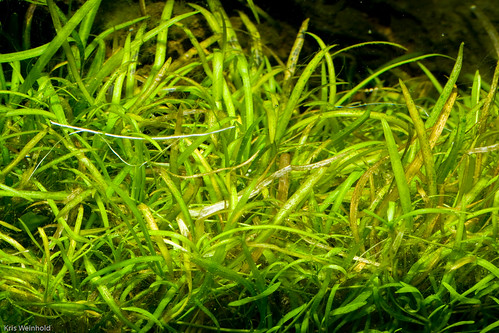
Witness how the grassy plant looks in my 40G. Compact growth, overlapping each other, where each blade is thin and relatively uniform.

Ranalisma rostrata - High Light

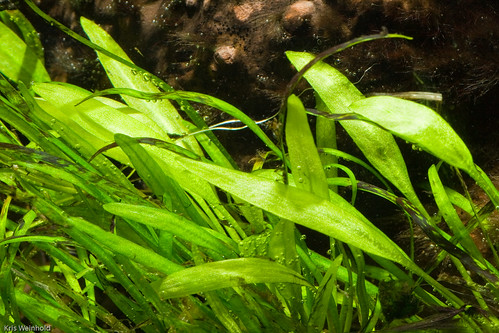
In my 20H, the growth is quite different (below), with blades more resembling a sword plant, than grass. The blades are longer and the growth is much slower. I suspect that the plant is sending out broader leaves to try and soak up more light since less is available. The color is also slightly different, with the broader leaves being a bit more pale, with a yellowish tint, where the regular form is a bright green.

Ranalisma rostrata - Low Light

I’m sure that this same phenomenon is present in a wide variety of plants, which is why it’s difficult to say exactly how a plant will grow in another person’s tank. I’m often asked at GWAPA meetings whether a plant is high light or not. In general, I can usually only respond that I’ve only ever grown it in high light, but that they should try it out, and see if it survives in their tank. Now, I can’t even guarantee that it’ll look the same!

Business Broker

Hydrocotle sp.

January 21st, 2008

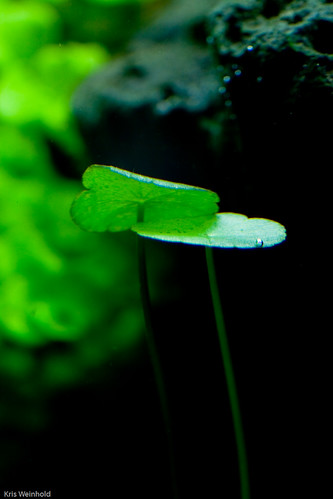
Back in June 2007, a few GWAPA members went down to Florida to see what kinds of plants/fish we could find for our aquariums. One plant that was absolutely everywhere was a Hydrocotle species that mixed into the grass of people’s lawns, and existed in virtually every roadside ditch we visited. I grabbed a small amount, expecting it to completely take over my tank.

Hydrocotle sp.

I couldn’t have been more wrong. This small plant has been living in my 40G tank for over 6 months, while only throwing up a single new stem. Recently, I upgraded my lighting to a 2x96W setup from AHSupply and I’ve noticed that the Hydrocotle sp. has started to grow, sending up a new stem and leaf in just the last week. Right now, the stems are approximately 6 inches tall, which is slightly taller than I’d prefer them. I’ll be sure to post if it evens out, and becomes a nice accent plant in my aquascape.

Business Broker

AHSupply 2x96Watt Canopy Upgrade

January 14th, 2008

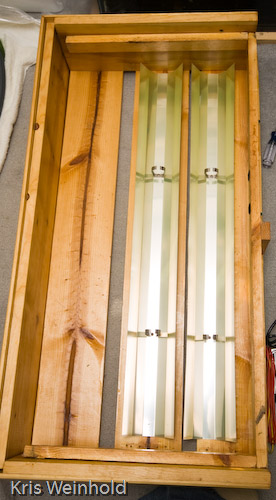
On Saturday, I decided to install a new AHSupply 2x96W kit into the canopy over my 40G aquarium. I used to have ODNO lighting on this tank, but I wasn’t comfortable with the amount of energy being wasted to squeeze out a little bit more light from the 36″ 30W bulbs. Below is what that configuration looked like: 4 bulbs driven by 4 ballasts, over cheap shop-light reflectors.

After I removed the existing equipment, I was pretty happy with the condition of the wood. When I built this canopy, I put extra coats of finish to prevent moisture damage. It held up to the moisture and heat pretty well!

I chose to go with AHSupply’s 96W kit because they have fantastic aluminum reflectors, and the 96W bulb fits a 3′ tank perfectly. I know that T5 lighting is all of the rage these days, but I’d prefer to stick with a consistent power compact lineup so that I can buy replacement bulbs in bulk for all of my tanks.

The kit comes with a set of very detailed instructions for installing into a canopy, or building a DIY strip-light enclosure. Everything you need for either configuration is included. To start, I installed the reflectors and bulb clips into the canopy.

The reflectors come with a yellow plastic film over top of them to avoid scratches during installation. They’re a fantastic parabolic reflector that really focuses most of the light output from the bulb down into the tank. They claim that their reflectors make their setup produce 2.5X as much light as a store-bought solution.

Wiring up the ballast was very straight-forward thanks to the included wiring diagram. The hardest part was trimming the wires to length, and stripping them to use the wire nuts. After screwing down the 2 ballasts, and installing the bulbs, I was all done.

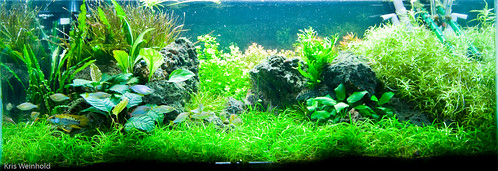
Time to fire them up — Man are they bright! It seems like they’re 10X brighter than my old ODNO lights, using equal or less the wattage. By mid-afternoon, the entire tank was pearling more than I’ve seen it pearl in years. This continued for 3 straight days, so I’ve increased my CO2 injection, and dosing amount to compensate. The fish really pop under these lights as well. I’d recommend AHSupply products to anyone looking for a DIY lighting solution.

40G - 1/14/2008

Business Broker

« Previous Entries   Next Entries »