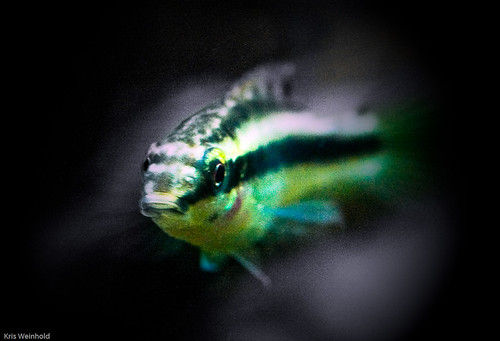
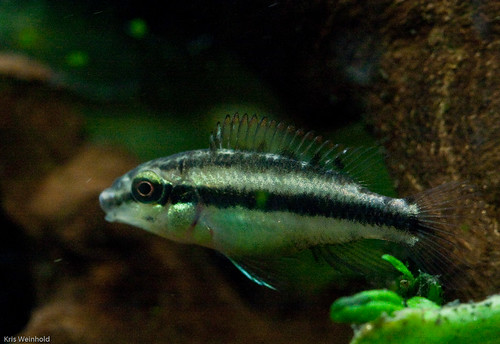
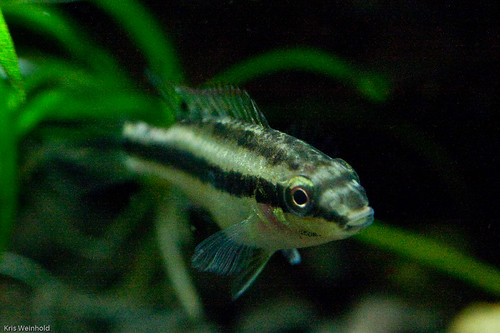
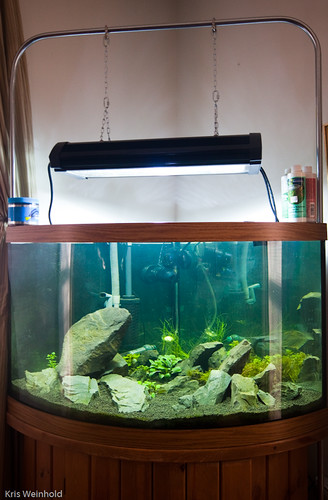
Since there’s multiple feet of snow outside, I’ve been sitting inside trying to come up with creative things to occupy my time. Today, I pulled out our old video camera and headed into the fishroom. I lucked upon some interesting activity going on in my 50G with the colony of Apistogramma baenschi ‘Inka 50’ . First, I have a video of a female in full bright yellow coloration guarding a little patch of territory she’s carved out underneath some Blyxa japonica stems.
Next, I caught two males displaying to each other, with the largest, most dominate one eventually chasing the other away. This happens all of the time, and doesn’t usually end up with anyone getting injured. It’s interesting to me how in both of these videos, the Apistogramma only cares about other cichlids. They never chase away the other tetras. (This would change if they were actually protecting fry.)
Finally, after the male-to-male domination display earlier, his female approaches him doing a kind of odd-looking dance to indicate that she’s not a threat. Recognizing this, he lets her go into their patch of Blyxa that he’s protecting.
The behaviors of these cichlids provide unending fascination to me as I enjoy my aquariums during a cold wintry day. Comments welcome!
I just wanted to share a couple photos of the new inhabitants in my 75G aquarium. After finding a good home for my Blue Spotted Sunfish, I decided that I would like to keep Angelfish again. This time, rather than just getting the various commercially bred color variations, I wanted to get ones with the wild coloration. I feel the natural coloration with the vertical black bars are the most elegant looking Angelfish of all. I was fortunate to have another GWAPA member turn me onto a breeder.
The breeder imports and breeds wild Peruvian angelfish to keep the gene pool healthy for their other various color variations. They also sell of some of the offspring from their live imports. Finding this out, I bought 7 first generation (F1) domestically bred wild angelfish. The breeder sent 8 fish, and they all looked fantastic, even in the bag.
At first in the tank, the fish hid every time I came into the room, but after a week of feeding them, they have really warmed up to me, and are starting to follow me up and down the tank when I’m working in my fish room. Right now, the Angelfish are the only mid-level swimming fish that I have in this aquarium. I still have my Nannacara, red-lizard catfish, and L279 bristlenosed plecos, so the bottom level is covered. I’m having a hard time settling on a small schooling fish to act as attractive dithers for the Angelfish. Suggestions welcome!
Last fall, I bought a dozen Vietnamese White Clouds in an auction at a Capital Cichlid Association’s meeting. I have never kept these fish before, but was always tempted by them in the fish stores. The one thing I never realized was how magnificent their fins can be until I put the group in my 20L and the males started displaying. In the stores, the fish just seem to hover in place, but in my tank, the males are constantly chasing each other around.
Supposedly these fish are very easy to breed, but I have not yet seen any eggs or fry in my aquarium. It’s possible that some loaches are taking care of any eggs that might be in the tank. These White Clouds seem to be fantastic fish for the planted aquarium. In addition, they can tolerate slightly cooler temperatures, so you don’t necessarily have to keep a heater in your aquarium. There is also a long-finned version of this fish which is even more impressive.
I wanted to post a small update on my 75G since my latest post. In that post I talked about how my original intent was to make three separate mounds with pathways between them. I still have that, but the more I looked at the tank, the more I felt that the right side wasn’t strong enough. So, I pulled out the remaining pieces of African bogwood that I had, and started toying around.
75G: Click for Larger Image
What I ended up with was an arch connecting the two mounds on the right. The mounds themselves haven’t changed, but the archway adds more height, making the right side the dominant side of the aquascape. The arch also mirrors a smaller arch on the left side. The only downside is that this essentially turned the scape into a two mound aquascape again, which is what I was originally trying to avoid. That said, I think it’s unique enough to let it grow in for awhile. Also, the Glosso is starting to spread rapidly, and the Cryptocoryne and Trident Java Fern are slowly starting to recover from being moved around and hydrogen peroxide sprayed for algae. Comments welcome!
Sometime before the holidays, a pair of my generic bristlenosed plecos dug a hole under one of the rocks in my 50G aquascape and produced a spawn of 15-30 baby plecos. I knew they were nesting because I could see the parents initially fanning the ceiling of the rock where they dug their cave, presumably keeping the water fresh around all of their eggs. A couple of weeks later I noticed a slew of baby plecos clutching to the top glass all around the tank.
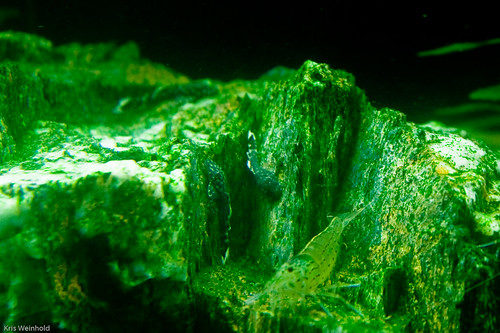
They hung around the glass for several weeks, but now they seem to have dispersed throughout the tank. In the picture above you can see three plecos cleaning the top of the largest rock in my aquascape. Obviously, the fish are still not huge as they are dwarfed by an adult Amano Shrimp. If anyone has any suggestions on what to feed these guys to grow them up a bit faster, I’d love to know. So far, I’ve just been feeding them algae wafers, and I feed the other fish in the tank frozen bloodworms and brine shrimp. Comments on anyone else’s pleco breeding experiences are welcome!
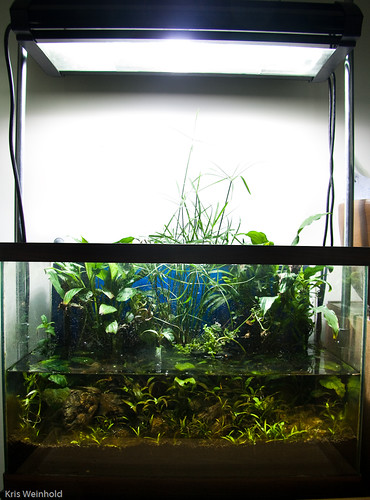
It’s been a little while since I’ve talked about my Riparium, but it’s been doing fairly well as of late. The biggest improvement has come after I suspended a 4x24W T5 + 250W MH pendant overtop of the tank, which used to light up my old 54G aquarium. This fixture is definitely overkill, but the plants, particularly the terrestrial ones, have really responded growing up above the rim of the 20-high. I’ve started dosing some ferts in this tank also, as I believe the aquasoil has run out. That, and since I added more light, I needed to make sure I balanced that with proper plant nutrition.
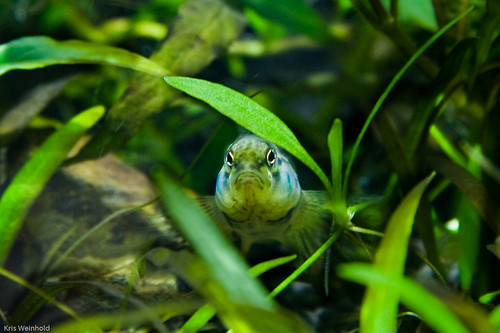
The Zebra Danios are still doing well in this tank, but my favorite fish in here are a pair of Rainbow Darters that I got in the Aquafest auction. They’re really odd, but strangely personable fish, that I feed frozen or live foods directly from a pair of tweezers. When I come into my fish room, they will often skirt right up to the glass and watch me, anticipating being fed.
I feed them via tweezers to ensure that they get fed, as they are not nearly as quick as the danios in the tank. As for the Riparium Supply equipment, I haven’t had any problems. All of the suction cups are still holding everything in place, and the plants anchored in the plastic cups are growing well.
Happy New Year! — I hope everyone had a nice holiday! I’ve been mostly offline for the last two weeks painting about 90% of my house. We’ve lived in our house for 8 years and had done a fair number of home improvement projects during that time, but somehow, painting wasn’t one of them. As you can imagine, aquariums can make home improvement projects such as these quite difficult, as a full aquarium is not very amenable to moving so that you can paint behind it. Therefore, a couple days before Christmas, I moved my 75G from our family room into my fish-room where all of my other tank are now congregated. This was the perfect time to do a quick new aquascape.
75G - Scaped 12/20/2009 - Click for Larger Image
I decided to try and make this aquascape fairly low maintenance, so besides the Staurogyne sp. ‘Porto Vehlo’ and Glossostigma elatinoides used in the foreground, I didn’t use any stem plants. The past couple of aquascapes I’ve done seem to consist of two mounds on either side of the aquarium, one larger than the other, with a pathway down the middle. I decided to try something a bit differently this time making three mounds, several pathways, and a fairly low profile so that the pathways could continue directly from the front to the back of the tank uninhibited. I reused most of the hardscape and plants that were previously in the 75G, and unfortunately, many of those had hair algae. Being distracted by my painting task, I pretty much neglected to dose for the last two weeks. Plus, I used some extra used Aquasoil I had in a bucket to make more of a slope in the mounds, which added a lot of silt to the substrate, creating cloudy water anytime one of the fish was spooked. So, I’m now faced with the difficult task of eliminating algae in a planted tank with slow growing and newly planted plants which likely won’t be able to outcompete it for the next little while. I’m hopeful that frequent water changes, Seachem Excel and H202 spot treatments, and cranked CO2 will hold the algae at bay and get the Glosso and S. ‘Porto Vehlo‘ going to outgrow the algae. Right now the Cryptocoryne and Trident Java Fern are looking a little sad from the transplanting, but hopefully they’ll fill in and create a nice lush aquascape. Comments/critiques welcome!
In October, my Pelvicachromis pulcher ‘Super Red’ spawned and I had a whole swarm of little Krib fry swimming around in my 40G farm tank. After only a couple months of paying extra special attention to feeding them, I now have a group of decent sized fish. The largest ones are about 1.5 inches long, with the smallest being about an inch.
The parents have left them to fend for themselves, although so far they are getting along just fine with the parents. I don’t completely know how many young fish I have, however, because they have dispersed throughout the tank, and the only time I ever seen a number of them together is when I’m feeding them. At those times, I’ve counted 7-8 together, but it wouldn’t surprise me to have double that number hiding in the overgrown farm tank.
They have yet to get the brilliant colors that the parents display, but you can definitely tell that they’re kribs now. Small patches of color are starting to show up around the gills and fins. They have the distinctive squat (or maybe pear shaped) body where the belly seems a little bit too big in comparison to the rest of the fish. I’m not able to sex them yet, but I’m never great at that anyways with most fish.
I’m really pleased with how easy these fish have been to keep and raise. The only thing I’m worried about is if the parents spawn again, and decide they don’t want their previous brood around anymore. If I see signs of spawning though, I may pull the parents out to their own tank to do their business.
Posted in 40G Tank Log, Fish Fry|Comments Off on Pelvicachromis pulcher ‘Super Red’ Fry Update
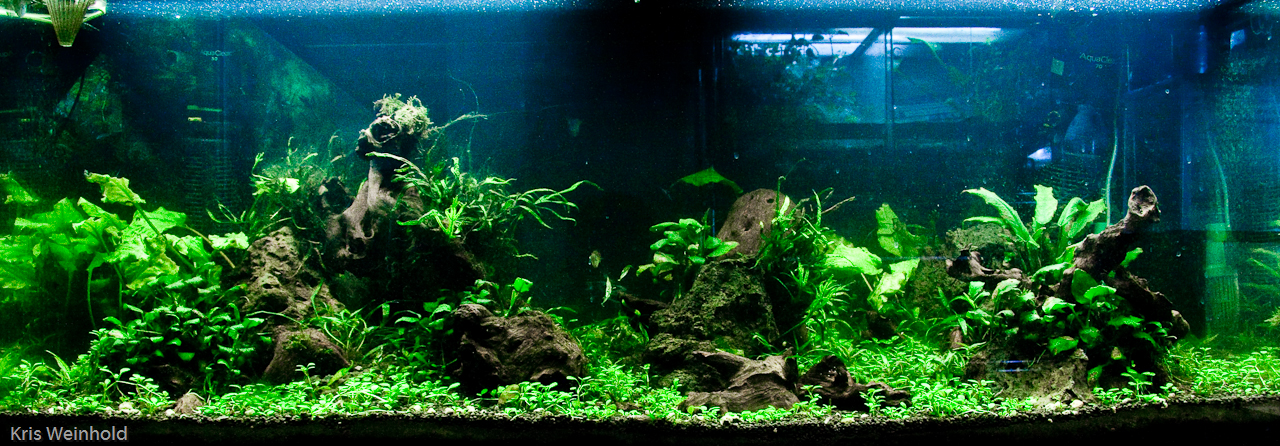
The holiday season has been really busy for me this year, so I haven’t been able to post near as much as I’d normally like to. Nevertheless, I did want to update everyone on the one aquascape that seems to be progressing along pretty well — my 50G Blyxa scape. I haven’t posted about this tank in almost three months, so if you were to look back at the last picture, just after rescaping, you’ll see that the Blyxa japonica has really taken over the scene, maybe too much so.
50G - 12/09/2009 (Click for larger image)
New additions to this aquarium include a colony of Apistogramma baenschi ‘Inka 50’, who I am hoping will breed. Speaking of breeding, the group of bristlenosed plecos have burrowed out a hole under the rock on the left side of the tank where there’s no hairgrass, and have already spawned once. The little black specks on the right wall of the aquarium are the baby plecos hanging out. They’ve survived for over a month now, so I’m hopeful that they’ll continue to grow to adulthood. Besides taming the monstrous Blyxa japonica, please let me know if you have any suggestions for improvement!
Well, my native plant aquascaping experiment has come to an abrupt end. The night before I left for vacation a few weeks ago, I was feeding the fish and noticed that the left side of the stand was a little damp. Upon closer inspection, the inside of the stand had some water pooled up, and upon even closer inspection, the bottom rim of the aquarium was overflowing with water dripping out of it.
I think, “wonderful, I’ve got a siphon somewhere in my auto-doser setup that’s leaking out.” – Nope
I look, “maybe the powerhead is forcing the water too hard against the top rim and it found a gap in the silicon up there, and is dripping down the side into the bottom rim.” – Nope, the black posterboard background was only wet along the bottom, so nothing dripped from top to bottom.
“Crap! My tank has developed a leak from some new rocks I put in it a week prior!” – Bingo!
I scrambled to net out the fish, siphon out the water, remove the plants, remove the substrate, and clean up the water on the floor. While this wasn’t how I planned to spend 2 hours of my evening prior to catching a plane in the morning for 2 weeks, I’m so thankful that I noticed this leak before I left for vacation. Had it leaked out during the 2 weeks I was on vacation, the floor around the tank surely would have been ruined, and the fish dead. My wife and I have been looking to move that tank out of the our living room for awhile, and since I don’t have anywhere else to put it while it was being repaired, I was fortunate to find another GWAPA member to take it off my hands, and put it back in service. It was a nice tank to have, and I hope it does well in its new home!