January 11th, 2010
On Saturday, a fellow GWAPA member, Rico, invited a few of us over to help him aquascape a new 75G aquarium that he had just bought. Originally, we were going to aquascape his 90G aquarium, but a leak developed in that tank, and he had to replace it with the 75G. My friend Cavan and I showed up mid-afternoon and helped Rico finish transferring stuff out of his 90G, bring in the the new 75G, and off we went. Rico had some manzanita wood and dark river rocks to use as hardscape items.
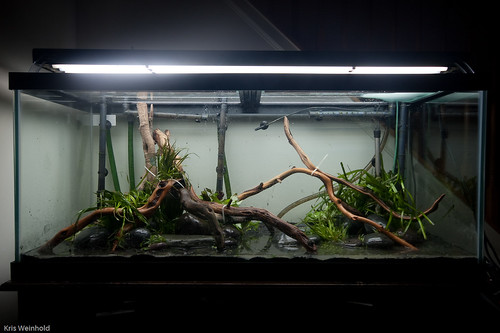
It took us a little while to figure out what direction we would take with the hardscape material at hand. The problem we originally ran into was figuring out how to get enough height in the hardscape, but we ultimately discovered the right combination of manzanita branches, zip-tied them together, and solved that problem. After the wood was in place, we filled in underneath it with the river rocks. Never having scaped with river rocks before, I wasn’t exactly sure how it would turn out, but I was very pleasantly surprised. The rocks match Flourite Black Sand almost perfectly!
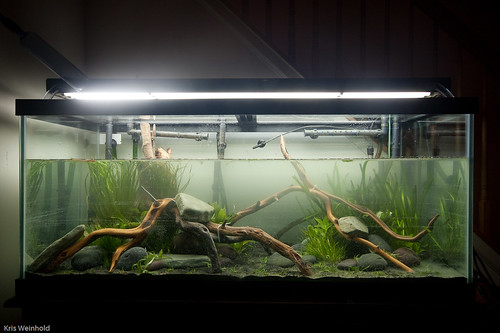
For plants, we used Ranalisma rostrata in the foreground, which should fill in as a nice short grassy lawn. In the mid-ground, we used Blyxa japonica and Hygrophila sp. ‘Kompackt’. As a transition plant between the foreground and mid-ground, we used Staurogyne sp. ‘Porta Vehlo’. Finally, in the background, we used Blyxa aubertii and a broad-leafed Sagittaria species. Ultimately, I hope Rico will remove the Sagittaria altogether and replace it with just Blyxa aubertii, but we didn’t have enough of that plant to do it in the beginning. Finally, for a little bit of color, Rico had some stems of Limnophila aromatica, which aren’t visible in the picture, but should be very nice to the right of the B. aubertii on the left.

Above is the picture a few hours later after Rico filled it up and added back in the fish. Please ignore the three rocks placed on top of the manzanita to keep it from floating — those will be removed in a few days after the wood is waterlogged. So, how did we do? Comments/suggestions welcome!
Posted in Aquascaping, GWAPA | 3 Comments »
January 10th, 2010
I wanted to post a small update on my 75G since my latest post. In that post I talked about how my original intent was to make three separate mounds with pathways between them. I still have that, but the more I looked at the tank, the more I felt that the right side wasn’t strong enough. So, I pulled out the remaining pieces of African bogwood that I had, and started toying around.
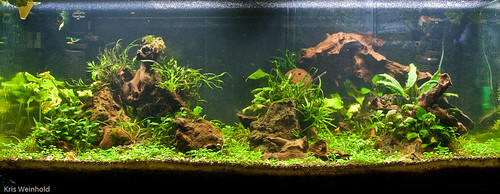
75G: Click for Larger Image
What I ended up with was an arch connecting the two mounds on the right. The mounds themselves haven’t changed, but the archway adds more height, making the right side the dominant side of the aquascape. The arch also mirrors a smaller arch on the left side. The only downside is that this essentially turned the scape into a two mound aquascape again, which is what I was originally trying to avoid. That said, I think it’s unique enough to let it grow in for awhile. Also, the Glosso is starting to spread rapidly, and the Cryptocoryne and Trident Java Fern are slowly starting to recover from being moved around and hydrogen peroxide sprayed for algae. Comments welcome!
Posted in 75G Tank Log, Aquascaping | Comments Off on 75G: Small Update
January 8th, 2010
Back in September, a fellow GWAPA member, Michael, asked me to come and take pictures of his beautiful 210G aquarium so that he would have something to submit to the AGA competition. I previously blogged about this experience, but at the time, didn’t want to post the pictures until after the AGA competition had been decided. Below are a few more pictures from the shoot:
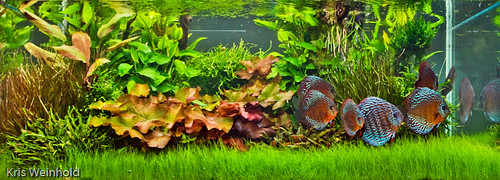
The 210G gallon aquarium acts as a room divider between Michael’s living room and dining room so that it is visible from three sides. This provides the unique challenge of making all three sides equally pleasing to look at. The picture above is what Michael considered the “front.” This shot was a lot of fun to take because I was behind the camera holding a flash up in the air toward the ceiling to bounce light from the ceiling into the tank. His wife was holding a hair dryer over-top of the water, creating the ripple effect, and Michael was to the right of tank trying to coax his pet discus to line up in a nice row like you see.
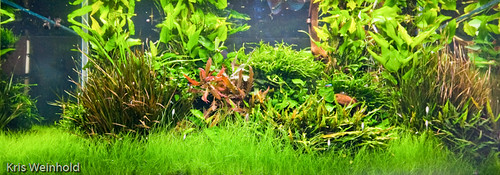
The “front” side of the aquarium is dominated by a beautiful stand of Nymphea lotus, with a really nice portion of Lagenandra meeboldii ‘pink’ to the left of it. The “back” of the aquarium(above) was much less vibrant in coloration, but still showed tremendous growth in the Cryptocoryne lutea and Blyxa aubertii. I’ve since heard that he has drastically thinned out these plants to provide more space for the discus.
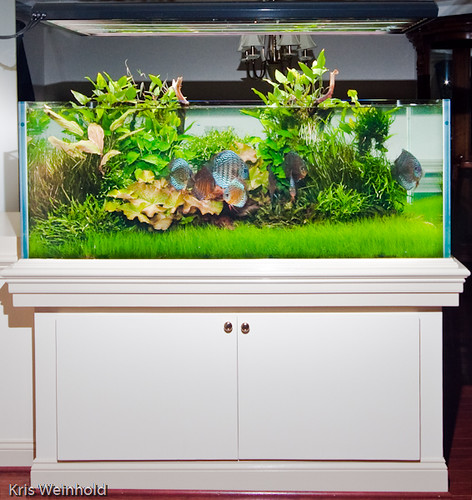
The full cabinet that the aquarium sits on was custom made, and is very well done. I don’t know how he keeps the white stand looking so nice, but he does. I also really like how he used emersed growing Anubias to obscure drip-tube that provide new water to the tank daily.

Finally, with quite a few nice discus shots, I couldn’t help myself from trying to get a little bit artsy with one of them. I especially liked the shot above because it reminded me of the pictures I looked at as a child in old black-and-white aquarium books from the library. In any case, I promised that I would share more photos was the AGA released their results, so I wanted to keep good on that word. You can find more technical information about Michael’s aquarium, as well as, the AGA judges’ comments on the Aquatic Gardener’s website.
Posted in Aquascaping, Photography | 1 Comment »
January 7th, 2010
Sometime before the holidays, a pair of my generic bristlenosed plecos dug a hole under one of the rocks in my 50G aquascape and produced a spawn of 15-30 baby plecos. I knew they were nesting because I could see the parents initially fanning the ceiling of the rock where they dug their cave, presumably keeping the water fresh around all of their eggs. A couple of weeks later I noticed a slew of baby plecos clutching to the top glass all around the tank.
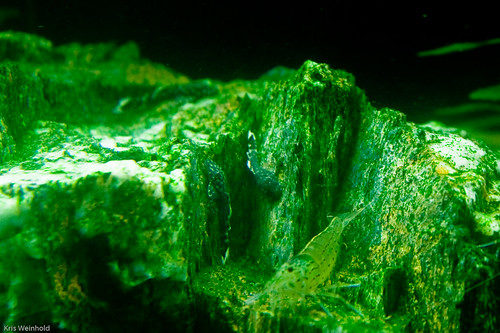
They hung around the glass for several weeks, but now they seem to have dispersed throughout the tank. In the picture above you can see three plecos cleaning the top of the largest rock in my aquascape. Obviously, the fish are still not huge as they are dwarfed by an adult Amano Shrimp. If anyone has any suggestions on what to feed these guys to grow them up a bit faster, I’d love to know. So far, I’ve just been feeding them algae wafers, and I feed the other fish in the tank frozen bloodworms and brine shrimp. Comments on anyone else’s pleco breeding experiences are welcome!
Posted in 50G Tank Log, Fish Fry | 2 Comments »
January 5th, 2010
It’s been a little while since I’ve talked about my Riparium, but it’s been doing fairly well as of late. The biggest improvement has come after I suspended a 4x24W T5 + 250W MH pendant overtop of the tank, which used to light up my old 54G aquarium. This fixture is definitely overkill, but the plants, particularly the terrestrial ones, have really responded growing up above the rim of the 20-high. I’ve started dosing some ferts in this tank also, as I believe the aquasoil has run out. That, and since I added more light, I needed to make sure I balanced that with proper plant nutrition.
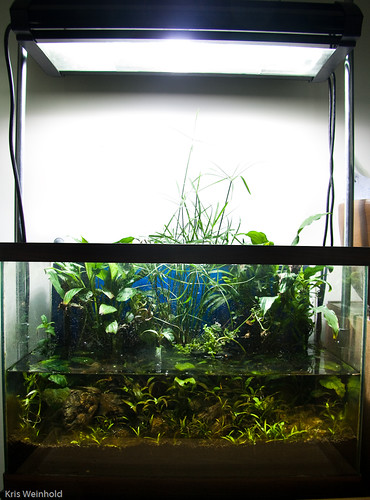
The Zebra Danios are still doing well in this tank, but my favorite fish in here are a pair of Rainbow Darters that I got in the Aquafest auction. They’re really odd, but strangely personable fish, that I feed frozen or live foods directly from a pair of tweezers. When I come into my fish room, they will often skirt right up to the glass and watch me, anticipating being fed.
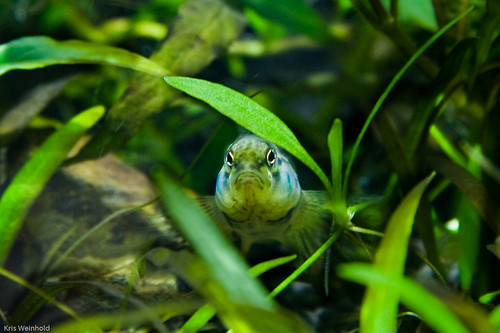
I feed them via tweezers to ensure that they get fed, as they are not nearly as quick as the danios in the tank. As for the Riparium Supply equipment, I haven’t had any problems. All of the suction cups are still holding everything in place, and the plants anchored in the plastic cups are growing well.
Posted in 20G High Tank Log | 10 Comments »
