2009 AGA Aquascaping Contest

August 13th, 2009

2009 AGA Contest

The 2009 AGA International Aquascaping Contest is coming up with the entry deadline only 1 month away, on September 15th. I encourage everyone, even beginners, to enter into this competition. One of the best things about the competition is that you get honest feedback from expert judges, which can really help you grow as an aquascaper. The first time I entered a tank, Takashi Amano was a judge, and his comment was “the foreground is ugly.” You know what, that was a bit harsh, but I look at foregrounds a heck of a lot differently now than I did before. So, whip your half-trimmed scape into shape, you’ve got 2 good trimmings left before September 15th, and show the world what you’ve got!


Business Broker

75G: New Aquascape!

August 12th, 2009

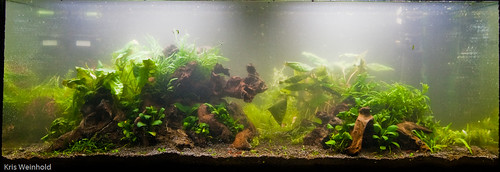
Last week, I finally got around to clearing out the jungle that had formed in my 75G, and completely rescaped it. Previously, the aquascape was dominated by a ton of Narrow Leaf Java Fern, but this scape doesn’t contain any fern, except for some Trident Java Fern topping off the two mounds of driftwood.
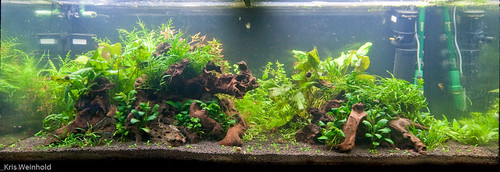
75G - 2 Days Later

75G: 2 Days After Setup

I had a couple of goals in mind for this new scape. For one, with my farm tank overflowing with plants, I wanted to use a few more stem plants in this scape than I did in the previous one. Hence, ferns are out, and stems are in. Additionally, since I’ve had some plecos breeding in the hollowed out driftwood, I wanted to continue to use the same African bogwood as I had in here previously, but I also wanted some more open space for a foreground. Those were the goals.
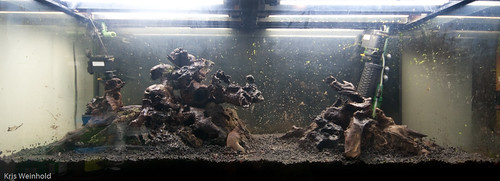
75G - Hardscape

75G: Hardscape Finished

Toying around with a couple of different layouts, I ultimately settled on the two mound approach, with one larger mound on the left, complemented by a smaller mound on the right, with open space in between. Yes, I know it’s been done a million times. So, I stacked up a bunch of pieces of the bogwood, trying to making them look like they fell on top of, or in the nook and crannies between, a base of rock.
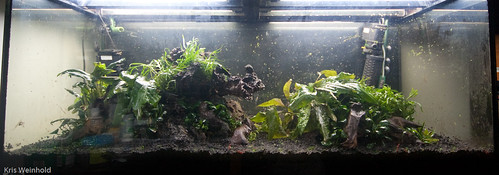
75G - Foundation Plants Planted

75G: Foundation Plants Planted

After finishing the hardscape, I planted what I feel are foundation plants. These are the plants that are actually kind of part of hardscape itself. Plants like Cryptocoryne, Anubias, Java Fern, etc. After getting those in place, you can really start to see what other areas need to be filled in. I added an inch or two of water, and finished planting the foreground and stem plants. The foreground is Glossostigma elatinoides, and in the back I have Hygrophila sp. ‘Guinea,’ Ludwigia repens x arcuata, Ludwigia arcuata, Elatine americana, Clinopodium brownei, Hottonia palustris, Limnophila aromatica, and Limnophila sp. ‘Wavy’. Of course, you can’t see most of them now.
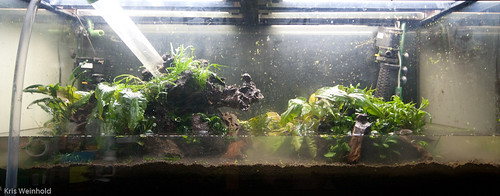
75G - Finished Planting

75G: Other Plants Planted, Filling Up Tank

After filling up the tank, this is what I had. I removed a ton of Malaysian Trumpet Snails so they wouldn’t uproot the foreground, and hundreds of cherry shrimp came out of the substrate to begin exploring their new home. It’s very difficult to catch all of the shrimp when doing a rescape, but fortunately, most survived the ordeal.
75G - Right after Scaping

75G: Right After Scaping

So now, it’s just a matter of letting it grow in a little bit. I already see a few things I’ll probably end up tweaking. I probably ought to pull out some of the background plants between the two mounds to keep them more seperate, and have the Glosso extend all the way to the back. Additionally, the Cryptocoryne pontederiifolia behind the right mound should probably be moved to the right a little bit. I may adjust some of the hardscape on the left side, but at this point, I kind of want to see how it evolves on its’ own, and go from there. Comments and critiques welcome!

Business Broker

Staurogyne sp. ‘Bihar’ Flowers!

August 8th, 2009

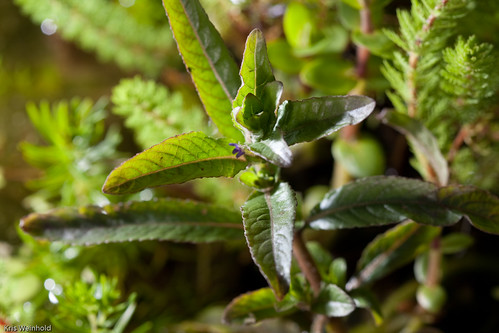
Back in April, I bought this plant from another hobbyist by the name Hygrophila sp. ‘Bihar.’ Submersed, this plant has pinnatifid (feather-like) leaves, which makes it very unique looking, but above water, it looks fairly ordinary.

Staurogyne sp. 'Bihar'

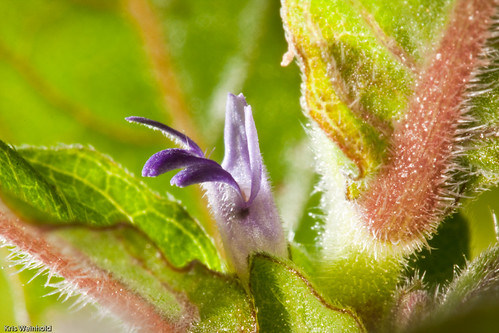
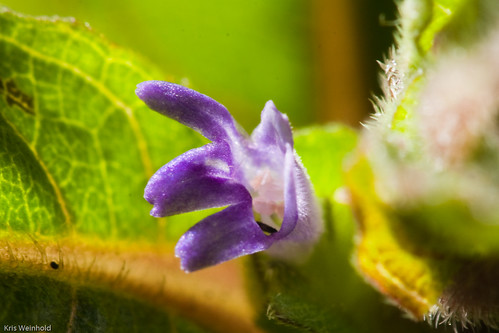
We now suspect that this is likely a Staurogyne, instead of a Hygrophila because of the pubescence (hairs) on the stem and leaves. In addition, one stem has flowered for me out in the pond, and the flower very much resembles that of a Staurogyne.

Staurogyne sp. 'Bihar'

Compared to the rest of the plant, the purple flowers are fairly small. I almost missed that a flower was present. Even the flowers have hairs on them.

Staurogyne sp. 'Bihar'

I’m hoping that combined with these pictures, and a pressed specimen of the plant, that my friend can work with other experts to figure out what species of plant this really is. S. sp ‘Bihar’ most certainly is not correct!

Business Broker

New Emersed Setup

August 6th, 2009

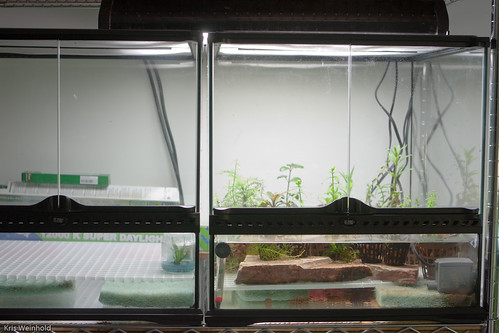
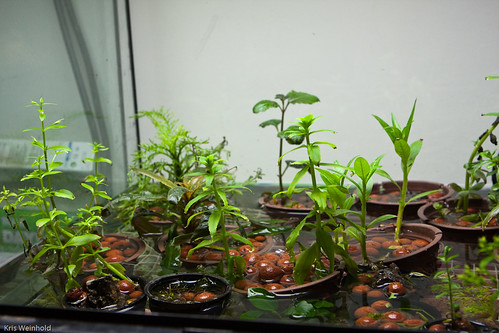
Last year, I posted about my previous emersed setup, which consisted of a domed tray and a 10G aquarium. I have recently retired that configuration, upgrading to dual terrariums that I picked up for a great price at an out-of-business sale. The nice thing about these ZooMed terrariums is that they have doors on the front of the glass, so you don’t have to fuss with moving the light over-top to work inside of the tank.

Emersed Setup

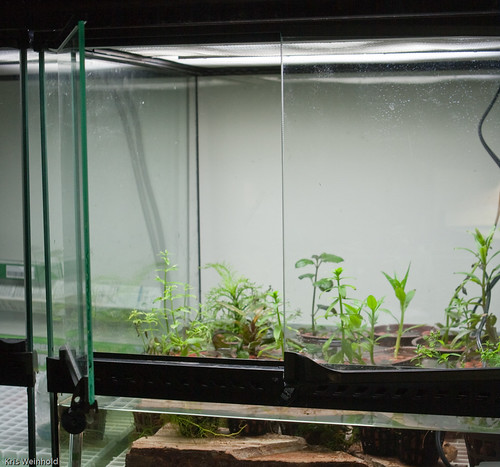
Out of the box, the terrium comes with a aluminum screen top for ventilation. Since I want to keep some humidity inside, I had window glass cut at the hardware store to fit the top. I didn’t cover it tightly because I don’t necessarily want 100% humidity.

Emersed Setup

I’m growing the plants with their roots/bases sitting in water, without any soil in the pots. I have mesh pots filled with clay balls, which are used in hydroponics, and a small powerhead to circulate the water. I also have a heater in the water to maintain a consistent temperature, and dose fertilizers into the water like I do my aquariums.

Emersed Setup

There are a number of reasons to keep an emersed setup, but I’m largely interested in two things: 1) Store plants that I want to keep for future use, but don’t want to take up valuable space in my aquariums, and 2) Attempt to flower unidentified plants to help my very knowledgable friend try to identify them.

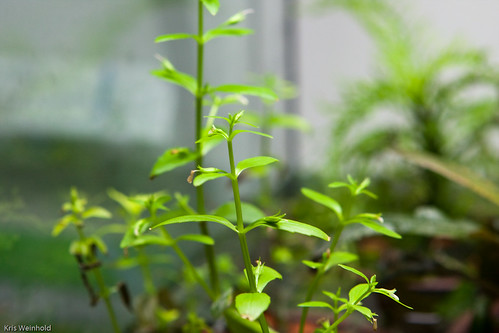
Lindernia dubia

I’m already getting a few flowers on my locally collected Lindernia dubia. I’m just hanging onto this plant. I am currently only using one of the two terrariums I picked up, but I suspect that in the fall when I shutdown my pond, I’ll use the second terrarium to overwinter many of those plants. So far, the only problem I’ve experienced is a little bit of mold on some of the leaves. I’ve manually removed those leaves, but would welcome any experienced grower’s advice on preventing it in the first place. Comments welcome!

Business Broker

Suitland Bog

August 2nd, 2009

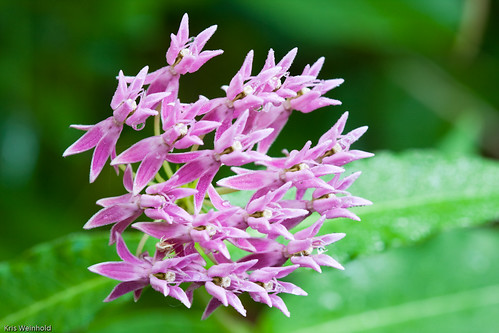
On Saturday, a few GWAPA members met at the Suitland Bog in Suitland, MD for a guided tour by the bog’s caretaker. We visited this bog two years ago, and thought it was time for another visit. On my previous trip, I had thought I had gotten a picture of Red Milkweed (Asclepias rubra), but was corrected by a reader that infact I had not. So, this year, I’m proud to have found it, and got the picture below!

Red Milkweed

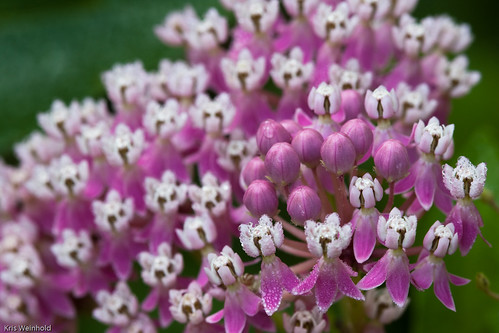
In addition to the Red Milkweed blooming, there was also another type blooming in the bog, which is shown below. Both are very pretty pink flowers. The ranger stated that the milkweeds weren’t always present in the bog, but showed up one day many years ago. He suspects that they were introduced by birds.

Milkweed

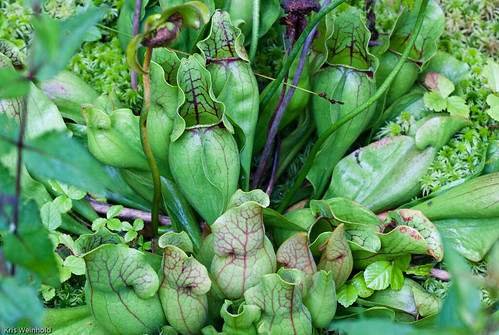
Also, interestingly enough, the main attraction at the bog, the Northern Pitcher-Plants (Sarracenia purpurea), are also not native to the bog. Apparently, prior to the mindset of preserving native habitats, botanists would collect interesting plants from other areas, and transplant them into habitats they believed the plants would do well. This is exactly what occured with the pitcher-plants, which were originally transplanted from New Jersey. Currently, the ranger actually has to weed out some of the pitcher-plants to prevent them from over-crowding the natives.

Sarracemoa purpurea

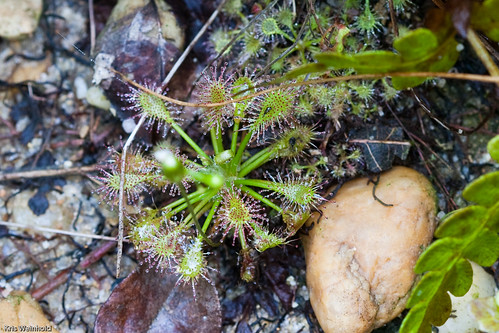
Another one of the carnivorous plants in the bog, Round-Leaved Sundew (Drosera rotundifolia) has been shaded out a little bit since I was there two years ago. Only a few remain, but the ranger is hopeful that some tree maintenance in the bog will help them make a comeback.

Sundew

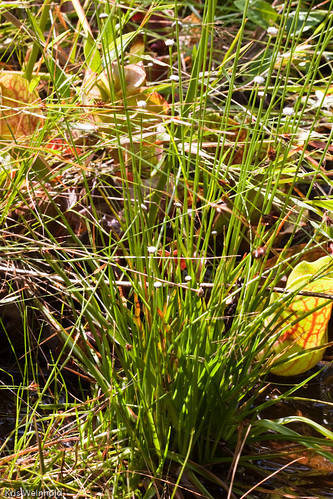
The main attraction for me personally is the Ten-Angled Pipewort (Eriocaulon decangulare), which is a magnificant grass, and was in full-bloom. One of the reasons I’m so interested in this particular plant, is that I believe it would probably grow submerged.

Eriocaulon decangulare

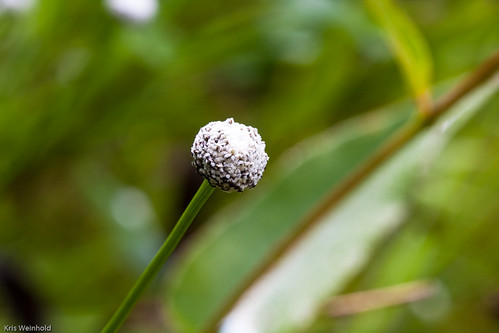
It’s quite easy to distinguish an Eriocaulon from other grasses, as the flower-heads are very distinctive. Fortunately, these plants seem to be doing pretty well in the bog. The ranger told us, however, that if they didn’t actively trim and maintain the area, that the whole bog would be totally reclaimed by the forest, and would likely disappear.

Eriocaulon decangulare Flower

For that reason, I’m extremely grateful to him and his colleagues for knowing the importance of preserving this habitat, and making it available for the public to visit. I’m hoping that a few GWAPA members will be able to help volunteer a couple times a year to further this effort.

Business Broker

« Previous Entries   Next Entries »