October 9th, 2007
GWAPA, CCA, and PVAS are co-sponsoring a regional (mid-atlantic) fall aquarium festival and show, Aquafest 2007, on October 20th and 21st. The show will have some excellent speakers including Eric Do, talking about invertebrates in the planted aquarium, Tony Orso, speaking about West African fish, Rusty Wessel, recapping his adventures collecting in Honduras, and of course, Ray “Kingfish” Lucas providing plenty of excitement during the banquet. Registration is only $10. If you want meals included, it’s very minimally more. If you do want to register for meals, the deadline is this Friday, so don’t wait! You can register at this URL:
http://aquafest2007.org/register.htm
In addition, GWAPA members, myself included, will demonstrate how to setup a planted aquascape. If you have questions about how to grow plants in an aquarium, please come and ask your questions. If you have trouble turning a design in your head into a real aquascape, please come by. If you can grow plants, but grow lots of algae too, please come. If you still can’t pull off an aquascape, don’t worry; we will be raffling off our final aquascaped tank on Sunday, so all you have to do it take it home and set it back up.
If you have some beautiful fish that you would like to show off to fellow hobbyists, please consider entering them in the fish show.
Finally, if none of this interests you, and all you want is an opportunity to buy fish/plant/dry goods that you can’t find at your local fish store, come to the auction on Sunday, the 21st. Admission is free and I guarantee that there will be items there you haven’t seen before.
I hope to see you there! Register now!
Posted in Conventions | Comments Off on Aquafest 2007
October 7th, 2007
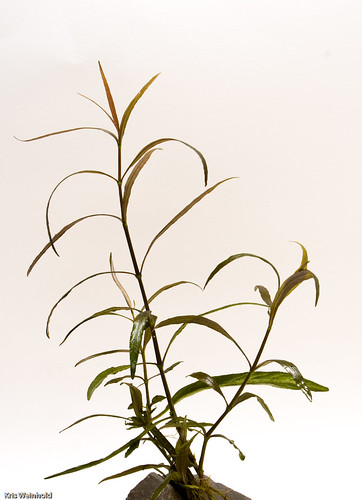
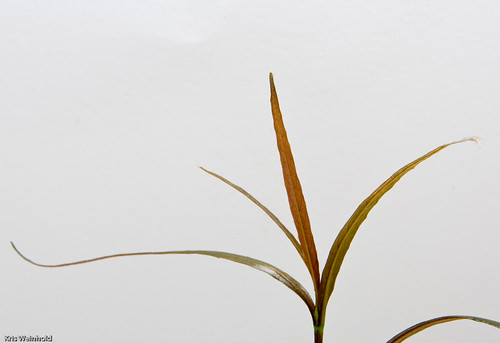
At one of the past GWAPA meetings, I won Hygrophila sp. ‘Sarawak’ in the mini-auction. One of our members had obtained seeds for this plant, grew it up emersed, and finally started propagating it for other club members. When I obtained this plant, it was in its emersed form which has much larger green leaves than the reddish submersed form. In the picture below you can see the contrast of the larger leaf form at the bottom verses the leaves at the top.
Most of us know the plants of the Hygrophila genus as weeds that require frequent trimming and care. For this reason, I usually avoid plants from this family. I’m pleased to report that Hygrophila sp. ‘Sarawak’ does not share this same trait. It is much slower growing than say, H. polysperma, and so it requires much less upkeep. I’m still reserving judgment on how apt this plant is for aquascaping, but my first impression seems to indicate that it will bush up, making it viable. Watch future posts of my latest 40G aquascape to see how it progresses along.
Posted in 40G Tank Log, Plant Profiles | 4 Comments »
October 5th, 2007
 Perhaps this is old news for some folks, but I wanted to share a fantastic tip I got from another fellow GWAPA member, Ben B., for easily cleaning the ceramic disk on your CO2 glass diffuser. A little background… I run nearly all of my CO2 in-line on my tanks because it’s easy, and because I personally don’t like to put any more equipment in my tank than I need to. But, when the glass diffusers started coming out and becoming quite trendy among planted aquarists, I ordered a couple to see what the fuss was about. For the first month or two, they worked perfectly, spewing small micro-bubbles, but as algae builds on disk, these bubbles turn larger and larger, until eventually most of the CO2 is being lost from the tank before it can be absorbed into the water.
I had been using the routine of grudgingly disconnecting the diffuser, and letting it soak in a diluted bleach solution for a number of hours, before returning it to the tank. This does a great job of cleaning the disk, but I’ve broken more than a couple diffusers performing the simple task of disconnecting/connecting the airline hose from the fragile glass stem.
Enter Ben B’s brilliant solution. Every time you do a water change, pull the glass diffuser above the surface of the water. Pour enough hydrogen peroxide onto the ceramic disk that it keeps the disk submerged in the H2O2. As you’re busy trimming, scraping the glass, and filling the tank back up, that H2O2 is busy oxidizing the algae from the surface of diffuser. By the time you’re done filling up your tank, the diffuser should be good as new. All that’s required is keeping a small bottle of hydrogen peroxide near you tank — something I already am in the practice of doing. Thanks Ben!
Posted in Equipment | 9 Comments »
October 3rd, 2007
Last weekend I finally decided to rescape my 40G tank. It had once again become a mishmash of plants from various local collecting sites, and exotics from GWAPA meetings. Some Vallisneria americana that was a mere 4-6″ in the wild had sent out runners throughout the tank, and coiled its 2-4 foot long leaves across the surface. Plus, there were a bunch of fish in this tank that I wanted to pull out to their own tank in order to more easily get rid of them to another club member or local store.
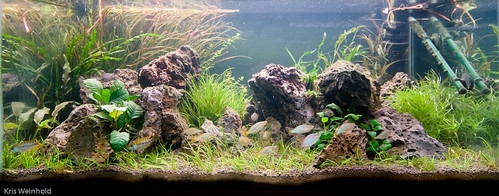
I wanted the new scape to be dominated by rock. The Apistogramma sp. ‘Rotpunkt’ need the extra caves to spawn and hide in, and in general, I just like rock scapes. This time, I tried to be conscious of how tall some of my foreground plants will become so that my rocks would be large enough to still stay visible with thick undergrowth. I moved my huge Blyxa aubertii from the right to the left back, with Micranthemum umbrosum next to that, some Ludwigia sp. ‘Guinea’ in the middle, a Potamegeton species from Florida, and then Hygrophila sp. ‘Sarawak’ in the back right. Various crypts line the left side, with anubias, Blyxa japonica, and Eriocaulaceae sp. ‘Type 2? making up the midground. Ranalisma rostrata makes up the entire foreground.
It has a long way to go to fill in, and I have a feeling that some of the background plants will come and go, but I’d love to hear what everyone’s first impressions are.
Posted in 40G Tank Log | 2 Comments »
October 1st, 2007
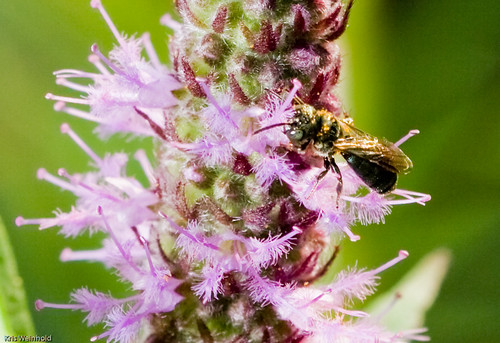
I promise that this is going to be my last post about Pogostemon yatabeanus flowers for awhile! I previously showed how the flower pod itself grows from the top of the plant. Now, that pod is bursting open with these very feathery, purple flowers. They’re very pretty with multiple plants starting to burst open.
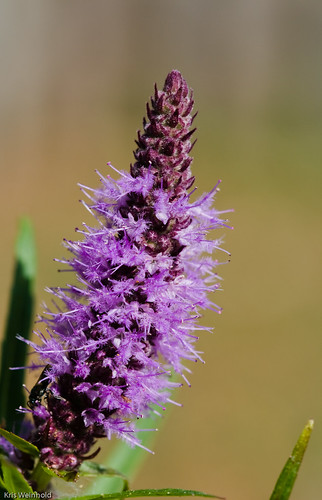
And, the flowers are attracting plenty of nectar-loving insects to the pond. If you hold your nose close to the flower, you can smell a very sweet aroma that’s much like the flowers in your typical grocery store bouquet. (Sorry, I don’t know which flower it smells like, but it’s familar.) I may try to collect seeds at the end of the season, just for the sake of growing them again indoors in my very small emersed setup.
Posted in Plant Profiles, Raised Brick Pond | 1 Comment »