Glosso and Utric: A good match!

March 19th, 2007

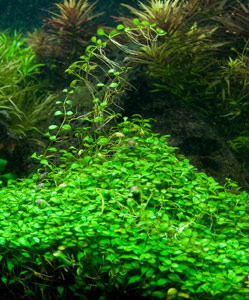
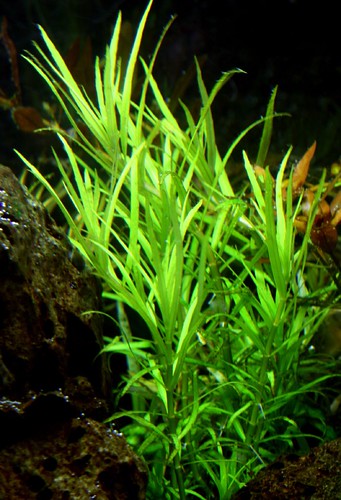
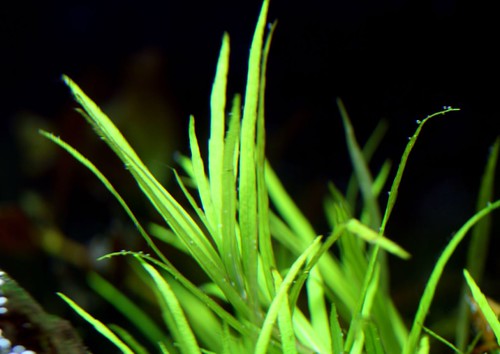
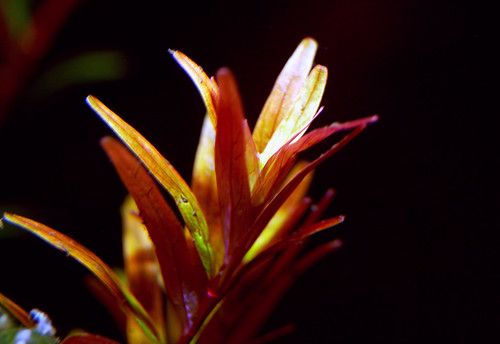
Kind of by accident (and as a product of my lazy trimming habits), I managed to find a plant combination that I really enjoy. Glossostigma elatinoides and Utricularia graminifolia appear quite nicely together once they become interspersed. The Utricularia adds a nice softening effect to the Glossostigma, both in shape and color. I’m currently attempting to replicate this look throughout the entire foreground of my 75G tank.

Glosso and Utric

Another added benefit of this combination is that the Glossostigma helps to pin down the Utricularia so that it doesn’t become uprooted from the substrate. I have a large whip-tail catfish that loves to lounge on these plants, and has yet to caused any damage, whereas he always tends to pull up the Utricularia when planted by itself.

What’s still left to be determined is whether the Glossostigma will ultimately overtake the Utricularia, leaving just your standard “glosso mat.”


Business Broker

40G: New ADA Scape

March 17th, 2007

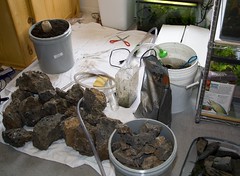
Preparing the roomGWAPA’s order of ADA goods came in this week, so after a long trip through traffic to pick it up, I’m finally ready to redo a few of my tanks. The first tank that I have redone is my 40G breeder tank that’s been quite the jungle of plants for more time that I care to state. This tank already had aquasoil in it, but I was never satisfied with the depth of the Amazonia I had previously added, so I’m basically just going to add another couple inches on top of the old stuff. So, like any new tank project, I move all of my buckets, hardscape materials, and tools into the room. I try to bring in more rocks than I could possibly use so that I’ll be able to choose the best rocks for the particular aquascape.
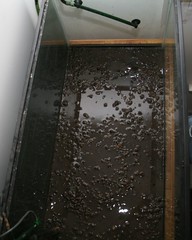
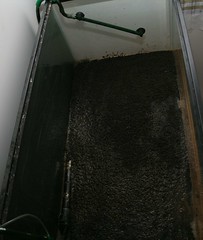
Adding PowersandAdding AquasoilSo, from here on out, I’m going to describe how to setup a basic tank using the ADA system, as I understand it. The ADA substrate system is composed of minerals, powersand, and then aquasoil. So, I scraped out the existing substrate to add more Tourmaline BC to the bottom of the tank. Only a tiny bit of this is needed. Then, I added the powersand (left), finally topping it off with aquasoil. These picture show a soupy mixture because I didn’t fully drain my tank, but this didn’t seem to be a problem. One thing to note at this point is that I reserved about 1/2 to 1 bag of Amazonia to add after I’ve established my hardscape.

So, now that the substrate is intact, it’s time for my personal favorite part of aquascaping — the hardscape. In this particular scape, I wanted to try to accomplish a sort of mound aquascape, with aquasoil in-between some of the rocks so that I can actually plant on the “mound.” The first step is to build up the mound with the rocks. Try to envision what the tank will look like with more aquasoil and plants filling in the gaps.
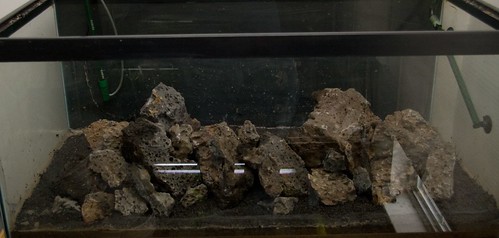
Setup the Hardscape

Then, after the rocks are in place, I add the remaining 1/2 bag of Amazonia on top of the rocks to soften some of the gaps in-between them. At this point, I also try to correct of the slope of the substrate to gradually ascend up the mound, and to the back of the tank.
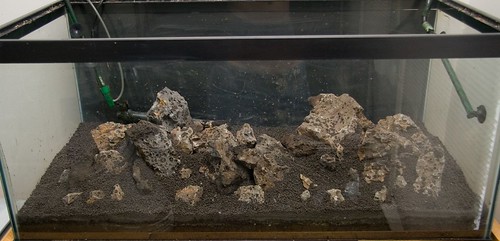
Fill in Hardscape with more Aquasoil

Finally, fill the tank up about 1/3 way, and begin planting. It’s helpful to have a spray bottle handy, so that none of your plants dry out while you’re still busy working. When you’re done, fill up the tank with water, and hopefully you’re happy with what you’ve accomplished. In this scape, I ran out of plants that I wanted to use, so I still have a little bit of work to do, but when isn’t that the case?
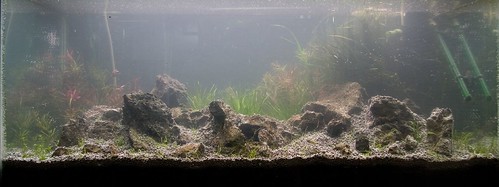
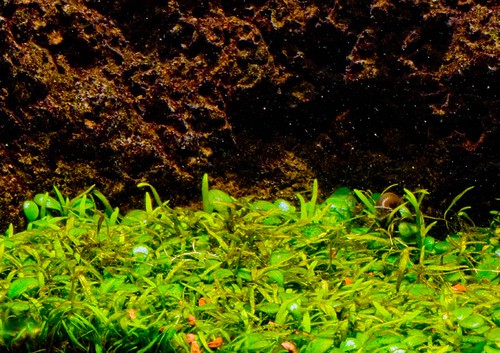
Final Aquascape

Business Broker

Time to replant

March 16th, 2007

Glosso overgrownWhen your aquascape has a glosso foreground, just about every 6-8 weeks, you glosso will look like it does in this picture. The glosso will have formed a mat that’s about 3-4 inches thick, with portions of that mat floating up away from the substrate. Underneath the substrate, you’ll have a nice thick mess of mulm sitting there. And if you’re lucky, you’ll have from fry using this thick mat as a refuge from much larger fish.
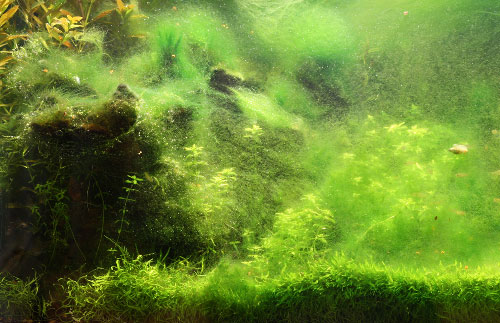
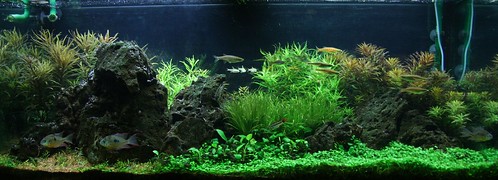
Too bad for those fry, when this happens, it’s time to replant! I have to do just this, this week. In about 6 weeks, I will be hosting the GWAPA meeting. Hopefully, by that time, that new glosso plantlets will have matured into a nice 1″ thick glosso mat.

Timing is one of the key things to keep in mind for every aquascape. Whether you’re planning to show the tank to friends, club members, or take that perfect photograph for sharing online or to submit in an aquascaping contest, timing is everything. I generally tend to play things by ear, but one of these days, I’ll spend a little more time counting backwards. What I mean by that, is the advice of another GWAPA member, Ghazanfar, who suggests writing down every time you trim a plant. Then, whenever that particular plant looks “perfect,” note that on your calendar too. If you subtract the “perfect” date from the date you trimmed, you should know exactly how long it takes for each group of plants in your tank to reach its ideal look. Then, anytime you want to show your tank, you just need to count backwards from that date for each plant, and trim accordingly. By the tank your friends are over, every plant in your tank should look “perfect!” (Of course, YMMV.)

Business Broker

Blyxa Japonica Flower

February 27th, 2007

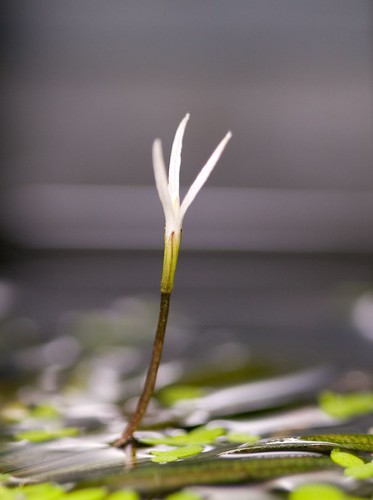
Blyxa_Japonica_Flower Previously, I’ve posted pictures of my Blyxa aubertii flower. Now, I’ve noticed that some of the Blyxa Japonica, that has been floating toward the top of the surface for some time, has also flowered! From my untrained eye, it’s quite difficult to tell any difference from the two flowers, but I suppose that why the two plants are so closely related.

In any case, it’s always nice to open up your aquarium hood, and see a pretty little flower waiting there for you.

What may be even more incredible is that this is flowering under 1.5 year old normal output flourescents that are being overdriven. I have a mix of 6500k and 10000k temperature bulbs. I’ve noticed in other tanks that 10000k bulbs have caused flowering, so I’m guessing that these bulbs are holding up okay, even though they’re being overpowered.

Business Broker

What a Mess!

February 22nd, 2007

I haven’t blogged in a little while due to an unexpected trip out of the state due to a family emergency. When these things happen, they don’t always fall conveniently right after a water change, or when your CO2 tank is 100% full. As happens, the timing for my 20G high was quite unfortunate. I had kind of let this tank go a little bit anyways because it seems that some kind of algae spore is embedded in the bogwood, and won’t go away. I didn’t want to pull out the wood because it makes a great shelter for the Apistogramma viejita in this aquarium. So, with an algae outbreak already creeping up, no water change for 2 weeks, and my CO2 tank running out, I came home to this mess.
20G high - Full of Algae!

I’m not really sure what I’m going to do here. I think I may just tear the whole thing down and start it fresh. I could make this a non-planted tank, specifically for the purpose of breeding apistos, using Rain/RO water and peat to lower the PH down to ridiculous levels. Or, I might rescape the whole thing, without this bogwood, once my ADA order of Amazonia comes in.

Eitherway, I guess this shows that while there are a lot of low-maintenance planted tanks, some of these higher light, nutrient dependant, CO2 sucking tanks can really go south in a short time if not tended to. This isn’t a terrible thing because I love the constant change of this hobby, but it’s a good headcheck that there’s more at work in these little biocubes than might meet the eye.

Business Broker

75G – This week’s photo

February 9th, 2007

Here’s this week’s picture of my 75G. As you can see, it’s about 90% there. The glosso is right about perfect. Too much longer, and I’ll have to pull it up, and start over. The aromatica is about where I want it too; albeit, maybe 2 days past it’s perfect look in this picture. The broadleaf stellata could afford to be a little bit bushier, but it’s well on it’s way. Really, I’m just waiting on the utricularia. It’s keeps getting uprooted anytime the whiptail catfish is spooked and uplifts the Soilmaster Select. Please feel free to comment and critique.

75G 02-06-2007 

Business Broker

Pogostemon yatabeanus

February 6th, 2007

Pogostemon yatabeanusAt the December GWAPA meeting, I was fortunate enough to obtain Pogostemon yatabeanus in the mini-auction that we have at every club meeting. P. yatabeanus is an Austrailian plant, from the same reknowned genus as Pogostemon stellatus, formerly Eusteralis stellatus. This particular species reminds me more of the broadleaf variety of P. stellatus, in that it’s a little bit larger of a plant, except that it stays a beautiful bright green instead of bronzing under bright light. It doesn’t seem to be particularly demanding if kept in your typical high-tech setup.

I currently have the plant in my 75G, planted in Soilmaster Select ‘Red’, with pressurized CO2, high-light, and regular dosing. In this environment, P. yatabeanus might be the fastest growing plant in the tank. Young stems stay rather slender with narrower leaves. Older stems can grow quite thick, with leaves that become longer and fatter, similar to how P. stellatus ‘broadleaf’ grows. When you trim P. yatabeanus and leave the lower portion in the substrate, 2-3 new stems start to grow out of the incision.

Due to this plant’s size, I don’t know if I’d recommend it for a smaller tank, but in a larger tank I think it’s the perfect ‘green’ companion to plants such as limnophilia aromatica, pogostemon stellatus ‘broadleaf’, etc… If you can get your hands on this plant, please give it a try.

Pogostemon yatabeanus closeup

Business Broker

A. Borellii Babies having Babies

February 4th, 2007

A year or two ago, GWAPA placed a group order for a number of apistogramma. In that order, I got about 6 apistogramma borellii fish. I successfully bred these guys in a 20G high and had at couple generations going. Then, unfortunately, while I was in California at the AGA, my CO2 tank

Apistogramma borellii female with babies
Apistogramma borellii female with babies (lower right)

dumped the remainder of the canister into this aquarium, and killed off all of my adult fish. All of the smaller fish in the tank survived, including 5-6 borellii babies, which at the time were not sexable. I decided to dedicate a 20G long tank to try and get a new population going. After a couple months of blackworm feeding to get the fish in good breeding shape, I finally noticed the drab juevenilles coloring up — bright yellows and blues! I noticed that a pair formed, which kept 2-3 other males to the outer parts of the tank. Then, this weekend I finally see the female hovering around with a handful of babies. To get an idea of perspective, this female fish is probably only 1.5 inches long. The babies are mere millimeters. Those large looking foreground plants are marselia quadrafolia! It seems that the female has taken to guarding the fry. I haven’t seen the male near them yet.

Business Broker

Rotala indica ‘Red’

February 2nd, 2007

I few months ago, I bought a plant from SCALES that was labeled “Rotala indica ‘Red’.” I believe this plant is probably the same thing as Rotala sp. ‘Colorata,’ but at least one GWAPA member believes this is the “real” rotala indica. Either way, this is a gorgeous stem plant that doesn’t need a ton of light to get some very vibrant red tones.
Rotala Indica 'Red' or Rotala Colorata
I’ve also noticed that this rotala will start to grow horizontally much more readily than many other rotala’s I’ve tried. As it does this, it sends up multiple vertical stems which can eventually be trimmed and replanted as their on stalk. The plant definitely takes off when CO2 is added, but it seems to grow, albeit much slower, without the added carbon injection. Right now I’m growing this using all SeaChem products in my 20L.

Business Broker

20G Long – Updated Photo

January 31st, 2007

Here is an updated picture of my 20 long tank in my office. Last week I noticed that one of the female apistogramma borellii had turned bright yellow. I haven’t seen any fry yet, but then again, I haven’t really seen the female fish either. There’s still a school of about a dozen male Endlers in here as well.

20G long 

The plants in this tank are rotala macrandra ‘green’, rotala indica ‘red’ (or rotala colorata), Crasula helmsii, Ranalisma rostrata, marselia quadrafolia, and Heteranthera zosterifolia. I’m finally starting to win the thread algae battle in this tank. Over the previous month or two this tank had a mess of 8″ long thread algae flowing in the current. My brother commented that at least I’m able to grow “cool looking algae,” but I wasn’t amused. Thankfully, thanks to a strict SeaChem-only dosing schedule with Excel overdoses, I’m now in control.

Maybe one of these days I’ll properly trim these stem plants. I hate growing stem plants in a 12″ tall tank! At least I like the rockwork!

Business Broker

« Previous Entries   Next Entries »