CCA: Eric Bodrock: Breeding Corydoras

June 14th, 2009

CCA LogoOn Saturday, I attended the Capital Cichlid Association’s meeting where they brought Eric Bodrock down from Pittsburgh to talk about breeding Corydoras. Eric is quite experienced in this regard as the owner of All Oddball Aquatics, where he breeds and sell many rare or hard-to-find fish, including Corydoras.

I’m going to provide a short summary of his talk, as I remember it from my notes. For starters, there are hundreds of Corydora species in the wild, all from South America. Just like with the L-numbers used to denote undescribed species of plecos, there are now C-numbers, and then CW-numbers which are being used to describe the multitude of new Corydoras species that are being discovered. Once you find a source for the species that you want to breed, you need to make sure you get healthy fish. Make sure their barbels are long, their eyes clear, and free of deformities in their body or fins. Cories are social animals, so buy in groups of 6-10, and try to break them down from there to 2 males/female, or pairs.

Corydoras Paleatus

Now you need a tank to use as a breeding tank. They don’t need large tanks, so 10G and 20G tanks work great. Use a sponge filter, and provide plenty of spawning mediums, such as Anubias or Java Fern, yarn spawning mops, piles of rocks, etc. Also, ensure that there’s plenty of circulation in the tank, as many species prefer to spawn in the current.

Corydoras Paleatus

Once in your tank, you need to prepare the fish for breeding. Feed them a variety of high-quality foods, such as tubiflex worms, earthworm sticks, daphnia, blackworms, etc. Blackworms in particular do a good job at conditioning the fish to breed. Sexing Corydoras is relatively easy. Females are much larger than males, broader across, and often their pectoral fins are rounded. Males are more slender, often have pointed pectoral fins, and also are often the more attractive fish.

When eggs are laid, you must either remove the parents, or remove the eggs, as the fish will eat their own eggs. It’s often preferable to use a mesh container, floating the eggs inside of that, with the whole box in the parent’s aquarium so that the water chemistry is consistent. In addition, alder cones are useful tools to prevent fungus from infecting unfertilized eggs. Once the eggs hatch, and you have free swimming fry, squeeze a dirty sponge filter into the tank to provide microscopic organisms for the fry to feed on. As they grow, switch to baby-brine-shrimp, and other live foods to rear them.

Corydora

Eric gave a great talk, and really provided much more information than I can possibly provide here. I’d definitely trust him as a source for healthy fish on Aquabid. He brought a number of fish to the auction. I ended up with Apistogramma alacrina, which I’m looking forward to breed. Another great meeting, thanks CCA!
Business Broker

Patuxent Research Refuge: North Tract

June 11th, 2009

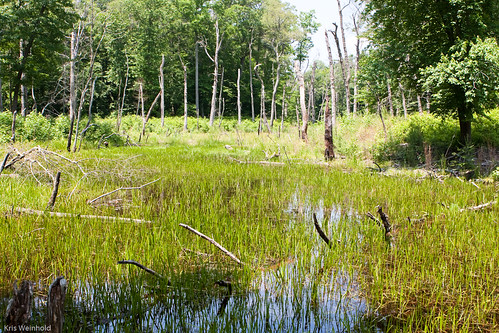
Last weekend, a friend and I visited the North Tract of the Patuxent Research Refuge, a 12,841 acres area which was formerly a military training ground, and has now been returned to nature. While collecting is not permitted in this park, it was still very interesting to hike around the various bodies of water to see what aquatic plants were present.

Lake Allen

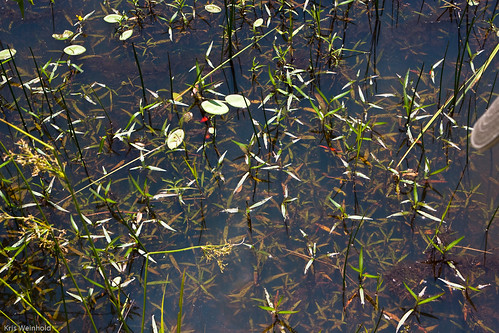
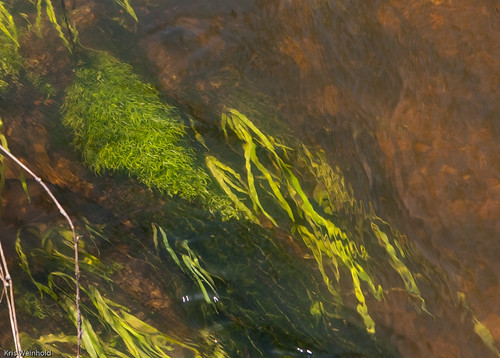
The first lake we visited had cattails on one side of it, and lillies on the other. The cattail side also had a number of other aquatic plants present including (but not limited to) Ludwigia palustrus, Hydrilla, Callitriche sp., and some aquatic grass shown below that we’re not entirely sure what it was.

Callitriche sp and Aquatic Grass

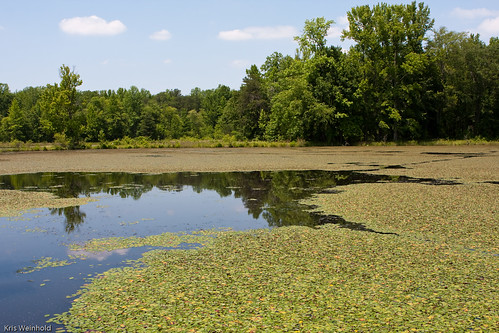
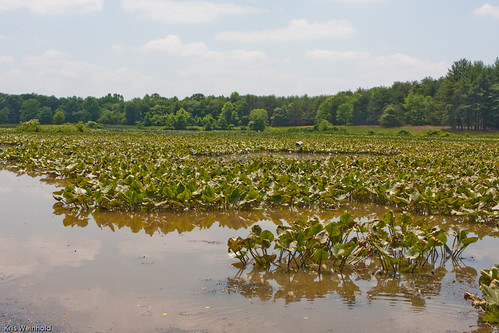
In other areas, spatterdock was present throughout. It was very interesting to see which areas had a variety of plants, and which were pretty much dominated by a single species.

Lake

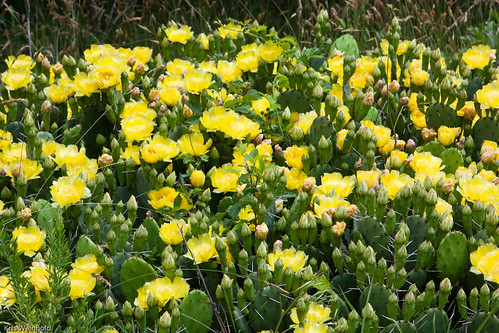
Not being limited to interesting aquatic plants, while walking along one of the roads, we came across a series of stands of Pricklypear (Opuntia humifusa) which were in full bloom, exhibiting beautiful yellow flowers. I believe this is the first time that I’ve seen this plant in Maryland, so I very much enjoyed checking it out. I guess cacti are not limited to southern hot zones!

Pricklypear: Opuntia humifusa

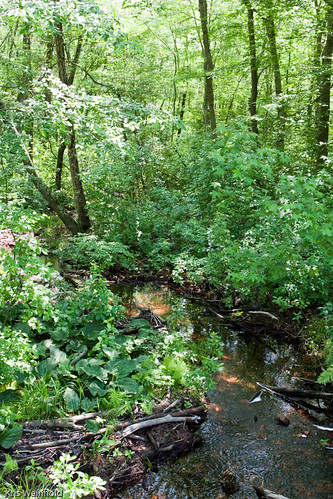
In addition to the lakes, a series of streams run through the property. Most of them are shaded, and so there’s little chance for aquatic plants to grow, but they’re beautiful nevertheless.

Stream

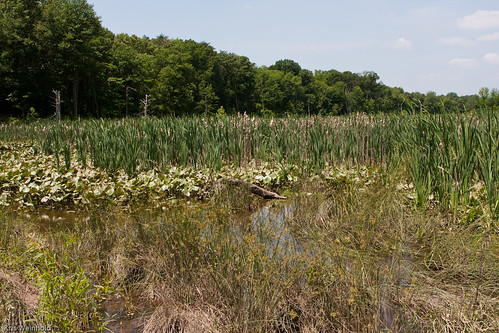
Across the street from that stream happened to be a large boggy area. We pulled over to have a look, and sure enough, we found sphagnum moss, but little else besides the grasses shown below.

Bog Area

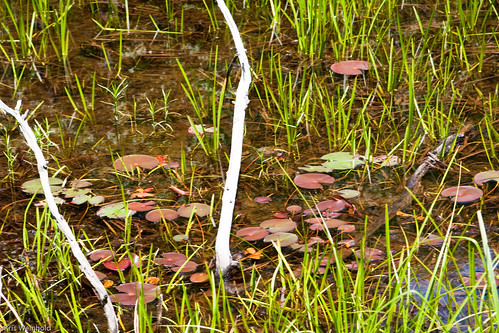
There were a few lillies there, but it seemed to mostly be a dead-zone in terms of the aquatic plants we were interested in. Throughout the course of our trip, we noticed a lot of beaver activity, evident from the saw off tree trunks, but we never did see any beavers.

Lillies

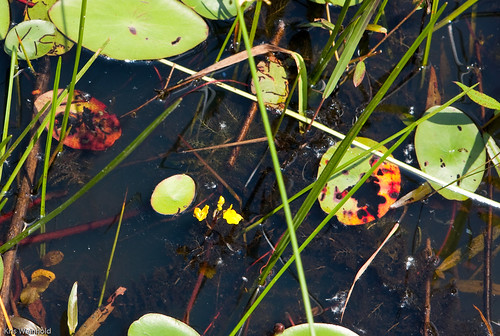
In contrast to some of the lakes, which were dominated by lillies, the marsh areas were covered in Brasenia schreberi. In amongst the Brasenia there were several other plants.

Brasenia schreberi

Many Utricularia flowers were present, most likely being U. geminiscapa, but that’s just our best guess. Some of the Brasenia was also flowering, showing smallish red flowers.

Utricularia flower

At our last stop, we found a field of Proserpinaca palustris, most of which was growing in its emersed form, even though it was submersed. This is likely due to recent rainfall that inundated the plants when the water levels rose. Further down the stems you could clearly see the fine-toothed-pinnate leaves that are so typical of Proserpinaca.

Proserpinaca palustris

To any other folks exploring nature in this region, please be sure to use proper tick prevention, as they’re out, and Lyme is prevalent throughout the area. So, while not a collecting trip, it was a great day to be out and about exploring our native Maryland habitats.

Business Broker

GWAPA: May 2009, CO2

June 5th, 2009

CO2 Canister & RegulatorLast Saturday, GWAPA held its May meeting, in which I gave a presentation about Pressurized CO2. The goal of my presentation was to reduce the intimidation factor for those members who weren’t yet using pressurized CO2. For many folks just getting into planted aquaria, the thought of buying a compressed gas tank at a welding/gas supply store is daunting, particularly with all of the different ways to rig your setup. Hopefully by showing off a number of different setups, and stepping through what each component does, we’ll have even more folks in the club using pressurized CO2.

In addition to the topic, we conducted another large auction. This month, plants were going for dirt cheap, with some of the most rare plants going for $2/bag. This is truly a wonderful thing about joining a local club, as you’re able to try out plants you couldn’t easily obtain otherwise for a very low price.

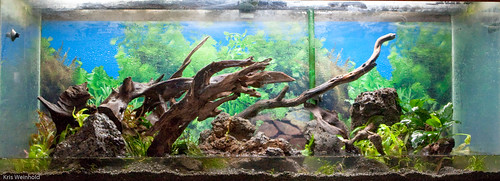
After the meeting was over, a few of us stuck around to help Rob, the host, aquascape his 75G tank. He had an absolutely fantastic piece of driftwood that we wanted to use, and incorporated it into the hardscape, along with some porous mossy rock. Below you can see the finished hardscape, and mostly planted tank before we filled it up.

Rob's 75G

I’m looking forward to see how this aquascape evolves as it grows in. All-in-all, it was another great meeting!

Update: Meeting notes with more information about Pressurized CO2 now up on GWAPA’s website.

Business Broker

Fissidens fontanus Moss

June 1st, 2009

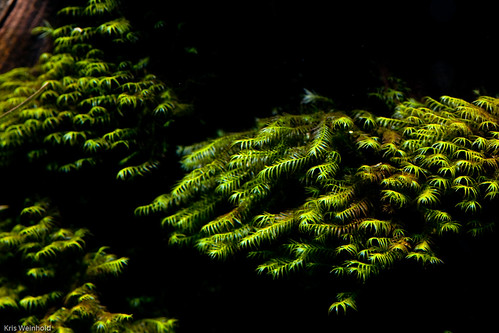
Fissidens fontanus is my favorite moss in the hobby right now. With fronds that curl down, and layer upon themselves, it’s a very unique looking moss. The effect is completely different from any of the other mosses in the hobby, as Java Moss, Taiwan Moss, Willow Moss, Christmas Moss, etc all give a similar look, despite minor differences. Fortunately, just like those others, however, Fissidens fontanus is just as easy to grow, and readily attaches to the hardscape.

Fissidens Moss

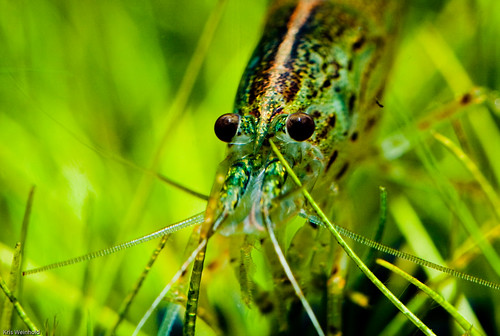
Similar to any moss, detritus tends to accumulate within, and can ultimately lead to some algae being intertwined with the moss. I use Amano Shrimp to graze on these bits and keep my moss clean. F. fontanus is a North American native moss, with distribution throughout much of North America. As such, it can tolerate a range of temperatures.

Amano Shrimp

Attaching it to wood/rocks is easy. Simply take a few fronds, and tie them down with cotton thread. By the time the cotton disintegrates, the moss should have attached itself. Now readily available in the hobby via hobbyists and online plant resellers, Fissidens fontanus is a moss that everyone should try.

Business Broker

Rotala sp. ‘Mini’ – Type 1

May 30th, 2009

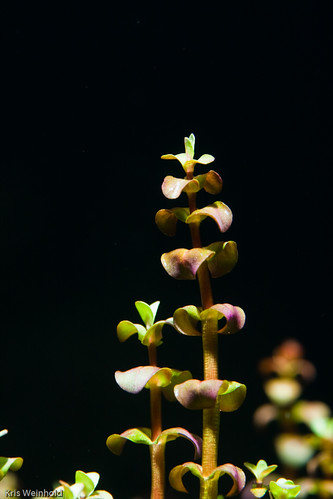
Another interesting plant that’s been floating around the hobby for a few years now is known as Rotala sp. ‘Mini – Type 1’. There are two plants going around as R. sp. ‘Mini’, so people refer to them as Type 1 and Type 2. The Type 1, shown below is a very petite stem plant with unique leaves that curve downward toward the substrate. The leaves can also get a nice gradient of orange and reddish tones under certain conditions.

Rotala sp. 'Mini'

In my opinion, this is a plant that is quite ugly individually, but as a large bush (50-100 stems) is incredibly striking because there aren’t many plants that look like it. The relatively vertical nature of its growth defines the interesting group-of-quills look of the bush. Rotala sp. ‘Mini – Type 1’ demands a little bit more attention (light, CO2, nutrients) than the easier Rotala species, but is still not too difficult to keep. Give it a try!

Business Broker

« Previous Entries   Next Entries »