September 11th, 2008
I haven’t talked about the Sulawesi shrimp that I got for awhile. Mostly, that’s because I only have two left, and am still waiting to get some replacements for the huge loses that I incurred from shipping. What I have left are Six Banded Black Bee Shrimp.
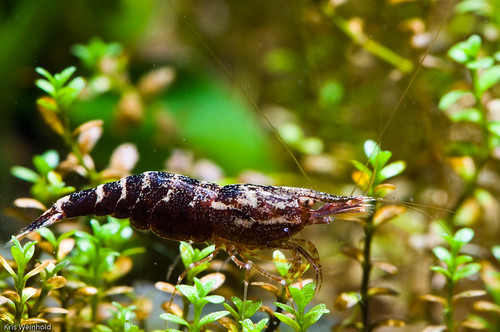
They’re aptly named this because of their black bodies with roughly six white bands across their back. The thing I like the most about them are their eyes, which are quite striking and intense. Due to the Hydras in their last tank, I finally moved them to a tank with more plants, which allows me to see them more.
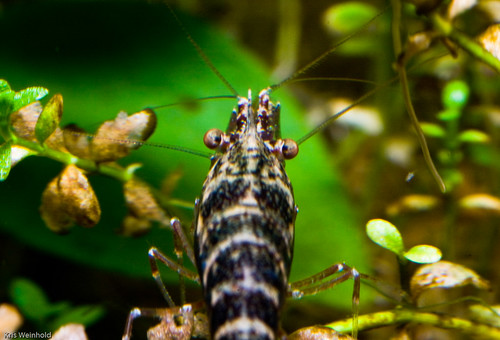
The previous tank had black sand as a substrate, so they were quite difficult to spot. They’re a little bit smaller than full adult cherry shrimp, but still big enough to be seen. Unfortunately, the ones I have are all the same sex, which means I’m still in a holding pattern in terms of breeding these fellas.

The ones that survived the shipping seem to be pretty tolerant of my water conditions, as I haven’t had a death in a few months. I really hope that all of these Sulawesi shrimp are starting to be commercially bred so that we can start having easy access (both in accessibility and price) to more of them.
Posted in Shrimp/Snails | 3 Comments »
September 8th, 2008
In a 20L aquarium, I have a small colony of Threadfin Rainbowfish, Iriatherina werneri, that I’m attempting to breed. These blue-eyes are beautiful fish that I’m hoping to eventually have a huge school for my 75G aquarium. The males are especially brilliant, displaying long fins, which they use constantly to prove their dominance to other males, and to impress females.
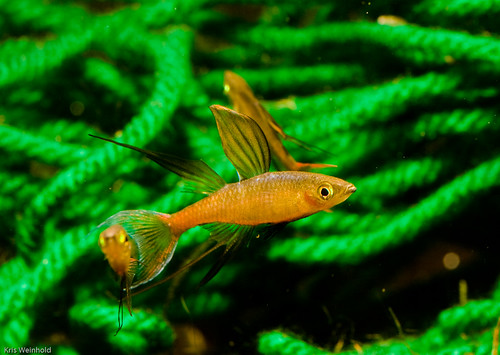
The males also tend to get a striking headlamp, a bright yellow/orange stripe along the top of their head, when they’re courting females. The females are not pictures here, but they do not have the elongated fins that the males do. It’s quite easy to tell them apart due to the noticable difference in finage.
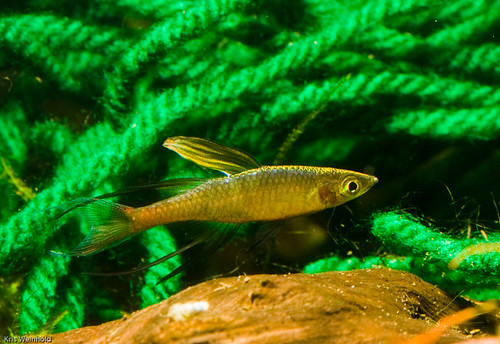
As you can see from the backgrounds in these pictures, I’ve been using spawning mops made from acrylic yarn to try and harvest eggs. The goal is to float these mops, have the fish lay eggs, and then remove the mop and place it into a hatching/rearing tank. By cycling two mops between these tank every 10-14 days, I hope to constantly have new fry. So far, I’ve been successful, but only on a very small scale.
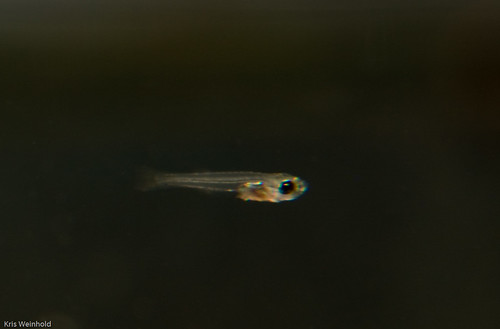
The fry are absolutely tiny when they first hatch; no more than a millimeter or two long. Right now, I have a couple that are 5-6mm long, but recently lost some to a Hydra infestation. I feed the newly hatched fry GP 5micron powder, which besides green water is just about the only thing that will fit in their tiny mouths. I’ve started feeding the larger fry some baby brine shrimp. Hopefully, they’ll grow up fast, and will be able to go in with the adults soon. If anyone’s successfully bred and raised these fish, I’d love to hear some advise.
Posted in 20L Tank Log, Fish Fry, Fish Profiles | 13 Comments »
September 6th, 2008
Today, I had the misfortune to discover a new creature in one of my fry tanks. Quite a few Hydra are present in this tank, presumably introduced by feeding incredibly small fry foods, such as newly hatched brine shrimp. It’s also possible that they’ve been present all along, but couldn’t survive until I provided high-quality micron-sized protein powder for them (and the fry) to feed on.
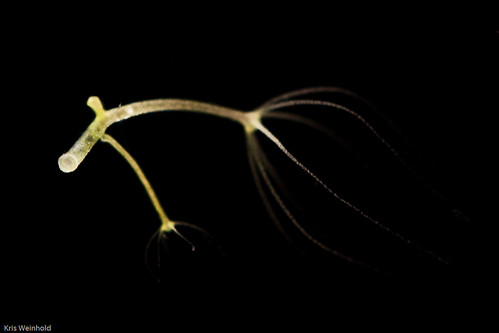
Hydra are bad to have because just like their marine cousins (jellyfish, corals, and sea anemones), they feed off of small organisms, capturing them using their stingers. If they just stuck to water fleas or infusoria, I wouldn’t mind, but they will also attack newly hatched fry. That’s unacceptable. Now, I have shrimp in this tank, which some folks report will keep them under control, but nevertheless the Hydras are still present. Supposedly, they can be killed by using Fluke tabs, raising the temperature significantly, or by breaking down the whole tank, and sterilizing it.
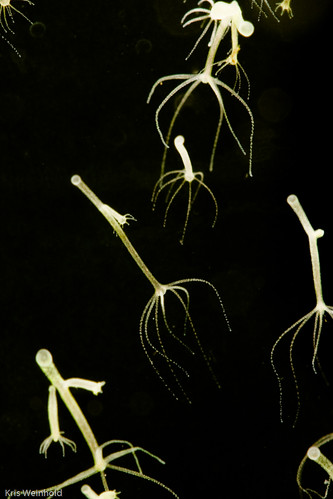
I’m not going to break down the whole tank because feeding fry will just continue to promote their presence in the future. For the next couple of hours, I’m just going to watch them, since they really are neat looking creatures. But, then, I’ll start my assault on their lives. Suggestions welcome!
Posted in Shrimp/Snails | 11 Comments »
September 4th, 2008
Yesterday, I got two new types of snails for my aquariums. The first is one that I’ve been looking at for a little while, but only recently had the opportunity to obtain. The Sun Snail has little horns or spikes spiraling off of the their shells.
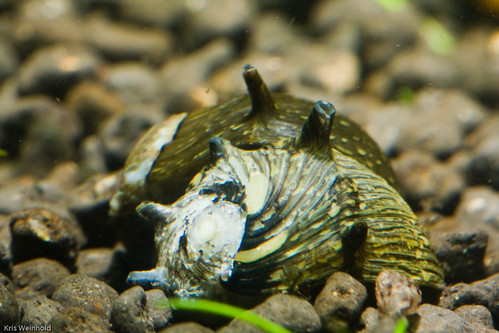
The bag that I got them in was actually punctured by the spikes. From what I’ve read, these snails should be similar to the Olive Nerite Snails in terms of their algae eating ability. In addition, I don’t think that they will reproduce in fresh water.
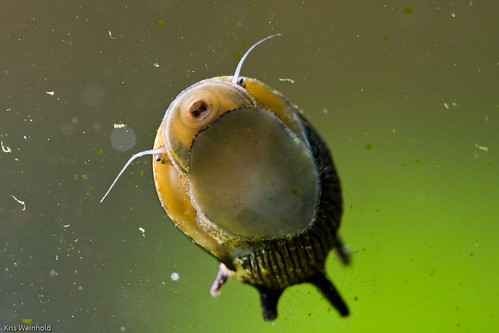
The other type of snail that I got was the Tiger Snail, named for the orange and black pattern on their shells. These seem to be larger than the Olive Nerite, and much larger than the Sun Snails.
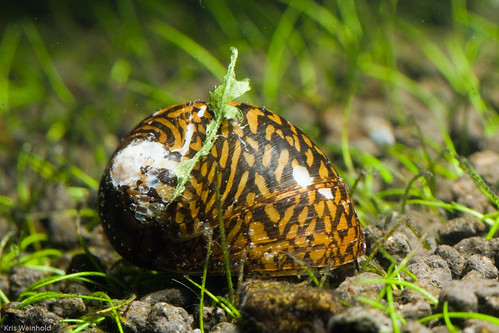
As such, they have a larger foot, and can really propel themselves across the substrate. I’ve also found two of them outside of my tank, thus far, hanging out on the light fixture above the tank, and on the rim of the tank. I suppose that means that they’re still adjusting to the water in my tank.
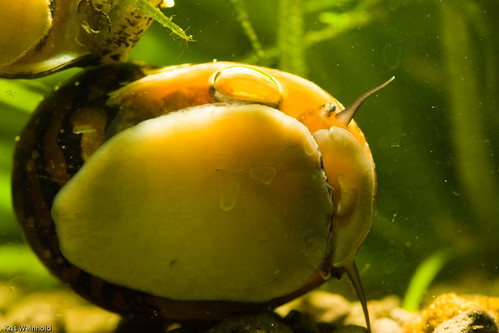
While these snails really just serve the same purpose as their Olive Nerite cousins, they add a little bit of variety to the options we have for snails in our tanks.
Posted in Shrimp/Snails | 1 Comment »
September 2nd, 2008
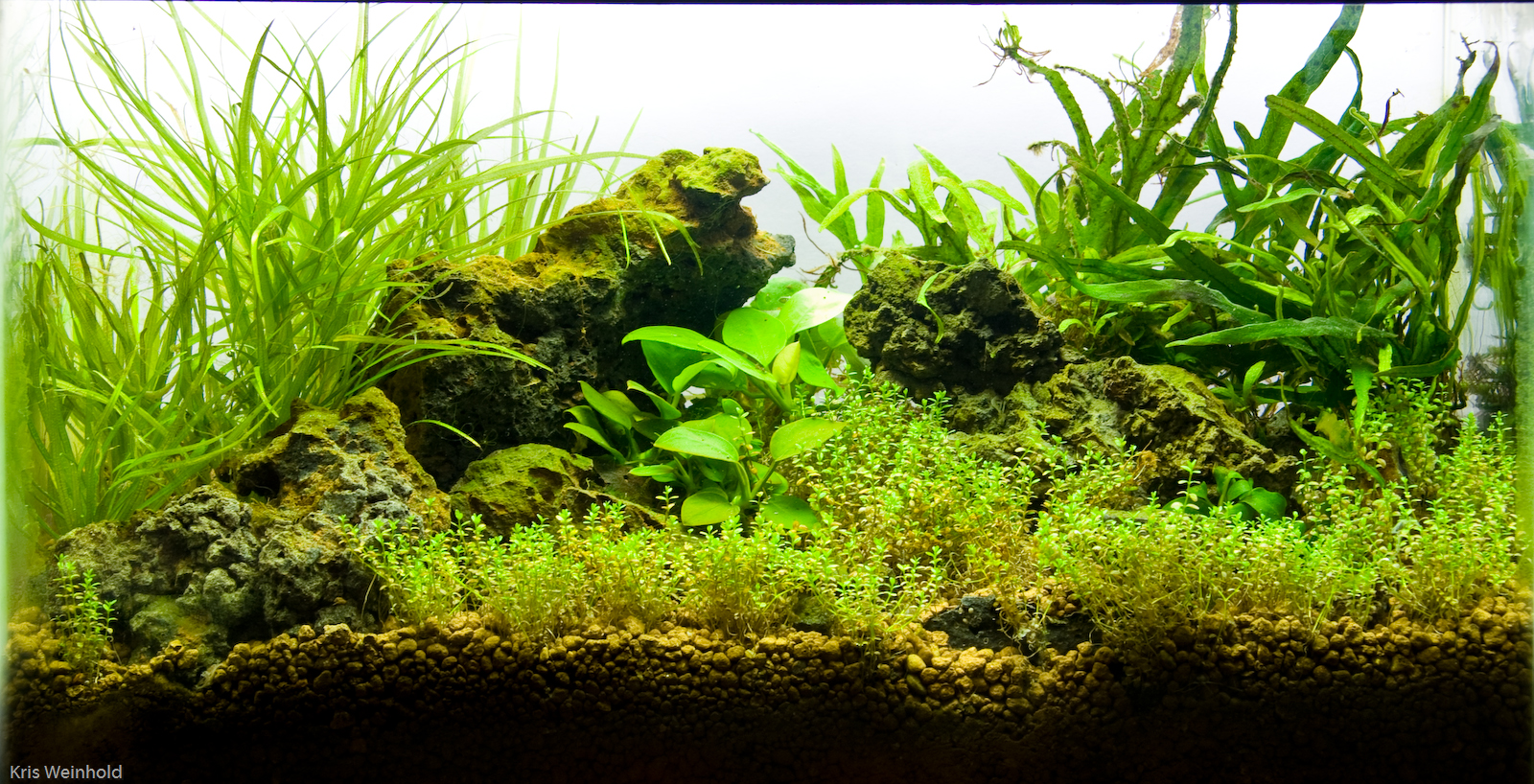
Two weeks ago, I posted a rather pathetic version of my 2.5G aquascape. I got some great comments from everyone, and have updated the scape in a few areas. It’s amazing the difference that the Blyxa japonica, in particular, makes in this scape in the back left. Otherwise, I added some Anubias barteri var. ‘nana’ and moved all of the Java Fern to the right side of the tank. What do you think?
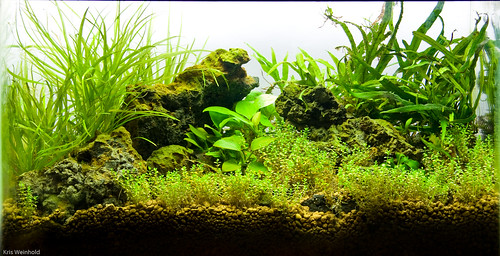
I also decided to practice some of my photography skills for this picture. With these smaller tanks, you really have the luxury of being able to flash the heck out of the whole tank evenly, using just a couple of strobes. You can see my setup below. I sat one flash on top of the light fixture pointing upward into a domed piece of computer paper. The dome reflects the flash down the back of the tank, illuminating the white paper background sitting about 3-4 inches behind the aquarium.
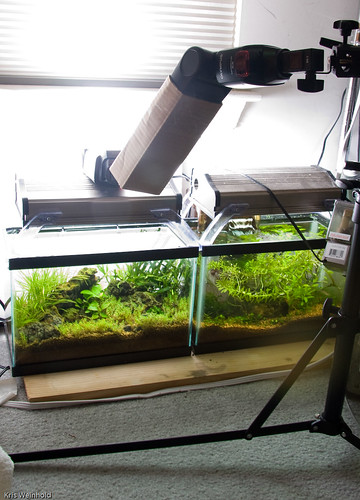
Then, I have a second strobe suspended, using an improvised snoot to focus the light into the tank, which illuminates the front of the scape, which would normally be shaded by the rocks. Of course, the aquarium light itself provides pretty decent light as well, so these strobes are really just for a bit extra refinement. Any suggestions?
Posted in 2.5G Tank Log, Photography | 2 Comments »