Bacopa monnieri from Florida

September 12th, 2007

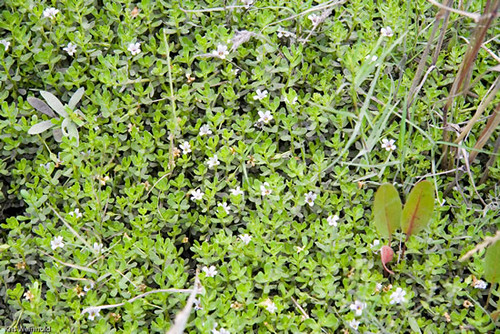
In June, when I went down to Florida with a few other GWAPA members, Bacopa monnieri was one of the plants that seemed to be everywhere, from the rest area drainage ditch when we entered the state, to the canals of Miami down south. Most of the time, we found it emersed and flowering like this picture below.

Bacopa monnieri Flowering

Despite its abundance, I honestly didn’t know I grabbed any until after I got my plants home, and found a single stem in among some of the other things I brought back. I decided to plant it, and see how it would turn out. A few months later, it bushed up very nicely, and is one of the few plants that I collected that I think I’ll try to incorporate into my next scape. It provides a really bright green color to the tank, which I like. Below is an isolated picture of a stem or two. I believe that Bacopa monnieri is quite common in hobby, but if you haven’t tried it yet, give it a whirl. It doesn’t seem to be a demanding plant, so it should do well in most planted tanks.


Business Broker

2.5G – More Height!

September 10th, 2007

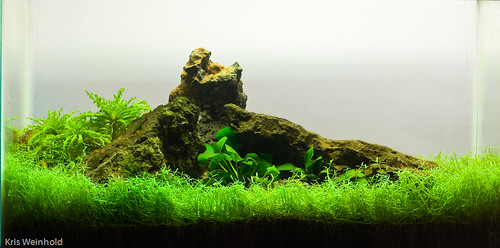
After the last set of pictures, with the help of a few honest individuals, I felt that the aquascape itself might be too flat. I contemplated adding some taller stems plants, but I didn’t think they would “bush up” enough in time for the October 1st deadline. So, the next best thing was to add more height with some rocks. So, that’s what I did. The rock composition on the left side previously was made up of three separate rocks. (Have I ever mentioned how much I love the fact that this California porous mossy rock lets you combine multiple rocks without obvious seams? I do!) So, I removed the back most two rocks, and replaced them with the larger rock you see in the picture. So, did I make the right decision?

2.5G - New Rock

Business Broker

CCA – Ad Konings – September 2007

September 9th, 2007

CCA’s September 8th meeting probably drew a record crowd, and for good reason; Ad Konings, author of over 30 books and expert of African cichlids traveled from his home in Texas to speak to us about the feeding behavior and relationships of Lake Malawian cichlids. There were quite a few items up for auction, including some of Ad’s books and fish traded from another club via a fish swap. Ad’s talk was fascinating, and included countless video clips demonstrating each type of feed behavior found in the lake cichlids.

To summarize his talk, he says that all cichlids in Lake Malawi are either algae eaters (herbivores), invertebrate eaters (carnivores), or fish eaters (piscivores). Inside of each of these groupings, there are a number of specializations describing exactly how they feed. For example, within the algae eaters, Tropheops tropheops is a “shaker,” which means that they lock their jaws on strands of algae, and shake their body to rip off whatever algae will detach from rocks. Others, such as Pseudotropheus sp. “elongatus aggressive” have specialized jaws with teeth protruding outward to be able to scrape algae completely from the rocks. Then, Hemitilapia oxyrhynchus is considered a “leaf stripper” which means that they affix their jaws on strands of Vallisenaria and then slide the leaf through their jaws, stripping it of any algae.


Copyright, Ad Konings. Presented at CCA September 2007 meeting.

The carnivores are even more specialized. Pseudotropheus sp. ‘williamsi’ leap from the water to catch flies congregating overhead in still patches of air surrounding large rock outcrops. Protomelas pleurotaenia blows detritus from the substrate, hoping to unearth hidden insects and invertebrates to feed upon. Meanwhile, cyrtocara moori will follow other earth-eating fish, and feed on any extra food in the clouds of detritus that they create. Mylochromis epichorialis only feeds on small crabs, while Aulonocara stuartgranti has a specialized holes in their jaw allowing it to use sonar to pinpoint insects underneath the substrate to prey upon.


Copyright, Ad Konings. Presented at CCA September 2007 meeting.

Finally, the fish eating cichlids find ways to prey upon other fish for their food. Metriaclima pursus cleans scales of other fish, often where the other fish willingly allow the Metriaclima to work. Caprichromis liemi manages to dart toward other fish, ripping aquatic lice from their throat for their meals. Genyochromis mento is a fin biter that has many color morphs throughout the lake to match the color patterns of its prey in each area. That allows the fish to get close to its prey, and nip patches of finage from unsuspecting fish. Nimbochromis livingstonii plays dead on the lake floor near other fish’s fry, waiting for them to move close enough for attack. Sciaenochromis fryeri actually imitates algae-eating behavior to get close enough to their target prey.


Copyright, Ad Konings. Presented at CCA September 2007 meeting.

This is only a subset of the information that Ad delivered during his presentation. It’s really fascinating how specialized the fish in Lake Malawi are. In Lake Malawi there are over 884 species of cichlids. That’s more than the 800 species of freshwater fish in all of North America. With so many species in a single lake, each has adapted to best be able to survive in their own micro-environment. A fascinating talk!
Business Broker

Where Two Rivers Meet

September 8th, 2007

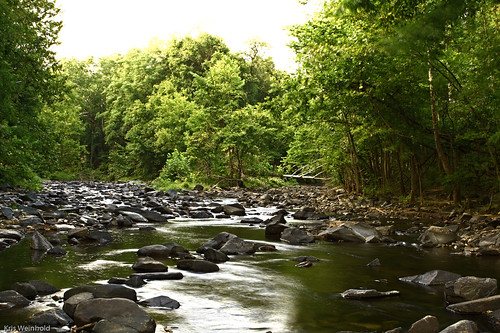
As I’ve posted previously, I enjoy taking my two dogs on some trails near my house that follow the Little and Middle Patuxent Rivers. Unfortunately, the trail ends right before where these two pretty rivers meet. Determined to get a good picture of this juncture, I waterlogged my shoes and headed down river, being careful not to fall on the algae-covered rocks. I probably should have waited another 30 minutes for this picture, but I hope it captures the beauty of these bodies of water. Just within 100 yards of the trail there was noticeably more wildlife, including a black snake, some large water birds, and countless little trout/bass in the pools.

Where Two Rivers Meet

Business Broker

Jewels – More Eggs

September 7th, 2007

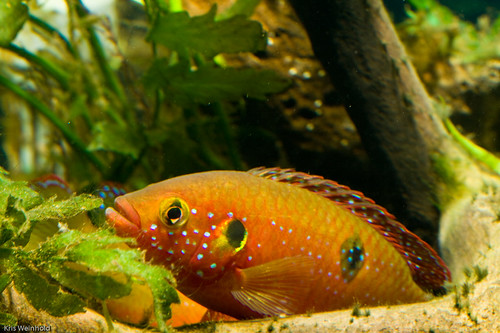
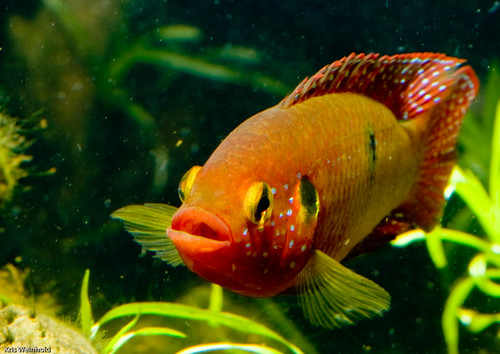
I noticed today that my adult jewel cichlids, collected in Florida, were acting more territorial than usual to their last set of offspring in the tank. Those young are now all 1-2 inches in length, and doing quite well. The adults, however, seem to have moved on, and are guarding a new patch of eggs.

Jewel Cichlid Guarding Eggs

They’ve taken a new spot this time, occupying the left side of my 20G high tank, underneath a manzanita branch. There are eggs scattered on the underside of the manzanita branch, but mostly on the surface of the rock directly beneath that.

Jewel Cichlid

The parents take frequent turns guarding and fanning the eggs. I probably spent a collective hour watching them today, and their rotation is really only about 1-2 minutes before the one roaming the tank comes back to the nest, switching places with the other one. That said, the female does seem to spend more time guarding the nest while the male patrols, but not by too much.

Jewel Cichlid

I suppose this means that I ought to move the previous fry from this tank into their own dedicated one before the eggs hatch. If there are new free-swimming fry, I fear that the last batch will be eliminated by the parents.

Business Broker

« Previous Entries   Next Entries »