May 31st, 2008
At the last CCA meeting that I attended, I picked up a pair of Apistogramma similis that the speaker had collected himself when in Bolivia. I’m hoping that they really are this species because they don’t exactly look like the pictures in my Cichlid Atlas Vol. 2, but they aren’t that far off either. In any case, Apistogramma similis is quite similar to Apistogramma inconspicua, with a different number of dorsal spines. The extent to which this species is distributed is unknown, being found a couple jungle rivers in the Bolivian province of Beni.
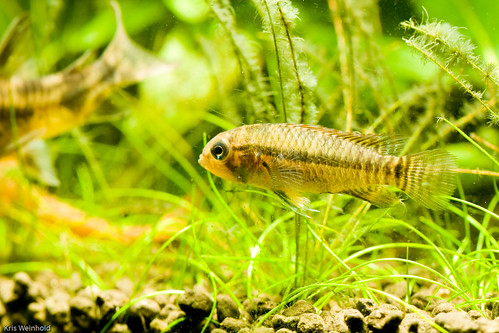
I don’t expect these guys to be terribly difficult to breed in my 75G aquarium, and hope that I’m able to garner a small population of them. These aren’t the prettiest apistos available, but still have their appeal, and if my juvenile specimens color up a bit, they’ll be nice to look at nevertheless. I’ll post updated pictures of these guys as they mature.
Posted in 75G Tank Log, Fish Profiles | Comments Off on Apistogramma similis
May 21st, 2008
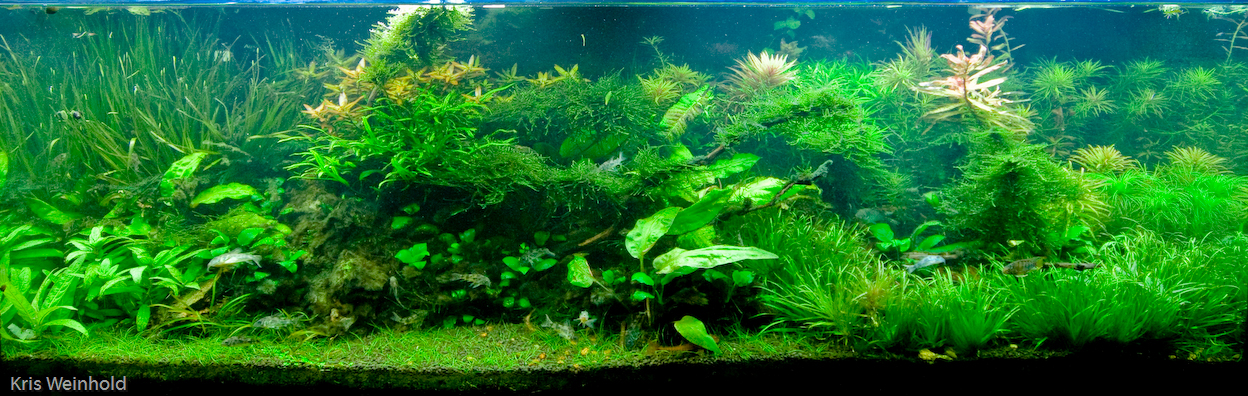
It’s been about a month since the last shot of my 75G aquarium. Since then, the Eleocharis sp. ‘Japan’ has continued to grow in, and is still exhibiting the fantastic downward sloping growth it’s known for. The Cryptocoryne pontederiifolia in the foreground/middle has really started to explode. I suppose the roots have reached critical mass, and now there’s no getting rid of it. (not that I would want to!)
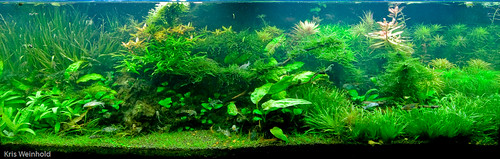
Otherwise, I have a few signs of collectoritis showing on the right-hand side of the aquascape with stems of Pogostemon stellatus, Ludwigia sp. ‘Cuba’, Eriocaulen sp. ‘Type 3’, and Ludwigia sp. ‘Pantanal’ all growing in close proximity. I ought to decide on just one of those, and go with that. Not to mention that I’ve totally mixed up Limnophila aromatica and Limnophila hippuroides in the middle of the tank! Honestly, I’m wondering if what I bought as L. hippuroides is really L. aromatica anyways because they look the same to me. Finally, the Java Fern sp. ‘Fingers’ in the top/middle/left is looking fantastic! All-in-all, for not paying much attention to this tank, I can’t really complain too much about its appearance. It could definitely benefit from a couple good trims, but otherwise, it’s maintaining itself pretty well, I think. However, suggestions are always welcome!
Posted in 75G Tank Log | 3 Comments »
May 15th, 2008
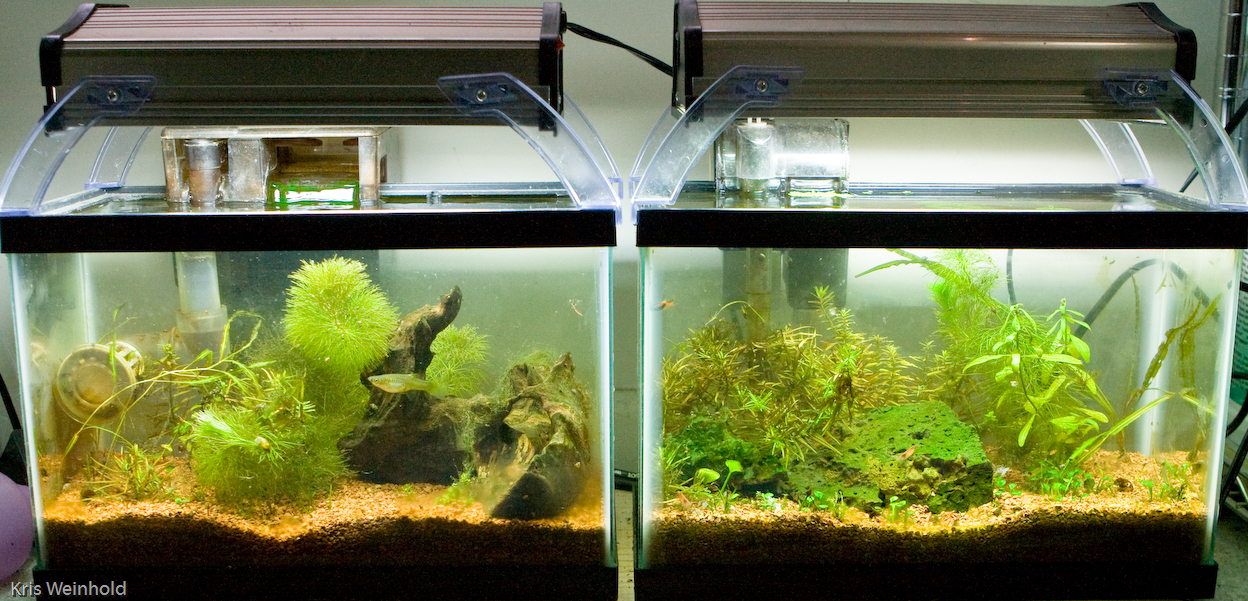
It’s been a little bit more than 2 months since I setup my side-by-side comparison of soil substrate (left) and worm casting substrate (right). Both are looking kind of pathetic, but the wormstrate appears to be doing a little bit less pathetic than the soil. Admittedly, I’m not convinced that these results have much to do with the substrate, however.
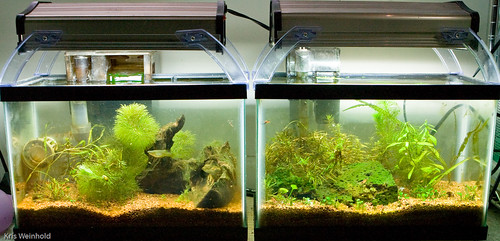
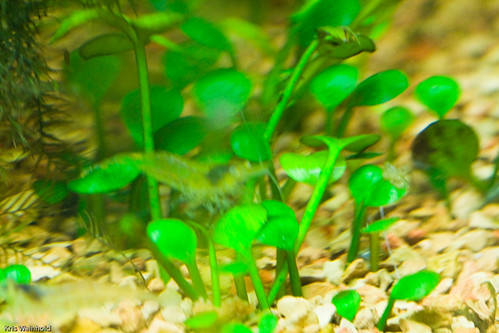
I still need to split out my CO2 lines to feed CO2 directly into this tank. I just don’t think that Excel cuts it in this case, even though I’ve been slightly more consistent in my dosing than I was previously. Some plants are starting to grow, however, such as the Marsilea quadrifolia below.
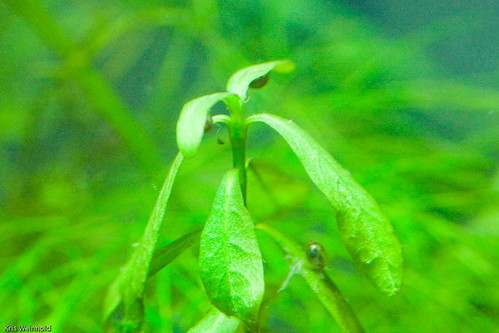
But, despite the growth, I think I may be missing some other vital nutrient. Many of the stem plants are starting to stunt on their new growth. Check out this pathetic looking Hygrophila polysperma from the wormstrate tank. Usually this plant grows moderately well in any conditions! It’s also possible that heat may be a factor as the 2x13W lights over each of these tanks put off a ton of warmth.
The Didiplis diandre has all but died out of the soil tank, but I must say that the soil substrate is growing the fullest stem plant — Asian Ambulia. The compact growth of this stem looks almost healthy!
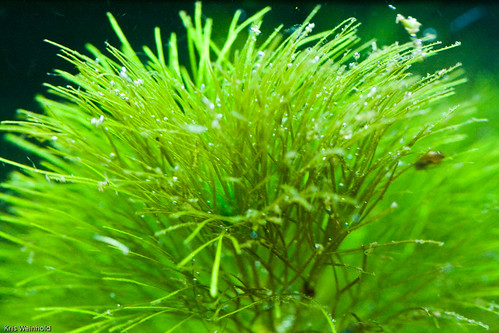
It’s really interesting to see how specialized some of these plants are, where one can thrive in conditions that melt other plants. I’m not considering either of these tanks a bust (or a success) yet, but I’m definitely looking for suggestions on what I should be doing to turn them around.
Posted in 2.5G Tank Log, Substrate | 7 Comments »
May 12th, 2008
Across two months of GWAPA meetings, I brought home four Goo Obo Gudgeons from the auctions. The Goo Obo Gudgeon is a small unidentified fish that was collected at Goo-Obo Falls in Papua New Guinea. According to the documentation that I got from the seller, while unidentified, this is probably either Allomogurnda or Mogurnda nesolepis.
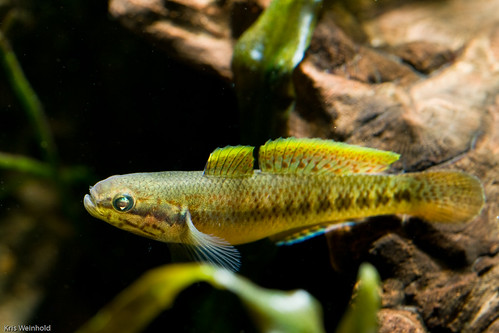
When I brought home the first pair, I was admittedly a little bit disappointed. Shortly after adding them to my 54G tank, they disappeared into the hardscape, and weren’t seen for at least another week. Eventually, I started noticing them, hiding in the shadows underneath large anubias or cryptocoryne leaves, or between pieces of wood and rocks.
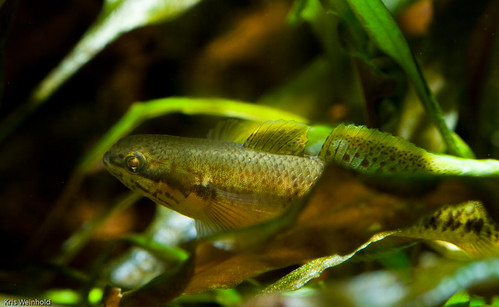
That’s when I decided to try adding 2 more to the tank, in hope that with four total, I’d see one of them more often. Fortunately, this strategy seems to have worked. Also, I started feeding the tank blackworms, which has definitely drawn them out of their hiding places!
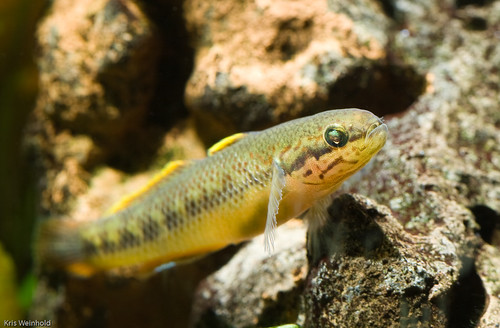
According to the Baensch Aquarium Atlas Vol. 4, these gudgeons “inhabit small, frequently swift-flowing, gravel to mud-bottomed rain forest streams.” They also enjoy the cover of vegetation and plant roots, which exactly what I’ve experienced in my tank.
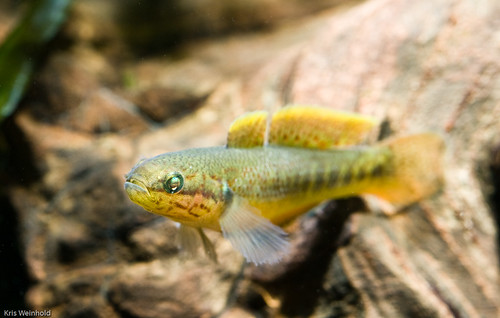
As young fish, they were not very attractive, but since feeding them blackworms, they have increased in size (max about 3″), and have definitely gone from rather drab looking to fairly colorful with bright yellow fins. I doubt that they will be able to successfully raise any young in this tank due to some very active catfish, but they’re very interesting fish to keep. (And they’re great additions for rainbowfish themed tanks.)
Posted in 54G Tank Log, Fish Profiles | Comments Off on Goo Obo Gudgeon
May 9th, 2008
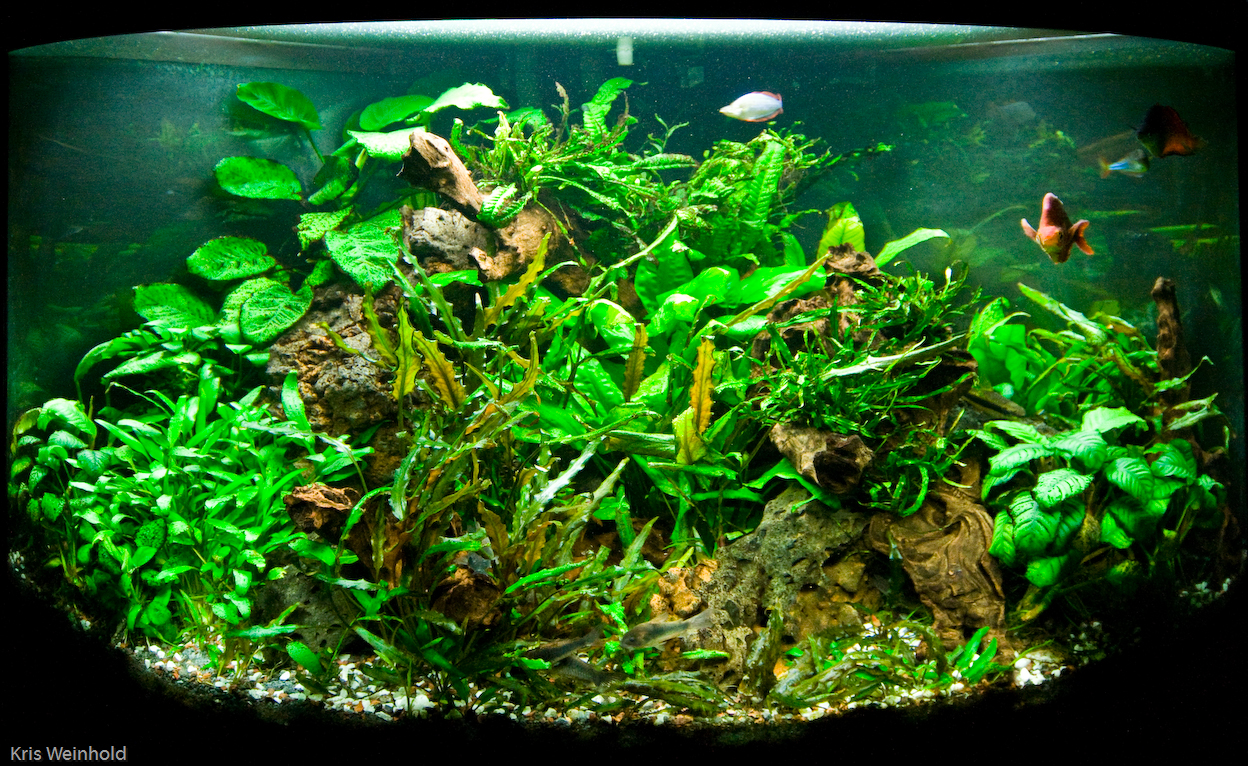
It’s been almost two months since I setup this aquascape, and it’s finally starting to fill in a little bit. The crypts in the foreground are beginning to cover up the substrate, and everything else is fanning out a little bit. The only thing I have been dosing is a few milliliters of Seachem Flourish every day, which seems to prevent most of the deficiencies that would creep up otherwise. I also have Flourish tabs in the substrate to feed the crypts.
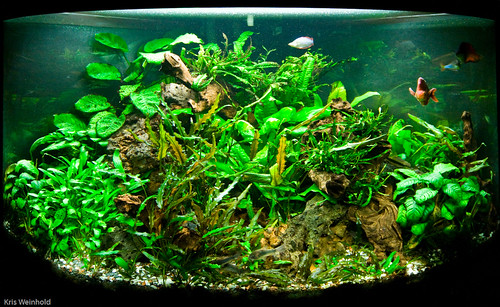
I do have one sad note regarding this tank. One of the two oldest fish, both chinese algae eaters, I had had since I got back into aquariums nearly 6 years ago passed away last weekend. All of the other fish in the tank are healthy, so I’m guessing that he simply died from old age. RIP CAE. As far as the aquascape goes, if anyone has any comments or criticisms, please leave them in the comment section — I’m always looking to improve my scapes. 🙂
Posted in 54G Tank Log | 3 Comments »
May 7th, 2008
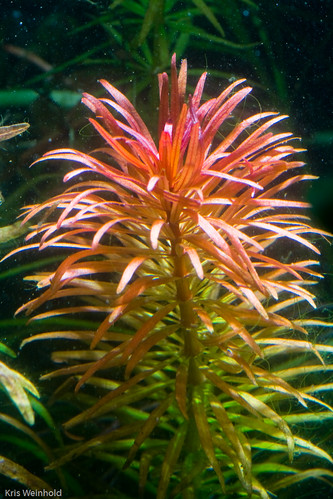 At the last GWAPA meeting auction, I bought Ludwigia inclinata var. verticillata ‘Pantanal,’ which is a plant I have tried to keep a few times previously. Known as a relatively difficult plant, any lack of nutrients or light causes the stem plant to melt away. In the past, I’ve even seen a single stem wave in and out, with leaf widths varying from about half an inch up to 2 inches, representing periods of neglect, and periods of proper growth.
Fortunately, if adequately cared for, Ludwigia inclinata var. verticillata ‘Pantanal’ is one of the most beautiful stem plants available, maintaining a brilliant red coloration that is sure to draw the attention of any onlooker. There are many more leaves per node than Limnophila aromatica, which makes the stem look more compact, particularly because the leaves themselves stay a tad bit smaller as well.
While certainly not a plant for any beginning hobbyist, I highly recommend this plant to any more experienced grower. High light, rich substrate/fertilization, and CO2 are a must for this plant.
Posted in 75G Tank Log, Plant Profiles | 2 Comments »
April 28th, 2008
The Jewel Cichlids from Florida are at it again! Last week, I had a cloud of fry, with a dozen or two remaining today, but nevertheless the parents are protecting them. The fry spend much of there time combing through algae on the manzanita wood in the tank. If they ever venture too far away, the parents suck them in their mouth, and bring them back “home.”
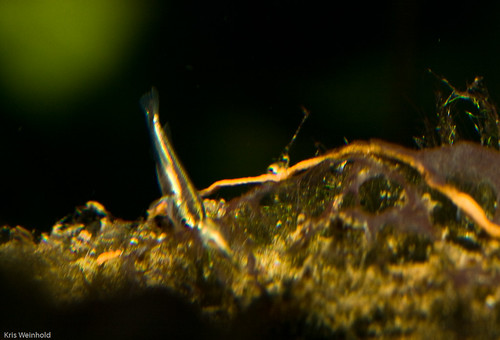
And of course, the bonded pair are acting like psycho parents toward the other two Jewels in this tank. Fortunately, all of the cichlids have plenty of hiding spots, and are roughly equal size, so no one has gotten injured. That hasn’t stopped the parents from lording over 2/3’s of the tank, however.
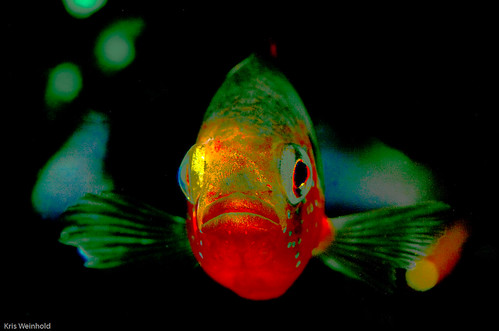
Despite being beautiful fish, I don’t really want anymore, so I’m not deterring much from my usual feeding routine with this batch of fry. I’ve added an occasional feeding of hatched brine shrimp and egg solution, but mostly I’m letting them fend for themselves. If a handful grow up, that’s great, but if not, I’m sure they’ll have more babies soon enough.
Posted in 20G High Tank Log, Fish Fry | 2 Comments »
April 22nd, 2008
I haven’t posted a picture on my 75G tank in about 2 months, so I decided that it was time, despite still being a work in progress. I suppose that my tanks have suffered a little bit from the nice weather outside, as I’ve been more focused on preparing the garden outdoors, than working on the aquariums inside.
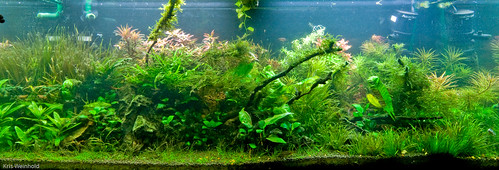
The Eleocharis sp. ‘Japan’ is starting to fill in the foreground. The right side of the tank has some Ludwigia inclinata var. verticillata ‘Cuba’ beginning to grow, as well as, some Rotala verticillaris that I’m hoping will provide a nice vibrant green in the back corner. There’s still something about this scape that I’m not entirely pleased with, something about the right side, but I haven’t taken the time to really move things around — largely because the Nannochromis nudiceps have dug out a cave on that side that I don’t want to disturb. If anyone has any comments, critiques, or suggestions, I’d love to hear them!
Posted in 75G Tank Log | 5 Comments »
April 17th, 2008
Last weekend, I purchased a pair of Apistogramma hongsloi ‘Super Rostrich’ from fellow CCA members, TwoFishGuyz. I had been looking at a number of West African cichlids for my 75G tank, but I came across these guys, and decided to stick with my beloved Apistogramma.
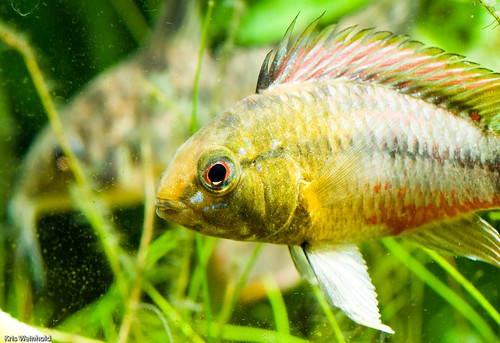
Apistogramma hongsloi ‘Super Rostrich’ are a captive bred strain of A. hongsloi that are selected to have more vivid coloration than their wild kin. This particular strain also has longer lyre-tailed fins. As far as Apistos go, this particular species gets fairly large at 3-4″ for males, similar to other members of the Macmasteri group, such as A. veijita. Despite still being fairly young, you can see the potential coloration of the male in the photo above.

As usual, the female is much less impressive (shown above), exhibiting a somewhat awkward body shape, and having the typical black markings on the front of their dorsal and pelvic fins, with an otherwise, mostly yellow body. So far, mine haven’t really seemed to bond, but hopefully in time, love will set in. *laugh*
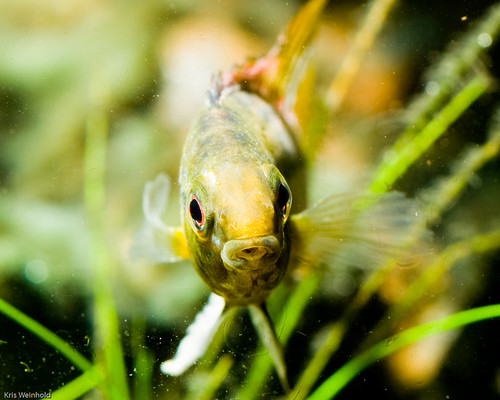
Despite the lack of mating behavior, they’re both fairly lively fish. The male is especially active, swimming up and down the glass, looking at me. Hopefully, after plenty of live foods, they will settle in, and produce a nice little colony of Apistogramma for my 75G.
Posted in 75G Tank Log, Fish Profiles | 4 Comments »
April 15th, 2008
I have recently replanted the foreground of my 75G aquarium with a new dwarf hairgrass that I came across called Eleocharis sp. ‘Japan.’ I ordered four pots of this plant in a GWAPA group order, and noticed that it looked just like any other hairgrass when it arrived. The reason for this is that the potted plants were grown emersed, and didn’t exhibit the unique behavior that is present in the submersed form.
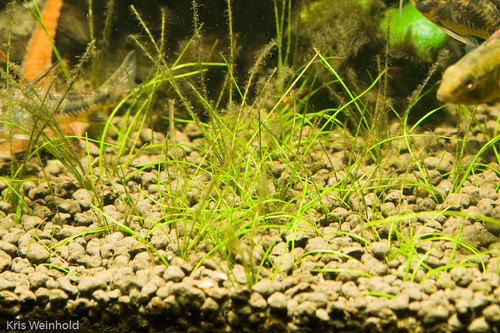
Submersed, Eleocharis sp. ‘Japan’ curls downward toward the substrate, creating an effect not present with regular hairgrass. You can see in the picture below how all of the new submersed growth is doing exactly that. Otherwise, this plant grows just as you would expect; it spreads by runners throughout the substrate. It took a little while to get going after I first planted it, but it is now finally starting to take off. I’m hoping that it will cover the entire foreground in another month or two.
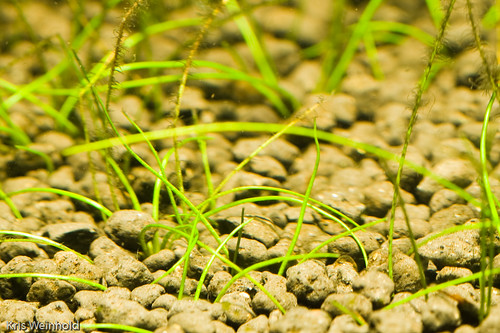
I will post an update once it has filled in, but I’m expecting this to be a very nice, and unique, addition to my 75G aquascape.
Posted in 75G Tank Log, Plant Profiles | 5 Comments »