Face-to-Face with Catfish

March 31st, 2008

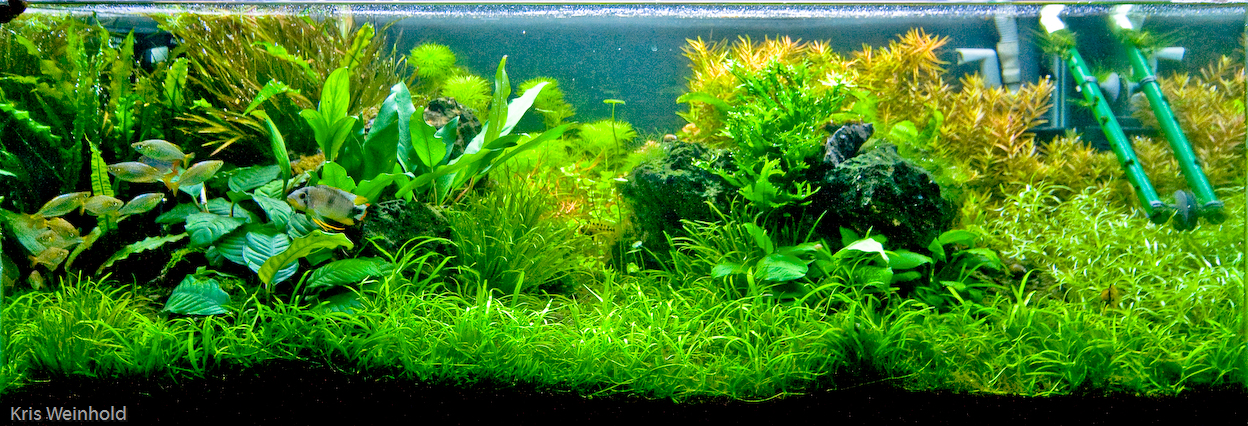
In my 54G corner aquarium, I’ve got quite a few different kinds of catfish. All of them are different looking, and each has a unique character.

The Ancistrus sp. L279 bristle-nose plecos stay around 3-4″, and are usually found sucking on the driftwood in the tank. They’re fairly timid, but do come out often enough to enjoy.

Ancistrus sp. L279

The Siamese Algae Eater, SAE, is a very common algae eating fish. They are commonly confused is the Flying Fox, which is not nearly as effective an algae eater. Becoming popular once they were observed eating black brush algae, they are often recommended to new aquarists as a means of algae control. Unfortunately, most people do not initially realize that the small fish they purchase in the store, turn into 6-7″ blimps. Despite their size, they’re usually lazy enough, lounging around most of the time in their old age, that they do not disturb the aquascape.

SAE

The Botia sidthimunki loach is a fantastic little catfish that stays small, is constantly active, and is very social when kept in a group. I have five of these in the tank, and they’re always scurrying around, chasing each other throughout the aquarium. They do not harass other tank mates, however, well, except for snails or shrimp!

Botia sidthimunki

I have a couple varieties of corydoras in this tank. Cories are also very social catfish, constantly searching the bottom areas of the tank. Occasionally, you will see one shoot from the substrate all the way up to the water surface, and then dart back down. Apparently, cories have adapted to be able to breath air from the surface, allowing them to survive in poorly oxygenated water. I’ve also witnessed them playfully swimming upside-down at the water surface for awhile before swimming back down to the bottom.

Corydora

Overall, I can highly recommend all of these catfish, for different reasons. The A. sp. L279 are great little plecos that eat algae, but don’t overwealm the tank. The SAEs get bigger, but are peaceful, and also eat algae. The “sid the monkey” loaches are a great, active, addition to any tank, and will eliminate snails from your aquarium. And corydoras are just plain fun to watch!


Business Broker

Wormstrate or Soil Substrate?

March 26th, 2008

About a week ago, I started a substrate experiment that I’ve been wanting to try for some time. Having always used commercial substrates, often at high expense, I’ve had a lot of success growing plants over the past few years in my aquarium. Of course, nearly all of these substrates, when used in a light-intensive+CO2 setup require supplemental dosing of fertilizers. Hence, my previous entry about automating the dosing of those fertilizers.

Wormstrate and Soil Substrate Experiment

I watched as both local GWAPA members and other enthusiasts around the world started growing beautiful aquascapes with nothing more than garden soil, and a few additives, at probably 1/10th of the cost of my ADA substrate. Not only that, but they aren’t required to dose additional fertilizers as the soil is sufficiently rich for at least a decade. In addition to these soil methods, I wanted to try something different as well — a wormstrate — that is, a substrate based on worm castings. With two empty 2.5G tanks sitting around, I decided to do a side-by-side experiment of the two natural substrate options.

For the soil substrate, I used a method designed and perfected by a local GWAPA member, consisting of mineralized topsoil, potash, dolomite, pottery clay, and an inert top layer. As mentioned, a number of GWAPA members have successfully run high-tech tanks using this method, with the only downside often being an green water outbreak at the beginning of the process.

For the wormstrate, I used Vladimir Simoes Method, which was used successfully by a number of AGA contestant tanks from Brazil. This is essentially just worm castings, mixed with sand, and topped with an inert top layer. The most appealing thing about this method is that I could use my own worm castings, produced from my kitchen scraps, creating a full cycle of food to waste to worms to aquarium to plants to compost. Can anyone else say that they made their substrate from their kitchen scraps? Nerdy, I know, but cool!

So, I setup both 2.5G aquariums within a few days of each other, fit a 24″ 55W light over top of them, outfitted each with a hang-on-the-back filter, and planted each with roughly the same number and type of plants from my other tanks. I started the tanks using water from the same established 20L aquarium, which I believe has helped me avoid the green-water cycle often experienced. The only thing I have been dosing has been Seachem Excel, since I don’t have two extra CO2 diffusers.

Over about a week and a half, I’ve seen some modest growth, zero algae, and clear water. I’m hoping that the growth will pick up, as the plants adjust to feeding from the roots instead of the water column. I’ll be sure to continue providing updates on this experiment as it progresses. My hope is to have one of these two methods convince me to redo one of my larger tanks with a natural-based substrate, so that I can further lessen my fertilizer use. Comments/suggestions welcome!

Business Broker

Auto-dosing Fertilizers – DIY Style

March 24th, 2008

DIY Auto Doser In my last post, I explained how I tested for two weeks to determine the proper amount of fertilizers my 40G tank needed to sustain healthy plant growth, and eliminate algae. With that knowledge in hand, I have now automated my dosing routine on this tank using a few readily available items to build a DIY auto-doser. I cannot take credit for this innovation, as I was following Jeff Ucciardo’s design, who adapted it himself from various designs posted on Aquatic Plant Central.

Building an auto-doser is really quite easy. You only need a container, a powerhead to move the solution from the container to the tank, some airline tubing, a check valve, and a digital timer that is accurate to the minute. You’ll also need some sort of a syringe or pipette to convert the output of the powerhead down to the size of the airline tubing.

For the container, I bought a clear container from the kitchen department of IKEA. A container that is taller will be better than one that is short and fat, as the tall and skinny containers will allow you to more easily differentiate how many days worth of solution it can hold — more on that later.

Powerhead

The powerhead you use has a few basic requirements — it needs to fit in the container, is best to draw water from the bottom so that it will run even partially emerged, and should be strong enough to pump from wherever you plan on storing the unit into the tank. I used the 606 Mini-Jet from Aquarium Systems, and have it set to the lowest setting.

Pipette Sawed Off

To attach the airline tubing to the powerhead, I found that a pipette from Seachem’s fertilizer bottles fits perfectly over the powerhead output if you saw off the large end.

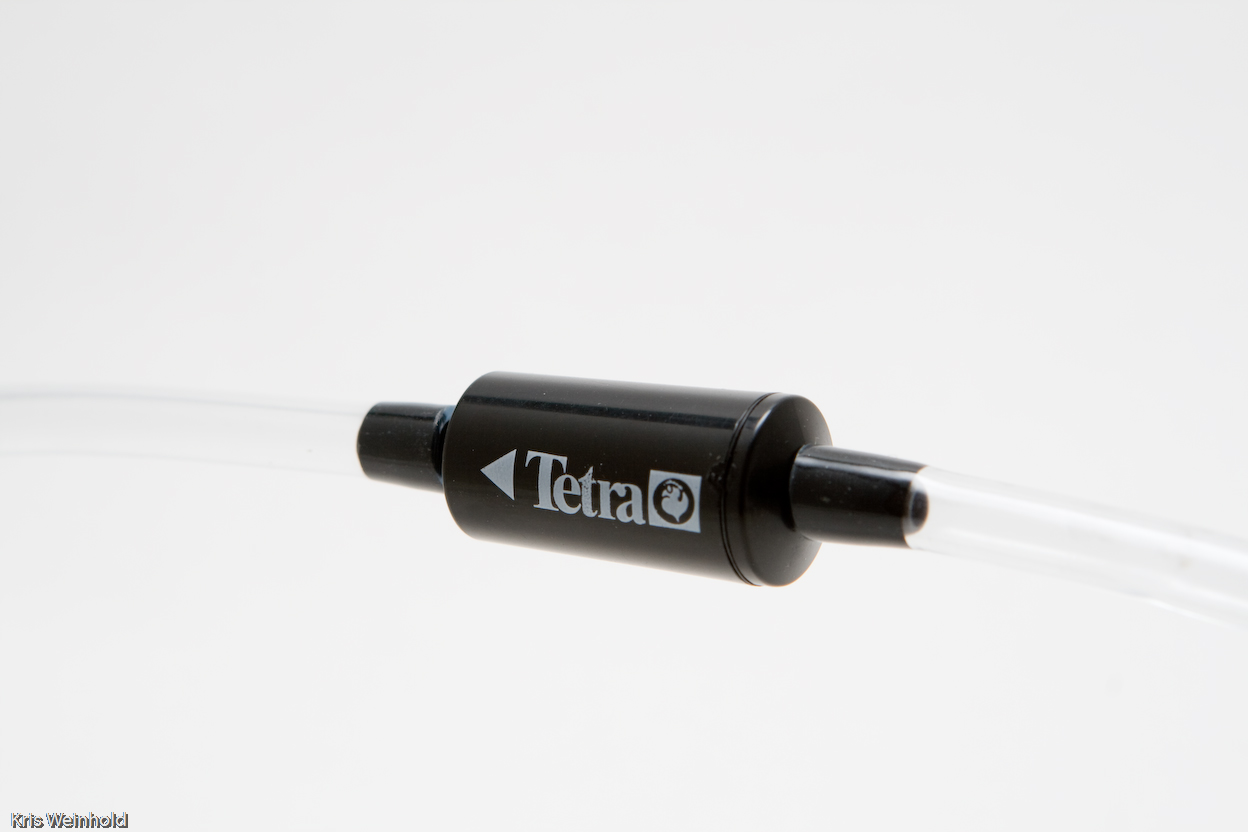
As in any case where you have tubing running into your tank, you definitely want to install a check-valve in the airline tubing to prevent a siphon from forming, and overflowing your aquarium out onto your floor — always a bad thing! I used an inexpensive check-valve from Tetra.

Check Valve

All said and done, I spent $2.99 for the container, $16.99 for the powerhead, $1.99 for the check-valve, and $9.99 for the Intermatic digital timer. I had extra tubing and pipettes on hand, but figure about $35 to build one of these.

Once you have all of your basic components assembled, you need to establish how much solution your powerhead moves every minute, thus figuring out how many total days worth of solution your container will hold. To do this, fill the container with water, and set it exactly where you want it to be next to the tank. This is important because the powerhead will pump different amounts of water depending on the height/distance it is pumping. Now, run the powerhead at 1 minute intervals, using a marker to mark the water level on the container at each interval. Once deplete of water, count the number of marks — that’s how many days you can automate your dosing with a full container. For me, it worked out to exactly 14 days — how convenient!

Now, armed with the previously knowledge of how much I should dose over the same period, I calculated my solution amounts. I put in 100mL of Seachem N and K, and 50mL Seachem Flourish, Iron, and Excel. It’s important not to mix P with Iron in the same container as they interact, so for now, I will have to dose Phosphate separately. Also, for the first time, err on the side of caution, and dose slightly less than what you’d expect. You can always increase it later.

It’s been running for 4 days flawlessly so far, so I’m hoping that this will further help me keep my nutrient levels exactly where they need to be in this tank. I’ll continue to do a few tests to confirm that it’s on target, but I’m looking forward to not having to worry about dosing except for once every two weeks.

Business Broker

Figuring my Ferts

March 22nd, 2008

Recently, after not quite being able to figure out what was going on with the fertilizers and algae in my 40G, I went on a meticulous 2-week testing schedule, where everyday I tested the levels of the two macro nutrients I suspected were out-of-balance, nitrate and phosphate.

DATE N (ppm) P (ppm) Changes:N P K
Day 1 5 .5 0 (WC) 0 (WC) 0 (WC)
Day 2 7.5 .5 15mL 10mL
Day 3 7.5 .5 10mL 15mL 10mL
Day 4 5 1 25mL 5mL 10mL
Day 5 7.5 1
Day 6 2.5 .25 30mL 20mL 20mL
Day 7 10 1
Day 8 5 .5 10mL 15mL 10mL
Day 9 7.5 .5 10mL 20mL
Day 10 7.5 .25 20mL 10mL
Day 11 7.5 1.0
Day 12 0 .5 30mL 15mL 20mL
Day 13 7.5 1.0
Day 14 2.5 .25 30mL 15mL 20mL
DATE What to add
Day 1 4mL Flourish
20mL Excel
4mL Iron
2.5mL N
2.5mL P
Day 2 10mL Trace
4mL Excel
4mL Iron
Day 3 7mL K
4mL Excel
4mL Iron
Day 4 10mL Trace
4mL Excel
4mL Iron
2.5mL N
2.5mL P
Day 5 7mL K
4mL Excel
4mL Iron
Day 6 3mL Flourish
4mL Excel
4mL Iron
Day 7 Water change

I dose my 40G aquarium using Seachem’s full product line of aquarium fertilizers, minimizing my costs by only buying 2L bottles of fertilizer solution, which usually last me some time. Up to this point, I had been following Seachem’s recommended dosing chart, which for a 40G aquarium calls for the dosing schedule on left.

What I essentially confirmed, when comparing the two charts, is that I was vastly under dosing my aquarium, particularly the macro-nutrients. Over the course of my experiment, as I adjusted my dosing levels according to the test results, hair algae disappeared from the tank. The plants really took off, and were looking much more healthy than before, especially plants such as Blyxa japonica that feed mostly from the water column. Although I didn’t document my trace and iron dosing levels, I found that the uptake of N and P are most definitely limited by the availability of those nutrients, as well as K. This was particularly evident between days 9 and 11, as the nitrate levels stayed roughly the same, even without dosing N. By increasing the dosages of the other nutrients, eventually, nitrate went to 0ppm, and I resumed dosing it.

The knowledge learned in this two week test is going to be invaluable going forward with this tank. More to come on that in my next post…

Business Broker

54G – New Aquascape!

March 20th, 2008

After thinking about it for a long time, I finally got around to re-aquascaping my 54G corner tank in my living room. This tank has had roughly the same aquascape for 2-3 years, and being a low-tech tank, has always seemed to kick along without much intervention from me. It might not be my most impressive tank, but it’s consistently, well, okay.

54G New Aquascape
Click picture for larger version.

With the new scape, I wanted to incorporate some rock into what had previously been a very wood-dominated aquascape. So, I grabbed my largest available piece of porous mossy rock, put it on the left/middle side, and went from there. I kept the plants the same, utilizing tons of anubias, java fern, crypts, and bolbitis. I’m not really happy with the foreground, and may try growing some Marsilea quadrafolia, but I’m unsure as to whether or not it will hug the substrate as this is a tall tank without a ton of light on top (only 110W). All in all, this is a scape-in-progress, but I wanted to document how it looked initially, so that I can keep track of how it progresses. Comments and suggestions are always welcome!

Business Broker

Melanotaenia praecox Photos

March 13th, 2008

I just wanted to share a few shots of my Dwarf Neon Rainbowfish, or Melanotaenia praecox. I have a school of 13 fish in my 40G tank right now, and they’re great for photography, as they tend to hover in place against the current. The school I have right now is mostly females, and I haven’t had any fry survive, probably due to the Apistogramma that are also in the tank.

Melanotaenia praecox

Here’s a close-up of one of the males in the tank. These fish are still relatively young, and haven’t fully developed the steep forehead that’s common among adult rainbowfish. The males seem to develop a slightly more pronounced arc than the females do.

Melanotaenia praecox

Below is one of the females, identified by the yellow in her fins, whereas the males fins have a reddish hue. The iridescent blue tint of their scales are even more intense and shiny in person, than in these photos. If you haven’t kept these fish, they’re perfect for planted aquariums, and wonderful community fish — just make sure to keep them happy by having schools of 6 or more.

Melanotaenia praecox

Business Broker

Pitbull Pleco – Parotocinclus jumbo

March 11th, 2008

A few weeks ago, I stopped by my local fish store on the way home from work, looking for some regular Otocinclus to help eat some algae in my 40G tank. Unfortunately, the store was out of Otos, but the owner recommended a curious little fish called the Pitbull Pleco, or Parotocinclus jumbo.

Pitbull Pleco

Of course, with the reputation that pitbulls have, I wanted to be sure that this little fish would not be a mean killing machine if let loose in my aquarium. So, the owner kindly helped me lookup more information on the fish, and as it turns out, the name is a bit of a misnomer. The fish was originally named after a pitbull due to the fact that its eyes are more on the top of it’s head, rather than on the sides, similar to the canine.

Pitbull Pleco

Satisfied, I promptly bought a half dozen of them, and brought them home. Once accustomed to my heavily planted 40G aquarium, these plecos are really quite attractive fish. They’re roughly the same size as an Otocinclus, and according to many sites only, they will not grow too much larger. In fact, they really look like a different colored Otocinclus, especially when hoisted on the glass, as seen below.

Pitbull Pleco

So, the next important question was whether they would actually eat any algae. Fortunately, it didn’t take me long to find the answer to this question, as they went straight to work, clearing the glass, rocks, and leaves of any of the spot, dust, diatom, or similar algae. They seem to leave alone the hair and fuzz algae, but that’s what I have Amano and cherry red shrimp for.

Pitbull Pleco

All in all, I would recommend the Pitbull Pleco to anyone looking for a similarly sized, but different algae eater, than the Otocinclus. They’re attractive, peaceful fish, that seem to group together, and do a fine job keeping the glass and hardscape clear. They seem to tolerate similar water parameters as most corydoras, making them ideal for 90% of the aquariums out there. Highly recommended!

Business Broker

40G Aquascape – Updated Picture

March 5th, 2008

Here’s an updated picture (click picture for larger view) of my 40G aquarium. If you remember what it previously looked like, you’ll notice a profound change in the plants present. For starters, I removed most of the Micranthemum umbrosum, replacing it with the Limnophila aquatica, and just a hint of red with some stems of Ludwigia arculata.

40G Aquascape - March 5, 2008

Additionally, the Didiplis diandra and Rotala rotundifolia in the back-right are much more pronounced, while I’ve significantly hacked back the Eriocaulon sp. ‘Type 2’ in the right midground to better transition from the grassy foreground to the plants in the back. I’ve also cured most of an algae outbreak that I had in this tank, after finally putting into practice some of the tips I mentioned in my algae presentiation.

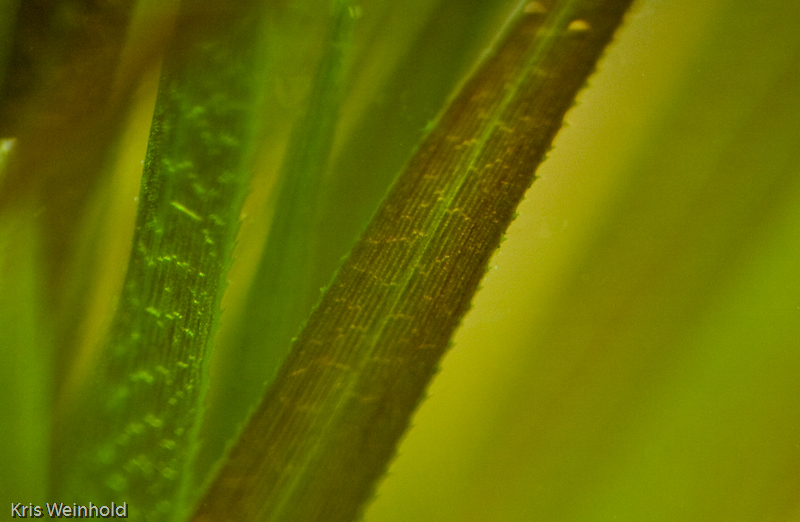
Blyxa aubertii

Once I did that, the Blyxa aubertii lost many of the hair-algae strands attached to its leaves. One of my favorite things about the various Blyxa plants is the cellular pattern on each leaf, as you can see above. Overall, I’m pretty happy with how the 40G aquascape is coming along, but I’d love to hear any of your comments or suggestions.

Business Broker

Limnophila aquatica – Ambulia

March 4th, 2008

At the last GWAPA meeting, a couple of bags of Limnophila aquatica were up for auction, and at one point, I think it reached market saturation, as no one was bidding on it. I decided to grab it for a $1.00, despite not really wanting it, but I’m glad I did.

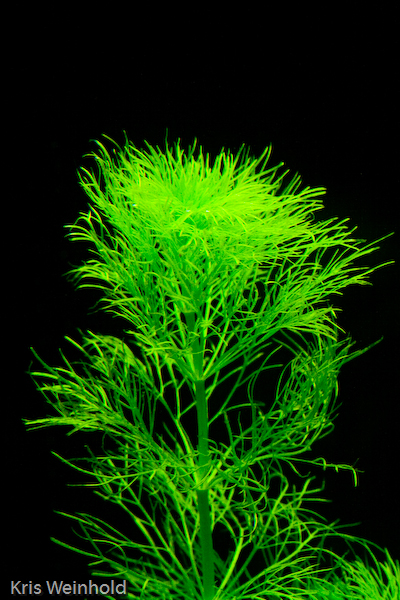
Limnophila aquaticaLimnophila aquatica, or Asian Ambulia as it is commonly known, has been in the hobby for a number of years. Its fine, feathery, leaves add a much softer texture to the tank that other, more solid bodied, plants cannot.

The plant is a bright green stem plant that is likely to be the brightest plant in your aquarium. Originally from Southeast Asia, Ambulia requires moderate high to have nice bushy growth. It can also grow very quickly with proper fertilization and CO2, and will reportedly grow out of the water with small blue flowers. I hope to see those flowers at some point!

Asian Ambulia can be propagated like any other stem plant, by cuttings or through side-shoots. So far for me, it’s been a rather fast grower.

Despite not originally having plans to add Limnophila aquatica to my 40G aquarium, it has really added a nice focal point for my aquascape. I’ll post updated pictures of the 40G, once the new plants grow in a little bit more.

Business Broker

Rotala macrandra ‘Green’ Confusion

March 3rd, 2008

You may remember this picture that I took of Rotala macrandra var. ‘Green’ last year at my friend Aaron’s house. He had it growing beautifully in his ADA 90P aquarium. Notice how the leaves are slight, with some hooked edges, and somewhat transparent.
Rotala macrandra var. 'Green'

Now, take a look at the picture below. This is the same plant in my 40G tank. The leaves are rounder, thicker, and lacking the spiked edges. Why the difference? Well, about 2 months ago, I got lazy, and didn’t trim this tank, allowing the R. macrandra var. ‘Green’ to grow emersed from the water. Then, I finally performed a water change, raised the water levels, and replanted the tops of the stems, submersing them.

Rotala macrandra var. 'Green' submersed

This also coincided with a significant increase of light when I upgraded to the AHSupply 2x96W kit. Since then, the emersed growth form of the Rotala has continued, even though it has been persistantly submersed. I would have figured that the lesser CO2 levels of the water verses the atmosphere would have triggered the plant to convert to its’ submersed form, but apparently not.

I’m still deciding which form I like best. Has anyone else experienced this phenomenon before?

Business Broker

« Previous Entries   Next Entries »