November 28th, 2009
Well, my native plant aquascaping experiment has come to an abrupt end. The night before I left for vacation a few weeks ago, I was feeding the fish and noticed that the left side of the stand was a little damp. Upon closer inspection, the inside of the stand had some water pooled up, and upon even closer inspection, the bottom rim of the aquarium was overflowing with water dripping out of it.
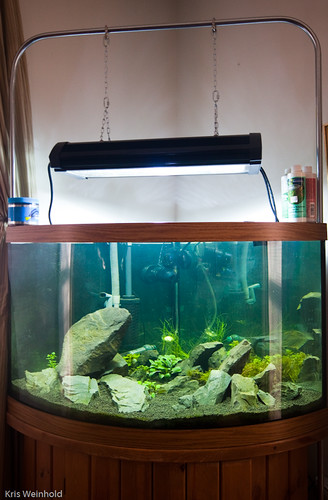
I think, “wonderful, I’ve got a siphon somewhere in my auto-doser setup that’s leaking out.” – Nope
I look, “maybe the powerhead is forcing the water too hard against the top rim and it found a gap in the silicon up there, and is dripping down the side into the bottom rim.” – Nope, the black posterboard background was only wet along the bottom, so nothing dripped from top to bottom.
“Crap! My tank has developed a leak from some new rocks I put in it a week prior!” – Bingo!
I scrambled to net out the fish, siphon out the water, remove the plants, remove the substrate, and clean up the water on the floor. While this wasn’t how I planned to spend 2 hours of my evening prior to catching a plane in the morning for 2 weeks, I’m so thankful that I noticed this leak before I left for vacation. Had it leaked out during the 2 weeks I was on vacation, the floor around the tank surely would have been ruined, and the fish dead. My wife and I have been looking to move that tank out of the our living room for awhile, and since I don’t have anywhere else to put it while it was being repaired, I was fortunate to find another GWAPA member to take it off my hands, and put it back in service. It was a nice tank to have, and I hope it does well in its new home!
Posted in 54G Tank Log | 4 Comments »
August 26th, 2009
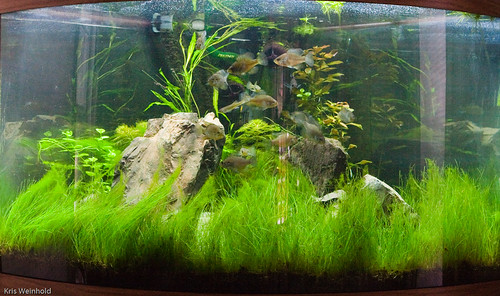
Today I did water-changes on my aquariums, and while looking at the 54G tank, I decided to actually try trimming back the hairgrass a little bit. I had talked about trimming it down for awhile, but various folks said they liked the long-wavy-look, so I put it off. I ended up deciding to just try it once and see how it goes.
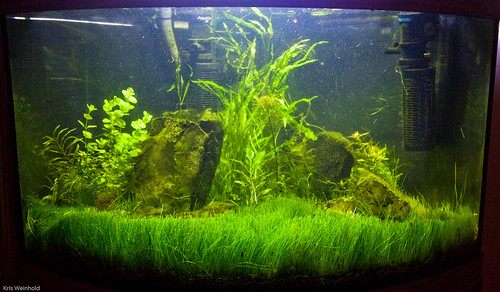
Above you can see the trimmed tank immediately after the water-change. Below is the tank, immediately prior to the trim and water change. Which do you like better? To me, I think the trimmed look brings out the hardscape a little bit more. I know that the rest of the plants are a bit of a mess right now. That’s my next problem to solve!
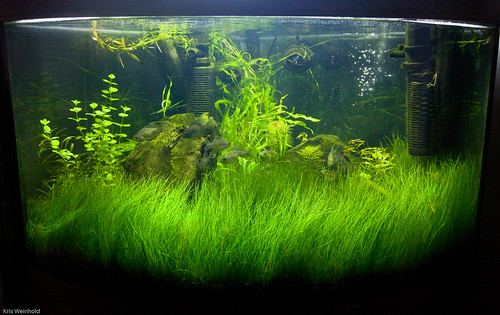
The good thing is that the plants are actually starting to grow quite well, and assuming I keep my dosing regimen and water-changes on schedule, I haven’t had near the issues with algae that I have had previously on this tank. The Potamogetons in this tank are doing wonderfully.
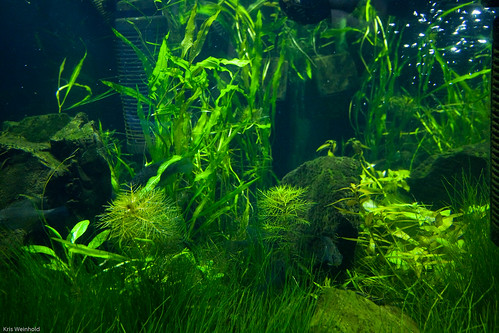
I did have a beautiful stand of Lindernia dubia in here, but I trimmed it very hard to send to a friend. I may have trimmed it too hard. Fortunately, I have more stashed away in my emersed setup. Overall, this tank is starting to come into its own. Please let me know if you like the haircut or not. Comments welcome!
Posted in 54G Tank Log, Aquascaping | 6 Comments »
July 11th, 2009
I’ll start by saying that this 54G aquarium is giving me more trouble than just about any aquarium I’ve setup before. It’s not the aquarium itself, but I just can’t seem to get the darn thing balanced and happy without ending up with beautiful views like the one below. I am using a few things that I don’t usually use in this aquarium. It’s my first time using a metal halide pendant, so I’m still figuring out the best light duration. Additionally, I’m using leftover parts for my CO2 system, and not the filter I’d prefer to use. So, those are my excuses.
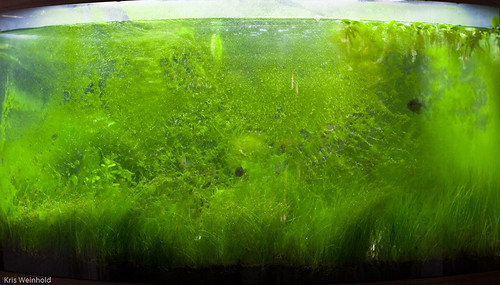
Now, what I’m trying to do about it. At least according to my test kits, my nitrate is at 10ppm and phosphate 1ppm, which is exactly where I want them. Nevertheless, I’m not sure I can trust those values because the plants aren’t looking like they’re that happy, although the algae is. I also decided to rearrange the rockscape that I did have in this tank, adding a large rock with much more character than the previous one. This allowed me to add a bit more height to the rockscape than I had before. Before repositioning, I pulled all of the rock out, and scrubbed them to get as much of the black-brush-algae as I could. I’m sure it’s a matter of time for it to return, but hopefully I can get my water parameters inline before then.
I may be forced to bend a few rules for this tank if I can’t rectify the situation entirely through water/light/CO2 adjustments. Unfortunately, there are no native plecos (or other suitable suckerfish) to Maryland, and grass shrimp are just quick treats for the bluespotted sunfish. If I have to add some bristlenosed plecos, it probably wouldn’t be the end of the world, but I’m going to try and avoid that for the time being. Comments welcome!
Posted in 54G Tank Log | 8 Comments »
May 17th, 2009
I wanted to provide an update for my 54G native fish and plant aquarium. I have, however, broken my own rules for this aquarium to help it mature a little bit. I added some non-native floating plants to the surface temporarily, to help soak up some of the excess nitrate from the aquasoil. In doing so, the algae on the hairgrass and the rest of the plants is almost entirely gone. As you can see, that’s not quite the case for the rocks though.
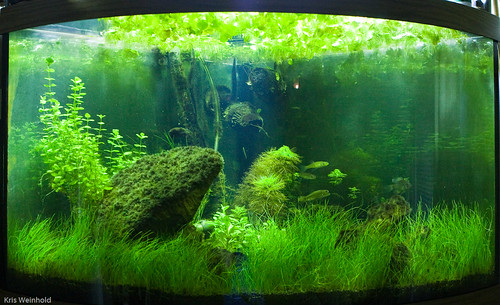
The rocks are completely covered in black brush algae, but I have increased the CO2 output and have refined my dosing routine, so I’m confident that it’s just a matter of time before I’m able to get rid of it. I will likely end up manually scrubbing the rocks at the next water change, and then let my adjustments do the rest.
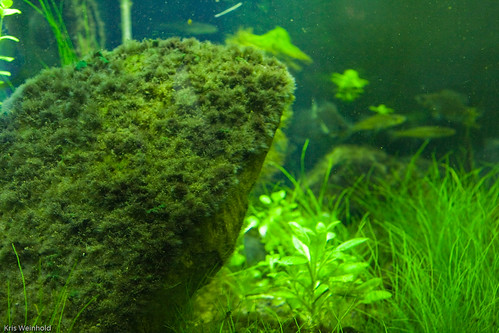
The fish are all doing very well, kept happy with a healthy diet of blackworms, and a few extra pellets when they’ll accept them. I still haven’t seen any spawning behavior, but I don’t really expect to see much of that since I didn’t chill these fish over the winter. They’re probably wondering why their summer has lasted 9 months!
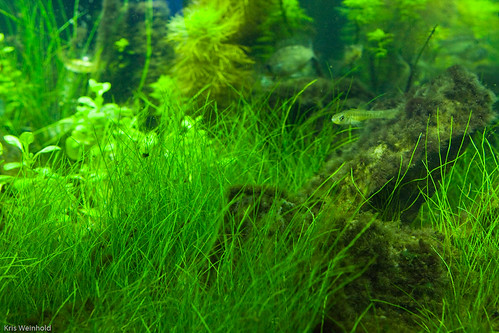
All in all, I’m very pleased with the direction of this tank. I will soon be able to collect some more native plants to fill out the background. After that, I’ll focus a little bit more of the aquascape itself. Comments welcome!
Posted in 54G Tank Log | 3 Comments »
April 2nd, 2009
It’s been roughly two months since I converted my 54G aquarium into a native plants/fish tank, and thus far it’s been a bit of a bumpy road, with a few bright spots here and there. I’ve been having some algae issues due to very high nitrate levels leeching out from the ADA Aquasoil. I’ve never had problems like this before with Aquasoil, so I’ll give it the benefit of the doubt for now.
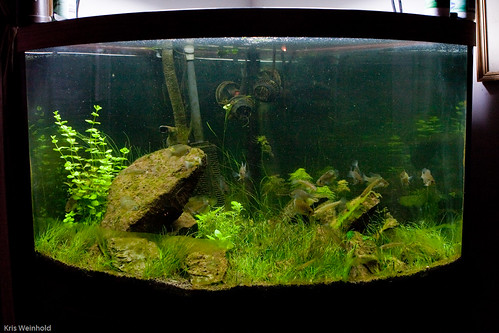
Despite having a bit of algae, the hairgrass is really starting to carpet the aquarium. The rocks are pretty well coated in fuzz algae, but I’ve recently started dosing more macros (N/P), and it has improved a little bit. Right now, I’m seeing better plant growth than I’ve seen in awhile, so I’m confident that given a little more time, I’ll be algae free.
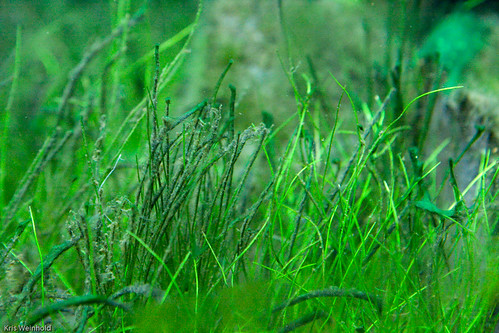
All of the bluespotted sunfish and banded killifish are in the aquarium now. They’re an interesting group of fish. Sometimes, I’ll look in the tank and it’ll look like an overcrowded zoo. Other times, I’ll look and not a single fish is visible, as they’ve blended themselves in-between rocks or in the hairgrass. I don’t see anyone getting beat up, so I think I’m okay in terms of fish load.
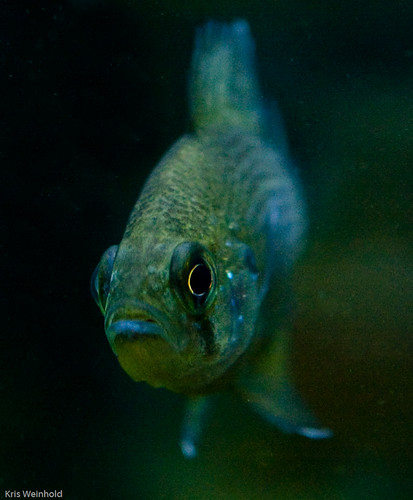
The killifish seem to especially like to dart in and out of the hairgrass. They’re also the fish that are more likely to accept commercial pellets, whereas the sunfish are hit or miss with anything but live blackworms. (About half of the sunfish will eat pellets, but not vigorously like commercially raised fish.)
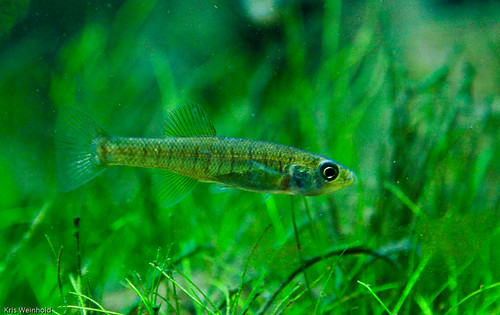
Overall, I’m happy with the direction of this aquascape, but I am looking forward to warmer weather so that I can go out and collect a few of the plants I ultimately want to feature in this tank. Comments/critiques welcome!
Posted in 54G Tank Log | 3 Comments »