Auto-dosing Fertilizers – DIY Style
March 24th, 2008 In my last post, I explained how I tested for two weeks to determine the proper amount of fertilizers my 40G tank needed to sustain healthy plant growth, and eliminate algae. With that knowledge in hand, I have now automated my dosing routine on this tank using a few readily available items to build a DIY auto-doser. I cannot take credit for this innovation, as I was following Jeff Ucciardo’s design, who adapted it himself from various designs posted on Aquatic Plant Central.
Building an auto-doser is really quite easy. You only need a container, a powerhead to move the solution from the container to the tank, some airline tubing, a check valve, and a digital timer that is accurate to the minute. You’ll also need some sort of a syringe or pipette to convert the output of the powerhead down to the size of the airline tubing.
For the container, I bought a clear container from the kitchen department of IKEA. A container that is taller will be better than one that is short and fat, as the tall and skinny containers will allow you to more easily differentiate how many days worth of solution it can hold — more on that later.

The powerhead you use has a few basic requirements — it needs to fit in the container, is best to draw water from the bottom so that it will run even partially emerged, and should be strong enough to pump from wherever you plan on storing the unit into the tank. I used the 606 Mini-Jet from Aquarium Systems, and have it set to the lowest setting.

To attach the airline tubing to the powerhead, I found that a pipette from Seachem’s fertilizer bottles fits perfectly over the powerhead output if you saw off the large end.
As in any case where you have tubing running into your tank, you definitely want to install a check-valve in the airline tubing to prevent a siphon from forming, and overflowing your aquarium out onto your floor — always a bad thing! I used an inexpensive check-valve from Tetra.
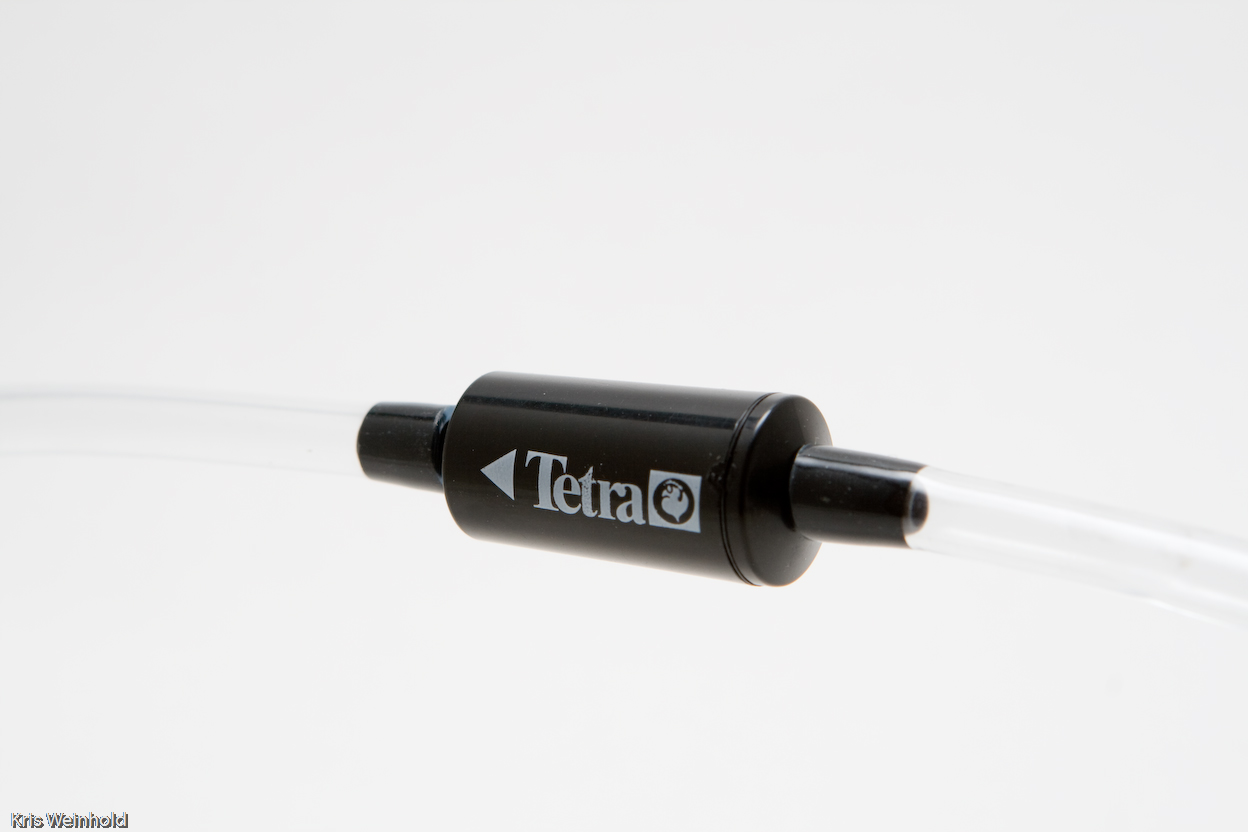
All said and done, I spent $2.99 for the container, $16.99 for the powerhead, $1.99 for the check-valve, and $9.99 for the Intermatic digital timer. I had extra tubing and pipettes on hand, but figure about $35 to build one of these.
Once you have all of your basic components assembled, you need to establish how much solution your powerhead moves every minute, thus figuring out how many total days worth of solution your container will hold. To do this, fill the container with water, and set it exactly where you want it to be next to the tank. This is important because the powerhead will pump different amounts of water depending on the height/distance it is pumping. Now, run the powerhead at 1 minute intervals, using a marker to mark the water level on the container at each interval. Once deplete of water, count the number of marks — that’s how many days you can automate your dosing with a full container. For me, it worked out to exactly 14 days — how convenient!
Now, armed with the previously knowledge of how much I should dose over the same period, I calculated my solution amounts. I put in 100mL of Seachem N and K, and 50mL Seachem Flourish, Iron, and Excel. It’s important not to mix P with Iron in the same container as they interact, so for now, I will have to dose Phosphate separately. Also, for the first time, err on the side of caution, and dose slightly less than what you’d expect. You can always increase it later.
It’s been running for 4 days flawlessly so far, so I’m hoping that this will further help me keep my nutrient levels exactly where they need to be in this tank. I’ll continue to do a few tests to confirm that it’s on target, but I’m looking forward to not having to worry about dosing except for once every two weeks.
March 26th, 2008 at 5:42 am
[…] About a week ago, I started a substrate experiment that I’ve been wanting to try for some time. Having always used commercial substrates, often at high expense, I’ve had a lot of success growing plants over the past few years in my aquarium. Of course, nearly all of these substrates, when used in a light-intensive+CO2 setup require supplemental dosing of fertilizers. Hence, my previous entry about automating the dosing of those fertilizers. […]
April 1st, 2008 at 2:29 am
Thats a pretty affordable price for a liquid dosing system! PerhapsI shuld try it. Now I´m dosing Easy Carbo each day and it would be nice to have it automated.
April 1st, 2008 at 8:30 am
It’s definitely worked out well for me. I’ve had mine running for almost 2 weeks without flaw. Other GWAPA members have been using them reliable for 1-2 years.
August 25th, 2008 at 6:15 pm
[…] Jeff Ucciardo gave a wonderful overview of fertilizers at GWAPA’s August meeting this month. Jeff is a former tank-of-the-month winner on Aquatic Plant Central and is known within the club as having one of the most algae-free and well maintained set of planted aquariums in the club. Much of this is due to his grasp of how to use fertilizers to maintain the proper balance of nutrients in the aquarium. He put together a fantastic presentation, going over Estimative Index (EI) and Perpetual Preservation System (PPS) methods of dosing. Then, he described how he does something in-between those two methodologies while using an auto-doser to maintain consistency. […]
February 23rd, 2009 at 8:59 pm
I’m going to try it with a 404 mini-jet pump b/c it’s a little cheaper… this should work too right?
February 23rd, 2009 at 9:06 pm
Shelly, yes it should work. With a smaller pump, you’ll need to position the container higher, relative to your tank (say next to it on a stand). You may end up getting more days/container with a smaller pump however, which isn’t a bad thing. Post back with your results. 🙂
February 23rd, 2009 at 9:37 pm
Wow, thanks for the quick reply! So where do you set your doser? Underneath the stand? If that’s the case, I might order a 606 instead so I can hid the container since it’s sort of big.
February 23rd, 2009 at 10:41 pm
Actually, I don’t think even the 606 will pump it the 4 feet from floor to rim of tank. I set mine on a table next to my tank.
July 1st, 2009 at 10:13 pm
I needed this! I’ve been dosing my 3 tanks daily, and it canbe pleasant, but taxing and time consuming. I have several spare powerheds that I will try out ofr this. I wil keep you posted.
October 27th, 2010 at 8:19 pm
[…] Re: Dry fertilizers for EI dosing. James/NursePlaty – ever thought of something like this? Auto-dosing Fertilizers – DIY Style– Guitarfish […]
October 27th, 2010 at 8:40 pm
[…] […]
February 21st, 2012 at 12:34 pm
ok so i can’t figure out the dosing solution can you provide any help. my container is 3liter and the pump puts out about 100ml a min. i wanna dose kno3, csm+b,k2so4, kh2po4, mgso4+h2o, and caso4, any help would be awesome.
February 21st, 2012 at 12:53 pm
Leslie, it’s actually pretty easy. Rather than trying to calculate based on how much liquid your powerhead produces per minute, find out how many days your container can dose. Sit the container in its final position, fill it with water, and run as many minute intervals as possible until the container is empty. After each interval, use a marker to make a line on the side of the container. When you’re done, count up the lines — that is how many days worth of dosing your container will allow. Let’s suppose that you find that your container will hold 24 days worth of dosing.
Now, how much KNO3 do you currently dose each day? Multiply that by 24, and add that amount to the container. Do the same for KH2PO4, MGSO4, and CaSO4. DO NOT ADD CSM+B or Iron to this container! If you wish to auto-dose micro-nutrients, you will need to add a second container.
Fill up the container again, and you should be all set. You will probably find that your plants actually need less fertilizers than what you’re currently dosing X 24. Start at that, and if you need to adjust the amount from there, no problem.
Good luck!
June 24th, 2012 at 7:06 pm
Hi, can this dosing method work if I only need to dose 7-8ml of excel carbon? Seachem excel says use 1ml per 10 gallons and my tank is 75 gallons. Can this method move such a small amount of fluid?
June 27th, 2012 at 5:12 pm
Rob, it would be difficult to use this method to only dose 8ml of fluid. The way to do it would be to dilute the Excel in R/O water, so that it would dose more than 8ml of solution, but in that solution, you’d contain 8ml of Excel. Whether or not Excel would disassociate in the container solution I’m not sure. I know Excel can be photo-sensitive so you’d want an opaque container. I’m sorry I don’t have a more concrete answer for you. For dosing small amount of liquid, look up some of the method other hobbyists have used using peristaltic pumps. Here’s a great one to get you started:
http://www.aquaticplantcentral.com/forumapc/diy-aquarium-projects/83361-diy-peristaltic-autodoser-detailed-how.html
September 20th, 2012 at 6:47 am
Good diy doser for big aquariums. To use in small aquariums, doser must be more accurate. To get bigger accuracy, better to use peristaltic pump. Here i found good diy project: http://www.expanser.wordpress.com/. Here are 3 channels, fully automatic dosing pump.
September 20th, 2012 at 7:03 am
Thanks for the comment, Robin. I agree that the peristaltic pump based dosers are very nice. That said, I’ve been successful at using the powerhead-based ones on smaller tanks, and the liquid added has been reasonable to limit the effect of evaporation on a small tank. You can put an in-line ball-valve on the output, which effectively increases the head pressure on the power-head resulting in less liquid coming from the doser. You just calibrate it to what you need. I usually will have a much less concentrated solution for smaller tanks even so.
That said, the peristaltic pumps have the very desirable trait that they can more easily pump liquid against gravity, meaning that you can have your reservoirs under the tank, which is usually more convenient. It does come at a cost, however, as the peristaltic pump based projects are usually significantly more expensive to build. Thanks for the link — that’s an awesome project — one of the more elegant solutions I’ve seen!