March 16th, 2007
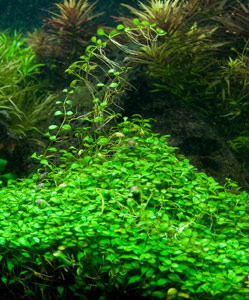 When your aquascape has a glosso foreground, just about every 6-8 weeks, you glosso will look like it does in this picture. The glosso will have formed a mat that’s about 3-4 inches thick, with portions of that mat floating up away from the substrate. Underneath the substrate, you’ll have a nice thick mess of mulm sitting there. And if you’re lucky, you’ll have from fry using this thick mat as a refuge from much larger fish.
Too bad for those fry, when this happens, it’s time to replant! I have to do just this, this week. In about 6 weeks, I will be hosting the GWAPA meeting. Hopefully, by that time, that new glosso plantlets will have matured into a nice 1″ thick glosso mat.
Timing is one of the key things to keep in mind for every aquascape. Whether you’re planning to show the tank to friends, club members, or take that perfect photograph for sharing online or to submit in an aquascaping contest, timing is everything. I generally tend to play things by ear, but one of these days, I’ll spend a little more time counting backwards. What I mean by that, is the advice of another GWAPA member, Ghazanfar, who suggests writing down every time you trim a plant. Then, whenever that particular plant looks “perfect,” note that on your calendar too. If you subtract the “perfect” date from the date you trimmed, you should know exactly how long it takes for each group of plants in your tank to reach its ideal look. Then, anytime you want to show your tank, you just need to count backwards from that date for each plant, and trim accordingly. By the tank your friends are over, every plant in your tank should look “perfect!” (Of course, YMMV.)
Posted in 75G Tank Log, General | 1 Comment »
March 14th, 2007
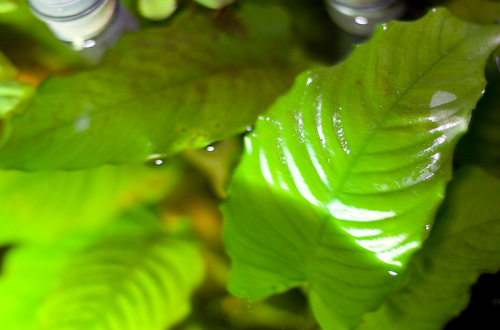 At the last GWAPA auction, “Delaware Jim” was auctioning off two bags of some “mutant anubias” that appeared in his tank. Apparently, he claims, this plant grew from a regular Anubias barterii ‘nana’ rhizome. What we’re talking about here, is an anubias plant with leaves that very closely resemble Anubias barterii ‘coffefolia,’ except the stems are approximately 12+ inches tall.
In the picture, you can see that some of the leaves are growing out of the water. This is in a 54G corner tank that is 24″ tall. That’s one heck of an anubias ‘nana!’ My theory is that some other species of anubias was hitching a ride with his nana plant, and over time, the plant grew to this incredible size. If that’s not the case, then something in his tank must have spurred this mutation. In either case, I promise that I won’t drink the water if I’m ever at Jim’s house!
Posted in General | Comments Off on Mutant Anubias!
March 5th, 2007
 This weekend, we made a trip down to New Bern, North Carolina to visit family. Since we were blessed with some beautiful 65 degree days, we decided to visit a park on the Neuse River where pine bogs and forest were all around. Of course, I couldn’t resist hiking through the surrounding areas to do some exploring and snap a few pictures.
 With pine needle litter everywhere, I can only imagine how soft the water must be here. As damp and marshy as this looks, there really was not an unpleasant smell whatsoever. This is why I believe this is a bog, as opposed to a swamp, where water sits, allowing organics to break down and release gases. The bog flowed directly into the Neuse River, where Cypress trees lined the water’s edge. Even despite the lack of summer leaves, the roots and water provided for a very nice landscape. I was hoping to find a few pitcher plants to photograph, but I imagine it is still too soon after the latest frost for

those. I did, however, see quite a few Hydrocotyle vines starting to emerge along the wet ground. I
bet the entire floor will soon be covered with these as the weather warms. One of the neat things about this specific location is that the Neuse River is brackish, so among the freshwater plants and species found in the bog, where the two met you could find more saltwater-related things of interest. There was plenty of barnacle-covered driftwood, mussels, and clam shells populating the sandy beach.
I hope to get back down to these bogs sometime later in the year when it’s warmer to see the contrast the seasons have on these areas. If anyone has any suggestions for places to go, please comment to let me know!
Posted in General | 2 Comments »
February 6th, 2007
This was posted on the forums, but I wanted to re-emphasize its importance. It appears that the native habitat of the Galaxy Rasbora is being threatened due to overfishing by exporters of the aquarium fish. I’m not really sure what we, as hobbiests, can do to help except to avoid buying Galaxy Rasboras that aren’t captive bred. Unfortunately, most LFS’ don’t know or display such information.
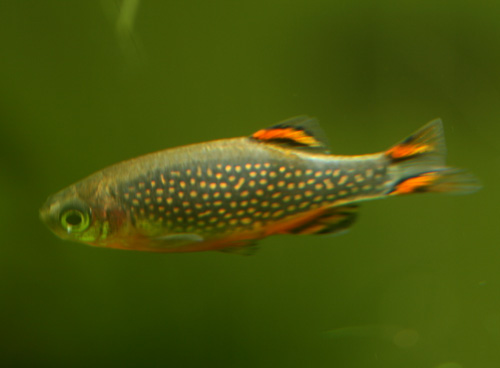
I’m a little bit conflicted because as I mentioned a few weeks ago, I recently purchased a bunch of these beautiful fish after coming across a deal I couldn’t refuse. I’ve been feeding them black-worms, so now I think I’m going to do my best to breed these guys. Unfortunately, there’s not a whole lot of information about their spawning parameters due to their newness to the hobby. Please comment if you know how to breed these fish.
Update: I manage to come across a link to another site that details how they’ve successfully bred the Galaxy Rasboras. Here’s the link: http://www.aquamoss.net/Articles/Microrasbora-sp-Galaxy.htm
Posted in Fish Profiles, General | 7 Comments »
January 19th, 2007
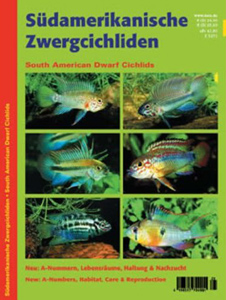 A few weeks ago, I came across this post on one of the cichlid forums, offering a dual language (English/German) version of a special DATZ publication on South American Dwarf Cichlids. I decided to contact the poster, Mike Wise, who consequently is the person who did the actual translation work from German to English, and is now selling copies of the book himself to folks in the United States.
This week, I received the book, and boy am I impressed. This doesn’t have the extensive information that the Cichlid Atlases have on each species, but as a simple photo log for hundreds of apistogramma or other dwarf species, with general locality information, it’s tremendous. Most species have multiple photographs, showing possible color morphs, and noting differences between different A-numbers currently attributed to the same species name. The book is organized sequentially by A-number, but the index is very comprehensive, listing both Latin and common names for fish, so they’re easy to lookup.
My only complaint for this book is that it doesn’t list pH or TDS information for each species. That said, I realize that this information is not necessarily available for every species, and even if it were, might fluctuate greatly depending on the wet/dry season.
All in all, this is a very dangerous book. It’s easy to flip through the pictures, and find some amazing species that you would like to try in your tank. I imagine many of these are hard or impossible to find unless you go collect them yourself, but it’s great to peruse nonetheless.
You can get a sample of some of the book’s pages here.
Posted in Books, General | 3 Comments »