• Pages

  • Categories

  • Photos

    Amazon Snail Kite Hairgrass with Algae
  • Archives

  • Options

GWAPA: Ghazanfar’s 90-P

January 30th, 2011

Ghazanfar Ghori hosted GWAPA’s January meeting last weekend, and I wanted to share a fantastic video that our recording secretary took of Ghazanfar’s 90-P aquarium and aquascape. The wood in this aquascape is a special wood from Southeast Asia that maintains its bark underwater without releasing too many tannins. He complements the detail in the wood with lots of Riccardia chamedryfolia (Mini Pelia) , Fissidens moss, Bolbitus, and Anubias barterii var. ‘nana’. The foreground is a very shallow layer of pool filter sand, with ADA Aquasoil in the background to provide nutrition to the plants. Check it out!

For more information about this tank, and the rest of the meeting, please see GWAPA’s website.


Business Broker

GWAPA: Hardscaping Workshop

April 6th, 2010

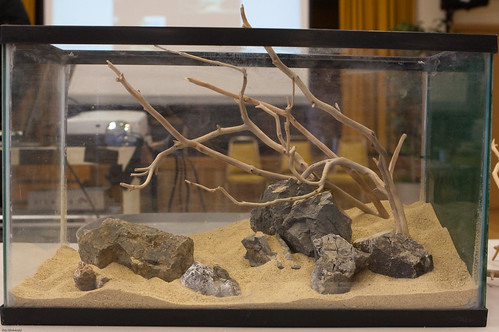
A couple weekends ago, GWAPA, our local aquatic plant club, held its first ever hardscaping workshop for its members. Twenty-ten is the year of the aquascape in GWAPA, as we are doing a whole series of meetings stepping thru the ins-and-outs of aquascaping, culminating in an aquascaping contest. The first meeting in this series was about setting up the hardscape (rocks/wood).
GWAPA Hardscaping Workshop

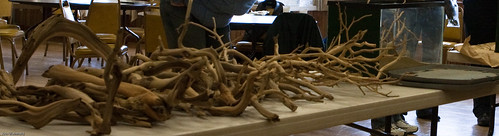
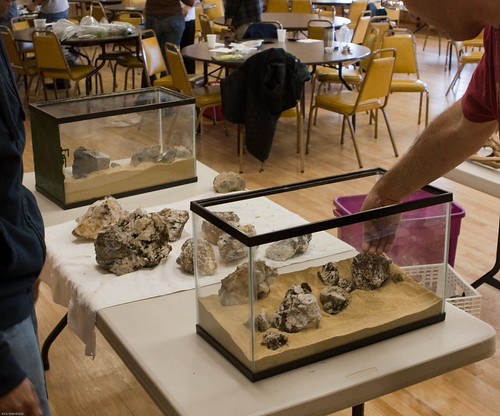
The club provided buckets of rocks and a large box of manzanita so that our members could get their hands dirty in several 10G aquariums we had setup. The idea was to provide the materials for folks to be creative, while having more experienced aquascapers in the room to assist and give pointers.
GWAPA Hardscaping Workshop

I had the privilege of doing a short presentation at the beginning of the meeting, where I showcased a number of award-winning aquascapes and pointed out how the hardscape was the foundation for why they were successful.
GWAPA Hardscaping Workshop

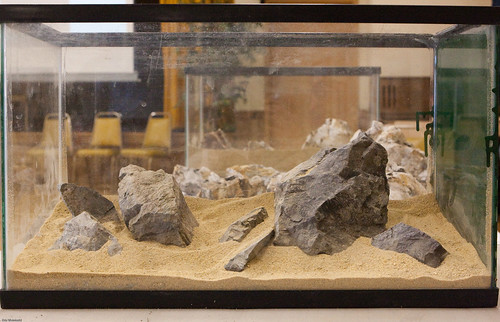
Our members produced a variety of different hardscapes. Some were rockscapes like the one above, using locally collected slate.
GWAPA Hardscaping Workshop

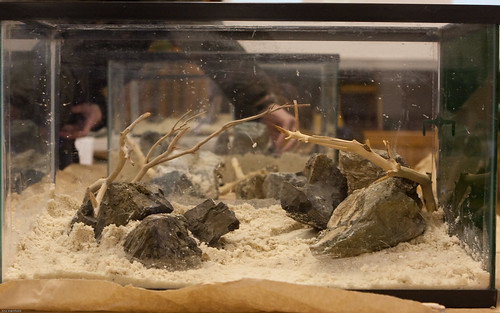
Others decided to mix manzanita and slate in their tanks. It’s not hard to figure out where this member would have planted this hardscape, leaving a path down the middle.
GWAPA Hardscaping Workshop

I was happy to see lots of collaboration among members when working on their hardscapes. Personally, I’ve found it very beneficial to aquascape by committee so because other folks can point out potential pitfalls that I would have otherwise missed.
GWAPA Hardscaping Workshop

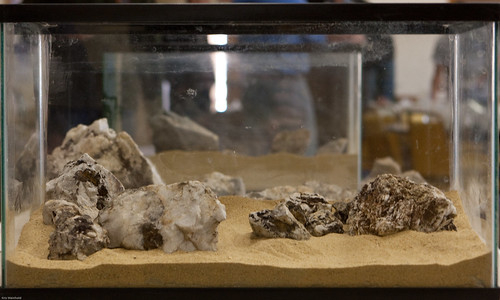
In addition to the slate, we also had some locally collected quartz-based rock, which looks very nice in an aquascape with a bright sand foreground.

GWAPA Hardscaping Workshop

In the end, we auctioned off all of the manzanita and aquariums at reasonable prices. The auction itself was pretty sizable, and overall, I think the workshop was a success. Has your club ever done anything like this? I’d love to hear other similar types of experiences in the comments…

Business Broker

Paul’s 90G Updated Aquascape

March 23rd, 2010

Last fall, a couple GWAPA members got together at Paul’s house to help him aquascape his 90G aquarium. To remind you, just after planting, the new aquascape looked like this below. Obviously, the initial planting did not feature many stems in the background.

Paul's 90G - Aquascape Just Planted

Just after planting...

Now, several month later, the tank has really grown in. Paul made a few minor adjustments to the original placement of the wood in the aquarium, which I think now looks better than one day one. The foreground is growing in very nicely, and the Sagittaria subulata in the middle background is adding a very nice jungle look. The Cryptocoryne looks especially healthy in this aquarium.

Paul's 90G Aquarium

Currently...

I think the hardscape, foreground, and mid-ground look pretty good. The background looks good, but I probably took the picture about a week past its prime. I think that when Paul trims the stem plants, and they grow back up to about 3-4 inches above the tallest rock, it’ll be perfect. What does everyone else think of this aquascape? I will pass any comments onto Paul…

Business Broker

GWAPA: January 2010 Meeting

February 4th, 2010

Two weekends ago, GWAPA hosted its first meeting for the year at our member Ghazanfar’s house. Ghazanfar is an accomplished aquascaper, and had a fantastic aquascape on display in his ADA 90P aquarium. He also has an extensive emersed setup, with several racks of 40G breeder tanks filled with various Cryptocoryne and similar plants. In the past I’ve always marveled at his huge 210G in-wall aquarium, with automatic water changes, metal halides, and a nice aquascape, but this meeting everyone was glued to his 90P.

Ghazanfar's 90P

Ghazanfar's 90P - Photo By Jim Michaels

The actual topic of the meeting was about growing aquatic plants in tissue culture. Ghazanfar showed us some jars of various Cryptocoryne that he has started to produce via tissue culture techniques. Doing this allows you to preserve and propagate large quantities of genetically identical plants, which could otherwise take much more time and space using traditional growing methods. We ended our meeting, as always, with an auction full of aquatic plants.

Business Broker

Rico’s New Aquascape

January 11th, 2010

On Saturday, a fellow GWAPA member, Rico, invited a few of us over to help him aquascape a new 75G aquarium that he had just bought. Originally, we were going to aquascape his 90G aquarium, but a leak developed in that tank, and he had to replace it with the 75G. My friend Cavan and I showed up mid-afternoon and helped Rico finish transferring stuff out of his 90G, bring in the the new 75G, and off we went. Rico had some manzanita wood and dark river rocks to use as hardscape items.

Rico's Tank

It took us a little while to figure out what direction we would take with the hardscape material at hand. The problem we originally ran into was figuring out how to get enough height in the hardscape, but we ultimately discovered the right combination of manzanita branches, zip-tied them together, and solved that problem. After the wood was in place, we filled in underneath it with the river rocks. Never having scaped with river rocks before, I wasn’t exactly sure how it would turn out, but I was very pleasantly surprised. The rocks match Flourite Black Sand almost perfectly!

Rico's Tank

For plants, we used Ranalisma rostrata in the foreground, which should fill in as a nice short grassy lawn. In the mid-ground, we used Blyxa japonica and Hygrophila sp. ‘Kompackt’. As a transition plant between the foreground and mid-ground, we used Staurogyne sp. ‘Porta Vehlo’. Finally, in the background, we used Blyxa aubertii and a broad-leafed Sagittaria species. Ultimately, I hope Rico will remove the Sagittaria altogether and replace it with just Blyxa aubertii, but we didn’t have enough of that plant to do it in the beginning. Finally, for a little bit of color, Rico had some stems of Limnophila aromatica, which aren’t visible in the picture, but should be very nice to the right of the B. aubertii on the left.

Above is the picture a few hours later after Rico filled it up and added back in the fish. Please ignore the three rocks placed on top of the manzanita to keep it from floating — those will be removed in a few days after the wood is waterlogged. So, how did we do? Comments/suggestions welcome!

Business Broker

Aquafest 2009 – Aquascaping Challenge!

October 19th, 2009

I haven’t posted in a long time, largely because I’ve been incredibly busy preparing for Aquafest 2009 in Laurel, MD. As president of GWAPA, one of the three clubs hosting the convention, there was plenty to do, but after a blur of a weekend, I think the convention was a success. Thanks to all of the sponsors, attendees, and volunteers who helped us pull it off! The main event that I was responsible for was the aquascaping challenge between Jason Baliban, our speaker, and Jeff Ucciardo, GWAPA’s vice president.

Aquascaping Challenge

We spent the hour prior to the event sorting a mass of materials into two equal piles so that Jeff and Jason would start on a completely level playing field. Above is some of the manzanita wood that we got from Manzanita.com to use in the scapes. Jason got off to a quick start, putting in the white pool filter sand, developing a hardscape, and topping it off with some Aquasoil.

Aquascaping Challenge

Jeff took a little bit of time to plan his scape, but was right behind Jason once he got his hardscape placed. Jason chose to extend the white sand all the way from front to back, while Jeff kept the sand confined to the foreground. Both competitors divided the tank into two mounds, one larger than the other.

Aquascaping Challenge

In the end, both Jason and Jeff finished before the hour was up, which is quite impressive given the amount of time I usually spend working on an aquascape. Below is Jason’s finished scape from the side. The judges liked the rockwork in his scape, as well as the use of manzanita to provide flow to the layout.

Jason Baliban's Scape

However, the judges thought he could have filled in the scape with more plants than he did, but recognized that it should fill in nicely once it grows in. The tanks themselves are very nice, being a first look at Aquarium Design Group’s own line of rimless aquariums. They are 24″x16″x16″ and Catalina Aquarium donated a pair of HO-T5 lights to go with them.

Jason Baliban's Scape

Jeff’s finished aquascape is below, and as you can see, he did a very nice job filling in the scape with plants from the get-go. The judges took off points for his hardscape saying that it got lost in the plants.

Jeff Ucciardo's Scape

They also wondered why he didn’t extend the white sand front to back between the two mounds. Ultimately, we ended up being able to exhibit two very nice scapes, especially considering that they were completed in an hours’ time frame. The judges gave a slight nod to Jason’s scape, but explained to the audience what they liked and disliked about each.

Jeff Ucciardo's Scape

Also, during the whole hour, I gave a mini presentation about Aquascaping in general. We wanted to avoid folks from getting bored while the planting was going on, so I fielded a number of questions keeping the competitors from having to. Our A/V team also did a great job projecting the two tanks live onto two large screens so that everyone could see what was going on. Overall, the event was a success!

Business Broker

Helping a Friend Rescape

September 1st, 2009

This weekend, myself and another GWAPA member helped a third GWAPA member, Paul, rescape his 90G aquarium. Paul has been in the club for awhile, but wanted to make an earnest foray into the high-tech world of aquascaping. He has a nice T5 fixture on order, CO2 rigged up, and replaced his old gravel mixture with several bags of Eco-Complete.

Paul's 90G - Rockscape

It took us longer than you would think to place eight rocks in the aquarium. We added a rock, stood back and looked, gave directions to the person closest to the tank to move a rock a little to the right or left, and ultimately ended up with the rockscape you see above. You can see a little bit of crayon on the front of the glass because we drew a very minor sketch on the tank beforehand. The crayon wipes right off.

Paul's 90G - Hardscape

After setting our rockscape, we added another two bags of Eco-Complete to mound up on both sides. Then, we added in a few manzanita branches that Paul wanted to use in the scape. After doing this, we were ready to start scaping. We wanted to to keep a relatively simple plant arrangement for the time-being, so we used a number of lower-maintenance plants, with a couple stems thrown in.

Paul's 90G - Aquascape Just Planted

We used Sagittaria subulata and a short Lilaeopsis species in the foreground, with Lobelia cardinalis and Crytocoryne wendtii in the midground, and on the right side background. There’s Echinodorus sp. ‘Vesuvius’ and Ludwigia inclinata var. verticillata ‘Cuba’ in the left background. Overall, I think we were all pretty happy with the scape. Obviously, it needs to do a lot of growing in, but it should fill out nicely. It’s definitely a lot of fun to aquascape with other people!

Business Broker

GWAPA: Carnivorous Plants Nursery

August 24th, 2009

On Saturday, GWAPA’s meeting was hosted by Michael Szesze, the owner and operator of Carnivorous Plant Nusery, in Derwood, MD. Michael runs an impressive local and online business, exclusively selling bog plants, with a huge emphasis on carnivorous plants. He currently has two greenhouses, filled with healthy plants.

Greenhouse

Walking through the nursery, it could have been easy to overlooked all kinds of interesting plants. The sheer number of pots was quite staggering. Michael explained to us that carnivorous plants are pretty easy to keep provided you follow a few strict rules. Provide a nutrient-free environment, water with nutrient-free water, and don’t overfeed.

Carnivorous Plants

He pots all of his plants in a near 50/50 mixture of peat and quartz sandbox sand. For some plants he may adjust the ratio slightly, but he says that if you start with a 50/50 mixture, you’ll be able to grow just about any carnivorous plant. He collects his own rainwater, linking all of his home’s downspouts to a subterranean series of cisterns to store the water.

Pitcher Plants

Outside of the greenhouses, Michael keeps several boxes of carnivorous plants. He is able to overwinter these plants in place, covering them and monitoring the temperature under the cover to ensure that it does not reach 22 degrees F. He explained that 22 degrees F is the bursting point for most vascular plants, so if you maintain the temperature above that, your plants will be fine.

Grow Boxes

Michael recommended against explicitly feeding carnivorous plants, as enough insects will find their way to the plants on their own. He leaves his greenhouses open during the summer to allow critters to come in and fall prey to his plants. He has also effectively used carnivorous plants as a fly and pest control method on his porch.

Sundew

In addition to the grow houses and boxes, Michael has maintains an attractive bog/pond area in his backyard. Many of the plants in the pond are not specifically bog plants, but he has filled the surrounding areas with the peat/sand mixture, so various carnivorous plants line the pond’s border.

Pond

Despite being a steamy rainy day, I very much enjoyed visiting this Carnivorous Plant Nursery. In addition to perusing the greenhouses and grounds, we also held our regular GWAPA aquatic plant auction. There were some serious deals to be had on plants this month!

Sundew

Of course, the dangerous thing about going to places like this is that now it’s tempting to try and start a little bog to try and grow these plants. I was able to forestall that impulse at the meeting, but I could foresee a bog plant or two in my future. Comments welcome!

Business Broker

Suitland Bog

August 2nd, 2009

On Saturday, a few GWAPA members met at the Suitland Bog in Suitland, MD for a guided tour by the bog’s caretaker. We visited this bog two years ago, and thought it was time for another visit. On my previous trip, I had thought I had gotten a picture of Red Milkweed (Asclepias rubra), but was corrected by a reader that infact I had not. So, this year, I’m proud to have found it, and got the picture below!

Red Milkweed

In addition to the Red Milkweed blooming, there was also another type blooming in the bog, which is shown below. Both are very pretty pink flowers. The ranger stated that the milkweeds weren’t always present in the bog, but showed up one day many years ago. He suspects that they were introduced by birds.

Milkweed

Also, interestingly enough, the main attraction at the bog, the Northern Pitcher-Plants (Sarracenia purpurea), are also not native to the bog. Apparently, prior to the mindset of preserving native habitats, botanists would collect interesting plants from other areas, and transplant them into habitats they believed the plants would do well. This is exactly what occured with the pitcher-plants, which were originally transplanted from New Jersey. Currently, the ranger actually has to weed out some of the pitcher-plants to prevent them from over-crowding the natives.

Sarracemoa purpurea

Another one of the carnivorous plants in the bog, Round-Leaved Sundew (Drosera rotundifolia) has been shaded out a little bit since I was there two years ago. Only a few remain, but the ranger is hopeful that some tree maintenance in the bog will help them make a comeback.

Sundew

The main attraction for me personally is the Ten-Angled Pipewort (Eriocaulon decangulare), which is a magnificant grass, and was in full-bloom. One of the reasons I’m so interested in this particular plant, is that I believe it would probably grow submerged.

Eriocaulon decangulare

It’s quite easy to distinguish an Eriocaulon from other grasses, as the flower-heads are very distinctive. Fortunately, these plants seem to be doing pretty well in the bog. The ranger told us, however, that if they didn’t actively trim and maintain the area, that the whole bog would be totally reclaimed by the forest, and would likely disappear.

Eriocaulon decangulare Flower

For that reason, I’m extremely grateful to him and his colleagues for knowing the importance of preserving this habitat, and making it available for the public to visit. I’m hoping that a few GWAPA members will be able to help volunteer a couple times a year to further this effort.

Business Broker

GWAPA: Ponds and Container Water Gardening

July 1st, 2009

Sherry Mitchell hosted GWAPA’s June meeting last weekend, where she took us around her beautifully landscape garden, which included a huge reflecting pool/pond. Appropriately, Sherry then described her various methods for successfully settings up a pond or container water garden.

Pond, Reflecting Pool

As you can see in the picture below, Sherry plants all of her pond plant in containers. Instead of using the overpriced pond-baskets, she recommends using plastic under-the-bed boxes which can be had for a dollar or two from any Target or similar store. She has a large colony of goldfish in her pond, many which she has rescued from situations that were not befitting of living creatures.

Goldfish

To filter the few thousands of gallons of water in her pond, Sherry uses a homemade “Skippy Filter,” which she built using designs from SkippyStuff.com. Essentially, water flows in the bottom, and is lifted through a series of filter pads before returning to the pond. The benefit of this system is that it’s comparatively low-priced, reasonable in terms of the maintenance required, and does a great job.

Skippy Filter

In addition to the filtration, she also believes in doing 50% water changes each month. The water does not go to waste, however, as she has a drain on the filter which automatically waters plants in the rest of her garden, using the nutrient-rich water from the pond.

Lilli

There were a number of lillies blooming while we were at her pond. She has a well-proven system for potting her plant. Instead of using a standard aquatic plant mix, she uses a combination of Osmocote fertilizer with top soil, kitty litter (for clay), and pea-gravel to keep the other stuff down.

Sealed Planter for Water Container

She’ll use the same methods in smaller containers for growing out plants, or when setting up a container water garden. Sherry mentioned how it’s often difficult to find large containers that don’t have drainage holes. She seals those holes using margarine lids and aquarium cement on either side of the hole. From there, the container should be water tight, and ready for use!

Frog on Lillipad

This was a wonderful meeting. In addition to the beautiful outdoor features that Sherry described to us in detail, she also had a nice fishroom inside. We had another large auction, and raffled off some pond and plant supplies. I’m going to have to apply many of the principles Sherry described to my raised brick pond when I get the chance.

Business Broker

« Previous Entries