Tank Tested: My 150G
August 3rd, 2018I’m flattered to have some of my tanks featured on the Tank Tested YouTube channel. The first is my 150G Amazon inspired aquascape.
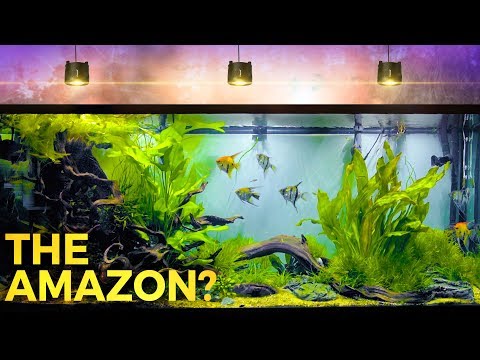
I’m flattered to have some of my tanks featured on the Tank Tested YouTube channel. The first is my 150G Amazon inspired aquascape.
About three years ago, I reviewed Ecotech Marine’s second generation Radion Pro light, and while I loved the configurability of the fixture, I felt the colors were not optimum for planted aquariums and the lens cast too many shadows. Two generations later, Ecotech has resolved both of those issues and has produced one of the most complete lighting systems on the market.

I received three items from the company for this review. A pre-release version of their XR30W light with the freshwater components installed instead of their normal reef configuration. The result is that this fixture is roughly twice as powerful as the XR15FW light that just hit the market. The Reeflink acts as a bridge to your home network so that you can control the light from their EcoSmart webpage or mobile app. The RMS Mounting System is a very nice mount that mounts on the rim of your aquarium.

Immediately out of the box, the unit looks an awful lot like the generation 2 light I reviewed three years ago. They replaced the touch-based buttons with more resilent physical buttons. More importantly, they have upgraded their lenses from the TIR lens to the new HEI (Hemispherical Edge Illumination) lens, which does a vastly better job at mixing the various LED colors and distributing the light evenly throughout the tank. I was dubious when I first read about these lenses, but after experiencing them in person, I can vouch that these new lights have far less shadows and a better PAR distribution that the previous version. 
Speaking of PAR, the readings at full power are off the charts! The light is mounted on a 24″x18″x18″ rimless aquarium which puts the light roughly 22″ from substrate. Measuring at that level reads an astounding 351 PAR! As mentioned, this light is roughly twice as powerful as the XR15FW, but the expected 175 PAR that fixture would deliver is still way more than you need. And measuring the power consumption, my unit maxes out around 185 watts, but the XR15FW is half of that at 95 watts at full power. However, the power consumption is based on your output. Hooking mine up to a power meter, it estimates that my yearly electricity costs would be less than $20.

I’ve been running the light since late January, and am just as impressed now as when I set it up initially. Rather than trying to use this on a typical Nature Aquarium Style aquascape that’s mostly green plants, I decided to setup more of a jungle-style aquarium that has plants of various colors to see how they look under the Radion unit.

As you can see above, the greens are very bright and not washed out or too yellow. The red of the Alternanthera is quite brillant, but also the most subtle orange of Rotala rotunifolia is well represented. And of course, as has been the case with all Radion units, you have complete control over the color using the web or mobile applications.

In the fourth generation, Ecotech Marine finally got the message that the old units had way too many blue LEDs. Now, the lights house mostly white LEDs, plus 4 Red, 2 Green, and 2 Blue LEDs, you don’t have to sacrifice PAR to achieve slight variations of the daylight spectrum we prefer in our freshwater planted aquariums.

Using their Ecosmart Live software, I configured a full-day schedule that begins to ramp up around 8am and shuts downs at 10pm at night. Normally this would be way too long of a schedule, but the flexibility of this system allowed me to configure very low light in the morning, and a low-light moonlight for much of the evening. I also varied the color spectrum to be more yellow in the morning, and more reds/blues in the evening to better simulate sunrise and sunset coloration and intensity. This creates a very natural lighting scheme and extends the period of time I’m able to enjoy this aquarium with the lights on.
In conclusion, the fourth generation Ecotech Marine Radion is one of the top lights on the market. With the enhanced HEI lenses and improved color configuration, combined with the already impressive EcoSmart Live, the XR15FW Radion is a high-output LED light without any real downside to note. The PAR can be set as high or low as needed for any planted aquarium
, multiple lights can be combined for a stronger or more comprehensive setup, and the overall performance is impressive. The XR15FW is currently selling for ~$350, which covers a 36″x36″ footprint, making it pretty economical for the coverage and features. In short, anyone looking for a high-end light for their planted aquarium should look no further than the Ecotech Marine Radion XR15FW G4 LED light fixture.
Here’s an updated shot of my recently rescaped Aquavas aquarium. This tank is the only tank that’s showcased in my home, in our living room, while the rest of them are consolidated in my fishroom.
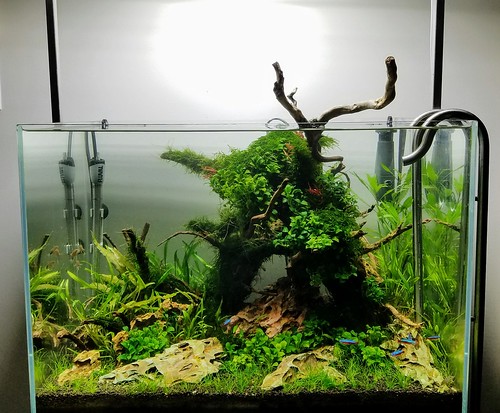
The goal of this aquascape is to prominent feature something of a twisted old tree , while keeping the rest of the scape fairly minimalist. I had previous done sand foregrounds in this tank, so I wanted to change it up with an Eleocharis ‘Mini’ foreground this time around.
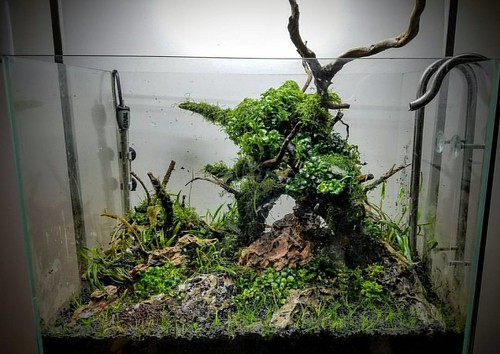
You can see above how the hardscape and planting came together. I try to plant as densely as possible to help the scape mature more quickly. I also had the luxory of wood that was reused from a previous scape and already had lots of moss and Anubias ‘petite’ attached to it.
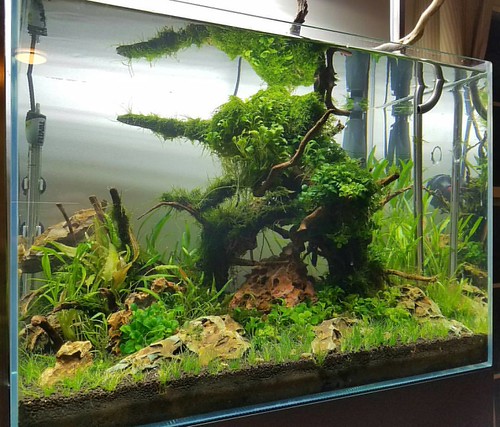
Finally , above is what the scape looked like a day after planting. You can see that it’s already maturing a bit in a week or so by comparing to the first picture. Comments/critique welcome!
During my winter break I rescaped my Aquavas aquarium that previously been setup for over a year. Below is the new scape, utilizing lots of spiderwood and dragonstone. It’s a pretty simple scape in terms of plants
, using mostly weeping moss, Anubias barteri var. nana, Hygrophila corymbosa ‘Angustifolia’, and some crypts.
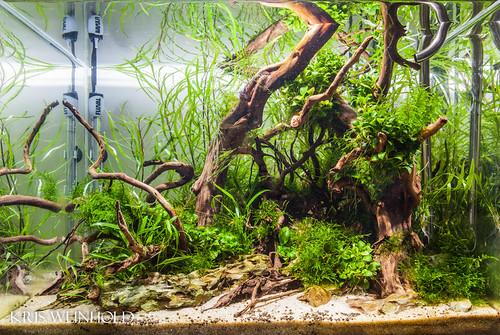
The old scape used pretty much the same plants, but had become very overgrown with moss and I was ready for a change.
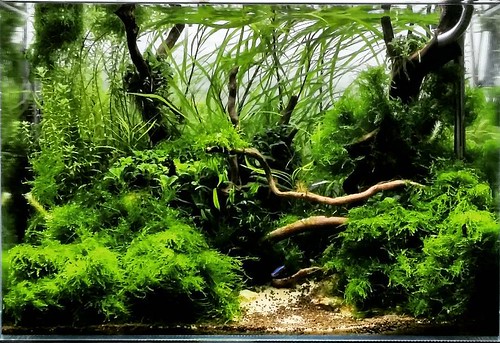
The biggest challenge in the new scape is the darker area created under the branches. I like the intrigue that this area creates
, but it definitely makes it more difficult to photograph. The fish, just a few cardinal tetras, usually like to hang out there, however. I still need the Hygrophila to grow in more in the back left and perhaps get a bit more moss established on the wood. Comments/critiques welcome!
My 120G aquascape is growing in nicely! The wood has finally sunked after a couple of months , and the mounds are filling in the gaps between the various pieces of Rosewood. I’m happy with the jungle effect in this tank, with most of the species of plants intermixed throughout each other. I will need to be diligent to keep the Hygrophila pinnatifida from throwing out runners that consume everything, however.

The Stuarogyne ‘Bihar’ is another plant that could easily take over the scape. I may pull it out, anyways, opting for more Ludwigia ‘Cuba ,’ but I haven’t fully made that decision yet. Comments/critiques welcome!