Apistogramma similis

May 31st, 2008

At the last CCA meeting that I attended, I picked up a pair of Apistogramma similis that the speaker had collected himself when in Bolivia. I’m hoping that they really are this species because they don’t exactly look like the pictures in my Cichlid Atlas Vol. 2, but they aren’t that far off either. In any case, Apistogramma similis is quite similar to Apistogramma inconspicua, with a different number of dorsal spines. The extent to which this species is distributed is unknown, being found a couple jungle rivers in the Bolivian province of Beni.

Apistogramma similis

I don’t expect these guys to be terribly difficult to breed in my 75G aquarium, and hope that I’m able to garner a small population of them. These aren’t the prettiest apistos available, but still have their appeal, and if my juvenile specimens color up a bit, they’ll be nice to look at nevertheless. I’ll post updated pictures of these guys as they mature.


Business Broker

75G - Updated Photo

May 21st, 2008

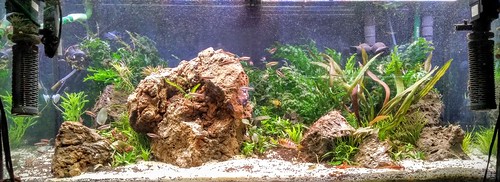
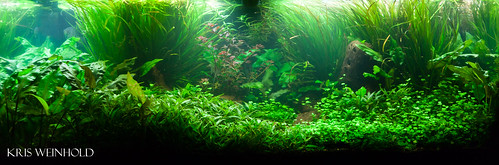
It’s been about a month since the last shot of my 75G aquarium. Since then, the Eleocharis sp. ‘Japan’ has continued to grow in, and is still exhibiting the fantastic downward sloping growth it’s known for. The Cryptocoryne pontederiifolia in the foreground/middle has really started to explode. I suppose the roots have reached critical mass, and now there’s no getting rid of it. (not that I would want to!)

75G - May 21, 2008

Otherwise, I have a few signs of collectoritis showing on the right-hand side of the aquascape with stems of Pogostemon stellatus, Ludwigia sp. ‘Cuba’, Eriocaulen sp. ‘Type 3′, and Ludwigia sp. ‘Pantanal’ all growing in close proximity. I ought to decide on just one of those, and go with that. Not to mention that I’ve totally mixed up Limnophila aromatica and Limnophila hippuroides in the middle of the tank! Honestly, I’m wondering if what I bought as L. hippuroides is really L. aromatica anyways because they look the same to me. Finally, the Java Fern sp. ‘Fingers’ in the top/middle/left is looking fantastic! All-in-all, for not paying much attention to this tank, I can’t really complain too much about its appearance. It could definitely benefit from a couple good trims, but otherwise, it’s maintaining itself pretty well, I think. However, suggestions are always welcome!

Business Broker

Ludwigia inclinata var. verticillata ‘Pantanal’

May 7th, 2008

Ludwigia inclinata var. verticillata 'Pantanal'At the last GWAPA meeting auction, I bought Ludwigia inclinata var. verticillata ‘Pantanal,’ which is a plant I have tried to keep a few times previously. Known as a relatively difficult plant, any lack of nutrients or light causes the stem plant to melt away. In the past, I’ve even seen a single stem wave in and out, with leaf widths varying from about half an inch up to 2 inches, representing periods of neglect, and periods of proper growth.

Fortunately, if adequately cared for, Ludwigia inclinata var. verticillata ‘Pantanal’ is one of the most beautiful stem plants available, maintaining a brilliant red coloration that is sure to draw the attention of any onlooker. There are many more leaves per node than Limnophila aromatica, which makes the stem look more compact, particularly because the leaves themselves stay a tad bit smaller as well.

While certainly not a plant for any beginning hobbyist, I highly recommend this plant to any more experienced grower. High light, rich substrate/fertilization, and CO2 are a must for this plant.

Business Broker

75G - Work in Progress

April 22nd, 2008

I haven’t posted a picture on my 75G tank in about 2 months, so I decided that it was time, despite still being a work in progress. I suppose that my tanks have suffered a little bit from the nice weather outside, as I’ve been more focused on preparing the garden outdoors, than working on the aquariums inside.

75G - Work in Progress

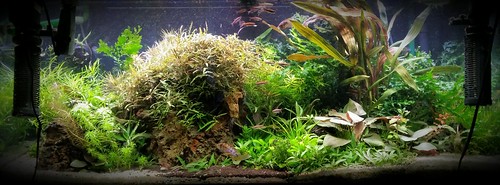
The Eleocharis sp. ‘Japan’ is starting to fill in the foreground. The right side of the tank has some Ludwigia inclinata var. verticillata ‘Cuba’ beginning to grow, as well as, some Rotala verticillaris that I’m hoping will provide a nice vibrant green in the back corner. There’s still something about this scape that I’m not entirely pleased with, something about the right side, but I haven’t taken the time to really move things around — largely because the Nannochromis nudiceps have dug out a cave on that side that I don’t want to disturb. If anyone has any comments, critiques, or suggestions, I’d love to hear them!

Business Broker

Apistogramma hongsloi ‘Super Rostrich’

April 17th, 2008

Last weekend, I purchased a pair of Apistogramma hongsloi ‘Super Rostrich’ from fellow CCA members, TwoFishGuyz. I had been looking at a number of West African cichlids for my 75G tank, but I came across these guys, and decided to stick with my beloved Apistogramma.

Apistogramma honglsoi 'Super Rostrich'

Apistogramma hongsloi ‘Super Rostrich’ are a captive bred strain of A. hongsloi that are selected to have more vivid coloration than their wild kin. This particular strain also has longer lyre-tailed fins. As far as Apistos go, this particular species gets fairly large at 3-4″ for males, similar to other members of the Macmasteri group, such as A. veijita. Despite still being fairly young, you can see the potential coloration of the male in the photo above.

Apistogramma honglsoi 'Super Rostrich'

As usual, the female is much less impressive (shown above), exhibiting a somewhat awkward body shape, and having the typical black markings on the front of their dorsal and pelvic fins, with an otherwise, mostly yellow body. So far, mine haven’t really seemed to bond, but hopefully in time, love will set in. *laugh*

Apistogramma honglsoi 'Super Rostrich'

Despite the lack of mating behavior, they’re both fairly lively fish. The male is especially active, swimming up and down the glass, looking at me. Hopefully, after plenty of live foods, they will settle in, and produce a nice little colony of Apistogramma for my 75G.


Business Broker

Eleocharis sp. ‘Japan’

April 15th, 2008

I have recently replanted the foreground of my 75G aquarium with a new dwarf hairgrass that I came across called Eleocharis sp. ‘Japan.’ I ordered four pots of this plant in a GWAPA group order, and noticed that it looked just like any other hairgrass when it arrived. The reason for this is that the potted plants were grown emersed, and didn’t exhibit the unique behavior that is present in the submersed form.

Eleocharis sp. 'Japan'

Submersed, Eleocharis sp. ‘Japan’ curls downward toward the substrate, creating an effect not present with regular hairgrass. You can see in the picture below how all of the new submersed growth is doing exactly that. Otherwise, this plant grows just as you would expect; it spreads by runners throughout the substrate. It took a little while to get going after I first planted it, but it is now finally starting to take off. I’m hoping that it will cover the entire foreground in another month or two.

Eleocharis sp. 'Japan'

I will post an update once it has filled in, but I’m expecting this to be a very nice, and unique, addition to my 75G aquascape.

Business Broker

Catfish Like Zucchini

February 20th, 2008

For many catfish, specifically “suckerfish” like plecos, it’s often stated that you want to keep wood in your aquarium as it’s an integral part of their diet. It’s also true that they ought to be fed other vegetable matter, such as algae wafers, veggie-based pellets, and so on. Well, fresh, clean vegetables are also a cheap and much appreciated treat for these fish.

Chinese Algae/Zuchchini Eater

We had zucchini as part of our dinner last night, so rather than throwing the ends down the disposal, I cut the stalk off, and set aside 4 small circles of the squash for my catfish. Now, these vegetables were certified organic, so I was fairly confident that they would be pesticide free. In the summer we grow our own vegetables, so we know their source as well. If there’s any doubt, at the least do a thorough washing, and at the best, don’t throw them in your tank. Also, if they’ve been contaminated with any oils, butter, or seasonings, don’t put them in the aquarium.

Chinese Algae/Zuchchini Eater

The problem with fresh zucchini is that it floats. Placing the pieces in a small dish with a bit of water, I microwaved them for 4-5 minutes, or until they stopped floating. This boiling process breaks down the cellular walls, allowing them to become water logged. Alternatively, you can tie them down to a heavy object. The last step is to slice a couple notches in the rind of the squash. The reason being that the catfish eat out the soft core, and could potentially get the “ring of rind” caught around their bodies.

Chinese Algae/Zuchchini Eater

At first, when I dropped the cooled zucchini into the aquarium, none of the fish took much notice. I was surprised that the cories didn’t seem to care for it at all. Then, my chinese algae eater (CAE) found one of the pieces, and started going to town. Two other plecos (Ancistrus sp. L279) took notice and latched onto the same piece. A rigmarole of back-and-forth swapping of the vegetable pieces ensued for 20 minutes before I let them continue on for however long.

Chinese Algae/Zuchchini Eater

Even when not scraping the inner core of the zucchini, the CAE sat over top of one of the pieces, claiming it as his own. While this was going on in my 54G, Red Lizard Catfish and some cherry shrimp were devouring two pieces in my 75G tank. Over the next day or two, I’ll pull out the rind once all of the “good stuff” has been eaten.

Bottom line, if you’re chopping squash for dinner, set aside a couple rounds for your catfish — they’ll love you for it!

Business Broker

Microsorum sp.

February 16th, 2008

Last fall, two GWAPA members, Jim and Ghazanfar, traveled to Europe to attend the European Cryptocoryne Society’s (ECS) annual meeting. Armed with all of the proper phytosanitary documents, they were able to bring back a number of species of plants from the meeting. One of these plants is a currently unidentified Microsorum species that is quite different than any of the other Microsorum (Java Fern) species we’re currently keeping in the United States.

Microsorum sp.

This particular specimen has a many more branches than your typical Java Fern. At first, we thought it might be the Tropica cultivar, Microsorum pteropus ‘Tropica’ ,but after comparing multiple pictures, that seems to have a fatter fern with my smaller saw-like edges coming off. The species Ghazanfar & Jim brought back looks much more like a hand with multiple fingers, or a trident’s staff, with narrower leaves.

Microsorum sp.

It grows just as quickly as your regular Java Fern, but unlike the Windelev variety, the irregular leaf shape appears to be present on plantlets forming on the end of leaves, in addition to new leaves from the rhizome. I think it’s a little bit prettier, as the narrower leaves bend down slightly, creating a cascading effect that you don’t usually get from a much more upright Microsorum pteropus.

Microsorum sp.

I’m hoping that eventually the folks in Europe will help us identify exactly what this fern is. But until then, I’m going to enjoy it as a centerpiece in my 75G aquascape. More info/pictures can be found on APC.

Business Broker

75G - February 2008 Update

February 5th, 2008

It’s been about a month since my last update on this tank. I recently pulled out a large number of plants for the GWAPA auction, harvesting plenty of Utricularia graminfolia in particular. I’m pleased that the tank is growing well, despite measuring 0ppm nitrates yesterday (prior to dosing more), but some parts are growing out of my favor. Largely, the Anubias heterophylla on the right side is getting a bit unwieldy.

75G - 02/04/2008

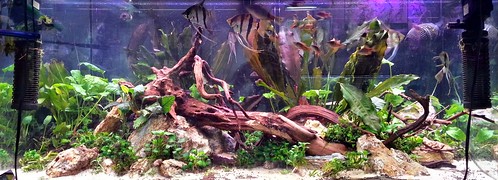
Also, the Pogostemon stellatus in the back right has gone in and out of looking great to looking like crap. So, I got some Ludwigia inclinata var. verticillata ‘Cuba’ and Eriocaulon sp. ‘Type 3′ at the last GWAPA auction that will hopefully replace the P. stellatus in the back right. My problem is that I haven’t found the best transition plant for the right mid ground. On the left, I have the Utricularia graminfolia in front, with Hygrophila sp. ‘Low Grow’ and Crypt. affinis behind that, stepping up to Blyxa aubertii. That’s a nice transition. On the right, it’s the Utricularia to Crypt. willisii to the stems. Unfortunately, the stems usually look like crap after a trim, messing up the transition. I’ve thought about moving some Eriocaulon sp. ‘Type 2′ over there, but that plant may then be repeated too closely together.

Maybe I’m thinking too much?

Business Broker

Bolbitis sp.

January 9th, 2008

Bolbitis species have long been regarded as a low-light, undemanding plant, that survives in most aquariums. It’s a nice looking fern, adds a deep green to the tank, and can be attached to driftwood, or other hardscape materials. A couple months ago, a species of Bolbitis showed up at a GWAPA meeting that our club hadn’t seen before. This is what I’m calling Bolbitis sp., since I don’t know the proper name.

Bolbitis sp.

At first, we suspected that it was a terrestrial fern, but due to the quantity brought to auction, it was clear that it grow just fine underwater. It was sent to the club by a rainbowfish breeder and collector, who happened to order it from an order source. The leaf form has many more indentations than the usual type. I’ve been keeping it in my 75G aquarium, and growth has been quite slow, but it is growing nevertheless. If anyone can identify the species of this bolbitis, please leave a comment.

Business Broker

« Previous Entries