2006 Catfish Convention – Day 2
October 21st, 2006 Today was the second day of the 2006 Catfish Convention. I was able to attend most of the sessions today, and I must say that all were of very high quality. Tomorrow, the convention will wrap up with an all-day auction.
The first session of the day was about African catfish, and was presented by Mark Soberman. Mark gave a brief overview of the 9 families of catfish native to the contient. A few highlights included Austraglanidae, who are an endangered species in South Africa. Of course, he had to mention the Claridae family of catfishes, who are an air-breathing group of catfishes that are now banned in the U.S. after a series of incidents related to Snakeheads. Don’t forget the Malapteruidae, who include a few electric catfish, and the Mochakiadae, who are Africa’s largest family of catfish.

Really, all of these were just leading up to Mark’s favorite group of African catfish, the Synodontus. Synodontis catfsh include many of the fish we are familar with in our LFS’s, such as the upside-down catfish. He describe a number of fishes, but also lamented a little bit, at the current influx of Synodontis hybrid fishes coming out of Singapore fisheries. Mark feels that African catfish species are unique enough in their own right, that the hybridization only confuses hobbiests.
Inbetween sessions, I decided to take a trip down the hall to the Fish Showroom. 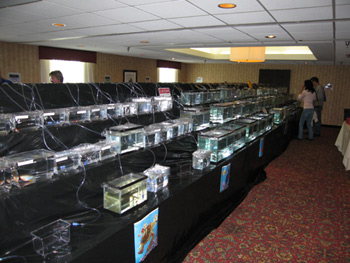 This room have about 200 tanks in it, stocked full of conference attendee’s best fish from their fishrooms. There were more than just catfish represented in this rooms; there were: catfish, killies, bettas, cichlids, livebearers, danios, pretty much any class of fish you can think of.
After purusing the fish, and admiring more than a handful of beautiful specimens, I headed back to the lecture hall for Ian Fuller’s second talk of the conference about Breeding Corydoras.

Ian covered all aspects of his breeding techniques for Corys. He recommends the following:
– buy fish already at breeding age.
– know how to seperate males from females. For example, males often have an elongated ventral fin. Females usually have broader bodies. Males are usually the more colorful fish.
– Use smaller tanks, such as 10-20 gallons.
– Use RO water, adjusting it to 6.5-7.0 PH, GH 0-3 degrees, mix in 1 part Epson salt, 1 part Marine Salt, and 2 parts chalk.
– Use fine grained salt/gravel. Do NOT use a bare-bottom tank because it’s bad for the Cory’s barbles.
– Setup the tanks with oak leaves, beech twigs, java fern/moss, etc.
– Feed a variety of foods. Brine shrimp, microworms, earth worms, and Tetra tabs are especially good.
– Trigger spawning by doing massive water changes, temperature changes, PH crashes, etc.
– When you see eggs, add Alder cones to the water as a mild anti-fungal treatment. Move the eggs to a hatching container with Java moss.
 The last session I attended today was by Dr. Peter Unmack about Austrailian catfishes. I think that Dr. Unmack might have had the most interesting talk of the day, largely because it featured catfish that I had never seen before.

There are only two families of catfish in Austrailia. Many of the species in these families actually spend a portion of their life in saltwater. Many are mouthbrooders (pictured right). Unfortunately, there aren’t many Austrailian catfish that are suitable for aquaria. Furthermore, the ones that are, rarely are seen because their natural habitats are too remote to easily collect and ship. This is a shame because most of these catfish would be relatively easy to keep. For example, they can tolerate a wide range of PH swings because in nature, when streams flood, the solids are diluted, causing the PH to drop. But, when the water recedes, the PH skyrockets. The catfish don’t care. Infact, this fluxation might trigger spawning.
The Plutosidae family is a really interesting family of catfishes. The look like someone took a South American catfish’s head, and put it on the body of a knifefish, or eel.
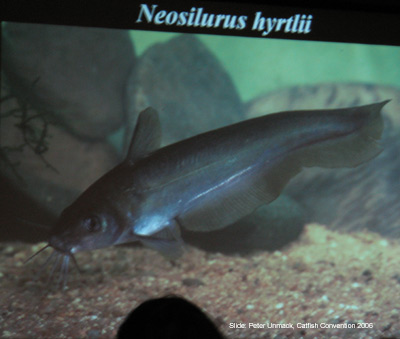
One of the most widely distributed fishes from this family is the Neosilurus hyrtlii (left). As you can see, they don’t have distinct caudral or dorsal fins. Peter also described the Neosiluroides cooperensis, which he thinks is one of the most bizarre catfish in Austrailia. This fish is found in Cooper Creek, has unusually good eyesight, and is an adept predator of other fish and shrimp. They lay huge eggs, and are rarely caught under 6″ in size. In his experience, it will kill anything it see’s.
Peter wrapped up his talk with a slideshow of other Austrailian fish, including rainbowfish and gobies.
After this session, I decided that I couldn’t risk not buying a few fish/crayfish that were on sale out of one of the hotel rooms, so I promptly bought more than I needed, and headed home to put my new fish in their tanks.
 Today was the first day of the
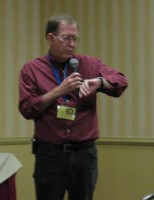
 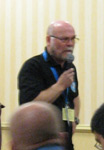 a large local aquarium club. The program director is Andrew Blumhagen (left), who opened the convention by introducing to us hobbiest, and corydora expert, Ian Fuller (right), all the way from Great Britain.
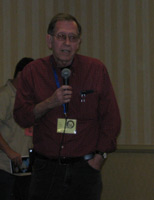 The second speaker at the convention was Lee Finley, who gave a presentation focusing solely on how to feed your catfish the kind of food they would normally eat in the wild. Basically, catfish don’t just eat algae and detritus when in the wild. Depending on the species, they’ll eat wood, bark, algae,
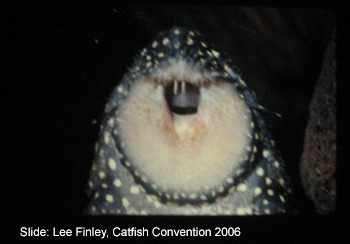 detritus, veggie matter, fish, insects, larvae, worms, the list goes on. His slide of the commonly known Vampire Pleco, or Rabbit Tooth Pleco, illustrated how specialized some of these catfish have become. These Plecos used their “two front teeth” to chisel away at wood, searching for inserts; much like a
  wood pecker would do in a forest. Unfortunately, Lee had to rush through his talk in order for everyone to make it to the much anticipated Italian dinner.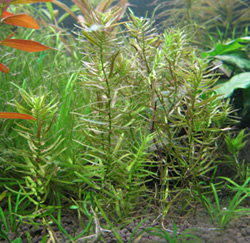
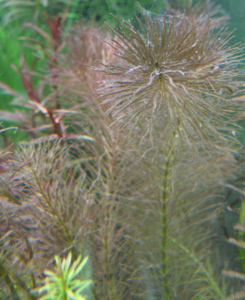
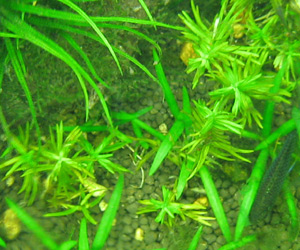 The main plant I wanted to try was didiplis diandra. Over the years I’ve seen a number of nice aquascapes using this plant. It’s got a nice greenish, bronze color, but the knock on it is it that the stems can be quite delicate, causing the bottoms to rot and the tops float up. I’m looking forward to see how this grows in my 40G in aquasoil.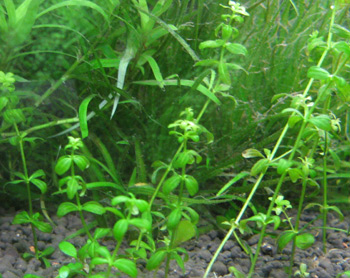
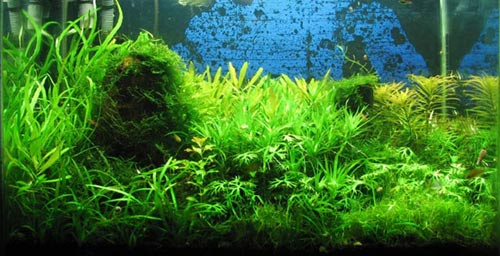
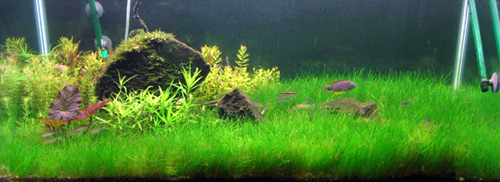 This is my first attempt at an iwagumi scape. A breeding population of apistogramma panduro are the main occupants in this tank. Most of the aquarium is covered by eleocharis acicularis, with more stargrass, rotala macrandra “green”, limnophila aromatica, and nymphea “red lotus” occupying the back left.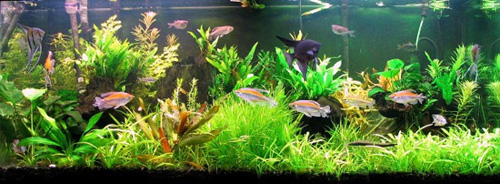
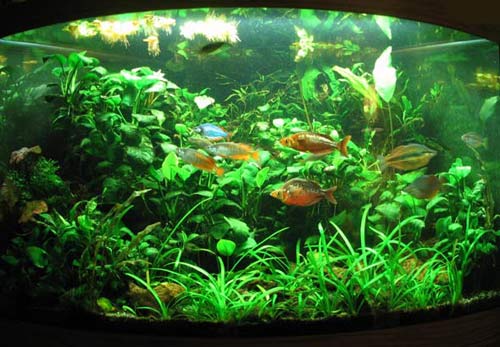
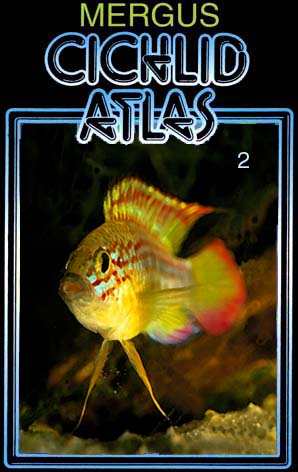 Many years in the making, Dr. Uwe Romer has volume two of is Cichlid Atlas series out! The book is currently available in the UK, but I don’t think it arrives in the U.S. until later this year. I ordered the UK version of this book upon release, and must say that it’s an excellent follow-up to volume 1. Like the first book, the multitude of information contained in this book is a little bit overwealming at first. But, after sitting down with it for a little while, it’s amazing how much useful information is contained.