September 8th, 2008
In a 20L aquarium, I have a small colony of Threadfin Rainbowfish, Iriatherina werneri, that I’m attempting to breed. These blue-eyes are beautiful fish that I’m hoping to eventually have a huge school for my 75G aquarium. The males are especially brilliant, displaying long fins, which they use constantly to prove their dominance to other males, and to impress females.
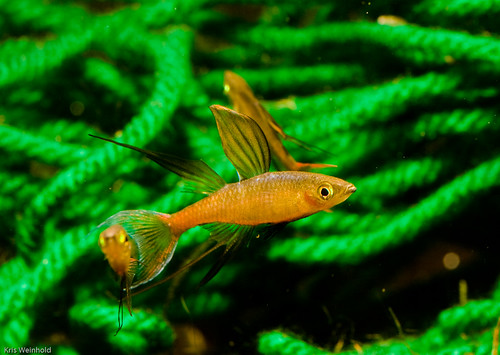
The males also tend to get a striking headlamp, a bright yellow/orange stripe along the top of their head, when they’re courting females. The females are not pictures here, but they do not have the elongated fins that the males do. It’s quite easy to tell them apart due to the noticable difference in finage.
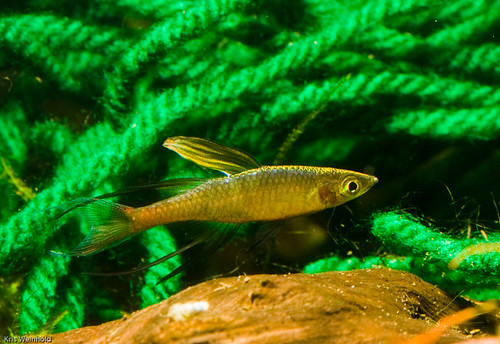
As you can see from the backgrounds in these pictures, I’ve been using spawning mops made from acrylic yarn to try and harvest eggs. The goal is to float these mops, have the fish lay eggs, and then remove the mop and place it into a hatching/rearing tank. By cycling two mops between these tank every 10-14 days, I hope to constantly have new fry. So far, I’ve been successful, but only on a very small scale.
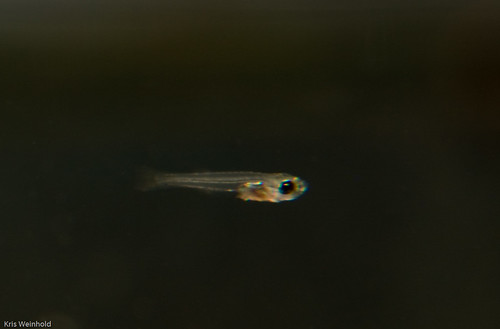
The fry are absolutely tiny when they first hatch; no more than a millimeter or two long. Right now, I have a couple that are 5-6mm long, but recently lost some to a Hydra infestation. I feed the newly hatched fry GP 5micron powder, which besides green water is just about the only thing that will fit in their tiny mouths. I’ve started feeding the larger fry some baby brine shrimp. Hopefully, they’ll grow up fast, and will be able to go in with the adults soon. If anyone’s successfully bred and raised these fish, I’d love to hear some advise.
Posted in 20L Tank Log, Fish Fry, Fish Profiles | 13 Comments »
January 29th, 2008
I’ve been growing Ranalisma rostrata in my 40G tank as the foreground for some time. When I originally setup my 20H, I decided to also plant it in there. As the 20H progressed, I realized that I had too much light, too little CO2, and too little desire to maintain the tank as I really wanted. Therefore, I removed the 55W PC light from overtop, and replaced it with an ordinary 15W fluorescent light strip. Over the past few months, besides being considerably darker than it was before, I’d noticed a huge change in the form of the Ranalisma rostrata in that tank.
Witness how the grassy plant looks in my 40G. Compact growth, overlapping each other, where each blade is thin and relatively uniform.
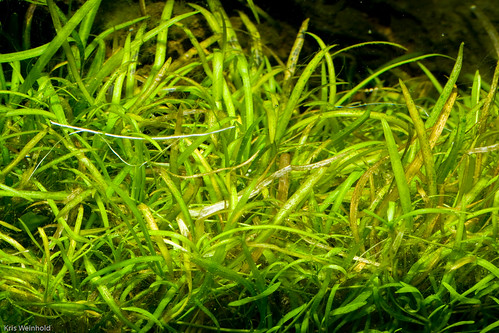
In my 20H, the growth is quite different (below), with blades more resembling a sword plant, than grass. The blades are longer and the growth is much slower. I suspect that the plant is sending out broader leaves to try and soak up more light since less is available. The color is also slightly different, with the broader leaves being a bit more pale, with a yellowish tint, where the regular form is a bright green.
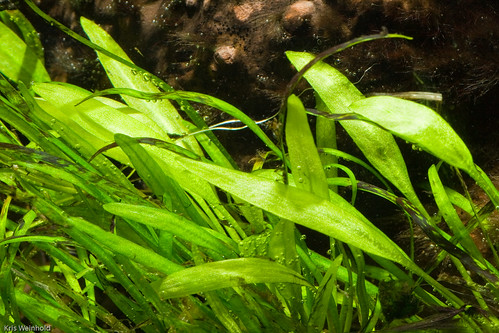
I’m sure that this same phenomenon is present in a wide variety of plants, which is why it’s difficult to say exactly how a plant will grow in another person’s tank. I’m often asked at GWAPA meetings whether a plant is high light or not. In general, I can usually only respond that I’ve only ever grown it in high light, but that they should try it out, and see if it survives in their tank. Now, I can’t even guarantee that it’ll look the same!
Posted in 20L Tank Log, 40G Tank Log, Plant Profiles | 3 Comments »
February 4th, 2007
A year or two ago, GWAPA placed a group order for a number of apistogramma. In that order, I got about 6 apistogramma borellii fish. I successfully bred these guys in a 20G high and had at couple generations going. Then, unfortunately, while I was in California at the AGA, my CO2 tank
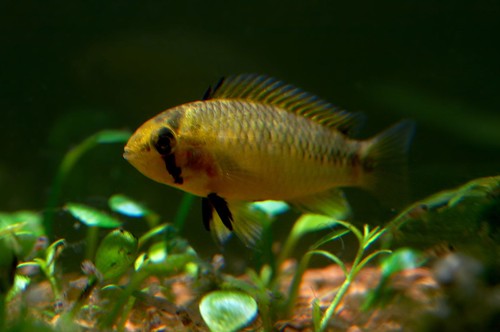
Apistogramma borellii female with babies (lower right) |
dumped the remainder of the canister into this aquarium, and killed off all of my adult fish. All of the smaller fish in the tank survived, including 5-6 borellii babies, which at the time were not sexable. I decided to dedicate a 20G long tank to try and get a new population going. After a couple months of blackworm feeding to get the fish in good breeding shape, I finally noticed the drab juevenilles coloring up — bright yellows and blues! I noticed that a pair formed, which kept 2-3 other males to the outer parts of the tank. Then, this weekend I finally see the female hovering around with a handful of babies. To get an idea of perspective, this female fish is probably only 1.5 inches long. The babies are mere millimeters. Those large looking foreground plants are marselia quadrafolia! It seems that the female has taken to guarding the fry. I haven’t seen the male near them yet.
Posted in 20L Tank Log, Fish Fry, Fish Profiles | 2 Comments »
February 2nd, 2007
I few months ago, I bought a plant from SCALES that was labeled “Rotala indica ‘Red’.” I believe this plant is probably the same thing as Rotala sp. ‘Colorata,’ but at least one GWAPA member believes this is the “real” rotala indica. Either way, this is a gorgeous stem plant that doesn’t need a ton of light to get some very vibrant red tones.
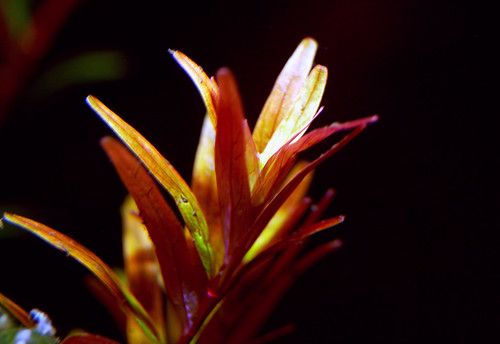
I’ve also noticed that this rotala will start to grow horizontally much more readily than many other rotala’s I’ve tried. As it does this, it sends up multiple vertical stems which can eventually be trimmed and replanted as their on stalk. The plant definitely takes off when CO2 is added, but it seems to grow, albeit much slower, without the added carbon injection. Right now I’m growing this using all SeaChem products in my 20L.
Posted in 20L Tank Log, Plant Profiles | Comments Off on Rotala indica ‘Red’
January 31st, 2007
Here is an updated picture of my 20 long tank in my office. Last week I noticed that one of the female apistogramma borellii had turned bright yellow. I haven’t seen any fry yet, but then again, I haven’t really seen the female fish either. There’s still a school of about a dozen male Endlers in here as well.
 Â
Â
The plants in this tank are rotala macrandra ‘green’, rotala indica ‘red’ (or rotala colorata), Crasula helmsii, Ranalisma rostrata, marselia quadrafolia, and Heteranthera zosterifolia. I’m finally starting to win the thread algae battle in this tank. Over the previous month or two this tank had a mess of 8″ long thread algae flowing in the current. My brother commented that at least I’m able to grow “cool looking algae,” but I wasn’t amused. Thankfully, thanks to a strict SeaChem-only dosing schedule with Excel overdoses, I’m now in control.
Maybe one of these days I’ll properly trim these stem plants. I hate growing stem plants in a 12″ tall tank! At least I like the rockwork!
Posted in 20L Tank Log | Comments Off on 20G Long – Updated Photo