February 9th, 2007
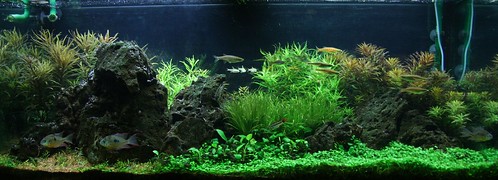
Here’s this week’s picture of my 75G. As you can see, it’s about 90% there. The glosso is right about perfect. Too much longer, and I’ll have to pull it up, and start over. The aromatica is about where I want it too; albeit, maybe 2 days past it’s perfect look in this picture. The broadleaf stellata could afford to be a little bit bushier, but it’s well on it’s way. Really, I’m just waiting on the utricularia. It’s keeps getting uprooted anytime the whiptail catfish is spooked and uplifts the Soilmaster Select. Please feel free to comment and critique.
 Â
Â
Posted in 75G Tank Log | Comments Off on 75G – This week’s photo
February 6th, 2007
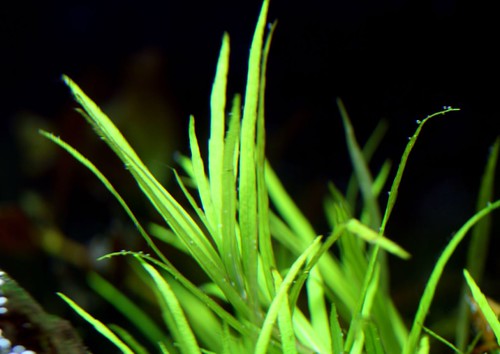
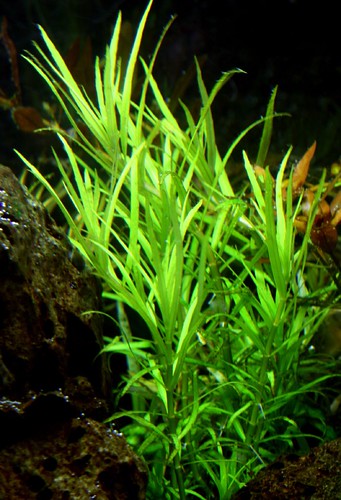 At the December GWAPA meeting, I was fortunate enough to obtain Pogostemon yatabeanus in the mini-auction that we have at every club meeting. P. yatabeanus is an Austrailian plant, from the same reknowned genus as Pogostemon stellatus, formerly Eusteralis stellatus. This particular species reminds me more of the broadleaf variety of P. stellatus, in that it’s a little bit larger of a plant, except that it stays a beautiful bright green instead of bronzing under bright light. It doesn’t seem to be particularly demanding if kept in your typical high-tech setup.
I currently have the plant in my 75G, planted in Soilmaster Select ‘Red’, with pressurized CO2, high-light, and regular dosing. In this environment, P. yatabeanus might be the fastest growing plant in the tank. Young stems stay rather slender with narrower leaves. Older stems can grow quite thick, with leaves that become longer and fatter, similar to how P. stellatus ‘broadleaf’ grows. When you trim P. yatabeanus and leave the lower portion in the substrate, 2-3 new stems start to grow out of the incision.
Due to this plant’s size, I don’t know if I’d recommend it for a smaller tank, but in a larger tank I think it’s the perfect ‘green’ companion to plants such as limnophilia aromatica, pogostemon stellatus ‘broadleaf’, etc… If you can get your hands on this plant, please give it a try.
Posted in 75G Tank Log, Plant Profiles | Comments Off on Pogostemon yatabeanus
January 12th, 2007
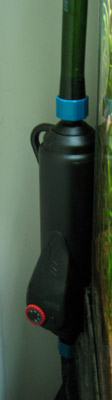 Even though it doesn’t feel much like it in Maryland this year, it’s winter time, and that means that my basement gets pretty chilly. Over the summer, I had previously pulled out a standard submerisible heater in favor of removing as much equipment as possible from my tank. I didn’t want to add my old heater back in, so I decided to try out Hydor’s in-line heater, which hooks right on your canister filter’s out-take line.
Installation couldn’t be simpler with this unit. Out of the box, there’s zero assembly to do. All you do is splice your filter’s output line, connect either end of the line to the heater’s barbs, and plug it in. The temperature is easily set using the red dial. Boom, you’re done.
Since installation, I’ve heard a few “clicks” here and there. That occurs when the heater turns on or off and isn’t audible unless you’re right next to the tank. Otherwise, it’s easy to forget that the heater is even there. The temperature of the water has been kept very stable, so it’s been doing exact what I bought it to do. I’d recommend to anyone with a canister filter who wants to avoid making an in-tank heater part of their aquascape.
Posted in 75G Tank Log, Equipment | Comments Off on In-Line Hydor Heater Review
January 11th, 2007
I used some time-off after Christmas to do quite a bit of maintenance on my tanks. In addition to adding the U.V. sterilizer, I also took this opportunity to rescape the tank, in an effort to hopefully clear up what had been a pretty nasty algae outbreak. When Ghazanfar, Rob, and I spent an afternoon breaking up our prized California rock, I had set one large piece aside, specifically for use in my 75G. That rock is the large rock one the left, and weighs a considerable amount.
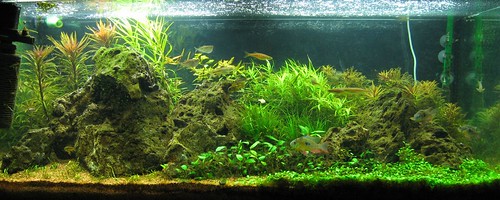
What I didn’t realize until after I put it in the tank, in that the rock has a natural cave in it, that’s just about perfect sized for a female apistogramma, but not quite large enough for the male. In essense, it’s the perfect size, and within a day of rescaping, one of the female A. cacatuoides took up residence.
So, besides the hardscape, I left the glosso intact on the right side of the tank before my previous scape. I repurposed the anubias baterii nana in front of the rocks in the middle, and replanted the utricularia on the left side. I’m a little curious to see if the U.V. sterilizer will have any effect on the growth rate of the utricularia. Finally, for the background, I went up to what has become a plant farm of my 40G, and trimmed out a variety of stems that I thought went together. From left to right: Pogostemon stellata ‘broadleaf’, Pogostemon sp., ludwigia repens ‘narrow-leaf’, Heteranthera zosterifolia, Blyxa japonica, and Limnophilia aromatica.
Posted in 75G Tank Log | 3 Comments »
January 9th, 2007
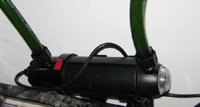
Thanks to some extra Christmas money, I decided to go ahead and get a U.V. Sterilizer for my 75G tank. I’ve been having a rash of green water, and a case of “something’s not right” situations in this tank for the past year, so I guess you could consider this my last resort.
After doing a fair amount of research on the web, I decided to go with Corallife’s Turbo-Twist Sterilizer. 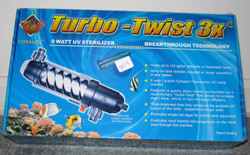 It seems to be a pretty popular product, and the price was right on Amazon.com. Setting the unit up was very easy using the instructions provided. Basically, you start by just unscrewing the one end to install the bulb. After that, you twist the middle section until the two barbs face in the direction that you need to connect to your filter. Finally, splice the output line of your filter, and connect either end of the line to the input and output barbs of the sterilizer. You’re done, once you plug it in.
I was a little bit worried about the sterilizer affecting the flow-rate of my filter, but so far that hasn’t proven to be a problem. And that’s having a CO2 diffuser and in-line heater running on the filter with it. Of course, that why I bought an over-sized filter, Eheim 2028, for my 75G in the first place.
Twelve hours after hooking up the U.V. sterilizer, my tank appeared fairly cloudy, with a white, milky hue. I presume that consistuted a mass bacteria/bad thing die off after being zapped by the U.V. rays. By the second day, the water cleared, and it’s looked clearer than I can remember in recent history. I’m not entirely sure whether I’ll leave it running 24/7, or will turn it off to save the bulb-life a little bit, but I’m glad to know that I have a last resort available to rectify any extra difficult problems with my water column.
Posted in 75G Tank Log, Algae, Equipment | 2 Comments »