• Pages

  • Categories

  • Photos

    Amazon Giraffe Frog Pine Cone Salmon Fry
  • Archives

  • Options

GWAPA: January 2010 Meeting

February 4th, 2010

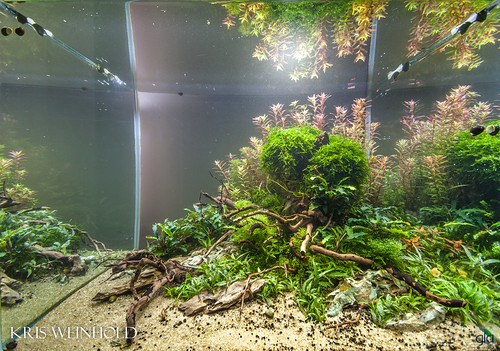
Two weekends ago, GWAPA hosted its first meeting for the year at our member Ghazanfar’s house. Ghazanfar is an accomplished aquascaper, and had a fantastic aquascape on display in his ADA 90P aquarium. He also has an extensive emersed setup, with several racks of 40G breeder tanks filled with various Cryptocoryne and similar plants. In the past I’ve always marveled at his huge 210G in-wall aquarium, with automatic water changes, metal halides, and a nice aquascape, but this meeting everyone was glued to his 90P.

Ghazanfar's 90P

Ghazanfar's 90P - Photo By Jim Michaels

The actual topic of the meeting was about growing aquatic plants in tissue culture. Ghazanfar showed us some jars of various Cryptocoryne that he has started to produce via tissue culture techniques. Doing this allows you to preserve and propagate large quantities of genetically identical plants, which could otherwise take much more time and space using traditional growing methods. We ended our meeting, as always, with an auction full of aquatic plants.


Business Broker

Wild Angelfish

January 29th, 2010

I just wanted to share a couple photos of the new inhabitants in my 75G aquarium. After finding a good home for my Blue Spotted Sunfish, I decided that I would like to keep Angelfish again. This time, rather than just getting the various commercially bred color variations, I wanted to get ones with the wild coloration. I feel the natural coloration with the vertical black bars are the most elegant looking Angelfish of all. I was fortunate to have another GWAPA member turn me onto a breeder.

F1 Wild Angelfish

The breeder imports and breeds wild Peruvian angelfish to keep the gene pool healthy for their other various color variations. They also sell of some of the offspring from their live imports. Finding this out, I bought 7 first generation (F1) domestically bred wild angelfish. The breeder sent 8 fish, and they all looked fantastic, even in the bag.

F1 Wild Angelfish

At first in the tank, the fish hid every time I came into the room, but after a week of feeding them, they have really warmed up to me, and are starting to follow me up and down the tank when I’m working in my fish room. Right now, the Angelfish are the only mid-level swimming fish that I have in this aquarium. I still have my Nannacara, red-lizard catfish, and L279 bristlenosed plecos, so the bottom level is covered. I’m having a hard time settling on a small schooling fish to act as attractive dithers for the Angelfish. Suggestions welcome!

Business Broker

Algae: Spot Treatment Techniques

January 20th, 2010

While I have compiled a reference on getting rid of Algae in the Planted Aquarium, I did not talk extensively about spot treatment techniques to get rid of individual sections of algae where you just can’t seem to get rid of it. Fortunately, there are a number of tools available to target your attack:

Syringe Treatment:

This method uses a cooking syringe like you would use to inject marinade into a turkey, but for the marinade, you use either Hydrogen peroxide (H2O2) or Seachem Excel. First, it is very important that you temporarily turn off all of the flow in your aquarium. While circulation is incredibly important to maintain an algae-free aquarium, when you are spot-treating a specific area of the aquarium, you do not want H2O2 or Excel to disperse throughout the tank. Generally, I like to do spot treatments when I’m doing water changes, simply turning off the flow for the duration of the water change. Load the syringe full, and squirt the troublesome areas of your aquariums. I usually try to limit my spot treatments to a single syringe dose once every 2-3 days. Use caution, particularly with Seachem Excel, as prolonged exposure to over-dosing of these chemicals can injure or possibly kill your fish and invertebrates. I like to do a spot treatment to weaken the algae, and then let natural algae eaters like Amano Shrimp finish the job for me. Combined with water changes, proper CO2/nutrient levels/circulation, and an algae-fighting-crew, you’ll eliminate your troublesome algae in no time.

Old Toothbrush/Wire Brush:

Sometimes algae such as Black Brush Algae (BBA) completely covers hardscape items, making the syringe treatment seem excessive to fully rid yourself of the infestation. In these cases, it is often effective to vigorously brush the algae from the rock/wood with an old toothbrush. For large patches, it may be worth removing the hardscape item entirely, and scrubing it with a wire brush in a 5G bucket of water.

Bleach Treatment:

When you pull items from your tank, you have the opportunity to use harsher chemicals such as a watered-down 1:20 water/bleach solution to kill the algae. Never use bleach in your tank, except for completely empty aquariums — it will kill all of your plants and inhabitants otherwise. Ensure that whatever you bleach is rinsed thoroughly until you can no longer smell bleach on the item.

Spray Bottle:

For hardier plants such as Java Fern, Bolbitis, Anubias, etc you can remove them from the tank and spray them with H2O2 or Seachem Excel. Simply fill a small spray bottle with your solution, and lightly spray the plant. Always do this in a well ventilated area, preferably with a mask to protect yourself from any fumes. With this method, you do not need to inundate the plant, but simply a couple sprays, and then add it back into your aquarium. Alternatively, you can fill a small container with H2O2 and dip the plant for 1-2 minutes.

Conclusion:

Using a combination of these methods, along with the ones I’ve already outlined in my Algae in the Planted Aquarium article, you should be able to defeat any algae that enters your tank.

Business Broker

Vietnamese White Clouds

January 15th, 2010

Last fall, I bought a dozen Vietnamese White Clouds in an auction at a Capital Cichlid Association’s meeting. I have never kept these fish before, but was always tempted by them in the fish stores. The one thing I never realized was how magnificent their fins can be until I put the group in my 20L and the males started displaying. In the stores, the fish just seem to hover in place, but in my tank, the males are constantly chasing each other around.

White Clouds

Supposedly these fish are very easy to breed, but I have not yet seen any eggs or fry in my aquarium. It’s possible that some loaches are taking care of any eggs that might be in the tank. These White Clouds seem to be fantastic fish for the planted aquarium. In addition, they can tolerate slightly cooler temperatures, so you don’t necessarily have to keep a heater in your aquarium. There is also a long-finned version of this fish which is even more impressive.

Business Broker

Emersed Setups Need Attention Too

January 13th, 2010

I’ve often talked about the wonderful benefits of having a place to grow your aquatic plants emersed:

  • A place to store plants you don’t want in your aquariums anymore but don’t want to lose
  • Ability to see flowers that you wouldn’t otherwise see
  • Algae-free!
  • Easy to maintain since growth is slower
Overgrown Emersed Setup

Overgrown Emersed Setups

While all of these statements are true, this doesn’t mean that you can just setup and forget about an emersed setup. A prime example of what can happen is in the picture below. Look at the setup on the right, and take note of what a tangled mess the plants are in there. Hyptis lorentziana and Pogostemon stellatus var. ‘Broad Leaf’ are the two culprits, taking a little while to establish, but then going absolutely insane in growth over the next few months.

Pogostemon stellatus var. 'Broad Leaf' Flower

Pogostemon stellatus var. 'Broad Leaf' Flower

I did get a number of Pogostemon flowers, but unfortunately the overgrowth shaded and outcompeted virtually every other plant I had stored in this setup. I surely would have had more plant-mass if I had grown these plants submersed in my aquarium, but I should have done a better job occasionally pruning back the stems as you would a weedy plant in your garden.

Murdannia sp. 'Red' Flower

Murdannia sp. 'Red'

In the other emersed setup, I’ve had a different problem. I made the mistake of introducing a pot of plants that was in my pond, and I believe the soil contained spider mites. I originally tried a DIY organic spray of vegetable oil and dish soap, but that ended up killing more plants than it did the intruders. I wanted to avoid using pesticides since I am not keen on spraying chemicals inside of the house (or outside for that matter), so I am now in the process of completely emptying out both emersed setups, submerging the plants in a bucket for 48 hours to drown the spider mites, and will then repot and set back up the two setups anew.

Murdannia sp. 'Red' Flower

Murdannia sp. 'Red' Flower

I will begin this process just as soon as the plant sold in the hobby as Murdannia sp. ‘Red’ finishes flowering. Above is a picture of a flower just before maturation. I’ve hoping that my friend will be able to use the flower to research its true scientific name. The long and short is that emersed setups are still valuable tools to grow and store aquatic plants, but they still require some maintenance. I suppose that if I didn’t keep any stem plants in my setups that the length of time between maintenance could be significantly reduced. Comments/suggestions welcome!

Business Broker

« Previous Entries   Next Entries »