September 11th, 2006
In less than 2 weeks, GWAPA will be judging the aquascapes of our member’s 2.5 gallon tanks. Earlier this spring/summer, GWAPA announced a club aquascaping contest. Any club members, who wanted to participate, would be given a 2.5G tank, complete with 3M ColorQuartz Sand, a 2x13W PC light with legs, and a set of Seachem fertilizers.
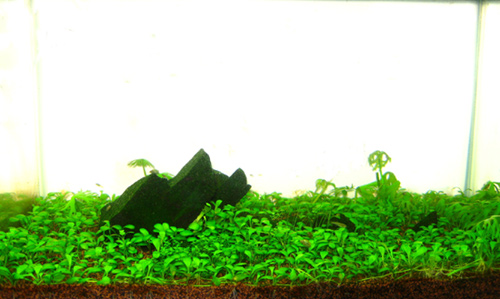
We soon found out that the ColorQuartz sand was nothing near the substrate we were used to dealing with. To put it lightly, growth was terrible! After adding a few root tabs, and fertilizing heavily, the glosso finally started taking off. Below is a picture of my tank, two weeks out from it’s final trim before judgement.
Posted in 2.5G Tank Log | 2 Comments »
September 8th, 2006
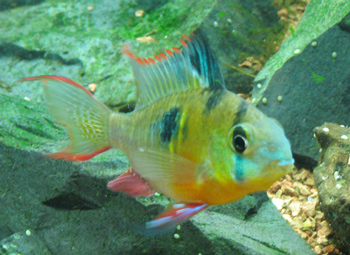
Below are some pictures of one the male bolivian rams, microgeophagus altispinosa, that I have in my 75G tank. Unfortunately, I haven’t been able to find any female rams to try breeding this fish. The local fish stores, generally only carry males because their coloration is much more profound than their female counterparts.
Rams are very nice additions to your tank, even in community tanks. Unlike some of their more aggressive cichlid cousins, these dwarf cichlids from South America are quite docile. I have found that when multiple males are put in the same tank, a hierarchy is definitely established, where the dominant male is the largest and most colorful.
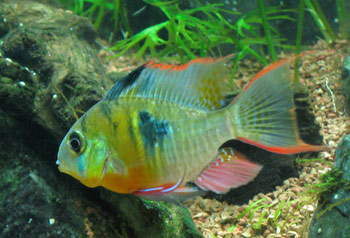
I have kept both rams and apistogramma in the same tank without problem. They will not interbreed, and so long as the tank is large enough, the two will not bother each other. The obvious exception is when either is spawning. Recently, my apistogramma cacatuoides began rearing fry, and seem to purposefully pick out the bolivian rams to chase away from their “nest”. They tend to leave various other rasaboras and tetras much more leeway than they do their dwarf-cichlid-counterparts.
Posted in 75G Tank Log, Fish Profiles | 1 Comment »
September 5th, 2006
I decided to snap a few updated pictures of my 75G tank today. I’m still figuring out all of this photography stuff, so bear with me as I try to get better and better pictures of my tanks.
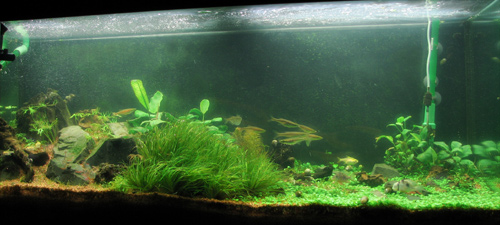
(Front/Angled view)
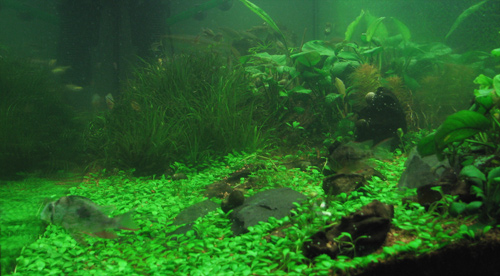
(View from right side)
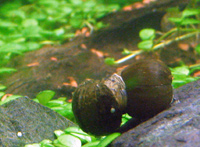
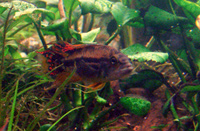 (Left – Apisto. cacatuoides, hovering over some anubias barteri, where his fry are swimming between the roots.)
(Right – Two Nerite Snails cling to one another. I don’t want to know what they’re doing!)
As you can see, the glosso is growing in quite nicely. The Rams have taken a particular liking to swimming in the open “glosso field.” That is, of course, when the female apisto. cacatuoides is not chasing them away from her fry.
Posted in 75G Tank Log, Shrimp/Snails | 4 Comments »
September 4th, 2006
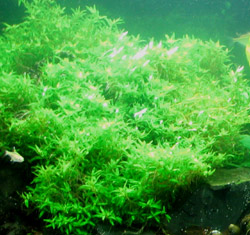 As you can see to the left, the elatine triandra that I had planted, in hope that it would fill the hill in my 75G has grown unmanagable. It looked fabulous for about a week, and then it overgrew itself, to the point where half of it wasn’t even rooted in the substrate anymore.
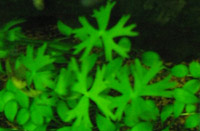
So, I decided to rip it all out, and instead try ranunculus inundatus as my “hill plant.” This is a funny little plant that is somewhat new to the hobby, and isn’t likely to be found in all but a few local fish stores.
Planting this plant is quite similar to planting glossostigma elatinoides; you break it into sections of 1-2 nodes, and plant them individually. Before long, each node will send out new nodes via runners, covering your substrate. From the picture below, you can tell that the leaves can be a number of inches above the substrate. These plants were transplanted from a more shaded aquarium, so they are quite high. I’m counting on the new growth to hug the substrate a little bit more tightly, as I have 220W overtop of this tank, with the top of the hill only being about 10″ from the lights.
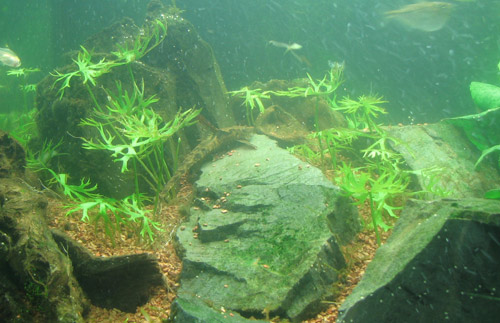
Ranunculus inundatus is a relatively fast growing plant when in the right conditions. Generally speaking, the required conditions are similar to glosso: decent light, plenty of macros, and CO2. You might be able to grow it in less-than-ideal circumstances, but the growth will likely be leggy, with deformed leaves.
Posted in 75G Tank Log, Plant Profiles | 2 Comments »