Ancistrus sp. L279

November 18th, 2007

At both the Catfish Convention and the Aquafest auction, I picked up a bag of Ancistrus sp. L279 dwarf bushy-nosed plecos. After keeping them for other a year, I think this species is a fantastic match for a planted aquarium. They max out in length around 4 inches so they’re not going to inadvertently uproot plants from their size. Mine are not shy, so I see them on wood or lounging on open substrate, and they’re fairly active algae eaters. Plus, they’re very attractive fish with white markings on the tips of their tail, and many have very nice spots on their body. I’m guessing that the spots are a gender distinction because some of mine have very pronounced ones, and others not so much.

Ancistrus sp. L279

I don’t have any with huge sections of tentacles/growths on their snout, but they do have some small barbels. I’m hoping that as my latest batch grows up, they’ll develop these further. I’ve seen this species posted on Aquabid, sometimes called Ancistrus sp. ‘Huaca Mayo,’ so if you come across this listing, give them a try — they’re a great little ancistrus!


Business Broker

Apistogramma sp. ‘Rotpunkt’

September 25th, 2007

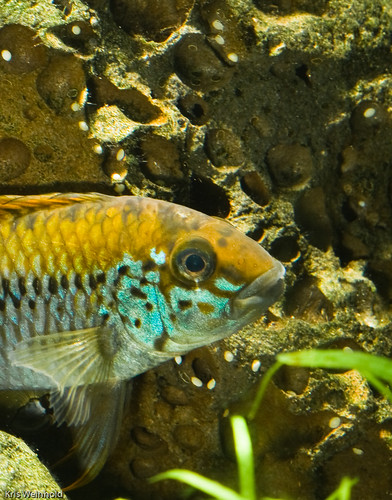
I have been keeping Apistogramma sp. ‘Rotpunkt’ for some time now. I originally received them from Rob in GWAPA, trading him my Apistogramma panduros for six juveniles. While not as flashy as the panduros, they’re still very attractive fish. Their specific taxonomy has yet to really be nailed down. Kullander has named one species formerly know as ‘Rotpunkt’ as Apistogramma alacrina, but it’s likely that this does not describe the most common color morph in the hobby. There are also other color morphs named A. sp. ‘Puerto NariƱo’ and A. sp. ‘Schwarsaum’ that are likely just variations on A. sp. ‘Rotpunkt.’

Apistogramma sp. 'Rotpunkt' Male

The Rotpunkt are very timid fish in my experience. I’ve been trying to get semi-decent pictures of these fish for months, but every time I attempted to setup my photo gear, they spent the next hour toward the back of the tank out of view. I finally managed to take these shots last week after setting everything up, and occasionally revisiting the tank throughout the day to snap some pictures.

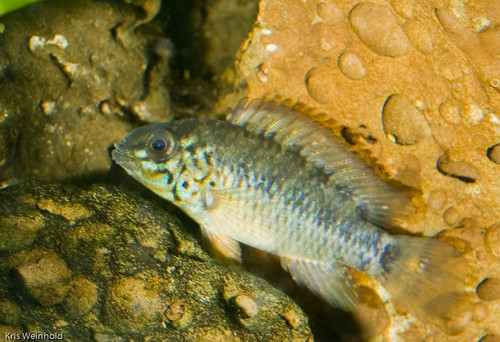
Apistogramma sp. 'Rotpunkt' Male

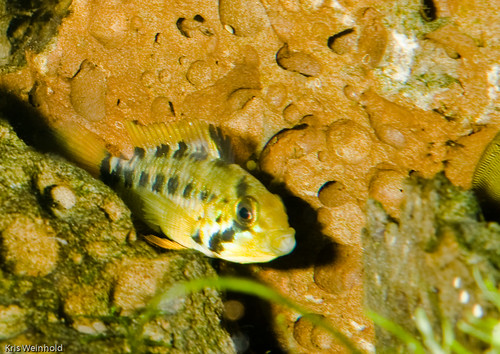
I have a couple of dominant males in the tank (shown above), and thus they have paired up with a few of the different females. I don’t know how many spawns I’ve had, but suffice to say that they don’t seem to be that picky about their breeding conditions. One of the juveniles (shown below) is just starting to color up. I suspect that he’ll probably keep this coloration for some time unless I move him from the tank to claim his own territory.

Apistogramma sp. 'Rotpunkt' Young Male
The females are attractive fish, having more black bars on their side than many of the apistogramma I have kept. When spawning, they become an absolutely stunning yellow. Just like the A. cacatuoides, they really seem to like the crevices provided by the porous mossy rock.

Apistogramma sp. 'Rotpunkt' Female

Business Broker

Red Lizard Catfish

September 20th, 2007

The Red Lizard Catfish, or Hemiloricaria sp. ‘Red’ (L10a), is my new favorite catfish. It’s a whiptail catfish, but stays much smaller than your typical whiptail. This fish tops out around 4 inches in length, making them a wonderful catfish for all but the smallest of tanks. I bought three of these fish last fall at the Catfish Convention from a vendor out of Erie, PA.

Red Lizard Catfish

Native to the Rio Tocantins in Brazil, I thought that these fish would fit in nicely with my Apistogramma cacatuoides. They’re very active fish, constantly scurrying along the rocks, glass, and substrate looking for something to eat. They’re not aggressive at all, and the cichlids don’t seem to bother them, even when the cichlids are spawning. I’m really hoping that some vendors at AquaFest 2007 will have more of these so that I can stock several more in my tanks. I haven’t tried breeding them yet, but it has been done, so if I do get more, I may dedicate a small tank to that purpose.

Red Lizard Catfish

Business Broker

Apistogramma cacatuoides

September 19th, 2007

I’ve kept Apistogramma cacatuoides for some time now in my 75G tank. I started with a trio of the ‘triple red’ color morph. After a few successful spawns, my brilliant male died of seemingly unknown causes. My local fish store had just gotten in wild A. cacatuoides so I decided to try one with my ‘triple red’ females. Before long they spawned, and I now have a small breeding colony of at least 12-15 fish in my 75G community tank.

Apistogramma cacatuoides male

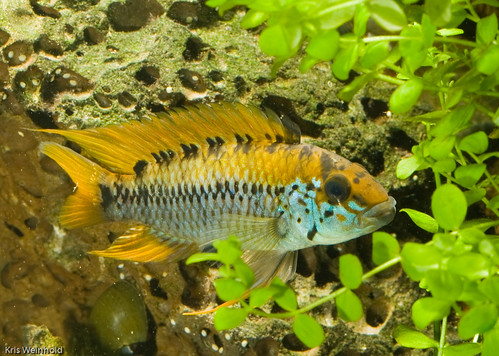
It’s really been fascinating to watch how the triple-red coloration has mixed with the wild male’s drab color. Some of the males, like the one above, only retain a tiny bit of orange on their dorsal fin. Others, have darker bodies, with more pronounced color in their dorsals. (below)

Apistogramma cacatuoides male
Then, some of them have orange blotches on their tail fins. It’s quite possible that this one below is actually a female, but you can see the coloration nevertheless.

Apistogramma cacatuoides male

The black and orange checkerboard pattern is starting to show up on this male’s tail fin, and there’s more orange on the dorsal fin, with slightly more color on the bottommost fins.

Apistogramma cacatuoides

Finally, I also have 1-2 nice specimens where the tail and dorsal fins are totally checkered with orange and black. This fish very much approximates the original male that I started with.

Apistogramma cacatuoides male

The females themselves are not ugly fish, but are very similar to other female apistogramma. I’m fortunate to constantly enjoy the breeding coloration of at least one pair of fish at any given time. I’m amazed by the small crevices these females fit themselves into in the rocks. They’ve located hollow areas in rocks that I never knew had hollow areas.

Apistogramma cacatuoides female

I’ve also found that these are not shy fish. Unlike some other apistos that I’ve kept, they come right up to the tank when I approach, and usually stare me down until I feed them. They’re not terribly aggressive fish, even when breeding. They’ll definitely try to defend their territory, but most of the time, I see 5-6 hanging around the same area. I’ve always liked dwarf cichlids because they give you the ability to keep colonies of a single species in a modest-sized aquarium. The behavior patterns definitely change in this situation, and that’s interesting to note.

Apistogramma cacatuoides female

If you haven’t kept cichlids before, Apistogramma cacatuoides is an excellent beginner cichlid. They’re easily obtained from most fish stores, will readily breed in most water, and exhibit all of the same behaviors that people love from cichlids.

Business Broker

Franken Fish – Freak Show!

April 10th, 2007

Fish without an EyeSo often, all we tend to show off are our pristine looking aquariums, with algae-free leaves, and beautiful fish. I try and show those pictures (as few as they may be), but more than that, I like to share everything else along the way, even if it might be a little embarrassing or not quite perfect. Well, here is another such example. I decided to feature a few of my less-than-ideal fish today. I’m sure we’ve all had them. You get that perfect fish home from the fish store. You’re proud to show it off to your friends, and after a few years in your tank, you notice that once graceful fish has a spine that nears 90 degrees, and it just kind of hovers around the tank being unable to swim. Well, I have a couple of these situations.

Case 1: Blind Fish

Fish without an Eye

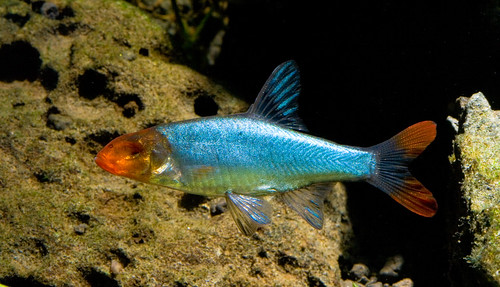
I don’t remember buying a fish without an eye, so this must have happened somewhere along the way. Presumably, the poor guy knocked his eye on a rock or piece of equipment, and wasn’t able to find it in time to have the ER sew it back on. Nevertheless, he’s an otherwise normal specimen that schools with the other fish, and seems happy.

Case 2: Siamese Endler

Siamese EndlerIt’s amazing how fast Endler’s breed. You start with a few pairs, and before you know it, you’re stuck with hundreds of these guys in your tanks. Mathematically speaking, you’re bound to see a few funny ones along the way. Well, here is the most bizarre one I’ve ever seen. This female was born perfectly healthy. As she grew up, I noticed a growth on the underside of her belly. As she continued to grow, so did the growth. Once it got larger, it was obvious that this wasn’t just a tumor of sorts, but another fish body altogether! Not only that, but there is an extra set of pelvic fins growing off of that body that she appears to be able to control. I’ve had her for at least 6 months, maybe a year, and she has shown no other abnormal behavior. Amazing!

Siamese Endler

So, I’ve shared some of my embarrassing fish. Please do the same via comments or email.

Business Broker

« Previous Entries   Next Entries »