March 4th, 2008
At the last GWAPA meeting, a couple of bags of Limnophila aquatica were up for auction, and at one point, I think it reached market saturation, as no one was bidding on it. I decided to grab it for a $1.00, despite not really wanting it, but I’m glad I did.
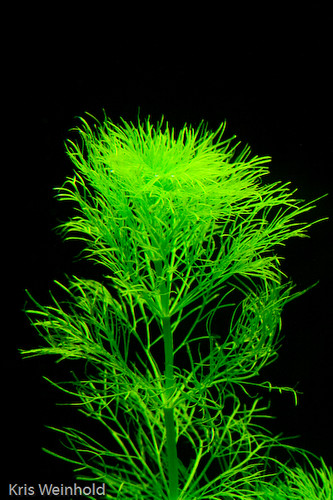 Limnophila aquatica, or Asian Ambulia as it is commonly known, has been in the hobby for a number of years. Its fine, feathery, leaves add a much softer texture to the tank that other, more solid bodied, plants cannot.
The plant is a bright green stem plant that is likely to be the brightest plant in your aquarium. Originally from Southeast Asia, Ambulia requires moderate high to have nice bushy growth. It can also grow very quickly with proper fertilization and CO2, and will reportedly grow out of the water with small blue flowers. I hope to see those flowers at some point!
Asian Ambulia can be propagated like any other stem plant, by cuttings or through side-shoots. So far for me, it’s been a rather fast grower.
Despite not originally having plans to add Limnophila aquatica to my 40G aquarium, it has really added a nice focal point for my aquascape. I’ll post updated pictures of the 40G, once the new plants grow in a little bit more.
Posted in 40G Tank Log, Plant Profiles | 2 Comments »
March 3rd, 2008
You may remember this picture that I took of Rotala macrandra var. ‘Green’ last year at my friend Aaron’s house. He had it growing beautifully in his ADA 90P aquarium. Notice how the leaves are slight, with some hooked edges, and somewhat transparent.
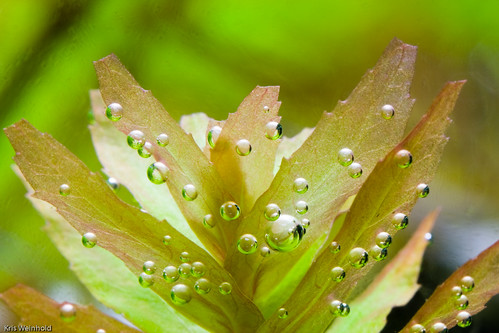
Now, take a look at the picture below. This is the same plant in my 40G tank. The leaves are rounder, thicker, and lacking the spiked edges. Why the difference? Well, about 2 months ago, I got lazy, and didn’t trim this tank, allowing the R. macrandra var. ‘Green’ to grow emersed from the water. Then, I finally performed a water change, raised the water levels, and replanted the tops of the stems, submersing them.
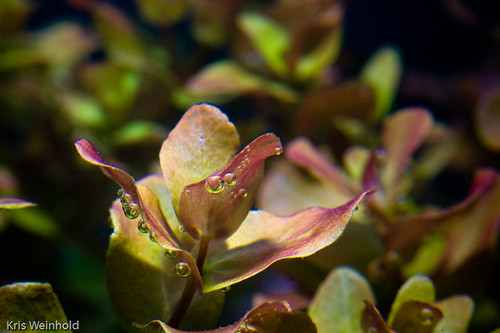
This also coincided with a significant increase of light when I upgraded to the AHSupply 2x96W kit. Since then, the emersed growth form of the Rotala has continued, even though it has been persistantly submersed. I would have figured that the lesser CO2 levels of the water verses the atmosphere would have triggered the plant to convert to its’ submersed form, but apparently not.
I’m still deciding which form I like best. Has anyone else experienced this phenomenon before?
Posted in 40G Tank Log, Plant Profiles | 1 Comment »
March 2nd, 2008
I just wanted to share a couple pictures I took of the Olive Nerite Snails in my 40G aquarium. As mentioned in last week’s algae writeup, these snails are fantastic organisms to have in your aquarium as algae eaters.

Here is a close-up shot of a Nerite Snail grazing on the glass. I imagine that this guy is scraping algae filaments from the glass that aren’t even visible to the naked eye.

Taken 100mm/2.8 with 68mm Kenko extension tubes
Here’s a little bit clearer shot of the snail’s mouth and foot. Their antennae constantly move back and forth over the ground in front of them, and sometimes appear to just flow with the current of the water.

Taken 100mm/2.8 with 68mm Kenko extension tubes
By keeping my nutrients balanced, and these snails in the tank, my tank is not algae free, but kept completely under control.
Posted in 40G Tank Log, Shrimp/Snails | 12 Comments »
March 1st, 2008
Over the past few days, I have noticed that my two females in the 40G have been bright yellow in coloration, and have remained very close to their caves. These are tell-tale signs that they’ve been spawning. It looks like the first female’s fry are now free swimming!

Right now, there is a sizable group of fry, with at least 20-30, but it could be even more. They move around so much, and they all look the same, that it’s near impossible to count. They spend most of the day grazing on tiny organisms and detritus throughout the tank, and especially on the porous mossy rock that contains all kinds of nooks and crannies for them to sort through.

Some of them even seem to take refuge in the small holes formed in the volcanic rock. I don’t plan on trying to remove the fry from the tank, so essentially it’s up to their parents and the cover of these rocks and plants to grow them up. I will, however, prepare a batch of baby brine shrimp for them this week to help them grow up big and strong.

Posted in 40G Tank Log, Fish Fry, Fish Profiles | 2 Comments »
February 3rd, 2008
I noticed some increased fin flashing activity in my 40G tank, and decided to try and capture a few good shots of my Apistogramma sp. ‘Rotpunkt.’ Some of the shots are better than others, but there’s no doubt that these are some pretty fish, whose colors especially pop under the new 2x96W lights!

Apistogramma sp. ‘Rotpunkt’ Male Flashing Fins

A. sp. ‘Rotpunkt’ Male Front On
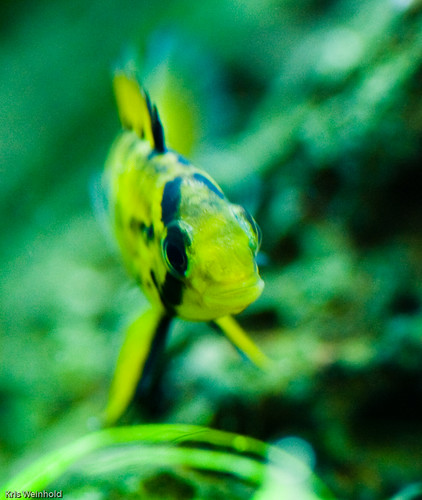
A. sp. ‘Rotpunkt’ Female in Spawning Colors

A. sp. ‘Rotpunkt’ Male Close Up. Notice how brilliant the blue on the face is.

A. sp. ‘Rotpunkt’ Non-Dominant Male. Not nearly as impressive, huh?

A. sp. ‘Rotpunkt’ Male Coming at You.
I should have used a flash above the tank to shoot at a better quality ISO, but I always end up spooking the fish in order to set that up.
Thanks for looking! Any comment/critiques are welcome, as always!
Posted in 40G Tank Log, Fish Profiles | 9 Comments »
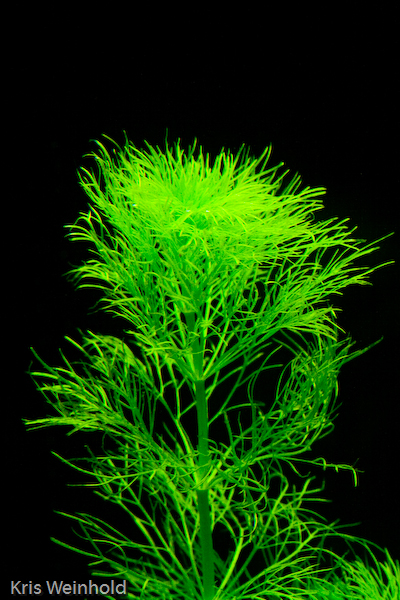 Limnophila aquatica, or Asian Ambulia as it is commonly known, has been in the hobby for a number of years. Its fine, feathery, leaves add a much softer texture to the tank that other, more solid bodied, plants cannot.


