Red Lizard Catfish

September 20th, 2007

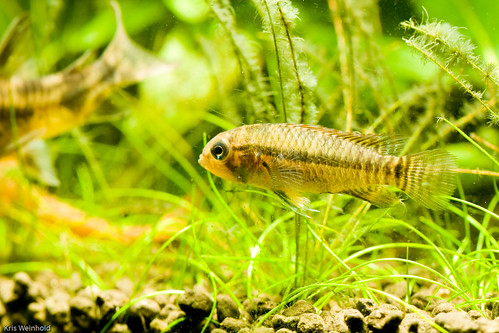
The Red Lizard Catfish, or Hemiloricaria sp. ‘Red’ (L10a), is my new favorite catfish. It’s a whiptail catfish, but stays much smaller than your typical whiptail. This fish tops out around 4 inches in length, making them a wonderful catfish for all but the smallest of tanks. I bought three of these fish last fall at the Catfish Convention from a vendor out of Erie, PA.

Red Lizard Catfish

Native to the Rio Tocantins in Brazil, I thought that these fish would fit in nicely with my Apistogramma cacatuoides. They’re very active fish, constantly scurrying along the rocks, glass, and substrate looking for something to eat. They’re not aggressive at all, and the cichlids don’t seem to bother them, even when the cichlids are spawning. I’m really hoping that some vendors at AquaFest 2007 will have more of these so that I can stock several more in my tanks. I haven’t tried breeding them yet, but it has been done, so if I do get more, I may dedicate a small tank to that purpose.

Red Lizard Catfish


Business Broker

Apistogramma cacatuoides

September 19th, 2007

I’ve kept Apistogramma cacatuoides for some time now in my 75G tank. I started with a trio of the ‘triple red’ color morph. After a few successful spawns, my brilliant male died of seemingly unknown causes. My local fish store had just gotten in wild A. cacatuoides so I decided to try one with my ‘triple red’ females. Before long they spawned, and I now have a small breeding colony of at least 12-15 fish in my 75G community tank.

Apistogramma cacatuoides male

It’s really been fascinating to watch how the triple-red coloration has mixed with the wild male’s drab color. Some of the males, like the one above, only retain a tiny bit of orange on their dorsal fin. Others, have darker bodies, with more pronounced color in their dorsals. (below)

Apistogramma cacatuoides male
Then, some of them have orange blotches on their tail fins. It’s quite possible that this one below is actually a female, but you can see the coloration nevertheless.

Apistogramma cacatuoides male

The black and orange checkerboard pattern is starting to show up on this male’s tail fin, and there’s more orange on the dorsal fin, with slightly more color on the bottommost fins.

Apistogramma cacatuoides

Finally, I also have 1-2 nice specimens where the tail and dorsal fins are totally checkered with orange and black. This fish very much approximates the original male that I started with.

Apistogramma cacatuoides male

The females themselves are not ugly fish, but are very similar to other female apistogramma. I’m fortunate to constantly enjoy the breeding coloration of at least one pair of fish at any given time. I’m amazed by the small crevices these females fit themselves into in the rocks. They’ve located hollow areas in rocks that I never knew had hollow areas.

Apistogramma cacatuoides female

I’ve also found that these are not shy fish. Unlike some other apistos that I’ve kept, they come right up to the tank when I approach, and usually stare me down until I feed them. They’re not terribly aggressive fish, even when breeding. They’ll definitely try to defend their territory, but most of the time, I see 5-6 hanging around the same area. I’ve always liked dwarf cichlids because they give you the ability to keep colonies of a single species in a modest-sized aquarium. The behavior patterns definitely change in this situation, and that’s interesting to note.

Apistogramma cacatuoides female

If you haven’t kept cichlids before, Apistogramma cacatuoides is an excellent beginner cichlid. They’re easily obtained from most fish stores, will readily breed in most water, and exhibit all of the same behaviors that people love from cichlids.

Business Broker

GWAPA – April 2007 Meeting

May 1st, 2007

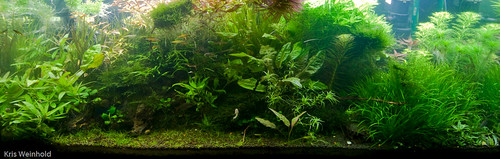
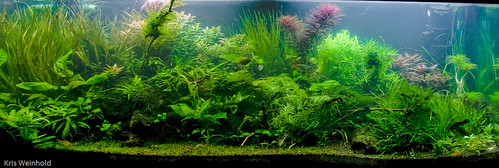
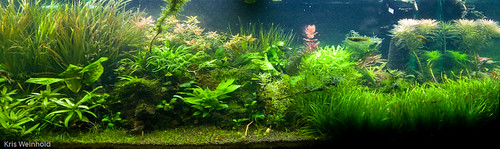
I had the good fortune of hosting GWAPA’s April meeting this past weekend. Preparing for any aquarium-related meeting is always a challenge because in addition to the usual cleaning and setting up when any folks are coming over, you also want your tanks to look their best. This can sometimes require planning as much as a few months ahead. For example, in my 75G (updated picture below), I replanted the glosso about six weeks before the meeting, anticipating that it would take about that long to fill in.

75G - 04-29-2007

Then, for the two weeks prior to the actual meeting, you have to time your water changes, and trimming sessions exactly, so that your stems plants will reach their perfect “bushiness” on the meeting date. Combine that with increased glass scraping, and more consistent dosing, and you’re looking at a bit of work. I’m not complaining because I enjoy all of it, and find that my tanks look the best because of my increased effort. The rest of the year is a crap shoot, however!

This month’s meeting had another nice turnout, reaching 15-20 folks. The weather was beautiful outside, which made talking about my raised-brick pond, much more enjoyable. It’s still too cold outside to actually grow many of my aquatic plants, so I had to cheat a little bit by covering the surface of the pond with lots of Phyllanthus fluitans from my 54G tank. I promise that I really do grow plants outdoors later in the year. I went through a brief overview about how I constructed the pond, and what my experiences were last year. After my pond talk, we all went inside for our auction, which was large and lively as always. The manzanita wood that the club purchased was met with very much interest, as were most items in the auction. I came away with a few goodies, namely an Eriocaulon species that I haven’t tried before. I also added another Red Lizard Catfish to my 75G. (Thanks Cristy!)

More pictures and info can be read on GWAPA’s website.

Business Broker

Glosso and Utric: A good match!

March 19th, 2007

Kind of by accident (and as a product of my lazy trimming habits), I managed to find a plant combination that I really enjoy. Glossostigma elatinoides and Utricularia graminifolia appear quite nicely together once they become interspersed. The Utricularia adds a nice softening effect to the Glossostigma, both in shape and color. I’m currently attempting to replicate this look throughout the entire foreground of my 75G tank.

Glosso and Utric

Another added benefit of this combination is that the Glossostigma helps to pin down the Utricularia so that it doesn’t become uprooted from the substrate. I have a large whip-tail catfish that loves to lounge on these plants, and has yet to caused any damage, whereas he always tends to pull up the Utricularia when planted by itself.

What’s still left to be determined is whether the Glossostigma will ultimately overtake the Utricularia, leaving just your standard “glosso mat.”

Business Broker

Time to replant

March 16th, 2007

Glosso overgrownWhen your aquascape has a glosso foreground, just about every 6-8 weeks, you glosso will look like it does in this picture. The glosso will have formed a mat that’s about 3-4 inches thick, with portions of that mat floating up away from the substrate. Underneath the substrate, you’ll have a nice thick mess of mulm sitting there. And if you’re lucky, you’ll have from fry using this thick mat as a refuge from much larger fish.

Too bad for those fry, when this happens, it’s time to replant! I have to do just this, this week. In about 6 weeks, I will be hosting the GWAPA meeting. Hopefully, by that time, that new glosso plantlets will have matured into a nice 1″ thick glosso mat.

Timing is one of the key things to keep in mind for every aquascape. Whether you’re planning to show the tank to friends, club members, or take that perfect photograph for sharing online or to submit in an aquascaping contest, timing is everything. I generally tend to play things by ear, but one of these days, I’ll spend a little more time counting backwards. What I mean by that, is the advice of another GWAPA member, Ghazanfar, who suggests writing down every time you trim a plant. Then, whenever that particular plant looks “perfect,” note that on your calendar too. If you subtract the “perfect” date from the date you trimmed, you should know exactly how long it takes for each group of plants in your tank to reach its ideal look. Then, anytime you want to show your tank, you just need to count backwards from that date for each plant, and trim accordingly. By the tank your friends are over, every plant in your tank should look “perfect!” (Of course, YMMV.)

Business Broker

75G – This week’s photo

February 9th, 2007

Here’s this week’s picture of my 75G. As you can see, it’s about 90% there. The glosso is right about perfect. Too much longer, and I’ll have to pull it up, and start over. The aromatica is about where I want it too; albeit, maybe 2 days past it’s perfect look in this picture. The broadleaf stellata could afford to be a little bit bushier, but it’s well on it’s way. Really, I’m just waiting on the utricularia. It’s keeps getting uprooted anytime the whiptail catfish is spooked and uplifts the Soilmaster Select. Please feel free to comment and critique.

75G 02-06-2007 

Business Broker

Pogostemon yatabeanus

February 6th, 2007

Pogostemon yatabeanusAt the December GWAPA meeting, I was fortunate enough to obtain Pogostemon yatabeanus in the mini-auction that we have at every club meeting. P. yatabeanus is an Austrailian plant, from the same reknowned genus as Pogostemon stellatus, formerly Eusteralis stellatus. This particular species reminds me more of the broadleaf variety of P. stellatus, in that it’s a little bit larger of a plant, except that it stays a beautiful bright green instead of bronzing under bright light. It doesn’t seem to be particularly demanding if kept in your typical high-tech setup.

I currently have the plant in my 75G, planted in Soilmaster Select ‘Red’, with pressurized CO2, high-light, and regular dosing. In this environment, P. yatabeanus might be the fastest growing plant in the tank. Young stems stay rather slender with narrower leaves. Older stems can grow quite thick, with leaves that become longer and fatter, similar to how P. stellatus ‘broadleaf’ grows. When you trim P. yatabeanus and leave the lower portion in the substrate, 2-3 new stems start to grow out of the incision.

Due to this plant’s size, I don’t know if I’d recommend it for a smaller tank, but in a larger tank I think it’s the perfect ‘green’ companion to plants such as limnophilia aromatica, pogostemon stellatus ‘broadleaf’, etc… If you can get your hands on this plant, please give it a try.

Pogostemon yatabeanus closeup

Business Broker

In-Line Hydor Heater Review

January 12th, 2007

Hydor In-Line HeaterEven though it doesn’t feel much like it in Maryland this year, it’s winter time, and that means that my basement gets pretty chilly. Over the summer, I had previously pulled out a standard submerisible heater in favor of removing as much equipment as possible from my tank. I didn’t want to add my old heater back in, so I decided to try out Hydor’s in-line heater, which hooks right on your canister filter’s out-take line.

Installation couldn’t be simpler with this unit. Out of the box, there’s zero assembly to do. All you do is splice your filter’s output line, connect either end of the line to the heater’s barbs, and plug it in. The temperature is easily set using the red dial. Boom, you’re done.

Since installation, I’ve heard a few “clicks” here and there. That occurs when the heater turns on or off and isn’t audible unless you’re right next to the tank. Otherwise, it’s easy to forget that the heater is even there. The temperature of the water has been kept very stable, so it’s been doing exact what I bought it to do. I’d recommend to anyone with a canister filter who wants to avoid making an in-tank heater part of their aquascape.

Business Broker

75G – New scape with Ca Rock

January 11th, 2007

I used some time-off after Christmas to do quite a bit of maintenance on my tanks. In addition to adding the U.V. sterilizer, I also took this opportunity to rescape the tank, in an effort to hopefully clear up what had been a pretty nasty algae outbreak. When Ghazanfar, Rob, and I spent an afternoon breaking up our prized California rock, I had set one large piece aside, specifically for use in my 75G. That rock is the large rock one the left, and weighs a considerable amount.

75G - 1-08-2007

What I didn’t realize until after I put it in the tank, in that the rock has a natural cave in it, that’s just about perfect sized for a female apistogramma, but not quite large enough for the male. In essense, it’s the perfect size, and within a day of rescaping, one of the female A. cacatuoides took up residence.

So, besides the hardscape, I left the glosso intact on the right side of the tank before my previous scape. I repurposed the anubias baterii nana in front of the rocks in the middle, and replanted the utricularia on the left side. I’m a little curious to see if the U.V. sterilizer will have any effect on the growth rate of the utricularia. Finally, for the background, I went up to what has become a plant farm of my 40G, and trimmed out a variety of stems that I thought went together. From left to right: Pogostemon stellata ‘broadleaf’, Pogostemon sp., ludwigia repens ‘narrow-leaf’, Heteranthera zosterifolia, Blyxa japonica, and Limnophilia aromatica.

Business Broker

Got a UV Sterilizer: Turbo-Twist 9X

January 9th, 2007

Coral-life Turbo Twist

Thanks to some extra Christmas money, I decided to go ahead and get a U.V. Sterilizer for my 75G tank. I’ve been having a rash of green water, and a case of “something’s not right” situations in this tank for the past year, so I guess you could consider this my last resort.

After doing a fair amount of research on the web, I decided to go with Corallife’s Turbo-Twist Sterilizer. Turbo-Twist 9W BoxIt seems to be a pretty popular product, and the price was right on Amazon.com. Setting the unit up was very easy using the instructions provided. Basically, you start by just unscrewing the one end to install the bulb. After that, you twist the middle section until the two barbs face in the direction that you need to connect to your filter. Finally, splice the output line of your filter, and connect either end of the line to the input and output barbs of the sterilizer. You’re done, once you plug it in.

I was a little bit worried about the sterilizer affecting the flow-rate of my filter, but so far that hasn’t proven to be a problem. And that’s having a CO2 diffuser and in-line heater running on the filter with it. Of course, that why I bought an over-sized filter, Eheim 2028, for my 75G in the first place.

Twelve hours after hooking up the U.V. sterilizer, my tank appeared fairly cloudy, with a white, milky hue. I presume that consistuted a mass bacteria/bad thing die off after being zapped by the U.V. rays. By the second day, the water cleared, and it’s looked clearer than I can remember in recent history. I’m not entirely sure whether I’ll leave it running 24/7, or will turn it off to save the bulb-life a little bit, but I’m glad to know that I have a last resort available to rectify any extra difficult problems with my water column.

Business Broker

« Previous Entries   Next Entries »