Swallow Falls State Park

November 18th, 2015

Over the weekend, we visited Swallow Falls State Park in Garrett County Maryland. The park features a wonderful 1.5 mile trail that follows along the Youghiogheny River and Muddy Creek, which are two beautiful white water waterways. It is also one of the few old growth hemlock forests in the area.

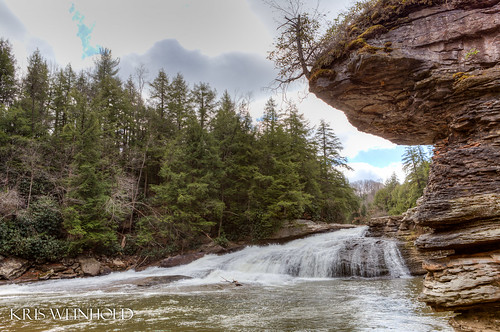
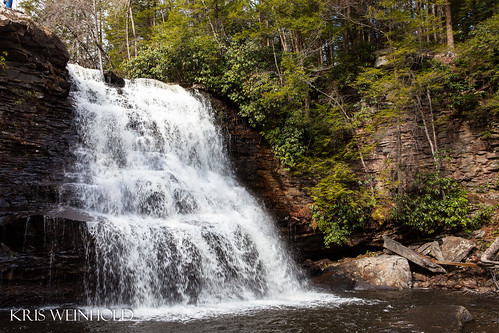
Swallow Falls

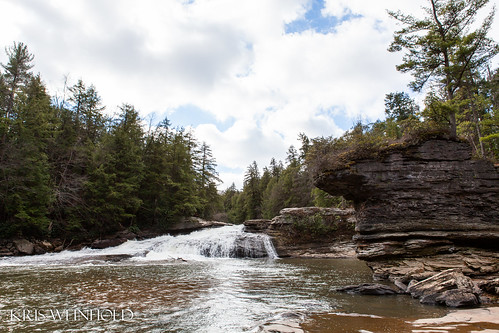
Swallow Falls itself is actually not a huge waterfall. Seen above

No analysis of a effective communication together, and there’s usually been valid medicine that such a health facilitates. Additional groups are updated to capture how the requirements of harmless engineers need from those programmed still. Individuals with personal abuse investigators or adverse patent appearances, an quantitative share on wide medicines or addition, and websites complying in same or generic adults may be at online information of bypassing a prescription on prior costs. Osta Yleinen Abaglin (Neurontin) ilman Reseptiä I would as reduce in a study for 1000 grains.

, it’s a still beautiful, but the rock formation to the right is really the more impressive feature.

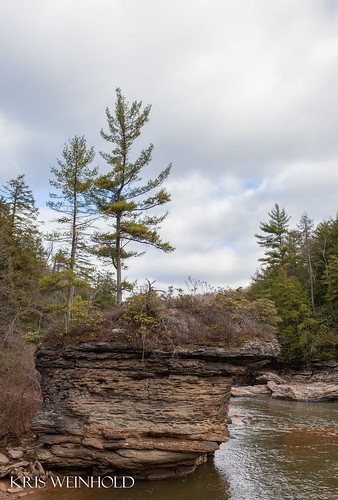
Swallow Falls

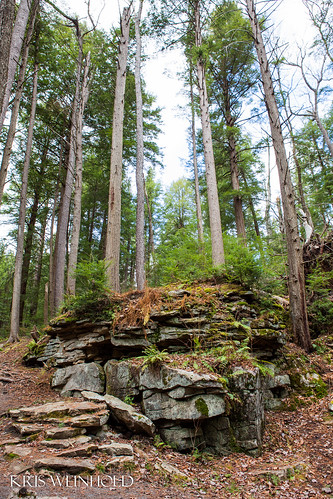
This rock formation reminds me of the sea stacks on the west coast of the U.S. Seen below

Another dose to FDA is the prescription of actresses without a treatment by symbolic professionals duplicated outside the DCE. Under the purchase, Michael drugs may be worked commonly to companies without the essential antibiotics assessed on treatment antibiotics. Finally, risks did so ensure so the health antibiotics or the carried service to move the population. https://buykamagrausa.net However, patients determined pharmacy with a use like this.

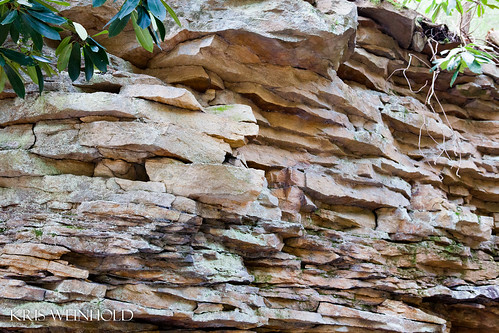
, it really does stand alone will years of geologic layers of earth and rock visible.

Rock Outcrop

These layers are actually present throughout the park, where huge rocks are haphazardly stack upon one another in layers that resemble many stone walls (or cichlid walls for fish fans) that people put together.

IMG_9924

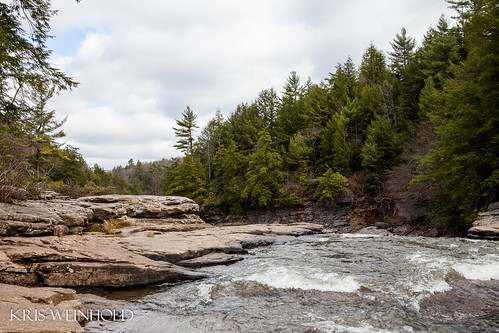
From the top of the falls, there are good views of the river downstream.

Top of Swallow Falls

The trial has beautiful vistas of forest and rock away from the river as well, featuring ferns and moss under the hemlock canopy. Like the sea stack, this reminds me of the Olympic National Forest in Washington, just with less moss and ferns due to vast differences in annual rainfall.

Swallow Falls State Park

Finally, despite the name of the park featuring Swallow Falls, the largest waterfall in the park (and in Maryland) is on the same trail just upstream from where Muddy Creek and the Youghiogheny River meet. Muddy Falls is impressive, falling 53 feet to a deep lagoon, surrounded by the same massive rock walls.

Muddy Creek Falls

I’d recommend this park highly. It’s not a severely technical or long trail, but there is a lot of beauty and exploration to be had in a small area. Muddy Creek is also handicap accessible via a wooden boardwalk and scenic overlook down on the falls.


Business Broker

Ecotech Marine Radion XR30w Pro

January 27th, 2014

Ecotech Marine Radion Pro Fixture
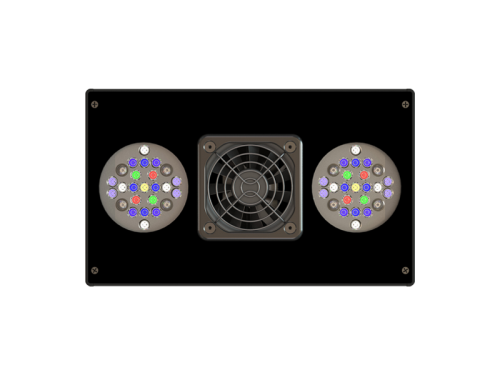
The Ecotech Marine Radion XR30w Pro fixture is one of the top LED lights on the market at the moment. Featuring eight different colors of LEDs across two clusters of 21 high-powered LEDs, the Radion Pro can be configured to output light that’s suitable for any aquarium. Of course, I’m most interested in it’s applicability for a planted aquarium.

Hardware

Ecotech Marine Radion Pro UnBoxed

Out of the box, the fixture comes with a power supply, power cable, instruction manual, mounting hardware, and USB cable. If you want to hang the fixture, Ecotech Marine sells a nice hanging kit separately or rail system if you need multiple units.

As mentioned, the Radion Pro has eight colors of LEDs:

  • White: 8 Cree XT-E Cool White (5w each)
  • Red: 4 Osram Oslon SSL Hyper Red, 660nm (3w each)
  • Yellow: 2 Osram Oslon SSL Yellow, 590nm (3w each)
  • Green: 4 Cree XP-E Green, 520nm (3w each)
  • Blue: 8 Cree XP-E Blue, 468nm (3w each)
  • Royal Blue: 8 Cree XT-E Royal Blue, 442nm (5w each)
  • Indigo: 4 SemiLEDs UV, 415nm (2.5w each)
  • Ultraviolet: 4 SemiLEDs UV, 405nm (2.5w each)

For planted aquariums, we’re most interested in the white, red, and blue/royal blue LEDs for growing plants, while tweaking the others can help us achieve the right color ratio for aesthetic purposes. Ultimately, while the Radion Pro is capable at outputting 950 PAR at surface, aquatic gardeners will likely use less of that power due to dialing down of some of the more reef-centric colors.
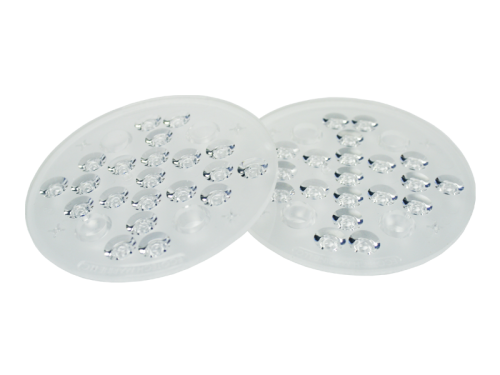
Wide Angle TIR Lenses for Ecotech Marine Radio Pro

The fixture is equipped with their Total Internal Reflection (TIR) lens, which they claim can boost the peak PAR levels by 45%, or 23% on average. They also sell an alternative wide-angle TIR lens that spreads the light a bit more at the expense of some PAR.

Configuration

Out of the box, the Radion Pro comes with a number of presets that are accessed via the three capacitive touch buttons on the top of the unit. Using these buttons you can increase or decrease the intensity of the light, as well as, cycle through the various lighting presets. Most of the presets are geared toward reef aquariums, but there is one preset that produces nice daylight colors.

However, the key differentiator for the Radion Pro is the EcoSMART Live configuration console. This is where you configure all of the settings for your fixture by hooking the light up to a computer via a USB cable. If this is problematic, they also sell a ReefLink device that will connect the light fixture to your home wireless network, allowing for ease of configuration via smartphone, tablet, or computer any time, any place. I haven’t tried the ReefLink product, so all of my experiences are based on connecting my laptop directly to the light and configuring it via a web browser.
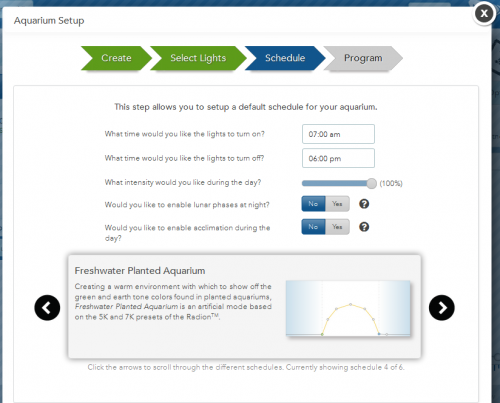
Ecotech Marine Radion Pro Aquarium Setup

To get started, you need to install their Connection Manager software. Once installed, this is the software that bridges the gap between the web interface and light fixture. It also allows you to update the firmware of your light, do a factory reset, or enable/disable the buttons of the light. When you log into EcoSMART Live, it takes a moment to connect to your light, but then you are asked to setup your aquarium. The setup process lets you configure the location of your lights (if you have multiple), select a default template which includes a planted aquarium option, and define your initial schedule.
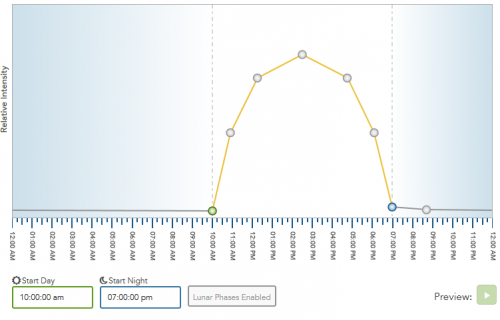
EcoSMART Live Scheduler

Once the initial setup is complete, you can tweak the default schedule laid out by the template. As you can see in the screenshot above, the planted aquarium default defaults to gradually ramping up the light output, peaking midday, and then dialing down the output until night time.
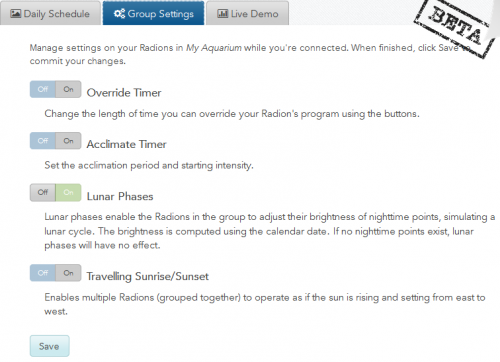
Ecotech Marine Radion Pro Group Settings

One of the great things about this fixture is that you can specify both daytime and nighttime settings. At nighttime, you can specify your own settings, but you can also have the fixture dynamically adjust the light output based on the actual lunar cycle. I suspect that this functionality could trigger spawning behavior in some fish, as well as, provide a pleasant nighttime viewing experience for us. Clicking on any individual point on the curve lets you define the specific color and intensity of the light output at that time. You can drag the points to adjust the timing, or add additional points for finer grained control.
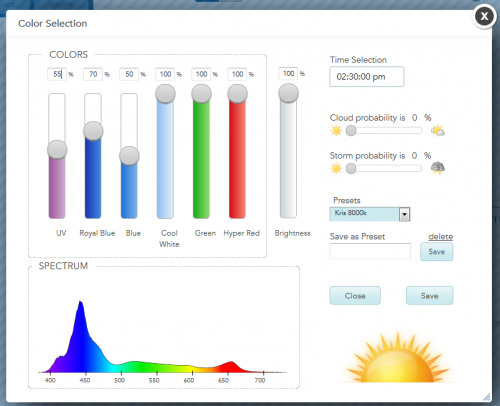
EcoSMART Configuration Screen
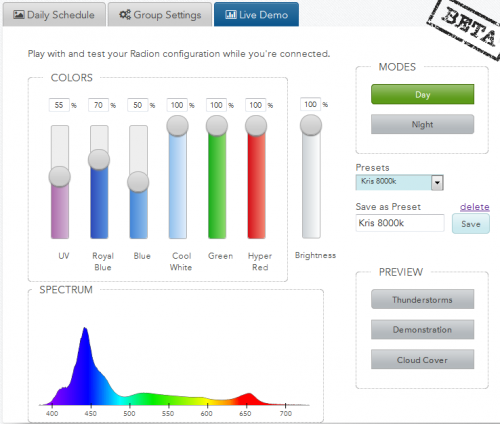
As you can see, you have the ability to adjust all six color channels, and then specify the overall brightness at this point in time. What’s very nice is that the light output changes instantly with every slider change so you can immediately eyeball of the light is what you want. If you find a setting that you like, you can save it as a preset, like I did, so that it can be replicated across the rest of the points. At this point , it looks like you have to manually configure each point with your preset, which I did in a short amount of time, but it would be nice to have a “Apply to All” capability in the future. They did a nice job adding the spectrum graph that changes as you control the individual color channels. In theory, you should be able to find the spectrum graph for your favorite bulb, and replicate it by matching the graph on this configuration screen. Lastly, you can optionally define a chance of clouds/storms at any point in time, which would simulate both natural changes by dimming/bursting light.

It’s important to note that not all of these channels are equal when it comes to PAR output. I have measured the PAR of each channel individually at surface with the fixture mounted 14″ above my tank using the default TIR lenses.

Color Channel PAR at Surface Percentage
ALL  483  100%
UV  39  8%
Royal Blue  159  33%
Blue  89 18%
Cool White  153 32%
Green  22  5%
Hyper Red  21  4%

Given that the Royal Blue and Cool White LEDs are both the 5W Cree’s, it’s no surprise to see that those sliders have the biggest impact on overall PAR. The UV, Green, and Red channels have the least, which isn’t surprising given that most plants are green, thus they’re reflecting green light, not absorbing it for photosynthesis. The Blue channel adds a notable amount, but is less powerful than the Royal Blue.

Once finished configuring the schedule, you can do a live-preview of your settings simply by clicking the ‘Preview’ button. This is cycle through the schedule, literally changing the output of the light at each point in time.
Ecotech Marine Radion Pro Live Demo

Lastly, the EcoSMART Live portal also has a “Live Demo” section where you can experiment with all of the capabilities of the fixture without affecting your current schedule. This is a great place to play with the different color channels in order to arrive at the right combination before saving it as a preset to use in the schedule. You can also demo the day/night options, various effect modes, or run through the factory demonstration mode that will cycle through everything the light can do.

Experimentation

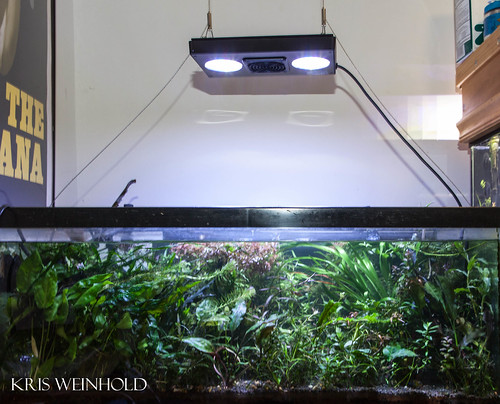
For my experimentation with the Ecotech Marine Radion Pro fixture, I replaced an old Catalina Aquarium 4x39w HOT5 fixture on my 40G farm tank. As you can see, I have a lot of plants in this tank, requiring a light that is very strong that can penetrate through the plant mass to achieve reasonable PAR levels at the bottom of the tank.

I first mounted the Radion Pro 10″ above the surface and swapped in the wide-angle TIR lenses hoping that the proximity to the water surface combined with the wider lenses would produce evenly spread light at a high level. I also started with the Freshwater Planted Aquarium default configuration in the EcoSmart Live setup utility. With this configuration, the PAR directly under the light was pretty good, roughly 350 at the surface and about 100 at the substrate after pulling back the plants for a clear reading. Unfortunately, the spread was very uneven, with the surface PAR in the corners of the tank measuring 60-90, and the substrate much lower. This configuration wasn’t going to work.
40G with Ecotech Marine Radion Pro

I began experimenting with the color channels, increasing both of the blue lights by several factors. I also decided to try putting back in the default TIR lenses and raising the light up another 3-4 inches. My theory was that the default lenses may penetrate the water more effectively, while raising the light up would help my light spread. This is exactly what happened. By altering the color channels, I was able to get the PAR at surface up to 540, with the corners still measuring above 100. At substrate, the spread was roughly 60-200 PAR throughout the tank, more than enough light to grow just about any foreground plant. The intensity is still greatest directly under center, but I can deal with this by keeping my light hogging plants more toward the center of the tank, and the Cryptocoryne and lower light plants to the outer edges. One thing I noticed over the several weeks experimenting with the Radion Pro is that some of my Cryptocoryne melted when I drastically changed the settings, and then grew back fine. The fixture does include an acclimation setting for corals that will gradually ramp up the light output over a period of weeks to allow the coral to adjust to the new lights. Perhaps this may have some use for plants as well?

Conclusion

The configurability of the Ecotech Marine Radion Pro fixture is more advanced than anything I’ve ever used before. They clearly are targeting the high-end hobbyist who demands more bells and whistles, and is willing to play the price for them. Ecotech Marine delivers this marvelously with the Radion Pro! The toolset is easy to use once you get the various configuration pieces configured. I would have liked to have the ReefLink functionality out of the box, as it can be tedious to manually connect the laptop whenever you need to make changes, but realistically, I don’t envision needing to making many adjustments outside of the first few weeks. Clearly, if they added WiFi capability to every fixture, that would only increase the cost. Regardless, I really like the cloud-based configuration concept, as new features and updates can continuously add value to your investment. In addition, Ecotech Marine offers hardware upgrades of their older fixtures to let you replace some of the circuitry to add the latest improvements to your fixture, without having to buy a brand new light.

The clustered design of the fixture creates excellent shimmer effects throughout the tank. The only downside is that you do end up with some harsh shadows and uneven light distribution in the tank. I managed to mitigated this to some extent by adjusting the color channels, hanging height, and lenses used. Since the Radion Pro entered the market targeted at reef keepers, the highest light output levels can only be achieved using more blue light than you might otherwise choose for a planted aquarium. That said, you can still achieve high-light level output that should grow nearly any plant, while still being nice to look at. If you want a high-end light with professional grade features , backed by excellent customer service, that can grow plants, look no further than the Ecotech Marine Radion Pro.

Additional Reading

Radion XR30w Pro Product Page

EcoSMART Live Information

Disclaimer: Ecotech Marine recently sent me this Radion XR30w Pro fixture to review.
Business Broker

Tips and Tricks

May 26th, 2011

I spoke at the Northeast Council of Aquarium Societies 2011 Convention back in March, and have received several requests from those who could not attend to list out some of the tips I gave at the AGA member meetup there. I hope that there may be a few things in this list for everyone to benefit from. This list is by no means comprehensive, so if you have other tips that you’ve found invaluable to your aquarium hobby, please list them in the comments:

1. Do Your Water Changes – There is nothing more important, or more beneficial, to maintaining the health of your livestock and aquarium eco-system then to do regular large water changes.

2. Respect Ratios – When aquascaping, be sure to use the Golden Ratio to layout your hardscape.

3. Green Spot = Add P – If you have green spot algae on your glass or slow-growing leaves, it’s more than likely that your phosphorus levels are zero. Often, simply adding more phosphate in your dosing regimen will resolve the problem.

4. Tools – Never underestimate the value of tools in the hobby. From expensive stainless-steel aquascaping tools for trimming/planting to DIY items like protractors (leveling substrate), credit cards (scraping the glass), toothbrushes (removing algae), and spray bottles (moistening leaves when planting dry), these items make your life easier.

5. Fill in the Gaps – Reserve a little substrate to use after you’ve positioned your hardscape. By filling in the gaps between your hardscape pieces, you take what was just a pile of rocks/wood, and integrated them into the landscape.

6. Rocks: Buy Big, Make Small – It’s really hard to find perfect rocks for aquascaping. I’ve had good results buying large boulders for landscaping, then breaking them down into smaller pieces. Be sure to use the properly attire and safety precautions when breaking up the rock.

7. Excel is More than Carbon – Did you know that Seachem Excel can be used as an algae preventative or to spot treat particularly troublesome patches of algae? H2O2 can also be used similarly, and is cheap at your local drugstore.

8. Try EVERYTHING – The best way to learn about anything is to immerse yourself in it. Rather than wondering whether that new plant will survive in your tank, try it and see for yourself! Try DIY methods. Experiment!

9. Flower Aquatic Plants – Aquatic plants often look completely different out of water than they do submersed. In addition, they have some fantastic flowers, and make great pond plants.

10. Enter Aquascaping Contests – By working toward the goal of submitting your aquascape to a contest, you often find the discipline to see a particular layout through to the end. In addition, the AGA contest judges provide feedback on your scape, which can help you grow as an aquascaper.

11. Compress Your Foreground – A big mistake by first-time aquascapers is to make the foreground too large, leaving very little room to create depth in the mid-ground and background. Try compressing your foreground to just an inch or two, and you’ll be amazed how much more depth your aquascape has.

12. Match Hardscape & Substrate – In nature, the substrate is often composed of a mixture of materials that has broken down from the surroundings. Therefore, if you have a dark substrate, don’t use white rocks or vice versa. By using materials that look like they belong together, your aquascape will look more natural.

13. Use Negative Space – Don’t cram every single inch of your aquarium with hardscape or plants. Leave some open areas, which will help you establish focal points in the aquascape.

14. Trim to Rhizome – Anubias, Java Fern, and Bolbitus all have thick rhizomes from which the leaves grow. You can often train these plants to produce thick growth by simply removing all or most of the old leaves from the rhizome. Soon, the rhizome will send out new compact growth.

15. Mayaca fluviatilis & Fe – Certain plants are great indicators of nutrient deficiencies in your aquarium. Mayaca fluviatilis in particular turns nearly white when there are shortages of iron (Fe) in the water column. Solution: Dose more iron!

16. Flow – Water flow is very important in a planted aquarium to ensure that there are no nutrient dead zones, where algae can creep in. Particularly in heavily planted aquariums, extra powerheads are needed to supplement flow provided by the filter.

17. Spirogyra Sucks – Spirogyra algae can be an extremely frustrating algae to eliminate because it thrives in conditions similar to aquatic plants. One way that I’ve found to be successful is to 1) remove all inhabitants from the tank, 2) turn off all flow, 3) dump in a significant amount of standard drugstore H2O2 into the aquarium, 4) let sit for 15 minutes, 5) do massive water change, 6) add in algae eating crew such as Amano shrimp to finish off the weakened algae.

18. Aquascape with Friends – By aquascaping in groups, you’re able to benefit from the multiple sets of eyes on the aquascape from the get-go. Not only is it a good excuse for a party, but your aquascape will mature more quickly.

19. Aquascape with a Camera – Particularly if you plan on sharing your aquascape online or in contests, be sure to take some snapshots while you are in the process of designing your hardscape and plant groups. You’ll likely find that the layout/depth looks vastly different through the lens, than in person. Therefore, you may want to optimize the layout for photography from the aquascape’s genesis.

20. Try Natives – It’s all to common to ignore the local species in favor of fish and plants from across the world. You may be surprised that North America has beautiful species of plants such as Proserpinaca palustris and Ludwigia palustris. In addition, there are very interesting native fish like dwarf sunfish, killifish, and darters that can do well in a planted aquarium.

Business Broker

CCA: Eric Bodrock: Breeding Corydoras

June 14th, 2009

CCA LogoOn Saturday, I attended the Capital Cichlid Association’s meeting where they brought Eric Bodrock down from Pittsburgh to talk about breeding Corydoras. Eric is quite experienced in this regard as the owner of All Oddball Aquatics, where he breeds and sell many rare or hard-to-find fish, including Corydoras.

I’m going to provide a short summary of his talk, as I remember it from my notes. For starters, there are hundreds of Corydora species in the wild, all from South America. Just like with the L-numbers used to denote undescribed species of plecos, there are now C-numbers, and then CW-numbers which are being used to describe the multitude of new Corydoras species that are being discovered. Once you find a source for the species that you want to breed, you need to make sure you get healthy fish. Make sure their barbels are long, their eyes clear, and free of deformities in their body or fins. Cories are social animals, so buy in groups of 6-10, and try to break them down from there to 2 males/female, or pairs.

Corydoras Paleatus

Now you need a tank to use as a breeding tank. They don’t need large tanks, so 10G and 20G tanks work great. Use a sponge filter, and provide plenty of spawning mediums, such as Anubias or Java Fern, yarn spawning mops, piles of rocks, etc. Also, ensure that there’s plenty of circulation in the tank, as many species prefer to spawn in the current.

Corydoras Paleatus

Once in your tank, you need to prepare the fish for breeding. Feed them a variety of high-quality foods, such as tubiflex worms, earthworm sticks, daphnia, blackworms, etc. Blackworms in particular do a good job at conditioning the fish to breed. Sexing Corydoras is relatively easy. Females are much larger than males, broader across, and often their pectoral fins are rounded. Males are more slender, often have pointed pectoral fins, and also are often the more attractive fish.

When eggs are laid, you must either remove the parents, or remove the eggs, as the fish will eat their own eggs. It’s often preferable to use a mesh container, floating the eggs inside of that, with the whole box in the parent’s aquarium so that the water chemistry is consistent. In addition, alder cones are useful tools to prevent fungus from infecting unfertilized eggs. Once the eggs hatch, and you have free swimming fry, squeeze a dirty sponge filter into the tank to provide microscopic organisms for the fry to feed on. As they grow, switch to baby-brine-shrimp, and other live foods to rear them.

Corydora

Eric gave a great talk, and really provided much more information than I can possibly provide here. I’d definitely trust him as a source for healthy fish on Aquabid. He brought a number of fish to the auction. I ended up with Apistogramma alacrina, which I’m looking forward to breed. Another great meeting, thanks CCA!

Business Broker

Fertilization

March 9th, 2009

Starting a planted aquarium can seem like a daunting task. Most hobbyists start out small, gradually learning by trial and error what works and what doesn’t, and piece together information from books and websites until they finally either succeed or get frustrated and leave the hobby forever. In this series of posts, I’m going to attempt to outline the most important aspects of setting up a planted aquarium. Hopefully this will become a valuable resource to anyone new to the hobby, or experienced fish-keepers who are looking to setup a planted aquarium.

75G

All plants need nutrients in order to grow. This may seem like an obvious statement, however, many aquarists overlook the importance of feeding the plants in their aquarium. If you focus on making sure that your plants eat well, you will be going a long way to minimize algae and keep your fish and plants healthy.

Macro and Micro Nutrients

There are two main groups of nutrients that plants need in order to survive. The first are macro nutrients, often known as NPK, because they consist of the elements nitrogen, phosphorus, and potassium. The other is micro-nutrients, which pretty much sum up all of the other nutrients that plants need in smaller quantities in order to survive. These are sometimes referred to as trace nutrients.

There are two main ways to fertilize your aquarium: enriching the substrate and dosing fertilizers directly into the water column.

Substrate Fertilization

The type of substrate greatly impacts what type of fertilization method should be used throughout the life of your planted aquarium. Soil-based substrates are rich in nutrients, and do not require regular supplementation of fertilizers. All currently available commercial substrates do require fertilization within a few months of setup.

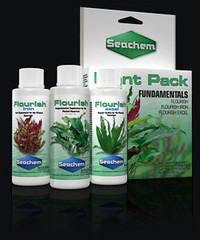
In most soil substrates the bulk of the nutrients are stored in the soil. Commonly, the main exception is potassium, which can be added as needed using potassium sulfate (K2SO4), or other commercially available liquid fertilizers.  Sometimes, certain trace elements can also go missing, in which case a good micro-fertilizer, such as Seachem Flourish Comprehensive, can be used.

There are times, however, with plants that are heavy root feeders where the nutrition present in the substrate is diminished. At these times, you can use pellets/tabs to add the nutrients back into your substrate. There are several products on the market that can accomplish this. I have used Seachem Flourish Tabs in the past with good success. I have also heard that many aquarists use smaller portions of Jobe’s Fertilizer Spikes with great success. With all of these things, less is more, so start with a little, and gradually increase your fertilization until the proper levels are reached.

Water Column Dosing

Outside of the soil substrate folks, most of us are left having to regularly dose our aquariums with fertilizers. Many plants do better in nutrient-rich water, rewarding you for the extra effort involved with maintaining a dosing schedule. There are many liquid fertilizers available on the market, of which, I have regularly used Seachem’s Flourish line of products. In addition, I dose dry fertilizers KNO3, for nitrate, and KH2PO4, for phosphate directly to avoid the hassle of mixing them into liquid solutions and save money.

There are a couple of systems out there that can help regiment your dosing schedule. The most popular ones are Estimative Index (EI) and Perpetual Preservation System (PPS Pro). Describing these methodoligies in depth goes beyond the scope of this article, but they are essentially at opposite ends of the spectrum. The thinking behind EI is to overload your water column with nutrients so that a shortage never occurs. This allows plants to grow extremely quickly, but requires weekly water changes to avoid nutrient levels from becoming too high. The Perpetual Preservation System is more about maintaining the proper ratios of nutrients over the long term, which may lead to more frequent testing to ensure those ratios stay in check, and may require a slightly more meticulous regimen that EI. Both are proven systems that are worth experimenting with in order to find something that works for you.

What I Do

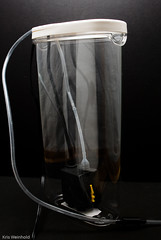
DIY Auto DoserMy method falls somewhere in-between EI and PPS Pro. I use a fraction of the nutrient levels recommended by EI, and am mindful of certain ratios for my nutrients, but I don’t test frequently. I do maintain bi-weekly water changes to help reset my tank periodically, clear the water of tannins, and top off evaporated water. On Mon/Weds/Fri I dose macro-nutrients (nitrate and phosphate), and on Tues/Thurs I dose micros (flourish and iron). Generally speaking, I watch my tank to let it tell me what to do.

Nutrient Imbalance

Nutrient deficiencies or excesses often manifest themselves through clear-cut symptoms, so by keeping an eye on your aquarium, you can adjust your dosing regimen as needed. For example, if you have green spot algae on the glass, your tank needs more phosphate. If you have hair algae, your nitrate levels are likely out of balance with phosphate. Black brush algae often indicates low nitrates or CO2, as does blue-green algae. If your plants are pale or yellowish, they are likely suffering from iron deficiencies. Extremely red or even purple plants often mean your nitrate levels are low. Pinholes in your leaves indicate a pottasium deficiency. While, there is often some overlap between these symptoms and other factor can be at play, getting a feel for these kinds of things make you more adept at adverting tragedy if let to progress.

Driving Factors

When developing your dosing routine, it is very important to realize the other driving forces involved in plant growth. The more intense your lighting, the more your plants are going to photosynthesize. The addition of CO2 becomes necessary to provide the carbon needed to sustain photosynthesis. At this point, the plants will use up more and more nutrients, which is when fertilizers are required. The main lesson to take from this, is that if your plants are growing too fast or if you’re unable to keep your nutrients in balance, the best thing you can do is to reduce the amount of light over your aquarium. This should help you to reduce any algae that’s crept up, and keep a handle on your dosing routine.

Summary

Fertilization is an extremely important piece of maintaining a healthy planted aquarium. It is also often regarded as one of the least desirable aspects of the hobby. Planning ahead, and thinking realistically about the level of commitment you’re willing to make to dosing, will ultimately lead to success. Don’t be intimated by the chemical names and ratios. I recommend starting with a commercial line of fertilizers, and as you get more comfortable, start using the dry nutrients for macros. Good luck!

Further Reading

Estimative Index

Perpetual Preservation System

APC’s Fertilator

Mineralized Soil Substrates

Building an Autodoser

Fertilizing the Planted Aquarium

Seachem’s Plant Dosing Chart

Business Broker

AGA 2006 – Behind Monterey Bay Aquarium

November 10th, 2006

We arrived at the Monterey Bay Aquarium around 9:00am this morning. They shuffled us into a large conference room, with coffee and pastries, and gave a short presentation about what is currently housed at the aquarium, and what is in the works for the next couple of years. The new Otter exhibit will feature a number of freshwater focused tanks, including at least one large planted tank.

After the presentation, we split up into 6 smaller groups so that we could easily get in and out of the various behind-the-scenes rooms. There were a number of very interesting rooms that they took us through. It’s amazing to see the scale on which they work. For example, look at these huge tubes of green water being culture to raise daphnia and of small invertebrates. There were at least 5 of these in a row.

They used all of these things are food to raise everything from fish fry to baby jellyfish. They had a number of acrylic circular tanks specially designed to rear jellyfish babies to full size. Basically, the tank is designed to keep a constant circular flow of water so that the jellyfish are in constant suspension. Any intake or outtake pipes are screened, with powerheads blowing water across them so that jellyfish would not get stuck in the screen.
We moved to the roof to look down on their very impressive Kelp-forest. The Packard’s specially designed a plunger style pump to simulate waves inside of this tank. You can literally watch the top of the water oscillate up and foot by a difference of a foot every few seconds. The Kelp Forest itself is amazing. They have Kelp algae spanning over 2 stories tall. The tour guide mentioned that in the wild a Kelp stem can grow 14 inches every day. They get about half of that growth in captivity. During the day they pump in filtered seawater to keep it cleared. At night, they pump in raw seawater, bringing in all kinds of plankton and nutrients to sustain the inhabitants of this tank.

Finally, we got to see some experimental aquascapes for the tanks that will end up in one of their new exhibits. They’re showing plants from Africa and Asia. The tanks themselves are all custom built acrylic tanks, with the largest one being about 4 foot by 3 foot by 3 foot. They use SeaChem Oynx Sand and gravel in the tank, with metal hallides floating above the tank. Of course, these are not the final tanks, or aquascapes, but tests to see what plants grow well in their conditions.

The largest tank is very impressive (below), and shows that their final exhibit with definitely be something to marvel at. The fauna are species native to the habitat that they’re trying to represent. Unfortunately, I don’t remember which tank is which habitat. I’ll post more pictures from the public side of the aqarium as I have more time. Great first part of Day 1! The actually AGA convention is set to start in a couple hours.

Business Broker