Lily Flowers Attract

June 5th, 2011

Every spring, one of the things I most anticipate is the blooming of our tiger lilies. These flowers are so fragrant, and so beautiful, that they attract both people and critters alike to them. One of the all-time-favorite photos that I’ve taken happens to revolve around the lily as well (below).

Ant Lily Marching

This year, I decided to go out and take a few more pictures that might complement the above photograph.

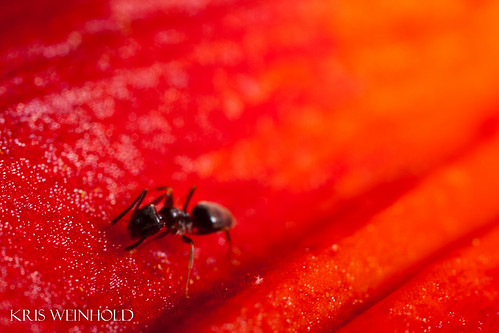
Ant on Lily Flower

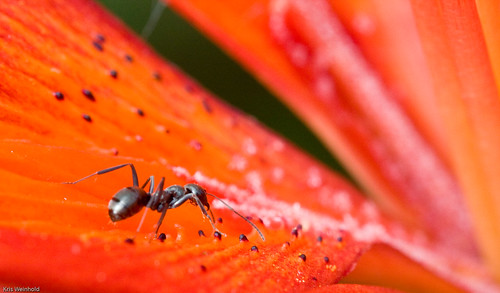
Fortunately, there’s always lots of ants on the lily flowers, so I didn’t have to wait long before snapping a few pictures.

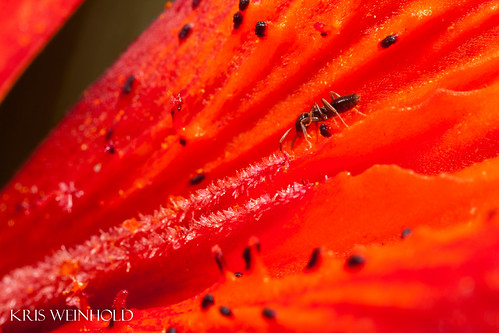
Ant on Lily Flower

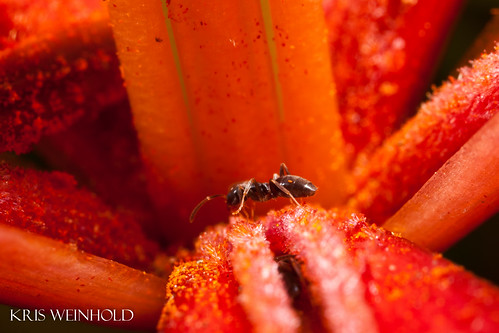
These are all sugar ants, shot with a Canon MP-E 65mm 1X-5X lens at various magnification levels. I was using a twin flash + diffusers to light the critters.

Ant on Lily Flower

I love how macro can open up an entire other world to photograph without having to travel great distances. The picture below looks like it could be taking place on another planet.

Ant on Lily Flower

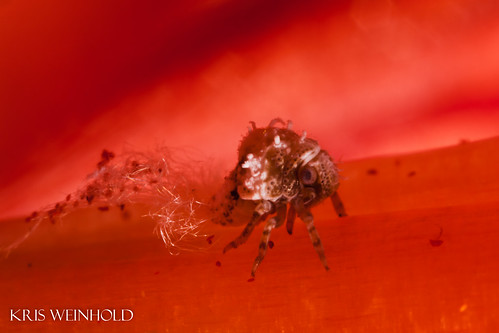
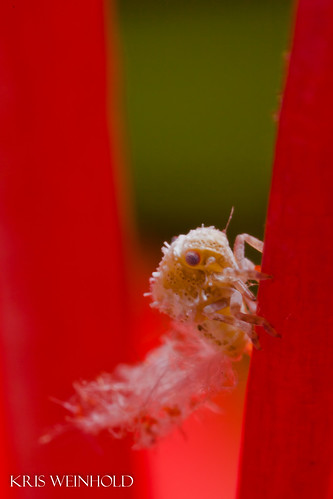
Now, of course, every good extra-planetary story has to have a villain, so enter the spider mites Homopterans, which unfortunately, are also taking up residence on the lilies.

Spider Mite on Lily Flower

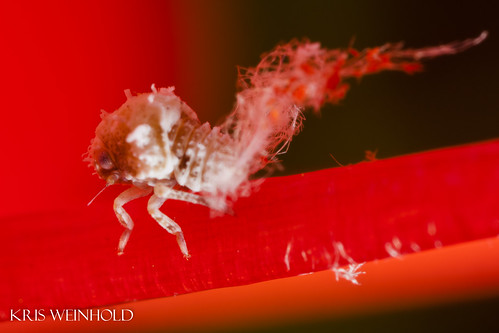
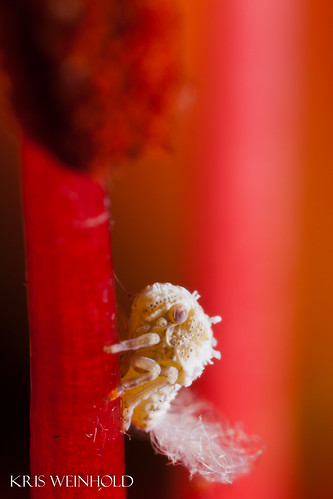
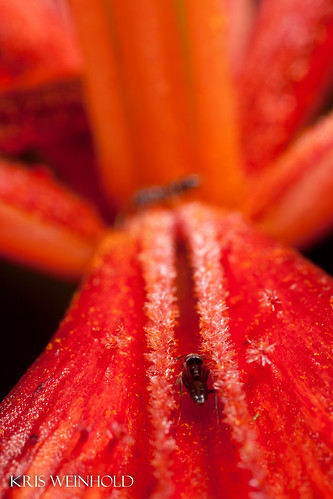
These tiny insects have a cotton poof coming from their rear, that looks like might it be full of eggs.

Spider Mite on Lily Flower

These guys would scurry to the other side of the stamen whenever I tried to get a shot, so I had to do the awkward maneuver of holding the camera in place, while using my other hand to shew the mite back toward the lens.

Spider Mite on Lily Flower

I suppose I ought to try to get rid of these critters to keep them from damaging the plants. Any suggestions on organically killing them?

Spider Mite on Lily Flower

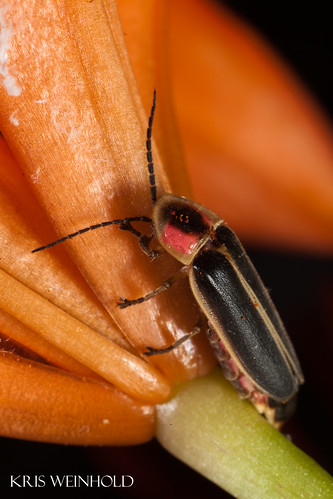
I also found a lightning bug taking shelter at the base of one of the flowers. There seem to be less lightning bugs today than there were when I was growing up, which I’ve read may be due to light pollution at night.

Lightning Bug on Lily Flower

I hope you’ve enjoyed my photographs! In a week or so, the flowers will be gone, and I’ll have to wait until next year to see what critters the lilies attract.


Business Broker

AGA 2010 – Day 1

November 13th, 2010

The first day of the Aquatic Gardener’s Association 2010 convention began with a field  trip to Florida Aquatic Nurseries (FAN).  FAN is the top supplier of aquatic plants in the United States, and have hundreds of plants under cultivation across two locations in south Florida. We began the tour strolling through several green houses filled to the brim with emersed aquarium plants. The largest plants in these greenhouses were often the sword plants, which were in full bloom.

FAN Greenhouse

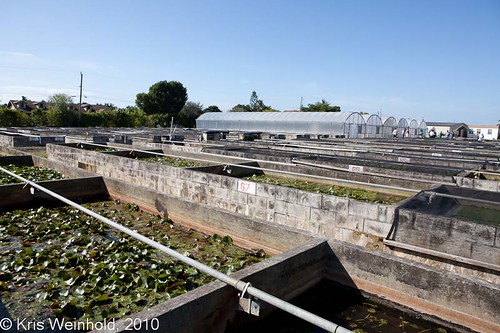
Anubias and Cryptocoryne were the other two very prominent plants in the greenhouses. Outside, rows of cement ponds contained lots of submersed plants, many that were throwing up flower stalks in the Florida sun.

Cement ponds at FAN

One of the most impressive of these flowers for me was the Hydrotriche hottoniiflora, which had a beautiful cluster of yellow flowers on each stalk.

Hydrotriche hottoniiflora Flower

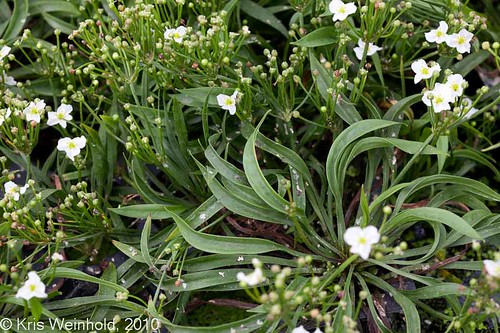
Another plant that was really neat to see was the Echinodorous sp. ‘Vesuvius’ fully emersed and flowering. After seeing it I think Vesuvius may be an even better paludarium plant than an aquarium plant. It’s quite unique looking! During the tour, we also learned about a new hairgrass FAN is hoping to soon put into production. This plant is about 4″ taller, but the leaves are a bit thicker than the other Eleocharis we have in the hobby, similar to how a Lilaeopsis looks.

Echinodorous sp. 'Vesuvius' Emersed

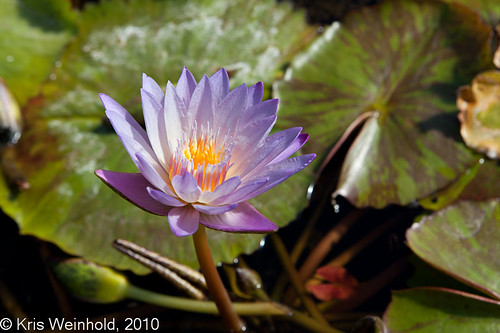
FAN also is a major player in the water lily market, winning international awards for the hybrids over the past few years.

Lily Flower

After touring through their two locations, FAN was kind enough to have the whole group there for lunch, during which they ran a slide-show presentation with more information about their award winning lilies.

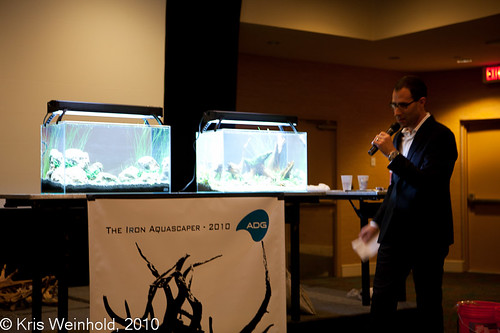
Jeff Senske Hosting Iron Aquascaping Competition

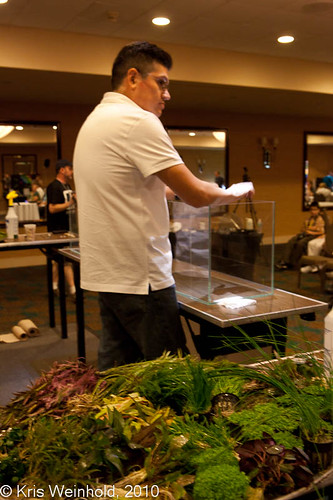
Following lunch, many attendees signed up for a tissue culture workshop, which I hear was very informative. Since I have already done a similar workshop with GWAPA members, I decided to take the afternoon off. The convention activities resumed later in the evening with the Iron Aquascaper Competition, hosted by Jeff Senske and ADG. This year’s competition pitted Houston aquascaper, Luis Navarro against ADG’s own Frank Wazeter. Both contestants were required to use the materials at hand to aquascape an ADA 60-P aquarium.

Frank Places Driftwood

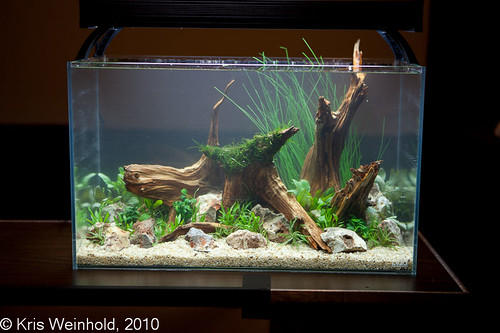
Frank started by setting up a driftwood hardscape, along with a bright sand foreground.

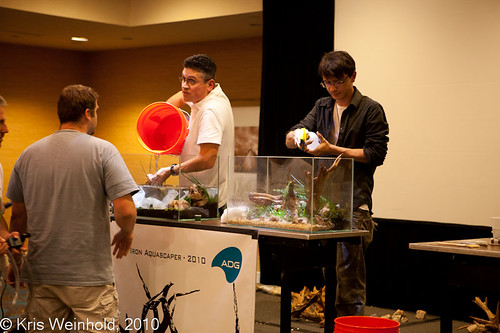
Luis Prepares

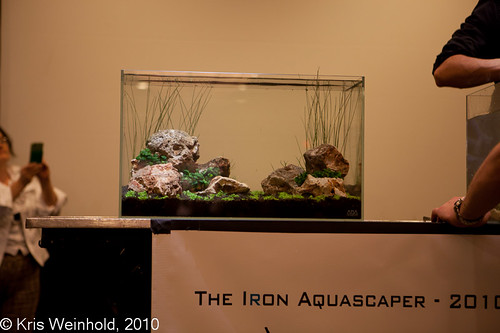
Luis, on the other hand, chose to plant his foreground, and use rocks as his hardscape. It’s always fascinating to watch other people aquascape, to pick up tricks from them. This was the first time that I saw someone use a paintbrush to level out the sand in the foreground. I’ll have to try that myself on my next scape.

Iron Aquascaper Competition

After about an hour, the two contestants finished their scaping, and began filling the aquariums with water.

Frank's Tank

Frank's Aquascape

In the end, Luis Navarro was the unanimous winner of the competition. Congrats Luis!

Luis' Tank

Luis' Winning Aquascape

Business Broker

Zebra Danio: Oldie But Goodie

October 27th, 2009

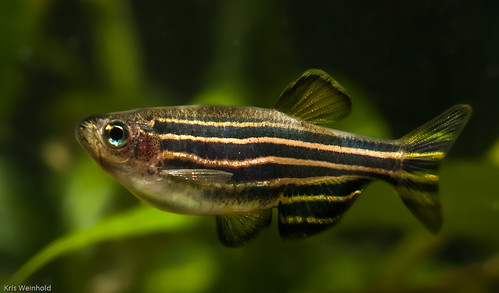
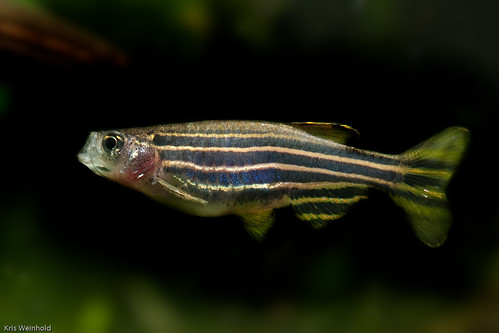
The Zebra Danio is one of the fish that has been in the hobby forever. They are commercially bred and are available for sale in virtually every pet store, commonly being one of the first fish people keep when entering the hobby. For this reason, they are easily overlooked by more seasoned hobbyists when choosing inhabitants for their aquarium. This spring, the temperatures outside were still chilly, but I was beginning to see mosquito larvae outside in my pond. I went to my favorite fish store, and asked the owner what he suggested for a reasonably cold-tolerant fish that would provide mosquito protection, and he suggested the Zebra Danio.

Zebra Danio

For all of the reasons I mentioned above, I was hesitant, but the price was right (less than $.99/fish) so I came home with a dozen fish. They cleared out the mosquito larvae problem nearly overnight, and were quite active in the pond. Also, outside in the full sun, I noticed far more colors than their typical brown and tan zebra stripes. Flashes of blue or green iridescence showed up, as well as, yellow on the tops of their fins. Before long, I noticed lots of small fry swimming outside in the pond. My dozen fish had easily tripled, if not more.

Zebra Danio

When fall came, and the nighttime temperatures began to decline again, I brought the danios inside and placed them in a riparium/terrarium setup that I have going. I thought they would like the extra water flow I have in that particular aquarium, and so far they don’t seem to have any complaints. They are probably the best schoolers and most active fish I’ve kept in a planted aquarium. They might stress more calm/docile tank mates, but they are fun to watch as they never stop schooling from one side of the tank to the other. If you’re looking for an inexpensive schooling fish for your planted aquarium, you really can’t go wrong with the Zebra Danio.

Business Broker

Helping a Friend Rescape

September 1st, 2009

This weekend, myself and another GWAPA member helped a third GWAPA member, Paul, rescape his 90G aquarium. Paul has been in the club for awhile, but wanted to make an earnest foray into the high-tech world of aquascaping. He has a nice T5 fixture on order, CO2 rigged up, and replaced his old gravel mixture with several bags of Eco-Complete.

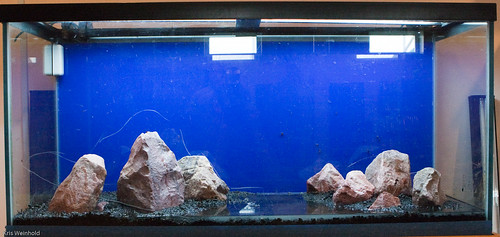
Paul's 90G - Rockscape

It took us longer than you would think to place eight rocks in the aquarium. We added a rock, stood back and looked, gave directions to the person closest to the tank to move a rock a little to the right or left, and ultimately ended up with the rockscape you see above. You can see a little bit of crayon on the front of the glass because we drew a very minor sketch on the tank beforehand. The crayon wipes right off.

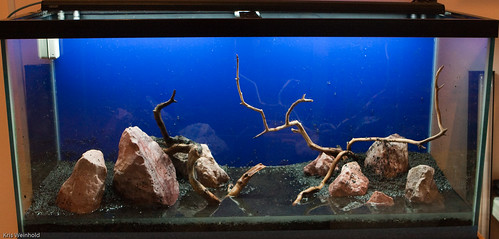
Paul's 90G - Hardscape

After setting our rockscape, we added another two bags of Eco-Complete to mound up on both sides. Then, we added in a few manzanita branches that Paul wanted to use in the scape. After doing this, we were ready to start scaping. We wanted to to keep a relatively simple plant arrangement for the time-being, so we used a number of lower-maintenance plants, with a couple stems thrown in.

Paul's 90G - Aquascape Just Planted

We used Sagittaria subulata and a short Lilaeopsis species in the foreground, with Lobelia cardinalis and Crytocoryne wendtii in the midground, and on the right side background. There’s Echinodorus sp. ‘Vesuvius’ and Ludwigia inclinata var. verticillata ‘Cuba’ in the left background. Overall, I think we were all pretty happy with the scape. Obviously, it needs to do a lot of growing in, but it should fill out nicely. It’s definitely a lot of fun to aquascape with other people!

Business Broker

Rotala sp. ‘Mini’ – Type 1

May 30th, 2009

Another interesting plant that’s been floating around the hobby for a few years now is known as Rotala sp. ‘Mini – Type 1’. There are two plants going around as R. sp. ‘Mini’, so people refer to them as Type 1 and Type 2. The Type 1, shown below is a very petite stem plant with unique leaves that curve downward toward the substrate. The leaves can also get a nice gradient of orange and reddish tones under certain conditions.

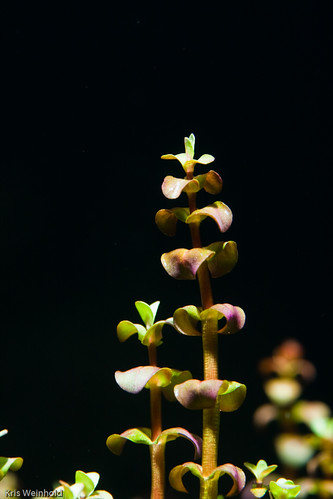
Rotala sp. 'Mini'

In my opinion, this is a plant that is quite ugly individually, but as a large bush (50-100 stems) is incredibly striking because there aren’t many plants that look like it. The relatively vertical nature of its growth defines the interesting group-of-quills look of the bush. Rotala sp. ‘Mini – Type 1’ demands a little bit more attention (light, CO2, nutrients) than the easier Rotala species, but is still not too difficult to keep. Give it a try!

Business Broker

Aquascaping Tips

March 13th, 2009

Starting a planted aquarium can seem like a daunting task. Most hobbyists start out small, gradually learning by trial and error what works and what doesn’t, and piece together information from books and websites until they finally either succeed or get frustrated and leave the hobby forever. In this series of posts, I’m going to attempt to outline the most important aspects of setting up a planted aquarium. Hopefully this will become a valuable resource to anyone new to the hobby, or experienced fish-keepers who are looking to setup a planted aquarium.
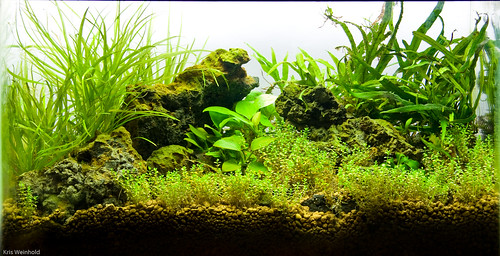
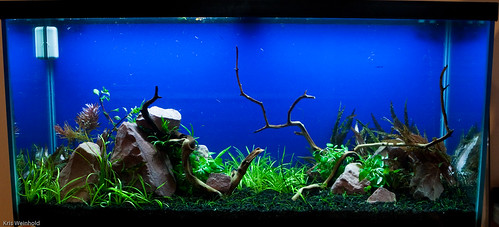
75G - 2-18-2009

Aquascaping, or the arrangement of the items within the aquarium to create a scene, is where the science of planted aquariums meets the artistic side. You can have a very healthy planted aquarium that isn’t very appealing to the eye. Of course, this is an extremely individualistic thing that is largely subjective, but there are a number of guidelines that can help you achieve a nice looking scape.

Ratios

There are certain proportions that throughout history have proven attractive to the human eye. These proportions can be found in nature, architecture, art, and so on. It only makes sense to incorporate them into our aquariums. In general, perfect symmetry is a bad thing when designing an aquascape. In nature, you don’t commonly see a rock repeated in one place from another, so you shouldn’t do that in your tank. Avoid placing the focal point, whether it is a large rock, piece of wood, or large grouping of plants directly in the middle of the tank. Instead, position the focal point off-center. There are many different possibilities, but the easiest to start with is to divide up your tank into thirds, and put the focal point a third of the way from the left, and a complementary group of wood/rocks/plants a third of the way from the right. The grouping on the left should be larger than the group on the right. If following the golden ratio, one grouping would be 1.61 times as large as the grouping on the right.

When grouping pieces of rocks or wood in your tank, try to ensure that each group has an odd number of items with in. This will help achieve a more natural appearance. In addition, most of the time it is better to slightly angle some of the rocks/wood, verses having them positioned completely vertical.

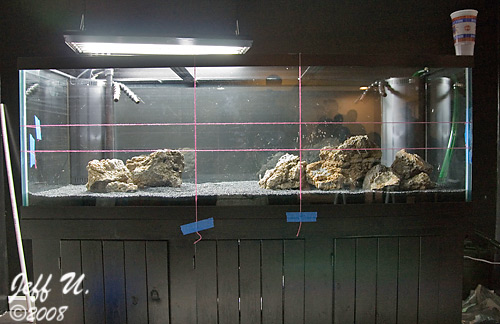
Using string, you can position your hardscape according to thirds.

Using string, you can position your hardscape according to thirds.

Depth

The biggest challenge when aquascaping is figuring out how to make the aquarium appear deeper than it actually is. Most people are only dealing with 12-18″ of space from front to back, however, you want to create the appearence that the scene could go on forever. There are a few tricks that you can use to achieve these feats. First, when you first add the substrate to your aquarium, don’t level it perfectly from front to back. Instead, slope the substrate so that the foreground is lower than the background. As you add the hardscape (rocks/wood), make sure that the slope remains. Second, you can simulate perspective in your aquascape by placing larger items toward the front, and smaller items to the back. This makes it look like things are getting smaller as they get to back of the tank. Don’t overlook leave sizes when considering this, in particular, various sizes of Anubias can be great for achieving this effect. Third, keep your foreground fairly shallow. Having a huge foreground compresses the midground and background, and takes away space from transitioning between them. Finally, position your hardscape so that there are clear lines for the eye to follow from front to back, paying addition to make sure that the foreground naturally transitions from to the midground, and then to the background.

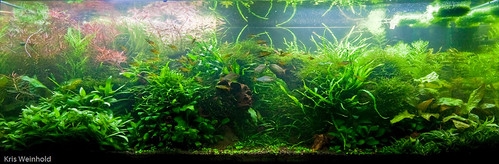
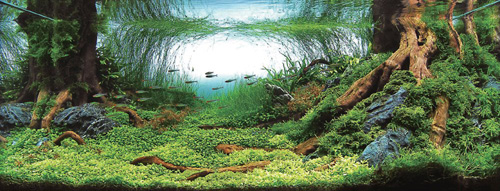
Cliff Hui created amazing depth in his 4th place ranked "Destiny" scape in the 2008 ADA Contest.

Cliff Hui created amazing depth in his 4th place ranked "Destiny" scape in the 2008 ADA Contest.

Colors/Styles

Make sure all of the separate items that you add to your aquarium look good together. If you have a blank sand substrate, it’s not very believable if you have very light/white rocks on top of it. In addition, if you ultimately want a large rock to look like a mountain top, don’t use a sword plant right next to it, as the large leaves of the sword diminish the impact of the mountain top. Use plants that complement one another, and choose your bright red plants carefully, as you want to use them as accent pieces, not much more. Seek out rocks and wood that have a lot of character, and relatively few straight edges. The more detail on each item, the more it will look like a miniature version of a larger piece of nature.

Hardscape

The rock and wood used in the aquarium make up the hardscape. Your hardscape supports and ultimately makes your aquascape possible — everything stems from the hardscape. After you add the substrate to your tank, it’s time to position your hardscape. I like to add my largest piece, or focal point, first and build around that. Remember to leave room for the plants! It’s easy to have the perfect looking hardscape initially, but then find that you either don’t have room for plants, or that the hardscape ultimately overpowers the plants. On the other hand, particularly for foreground pieces of hardscape, remember that the foreground plants will take up 1-2 inches of height, so don’t use rocks that are going to get covered up by the plants. Plan ahead, even if initially they look slightly too tall there. The idea is to place the hardscape, and have the plants complement it, as they grow in. When you are done positioning your hardscape, use a little bit of extra substrate to fill in any gaps, and to make the scene a little bit more natural looking.

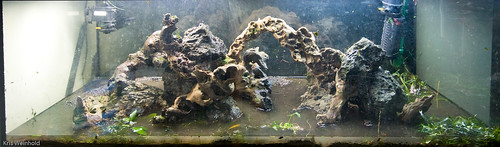
75G Hardscape

Original hardscape for the 75G at the top of post.

Use of Plants

Obviously, plants are an integral part of the aquascape. Mosses, ferns, and Anubias are great plants to use to hide cracks between two rocks, transition between foreground and midground, or to slightly obscure/soften a larger hardscape item to accentuate a particular part of that item. Stem plants are often used as background plants, as they can grow and provide a nice backdrop for your hardscape. By trimming your plants to keep them taller in the back, and shorter in front, you help create a sense of depth from front to back. It’s often better to use more of a few types of plants in an aquascape than the try and cram lots of different species into a single aquascape. The reason is that it’s often hard to ensure that all of those species truly match each other. Besides, in nature, you usually don’t encounter tons of species all growing in the exact same area.

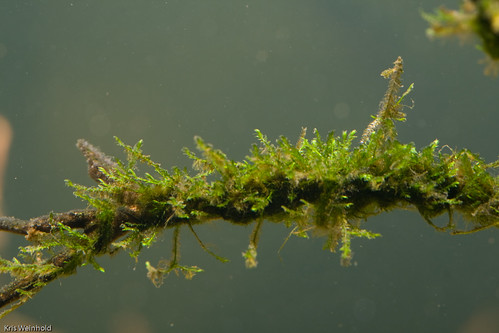
Taiwan Moss

Moss helps soften wood, when tied to it using cotton thread.

Negative Space

So far, I’ve talked mostly about things you want to add to have a nice looking aquascape. Sometimes, it’s as much about what you leave out that really makes the aqauscape great. For example, if you want to have a large rock represent a mountain range, the impact will be the greatest if you have some empty space around that rock. This contract is what draws the eye to the mountain. Similarly, open pathways where the foreground extends back into the midground or background help create a sense of depth, and also highlight the rocks/wood/plants along those pathways. Basically, don’t try to fill every inch of space in your aquarium with something — leave some parts open.

Summary

While I have provided a number of good “rules” to aide you when aquascaping your planted aquarium, the design of an aquascape is a very personal thing. There are times when it makes good sense to break one of these rules in order to achieve a desired effect. In all, use these as a basis, and go from there. I hope to see lots of great aquascapes popping up online and in the various aquascaping contests. Good luck!


Business Broker

Lighting

February 13th, 2009

Starting a planted aquarium can seem like a daunting task. Most hobbyists start out small, gradually learning by trial and error what works and what doesn’t, and piece together information from books and websites until they finally either succeed or get frustrated and leave the hobby forever. In this series of posts, I’m going to attempt to outline the most important aspects of setting up a planted aquarium. Hopefully this will become a valuable resource to anyone new to the hobby, or experienced fish-keepers who are looking to setup a planted aquarium.

2.5G - 08-31-2008

More than any other factor, lighting is the driving force that determines plant growth rates and fertilizer/CO2 requirements. Before purchasing a light for your tank, you need to determine what your ultimate aspirations in the hobby are. Do you want to be able to grow any type of plant? Do you mind spending time trimming your plants every week? Do you want to inject CO2 or add fertilizers on a regular basis? Lighting doesn’t completely determine all of these things, but it definitely has a significant impact on them.

Light Levels

The amount of light placed over your tank is often measured in watts (W). There are many resources that recommend a range of watts per gallon ratios (WPG) for categories called “low light,” “medium light,” and “high light” tanks. Unfortunately, the whole WPG paradigm is not a perfect formula for success. Instead, the height of the aquarium is more important than the volume. Water diffuses light so it is very difficult for light to penetrate deep into a body of water. This is why the tops of your plants near the light are often red and vigorous growers, but lower leaves remain green, or melt away altogether. Infer from this that the taller your aquarium is, the more light you will need to adequately grow plants, especially foreground plants near the substrate.

To demonstrate how the WPG rule falls apart, on a 2.5G aquarium, 26W of light would be 10.4 WPG. On a 75G aquarium, 220W would be 2.93WPG. Both are considered high light tanks, with relatively equivalent plant growing capacity. For a smaller tank, the WPG ratio is likely to be skewed due to the fact that plants need a base level of light to grow. Combine that with the smaller stature of a 2.5G tank relative to the 75G aquarium, and you don’t need a ton of light. A 75G aquarium is 20 inches tall, so much more light is required to penetrate to the bottom of the aquarium. Much less and the foreground plants could be leggy, and reach for the surface instead of crawling along the substrate.

Keeping the height and volume discrepancies in mind, in general, light levels for fluorescent fixtures can be determined as follows:

  • 0-1 WPG Low Light
  • 1-2.5 WPG Medium Light
  • 3-4+ WPG High Light

LED fixtures are an entirely different beast. A 25w fixture can output light superior to a 350W HOT5 and metal halide fixture. As such, for LED fixtures you must rely on PAR (Photosynthetically active radiation), the measurement of the amount of photosynthetically active wavelengths in light. To define light levels, you should figure out how much PAR you have at the substrate. Here is a rough guideline. These guidelines are true for florescent and incandescent fixtures as well:

  • 0 – 30 PAR – Low Light
  • 30 – 80 PAR – Medium Light
  • 80-120 PAR – High Light

If you have at least 80 PAR at the substrate, you should be able to meet the lighting requirements for almost any plant in the hobby.

Choosing the Right Plants
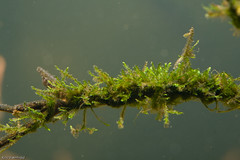
Taiwan Moss

It is very possible to have a beautifully planted aquarium with very low light levels. In order to achieve this, you must choose only plants that are predisposed to growing with less light. Some examples of these plants are Anubias, Cryptocoryne, Bolbitus, Java Fern, Swords, Vallisneria, most mosses, and a small handful of stem plants. While there are a large number of species within these genera, your plant selection is quite curtailed from that of higher light levels. These plants will grow extremely slowly in low light, which means that they will not require frequent trimming, but if you suffer from an algae outbreak, it will likely take longer to recover since new growth will not as quickly replace the old algae-laden leaves. Some other plants will grow, but may exhibit larger leaves, leggy growth, and green coloration. Of course, the low-light tanks are inexpensive to setup and maintain, so they do have some appealing qualities.

As you increase the light levels over your aquarium, the number and types of plants that will grow expands rapidly. Hundreds of different stem plants become viable, as do several foreground plants that are impossible to grow under lower light levels. Of course, the added light also causes plants to grow faster, thus using more nutrients and requiring more frequent trimming. While CO2 is used most readily in higher light tanks, I recommend CO2 supplementation for all light levels.

Kelvin Ratings

So far, we’ve only talked about the intensity of the light, but not the quality. Plants use specific colors within the light spectrum for photosynthesis, so it makes sense that not every bulb will adequately supply the type of light needed for plant growth. The color of a bulb is determined by the bulbs’ Kelvin rating. There are many different Kelvin ratings that will work, but the most popular are 6500K, 8000K, and 10,000K. Bulbs in the 6500K range are usually a little bit yellow-cast, while 10,000K bulbs are more bluish. I prefer to mix colors, which tends to illuminate the tank in a more natural way. If the bulb isn’t labeled with a Kelvin rating, most “daylight” or “full spectrum” bulbs will work, as will “plant grow” bulbs. Stay away from most “cool white” or general purpose bulbs. Even within the Kelvin ranges, one 6500K bulb may be more or less yellow than another manufacturer’s 6500K bulb. Experiment with a few different brands to find the one that looks the best to your eye. (Don’t be surprised if more expensive bulbs last longer, and produce a more appealing type of light.)

Degradation of Quality Light

To make matters even more complicated, the quality of light that is produced by a light bulb decreases over its lifespan. Generally speaking, a brand new bulb will appear much brighter, and produce a more photosynthesis-friendly light source than bulbs that are more than a year old. The type of bulb makes a difference, as does the daily operating temperature of the bulb, but a good rule of thumb is to replace your light bulbs yearly regardless of whether or not they have burned out. Obviously, if you can reuse these bulbs in household fixtures that would be ideal. If not, be sure to dispose of them properly (not in your regular trash), as most of these bulbs contain mercury. LED generally have a much longer degradation period, lasting 5 or more years, however, unlike bulbs, they continue to emit the same quality of light, just at a decreased brightness. You can extend the life of your LEDs by dimming them over their lifetime.

Photo Periods

Intermatic Digital TimerThe photo period is the amount of time that you have the light turned on over your planted aquarium. The recommended time for most aquariums is 10-12 hours. If you notice that your stems plants are closing up toward the end of the day, they’re done photosynthesizing, and there’s no benefit to leaving the light on any longer. In addition, if the lights are on too long, algae can advantageously utilize the extra light. Lighting systems containing multiple bulbs or fixtures can be timed to run less bulbs in the morning and evening, and more bulbs during the middle of the day, simulating dawn, mid-day, and dusk light levels. For consistency, I recommend using a timer for your lights regardless of your lighting scheme.

Lighting Options

Once you’ve decided whether you want a low-light or high-light planted aquarium, you now have to choose from a variety of lighting technologies. Fortunately (and unfortunately) there are lots of options to choose from, allowing you to customize your light solution to the specific needs of your aquarium. I’m going to give a brief overview of the most common options:
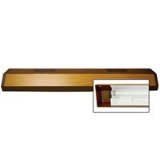
AGA Strip LightNormal-Output Fluorescent

Normal-output fluorescent lights are the standard fluorescent light tubes that are common in business ceiling lights, and the type of light fixture that’s often bundled with new aquarium purchases. Unfortunately, these fixtures are not appropriate for anything but low-light setups. Be sure to purchase plant-appropriate bulbs, and replace them yearly. Even for low-light tanks, you will likely want to invest in a double or triple tube solution. The reflectors in most of these fixtures are not very good, so a lot of light is not properly directly into the aquarium.
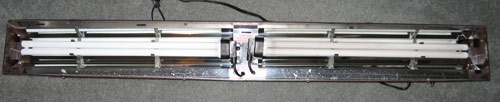
Power Compact Fluorescent (PC)

Just as power compact bulbs are growing in popularity for household use, they are also widely used with planted aquariums due to better efficiency and intensity than their normal fluorescent counterparts. They do produce a moderate amount of heat, and due to the width of the bulb, they suffer from some restrike problems. (Restrike is when light is emitted from the bulb, bounces off of a reflector, and goes right back toward the bulb, instead of going into the aquarium.) Overall, cost wise, PC fixtures often give you the best bang for your buck.

T5 Fluorescent Lighting
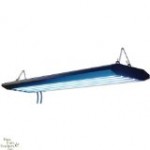
TEK T5 Lighting SystemT5 lighting is immensely popular in the planted aquarium arena. T5 bulbs are smaller in diameter than normal-output fluorescent bulbs, but otherwise look similar. The difference is that high-output (HO) bulbs and fixtures are available that produce far more light. In addition, due to their smaller diameter, less heat is generated and restrike is not as much of an issue. In a fixture where each bulb is wrapped in its own individual reflector, the efficiency is very high, producing extremely good results.

Metal Halide (MH)
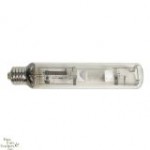
Iwasaki 6500K MH BulbMetal Halide lighting is commonly used in the hydroponics industry as grow lights. The technology has been in the aquarium hobby for a number of years, particularly on the reef side. These lights are very good at penetrating to the bottom of tall tanks, and produce an incredibly bright light. They also produce a mesmerizing shimmer on the bottom of the aquarium. The biggest downside to metal halides is the heat that they generate, making them less efficient than most other forms of lighting. Of course, the amount of light produced can really drive plant growth and colors to the extremes.

LED Lighting

LED lights are taking the aquarium hobby by storm. There are already a few planted aquarium specific LED fixtures on the market. The benefit of this type of lighting is the extremely high efficiency of the light, with very low heat generated. In addition, LED lights are directionally oriented, so they do not require reflectors, and thus restrike is not an issue. In addition, the directional light combined with any surface ripples create the same shimmer effect that metal halides produce. Many LED fixtures include dimming capability that allow you to convert your lighting from low light to high light at the touch of a button. Finally, high-end lights include all kinds of features ranging from custom color configuration, lighting storm and cloud effects, moon lights, ramping up/down the light to simulate the movement of the sun, and more.

Do It Yourself Solutions

There are many DIY solutions to lighting a planted aquarium. The simplest DIY method is to purchase a retrofit kit for any of the above technologies, and install that into a custom built canopy or light strip. You can also rewire existing normal-output fluorescent fixtures to overdrive them, producing about 1.5X the amount of light that they normally would produce. I have seen examples of people using regular screw-in light bulbs in a canopy to light the aquarium. There are also excellent LED kits that allow you to completely customize the intensity and color of your light. In all, if you can think it, you can do it. Just be sure that you use good electrical practices, and that the bulbs you use are suited to grow plants.

Combined Solutions

There are several fixtures on the market that combine two types of lighting technology. The most popular is to combine PC/T5 lighting with MH in one fixture. These fixtures are designed to run efficient power compact lights for most of the day, with the metal halide light running in the middle of the day as  a noon-burst. This is supposed to emulate the 3-hour period of the day where the sun is most intense.


Reflectors

While reflectors aren’t part of every lighting solution, they DO make a difference in the effectiveness of your equipment. The shape of the reflector, as well as, the shininess impact its ability to direct more light into the aquarium. Parabolic (rounded) reflectors are generally better than rectangular ones. Polished aluminum is generally better than white or other types. In addition, using one reflector for each bulb in your fixture is generally better than using a single large reflector for all bulbs, as this minimizes restrike.

Summary

Lighting is an important part of every planted aquarium. The more light you have, the more you are pushing your plants to grow, which causes plants to need more resources to sustain that growth. If you do not adequately balance you light levels, CO2 injection, and fertilization schemes, you are asking for poor plant growth and algae problems. Fortunately, there is a lighting solution for every lifestyle and price point, so do your research and choose wisely. At this point, I would recommend any new hobbyist seriously consider investing in an LED fixture as they bring the best balance of light output, energy efficiency, customization, and configuration.
Business Broker

Substrate

February 4th, 2009

Starting a planted aquarium can seem like a daunting task. Most hobbyists start out small, gradually learning by trial and error what works and what doesn’t, and piece together information from books and websites until they finally either succeed or get frustrated and leave the hobby forever. In this series of posts, I’m going to attempt to outline the most important aspects of setting up a planted aquarium. Hopefully this will become a valuable resource to anyone new to the hobby, or experienced fish-keepers who are looking to setup a planted aquarium.

20L using SoilMaster Select

I remember how choosing the proper substrate for an aquarium used to be as easy as picking the color your wanted from a palette of about 10 colors, ranging from black to neon pink. For planted aquariums, the choice isn’t nearly as straight forward, but depending on your decision, the implications are quite significant. Fortunately, there are many right answers to which substrate is used, so it’s just a matter of knowing what each choice requires of you in order to be successful.

What to Look For

There are a few common attributes that should be sought from whatever substrate you choose. In general, you want something that is attractive, and will look natural with the plants and hardscape you are choosing. I would suggest going with browns, grays, and blacks instead of any of the colored substrates. In addition, plain gravel is usually not a great substrate for plants, although it can be done. The main reason is that gravel is 100% inert, meaning that it cannot absorb and store nutrients for the plant roots to later consume. There’s a more technical term for this called the cation exchange capacity (CEC), which defines how easily a given substance can exchange positively charged ions between itself and a solution. Fortunately, you don’t have to worry about the technicalities of this besides trying to avoid plain gravel if possible.
Another thing to consider is the granule size of whatever substrate you are evaluating. Anything much bigger than pea-sized is going to be difficult to physically plant in. In addition, more delicate and smaller plants, may be unable to navigate the larger granule size, making it impossible to plant a field of hairgrass or similar type of aquascape. Very fine sand should also be avoided as it is inert, and can compact on the roots, causing anaerobic conditions.

Commerical Substrates

Fortunately, there are several commercial substrates available that are specially designed for planted aquarium use. Unfortunately, many of these come with a high upfront cost, which should be considered.

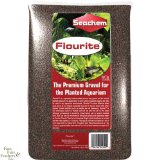
Seachem Flourite

Seachem FlouriteOne of the most widely available substrates on the market for planted aquariums is Seachem Flourite. Originally a course reddish clay-based material, Seachem has now expanded their product line to include several other colors and granule types, including the attractive Flourite Black Sand. For all but the lowest-light tanks, planted aquariums using these products will require supplemental fertilization for plants to get the nutrition they need, but Flourite has an excellent CEC rating, ensuring that these fertilizers will be captured for use by the roots. For the traditional Flourite products, many people prefer to pre-rinse the substrate before putting it into their tank to remove any particulate matter that often initially clouds the tank. In my experience, you can get away with not rinsing, but you must be cognizant of minimally disturbing the substrate when initially filling the aquarium, and when uprooting plants. The original Flourite is sometimes too large for some small foreground plants, but their newer sand product lines correct that.

CaribSea Eco-Complete

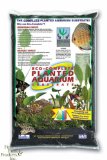
CaribSea Eco-CompleteAnother widely available commericial substrate is CaribSea’s Eco-Complete. Eco-Complete is an attractive substrate, resembling black sand with a small granule size. Differentiating itself from Flourite, Eco-Complete comes with bacterial starting liquid in the bag, so it should not be rinsed prior to use. This substrate also will require fertilization in most aquariums, but should be capable of growing nearly any type of plant you throw at it. The substrate is fairly dense, doing a good job of holding plants down where you plant them.

ADA Substrate Line

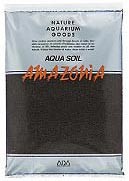
ADA Aquasoil AmazoniaCurrently, the premium line of planted aquarium substrates on the market are made by Aqua Design Amano, operated by planted aquarium and aquascaping guru, Takashi Amano. The ADA substrate line can be confusing to understand at first, but essentially, it consists of 4 components: additives, Power Sand, Aquasoil, and Bright Sand. When setting up an aquarium, you first sprinkle some additives on the bottom of the aquarium. These can include Tourmaline BC, Clear Super, Bacter 100, among others. These additives are designed to provide additional minerals, jump start bacterial colonies, and aide in maintaining clear water. Then, Power Sand, a porous stone mixed with peat and other nutrients is added. Power Sand aides in preventing compaction over time, so that water continues to flow throughout the substrate after years of use. On top, Aquasoil is used either in the whole aquarium, or just in the background. If you want a decorative white sand foreground, you would put Bright Sand there instead of the Aquasoil. The most commonly used product is Amazonia Aquasoil.

Unfortunately, the ADA product line is only sold at a handful of shops in the U.S., but is available online from Aquarium Design Group and Aqua Forest Aquarium. As you can imagine, this product line is more expensive to use in most cases than other more widely available commercial substrates. In my opinion, the main reason to choose the ADA brand is that it comes out of the bag with a ton of nutrients, jump starting your aquascape without the need for dosing. Keep in mind, however, that after 4-6 weeks, additional fertilization will be required after that initial burst. In addition, Aquasoil buffers the water, ensuring a more acidic environment which is proven to facilitate the uptake of nutrients by plants. Finally, as a planting medium the weight, consistency, and granule size is ideal for holding plants in place. I recommend doing several water changes per week for the first two weeks after initially using Aquasoil to ensure that your pH and nutrient levels do not become too extreme. For this reason, you may want to wait a couple weeks before adding fish to your tank. In the end, it’s worth it, as your plants should be healthy, and ready to support the extra bioload that fish bring.

Other Commercial Substrates

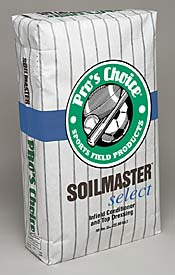
Soilmaster SelectThere are quite a few other substrates available commercially, but the three I have mentioned are the ones I have personal experience with. These other substrates are most likely just fine to use, but be sure to research other aquarists’ experiences prior to using. In addition to  substrates that are specifically designed for planted aquariums, another substrate which has been widely used is SoilMaster Select (SMS). This is actually a turf product designed for use on baseball fields, but through experimentation, it has been found to work very well in aquariums. Like Aquasoil, it slightly reduces the KH of your water, providing a good acidic environment for the roots. It also has fine granules, and an extremely high CEC. The downside of SMS of that it’s fairly lightweight, so strong currents can blow it around. It does a reasonable job at holding down plants, but I would make the substrate a little bit deeper than with some of the other heavier ones available. With no inherent nutritional value, you should expect to provide supplemental fertilization from day one. The main benefit is that a $16-$20/bag of SMS will completely fill a 75G aquarium, while most of the other substrates would cost 5X or more for the same tank. Unfortunately, I’ve heard that SMS has been discontinued by the manufacturer, but hopefully a replacement product-line will arise that is similarly suitable for aquarium use.

Soil Substrate

There is another DIY substrate that is gaining use in the hobby. While traditionally, many people have recommended against using soil in the aquarium due to huge algae outbreaks, recent formulas for success have been developed to make this a viable option. Diana Walstad, author of Ecology of the Planted Aquarium has garnered a following for her low-tech, el Natural, style of soil-based aquariums. One of my fellow GWAPA members, Sean Murphy, has also developed his own mineralized soil substrate recipe, which has attracted much use throughout the hobbyist community. The key benefit to setting up one of these tanks is that very little dosing is required on a day-to-day basis, as all of the nutrients should be present within the soil itself.
Soil substrates are not for everyone. They cannot grow plants that draw nutrients from the water column, instead of via their root systems. In addition, there is a 4-8 week preparation process of breaking down the organic material in your soil, prior to setting up your tank. Finally, even after running this process, you may or may not experience a period of severe algae while the ecosystem of the tank is established. That said, once established, the substrate has been proven to last at least a decade. The full process of setting up a mineralized soil substrate tank can be found here.

Plain Gravel + Additives

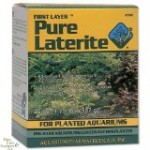
Pure LateriteIf none of these other options are amenable to you, it is possible to have some moderate success using plain gravel. I will stress that it is much preferred to use any of the other options detailed above, but if you insist on using gravel, you ought to at least supplement it with a few additives placed underneath. Most importantly, make sure to add laterite, an iron-rich mineral, which can be purchased in most pet stores. In addition, a small amount of peat will help acidify the substrate and provide a material with a decent CEC ratio. I would also encourage you to use form of fertilizer sticks/pellets, such as Seachem’s Flourish Tabs, which will add other trace nutrients to your substrate. Finally, expect to have to add additional fertilization, especially in high-light+CO2 setups. Again, this solution should be your last choice.

Summary

Choosing a proper substrate is an integral part of a successful planted aquarium. There are several out-of-the-box solutions that can get you up and running very quickly. If you would prefer a more natural substrate, topsoil-based substrates can also do the job quite well. There may be some trial and error involved in finding a substrate that fulfills the aesthetic or dosing regimen that you’re striving for. I hope that you now understand the most popular options that other hobbyists are employing.

Business Broker

Flow: Filters / Powerheads

January 28th, 2009

Starting a planted aquarium can seem like a daunting task. Most hobbyists start out small, gradually learning by trial and error what works and what doesn’t, and piece together information from books and websites until they finally either succeed or get frustrated and leave the hobby forever. In this series of posts, I’m going to attempt to outline the most important aspects of setting up a planted aquarium. Hopefully this will become a valuable resource to anyone new to the hobby, or experienced fish-keepers who are looking to setup a planted aquarium.

Algae Filled 40G

Algae can set in without adequate flow.

Flow is one of the most important things to consider when setting up a planted aquarium. As plants use up CO2 and nutrients in the surrounding water, adequate flow ensures that fresh water and nutrients are circulated around the plants so that they can continue growing. Without this, your aquarium can have dead zones where algae adventitiously steps in. To prevent this, add filters and powerheads to your aquarium to clean and circulate the water.

Filtration

While filters do provide circulation within an aquarium, they also perform the task of cleaning the water. There are many different types of filters on the market, but some are much better suited for a planted aquarium than others. Since CO2 is an important addition to any planted aquarium, you should ensure that the filter you choose will not work against this addition. Carbon dioxide can easily be driven out of the aquarium through surface ripples created by equipment. Inherently, hang-on-the-back filters such as the very popular Hagen AquaClear series is ill-suited for a planted aquarium for this reason.
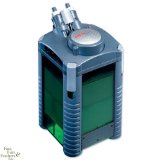
Eheim Pro II FilterCanister filters are the ideal filter for a planted aquarium. Not only do they efficiently clean the water due to their ability to easily customize the cleaning medium used (sponges, carbon, bacteria balls, etc…), but their intake and outtake lines can be position well below the water line to prevent surface disturbance. Of course, there are many types of canister filters on the market. I prefer to use filters that will not air-lock when injecting CO2 into their intake, as a means to diffuse the gas into the water column without adding extra CO2 equipment inside of the tank. (A filter with air-locking problems is one where the impeller stalls when a gas is introduced into the impeller chamber.) In addition, most canister filters can easily be hooked up to external heaters, U.V. sterilizers, or other equipment.

Currently, I successfully use several Eheim Pro II series of canister filters on my aquariums. If you do not plan on injecting CO2 into your filter, virtually any canister filter is appropriate. I’m also successfully using the Hagen Fluval series of filters in this way. When purchasing your filter, it’s often better to buy the next model up for your size of aquarium because when a filter is rated for a certain gallon tank, they generally do not take into account that much of that tank will be obstructed by plant mass.

There are other types of filters that are a little bit less appropriate for the planted aquarium. Sponge filters tend to get plants stuck to them, add too much surface agitation, and do not provide any flow. Additionally, undergravel filters should be avoided as they interfere with plant root systems.

Powerheads

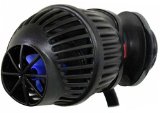
Hydor Koralia Powerhead

Once you have decided on your filtration method, you may still discover that certain areas of your aquarium are not receiving adequate flow. In these situations, you could add another filter, but it’s usually much less expensive to simply add a powerhead to the aquarium. Powerheads are designed to move a certain amount of water per hour. I’ve recently started using Hydor’s Koralia Powerhead because the design is extremely energy efficient, produces a wide stream, and doesn’t easily clog. There are, however, less conspicuous powerheads on the market that work very well, such as the Hagen AquaClear series. These also have the added benefit of being able to drive a quick filter, which does a great job at clearing micron-level debris from the water column.

Sumps and Pumps

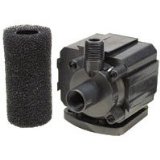
There are other ways to add circulation to your planted aquarium. While, in general, adding a sump (a large hidden aquarium underneath Supreme Mag-Drive Utility Pumpyour visible aquarium to add overall water volume to your system) is not ideal in planted setups, I have seen it done. The key is to make the path from the main aquarium into the sump as smooth as possible so that CO2 is not lost. The benefit of a sump is that you can put extraneous equipment such as your heater down there. You can also dose fertilizers into the sump, and have them dissolve and subsequently migrate back into your main aquarium. A submersible pump, like the Supreme Mag-Drive Utility Pump moves the water back into the main aquarium. These pumps can also be used externally, in conjunction with PVC pipe or hoses to act as an external powerhead. In this way, I have seen some people create a closed-loop from their aquarium through a DIY CO2 reactor, and then back into their aquarium via an external pump. This setup is advantageous if your canister filter does not have enough horsepower to use an external CO2 reactor without losing too much flow.

Summary

In conclusion, having adequate circulation is extremely important in a planted aquarium. There are a number of ways to achieve this, while also accomplishing some other goals, such as filtration, heating, CO2 injection, etc. Hopefully, you now have the knowledge needed to obtain the right circulation system for your planted aquarium.

Business Broker

GWAPA – January 2009 – Driftwood Collecting

January 26th, 2009

On Saturday, GWAPA had its first meeting of the year at Viktor’s house. Viktor keeps a number of tanks, all of which I believe use a soil-based substrate. This was not the topic of the meeting, however, as Viktor also collects and prepares his own driftwood, which he described his process in detail.

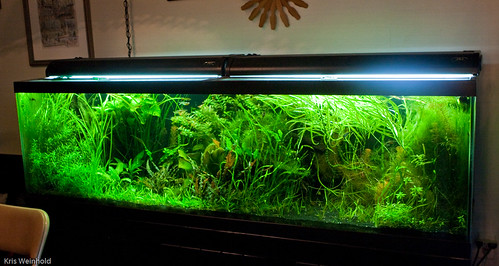
Viktor's 125G

In general, Viktor looks for roots of fallen trees because they’re usually more interesting than many of the upper portions of the tree. Bosemani RainbowfishThen, he soaks the wood outdoors in a friend’s pond for several months to allow it to because waterlogged, and to release some of the tannins. He has used a dishwasher to subsequently sterilize the driftwood, but has more recently shyed away from this practice because he’s wary of the drying chemicals that are often required for newer dishwasher’s drying cycle. So, if it’s a small enough piece, boiling is a good option, and he’s heard that some people even bake their wood. If neither of these is an option, scrubbing it down with hot water is usually the best you can do before putting it in the aquarium. Once in the aquarium, it’s fairly common for a white fungus to appear on the wood. This is nothing to worry about, as it will usually go away on its own, or with the help of a number of algae-eaters, which love the stuff. At this point, the wood should be usuable for years in the aquarium.

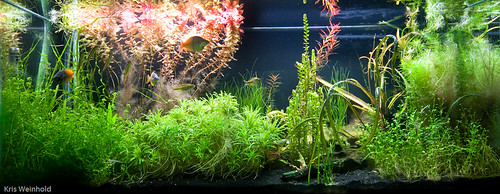
Viktor's 75G

After the talk, we continued to mill around, looking at Viktor’s aquariums. He has some gorgeous rainbowfish, including the Melanotaenia boesemani seen above. We conducted our regular monthly auction, which consisted of over a hundred bags of plants and items. I think everyone walked away with something new to try in their tanks. Another great meeting!

Business Broker

« Previous Entries   Next Entries »