GWAPA – Fertilizers 101 by Jeff Ucciardo

August 25th, 2008

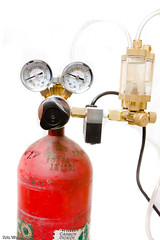
Jeff Ucciardo gave a wonderful overview of fertilizers at GWAPA‘s August meeting this month. Jeff is a former tank-of-the-month winner on Aquatic Plant Central and is known within the club as having one of the most algae-free and well maintained set of planted aquariums in the club. Much of this is due to his grasp of how to use fertilizers to maintain the proper balance of nutrients in the aquarium. He put together a fantastic presentation, going over Estimative Index (EI) and Perpetual Preservation System (PPS) methods of dosing. Then, he described how he does something in-between those two methodologies while using an auto-doser to maintain consistency.
Ferts 101

We also had another huge auction this month. I came away with the biggest anubias I have ever seen. This monster plant is well over 2 feet tall, and more than a foot wide. It looks like Anubias barteri in some places, but in others like a totally different species. I stuck it in the back corner of my 54G aquarium to give a little bit more height to that scape. Otherwise, I came away with Lobelia cardinalis var. ‘small form’ and some pond plants. All-in-all, another great club meeting!


Business Broker

GWAPA – June 2008 – Bob Bock – Sunfish

June 28th, 2008

GWAPAAt GWAPA’s June 2008 meeting, we invited Bob Bock, past president of the North American Native Fishes Association, to speak about native sunfish. While this doesn’t sound much like a “plant topic,” we asked Bob to be sure to let us know which fish throughout his presentation would be suitable for a nicely aquascaped tank. Otherwise, since many American aquarists are unfamiliar with fishes in their backyard waterways, we felt it was a beneficial topic regardless.

Bob Bock

The theme of Bob’s presentation consisted of comparing how sunfish, though unrelated to cichlids, exhibit rather similar behaviors. They are both intelligent fishes, care for their young, feed by sight, and are widely distributed throughout their areas. Conversely, sunfish have far fewer species, are solely predatory in diet, and don’t exist below some portions of Mexico. Bob then proceeded to discuss in detail many of the species within the Lepomis genus of sunfish.

Pumpkinseed - Lepomis gibbosus

One of the species that I had been looking forward to hear about was the Pumpkinseed sunfish, or Lepomis gibbosus. A beautiful fish (shown above), it is unfortunately not very well suited for a planted aquarium because it grows a tad bit too large, and uproots plants to nest. It can also be quite agressive, and thus would require much larger tank sizes.

Longear sunfish - Lepomis megalotis

A better suggestion might be the Longear sunfish (above), which is a medium-sized sunfish, just as beautiful, and can be kept more managebly in aquariums. Bob also mentioned how Longear males develop a lump on their heads with age similar to the flowerhorn cichlid.

Blackbanded Sunfish - Enneacanthus chaetodon

Bob also mentioned another nice aquarium dwarf sunfish called the Blackbanded Sunfish, or Enneacanthus chaetodon, which he keeps several. Unfortunately for me, these are protected fish, and Bob had to obtain a permit to collect and breed them. Nevertheless, I very much enjoyed the presentation today, and hope to sometime collect and keep a few species of native fishes.

Business Broker

GWAPA – May 2008 Meeting

May 24th, 2008

GWAPANancy Rybicki of the US Geological Survey spoke at GWAPA’s May 2008 meeting in Silver Spring, MD. Being the first club meeting held at a meeting hall, rather than a member’s home, we had a pretty good turn out with 27 members showing up. Nancy gave an excellent presentation detailing the current state of submerged aquatic vegetation (SAV) in the Potomac River system, which flows into the Chesapeake Bay.

At first, she described why SAV is so important to the ecosystem. In tests, they have determined that in rivers that are lush with aquatic plant life, 10-60% of all nitrate in the waters are absorbed by the plants. This prevents these extra nutrients from eventually ending up in the Bay. So, her team worked to find out what the ideal conditions for SAV to survive are, and they found that ultimately, light is an important factor. The amount of light (13% needed by freshwater SAV) that reaches the plants is dependent on a number of factors. Water clarity is vital, but can be disturbed by algae blooms, wind storms, or high water flow that stirs up and introduces silt into the water.

Fortunately, since the 1980’s, many areas are experiencing a period of increased SAV. Improved sewage treatment methods have reduced that amount of nitrate that’s introduced directly into the Potomac. Even when faced with threats from exotic plants, such as Hydrilla or water lettuce, beds of Wild Celery (Val. americana) continue to do well in many parts of the river. This can largely be attributed to the fact that Val’s tubers provide energy stores that let them establish themselves in the riverbeds earlier in the season than the exotic plants can. Of course, environmental conditions vary yearly, and the state of the Val./Hydrilla competition does likewise.

I was interested to find out that one of the local native plants Nancy referred to was Stargrass. In the aquarium hobby, this is of course, Heteranthera zosterifolia, but to the local scientific community, they are referring to Heteranthera dubia. In addition, Nancy has helped on many efforts to introduce native plants back into parts of the Anacostia River to ensure a diversified selection of SAV in the river. By ensuring multiple native plants, they are increasing the likelihood that one of them will outcompete the exotic plants, and increase the health of the water ways.

Also, Nancy wanted to stress to all hobbyists that they continue to enjoy the aquatic plant hobby, but properly dispose of their plant trimmings. This means, throwing them in the trash or compost bin, instead of flushing them down the toilet, or dumping them into a local stream or river. Even better, use more native plants in your tanks. All in all, a very interesting talk about the plants/habitat in our own backyard.

Business Broker

GWAPA – March 2008 Meeting

March 30th, 2008

Yesterday, GWAPA conducted its March 2008 meeting at Don’s house in Catonsville, MD. In what is becoming a great trend, we had a couple of new members show up, and a record number of current members attend. Don has a 125G aquarium, with a really nice looking fake-rock background built inside. Normally, I don’t care for these kinds of backgrounds much, but this one was one of the most realistic-looking ones I’ve seen.

125G Aquascape

Ghazanfar gave a fantastic, in depth, presentation about the things to consider when setting up an aquascape. He described three types of layouts: concave, mounded, and sloped, with the one below being an example of a sloped layout. Ghazanfar really does have a wealth of knowledge about aquascaping, and I definitely learned a few things from his presentation.

Sloped Aquascape

Afterwards, we brought a few 2.5G aquariums and allowed anyone who wanted to, to try their hand at using Ghazanfar’s aquascaping principles to design a hardscape, and get immediate feedback. It’s fun watching others use similar materials, and come out with hardscape designs that I wouldn’t have thought of myself.

We finished the meeting with a huge auction, containing over 150 items for sale. I came away with another pair of Goo Obo Gudgeons, Cryptocoryne usteriana, Ludwigia peploides, and  Rotala verticillaris. Another fantastic meeting!

Business Broker

Beautiful Manzanita

March 18th, 2008

Manzanita WoodGWAPA recently ordered a large box of manzanita wood from manzanita.com to divide up and auction at our next couple meetings. While there are many fantastic driftwood choices available to aquarists, manzanita is one of the most interesting because there is such a variety of different looking pieces, all from the same tree.

Depending on the part of the tree used, the color of the wood can vary from a light tan to a light orange or dark brown color. Native to the coastal regions along the west coast, manzanita is a fast growing evergreen that is a renewable resource in that region. Sometimes more like a bush than a tree, one of the strengths of this wood is that there are usually many uniquely branching pieces available. In addition, the thicker branches are usually gnarled and twisted, providing plenty of natural character to use in your aquascape.

The branchy pieces are perfect for tying moss to, effectively softening them, or nice to invert, creating the effect of a tree limb hanging low over and into the water.

Manzanita Wood

There are a few things you need to know before putting manzanita into your tank. First, you definitely need to soak it, as it does release a fair number of tannins initially, and will float before becoming water logged. Most branches will sink after a few days of soaking, but some are stubborn, and may take weeks to fully water log. Also, when purchasing or collecting manzanita, make sure that you have the bark removed, preferably sandblasted. If you follow these simple rules, manzanita is beautiful and versatile wood to use in a multitude of aquascape styles.

Manzanita Wood

Business Broker

GWAPA – February 2008 Meeting

February 24th, 2008

Yesterday, GWAPA held their February meeting down in Vienna, VA at Rick & Mary’s home. I had been preparing for this meeting for the last couple weeks because I gave the meeting’s presentation on Algae in the Planted Aquarium. I thought the presentation was pretty well received, and I hope the members in attendance felt the same way.

Me giving the Algae presentation

Rick and Mary had two tanks on display, a 75G and an ADA cube, both which were planted very nicely. In my haste, I forgot to get pictures of their tanks, but the 75G is a nice jungle-style, open-top tank with Bacopa monnieri and Ludwigia repens growing emersed out of the top of the tank. This tank was also outfitted with a neat pH/temperature monitor, and automatic water changing system. Mary’s ADA tank was recently planted in the Amano style, with white sand creating a path from front to back, and was well on its way to becoming a fantastic scape.

Look at the size of this auction!

The meeting set a GWAPA record for attendance with 39 people showing up. With many of them bringing items for auction, the auction was huge with over 130 items for sale, including many plants that are very rare in the hobby. I managed to come away with Ludwigia arculata, Goo obo gudgeons, Lagenandra thwaitsii, Eleocharis parvula, and Limnophila aquatica. The gudgeons are F1’s, bred by a club member, and will go in my 54G with my other rainbowfish. I’m still figuring out where all the plants should go.

More pictures/info about the meeting available on GWAPA’s website.

Business Broker

GWAPA – January 2008 Meeting

January 27th, 2008

On Saturday, GWAPA kicked off 2008 with its first meeting of the year. Dave had been working for months on getting his basement ready for us to aquascape his newly installed 180G aquarium. Dave is doing a soil-based substrate, using mineralized topsoil with a few added nutrients, as his base. It’s capped with a layer of 3M Color Quartz pebbles.

Dave's 180G aquarium

Of course, the hardscape is made up of our porous mossy rock and manzanita, both from California. Being such a large tank, he’s trying to keep it manageable by using lower maintenance plants, such as crypts, anubias, and java fern. There are some other exotics, such as Pogostemon stellatus and Hygrophilia sp. ‘Low Grow’ as well.

Golden Ratio Demonstration

Prior to scaping, Dave gave a nice presentation about the Golden Ratio, using yarn, strewn across the front of his tank to demonstrate the principle. As you can see, he’s applied the rule of thirds when setting up his hardscape, as well as, using asymmetry in terms of the size and numbers of rocks in each grouping to make the hardscape appealing to the eye.

The hardscape partially planted

We had a huge auction at our meeting this month, as well. I brought the most plants I think I’ve ever brought to a meeting. That’s what happens when there’s almost 2 months in between meetings! My tanks are looking a bit bare right now as a result.

Thanks to Jeff U for the meeting pictures!

Business Broker

GWAPA – Nov/Dec 2007 Meeting

December 4th, 2007

Viktor kindly hosted GWAPA December meeting this past weekend. Since the holidays are so busy, GWAPA combines the November and December meetings into one meeting; this year a holiday potluck. Besides being fantastic aquarium keepers, we’ve got a few good cooks in the club too. I really enjoyed a number of the salads that were brought, Dave’s sausage rolls, the various dips, yeah… pretty much everything. Oh, and the desserts were good too — especially the fudge!

Viktor's low-tech tank

Besides eating and socializing, we also finalized the GWAPA board. I was fortunate enough to be elected the club president, which is a challenge I’m really looking forward to in 2008. I’m still trying to figure out exactly what I want the driving focus of the club to be this year, but with a few local stores already expressing an interest to work with us, I’m hoping to help get some workshops off the ground.

Of course, one of the treasures of GWAPA is our members’ ability to create beautiful tanks in many different ways. Above, Viktor has created a wonderful planted aquascape without CO2, without a designer substrate (soil), and that doesn’t require constant attention or water changes. Yet somehow, he always has extra plants in the auction, which is a great testament to his ability to grow them. With four new members at this month’s meeting, the talent within GWAPA is only growing.

Business Broker

GWAPA – October 2007 Meeting

October 30th, 2007

On Saturday, GWAPA’s October meeting took place at John G’s house in Springfield, Va. I was wondering how many people would show up since Aquafest was less than a week prior, but fortunately, we had a sizable turnout. Beyond that, there were a number of items in the auction that we hadn’t seen before. Eileen had sent some rare bolbitis sp. fern that we’re not immediately sure where it’s from, but it’s not the same leaf form as the type we’re used to seeing. Jim and Ghazanfar brought a few items that they got from Europe at the recent ECS (crypt keepers) conference.

In addition to the Bolbitis sp., I also got some various crypts, a stem of Rotala macrandra, and a bag of Taiwan moss for my new 75G scape. The meeting itself, was pretty interesting. John’s found a way to successfully grow some of the easier plants in the hobby without much intervention.

Also, the results of the aquascaping contest were in. I didn’t take top honors, but finished second in the advanced category. Next year, I think I’m going to abandon the hill-scape idea of the past two years, and move toward a miniature dutch/amano style scape. The tanks in the beginner category really were quite fantastic, with a tight race between the top three tanks in that category. For more pictures and information about the October meeting, check out GWAPA’s website.

Business Broker

Aquafest 2007 – Aquascaping Demo & Auction

October 24th, 2007

Aquafest 2007 was much more than just a set of lectures. In addition to being a fun, social event, CCA also hosted a fish show, showcasing over 100 top-quality fish from around the area. As you can see below, there was no lack of tanks. Cichlids seemed to be the most prominent type of fish on display with discus the size of dinner plates, gorgeous Africans, and even a few apistogramma making appearances. There were also a number of catfish showing.

Fish Show - Aquafest 2007

In addition to the fish show, Ray “Kingfish” Lucas had a number of displays setup, touting products from a number of great aquarium-related manufacturers. Tony Orso was also setup, with a few other vendors, such as Anubias Design, at the festival.

Vendor Displays

Besides introducing Eric Do, GWAPA’s big event of the weekend was the aquascaping demonstration, led by myself and recent APC tank-of-the-month winner, Jeff U (bigstick120). Aaron T, Dave W., and Eric Do also helped field questions while we were presenting.

Creating the Hardscape

We gave a pretty straight forward aquascaping demonstration, trying to mimic Amano’s demonstration at the 2004 AGA convention that GWAPA hosted. Jeff added some brand new Seachem Flourite Black to our 37G Oceanic tank, and began setting up the hardscape. I did my best to explain that you often want to group rocks into odd numbered groupings, and avoid symmetry when possible.

Dual Planting

Once the hardscape was in place, Jeff and I started planting HC in the foreground, along with some Blyxa japonica, anubias barteri var. nanaand downoi in the midground.

Planting

We explained how you want to plant the tank mostly dry, with just enough water to compact the substrate for easier planting. After planting all of stems it was time to fill up the tank.

Nearly Done

Eric Do helped out with the chore of filling up the tank, using the empty Flourite Black bag as a shield to disturb the substrate as little as possible. (I mentioned yesterday how Eric is a great guy, right?) I continued planting, and also added some Java moss to the branches of the manzanita.

Eric Do Helping Out

Finally, with the help of a H.O.T. magnum micron filter, the water cleared, and we were left with the aquascape below. It didn’t come perfectly, but it was enough to inspire plenty of questions from the folks attending. This entire setup was raffled off the next day, with lucky winner Rodney C., winning the raffle.

Finished Aquascape

The auction itself was a HUGE event. Registration started around 9:00am. All items were auctioned off by 7:45pm. Yes, the auction ran non-stop from 10:00am to 7:45pm, selling at least2000 individual items by my estimate. Some club members believe that it may be the largest aquarium auction ever in the history of the three clubs participating. If you missed it, you missed an opportunity to grab anything from books, tanks, equipment, fish, plants, invertebrates, substrate, etc. at great prices.

Ray

I didn’t come away empty-handed, either. I won the following:

Fish:
Nannochromis nudiceps
Ancistrus sp. L279 “Huaco Mayo”
Corydoras Paleatus

Plants:
Crypt. wendtii “Dewitt”
Anubias sp. “Gasser”
Anubias barteri var. ‘nana eyes’

I’ll post more about where all of those things went later this week.

Business Broker

« Previous Entries   Next Entries »