Aquafest 2007 – Speakers

October 23rd, 2007

On Saturday, three local clubs, GWAPA, CCA, and PVAS put on a great aquarium festival. Over 100 hobbyists attended, and the fish show was stocked with the best fish of the area. Three key speakers were present, each giving very insightful presentations about their area of expertise.

IMG_1277

Tony Orso gave the first talk about West African Fish. Tony and his wife breed many exotic fish, and also had a vendor table setup with many for sale. During his talk, Tony rattled off facts about more West African fish than I could scribble notes about in my notebook. He ran through nearly all of the Hemichromis jewel cichlids, spent quite a bit of time on the Tilapia, and many other genera. As it turns out, he talked about Nanochromis nudiceps, which I ended up snagging in the auction on Sunday. Ultimately, I have a long list of species names that I need to start chugging into the web to learn more about after this presentation.

Rusty Wessel

Next on the bill was Rusty Wessel to talk about experiences collecting in Honduras. Rusty has been to the country over 18 times, and noted many differences between his visits. He mentioned how much more accessible the rivers became after Dole corporation built paved roads all throughout the country to transport their produce from the fields to port. Unfortunately, deforestation by slash/burn, generally poor infrastructure and pollution throughout the country, and introduced Tilapia still threaten the native fish population.

Liberty Molly - Rusty Wessel

Above is a brand new fish discovered in Honduras called the Liberty Molly. Rusty was nice enough to bring a pair of these to auction on Sunday. He talked about many different river systems, including the Rio Choluteca that flows toward Nicaragua, and is home to many convict cichlids and a native anableps livebearer, shown below.

Anableps

The Honduran Red Point Convict Cichlid is another excellent fish from the country. It is easy to breed, producing up to 75 fry per spawn, and only grows to 3-4 inches in length. In addition, it’s not very agressive, and is pretty too, as you can see below. This species was just described about a week ago, and is distinguished from other convicts by the broken vertical line above the head.

Honduran Red Point Convict Cichlid

Rusty went on to cover a number of other native fish such as the Rainbow cichlid, Black-belt cichlid, Jack Dempsey, cuteri, and many others.

Eric Do at Aquafest 2007

Finally, GWAPA’s speaker, Eric Do gave his presentation about “Freshwater Invertebrates in Planted Aquariums.” I was fortunate enough to spend most of Friday with Eric and a few other GWAPA members as we gave him a brief tour of Washington D.C. Not only does Eric know his invertebrates and plants, but he’s a great guy. Eric gave an updated version of the same presentation I saw him give at the AGA last year. He went through a huge list of shrimp that we know in the hobby — Cherry Reds, Amanos, Snowball, Red Dragons, Tigers, Greens, etc…

Crystal Red Color Morph

New to his talk were many pictures of some of the color morphs breeders are creating with the crystal red shrimp. Above is a very valuable anomaly of a crystal red where half of its body is red and the other half is black. He also noted that although uncommon, crystal reds and cherry shrimp can hybridize so they should be kept separately. In of tank of many females of one species, and only a few males from the other, nature will find a way.

Aegla platensis

Finally, Eric introduced the Aegla platensis freshwater dwarf crab. It really looks more like a cross between a crayfish and a crab, but is a crab nonetheless. It only gets to 2″ in length. Neat!


Business Broker

2.5G – Final Picture

September 27th, 2007

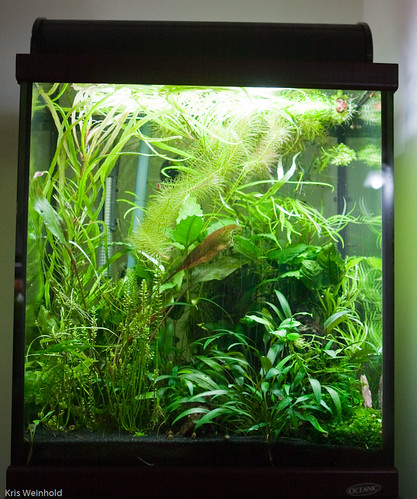
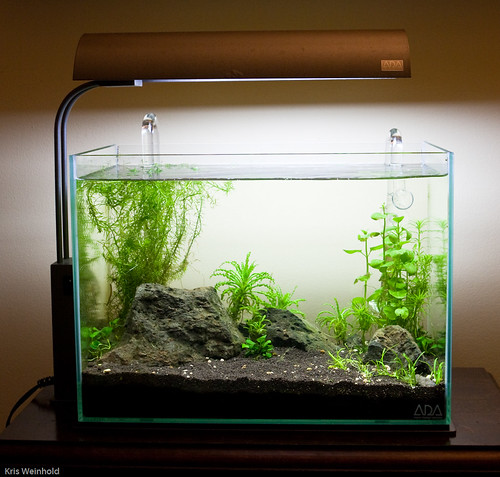
Well, here’s my final picture for GWAPA’s aquascaping contest. It’s pretty much the same as last time, except the anubias are slightly better positioned in front of the rock. I don’t know what other tanks I’m up against yet, so I’m not going to place any bets yet on its chances of winning.

2.5G Aquascape

After I tear down this aquascape, I think I might use this aquarium to start trying some of ADA’s other substrates. I have two small bags of their Malayan and Africana aquasoils. I can’t imagine that they’re too much different, but you never know. Comments welcome!

Business Broker

DIY Autodosing – GWAPA Sept 2007 Meeting

September 24th, 2007

On Saturday, I attended the September GWAPA meeting at Jeff’s house in Ellicot City, MD. In addition to having some awesome sweet/sour meatballs and two gorgeous aquascapes, Jeff also demonstrated how to make the DIY autodoser that he’s been using on his tanks for some time. Made of easily attainable materials, this provides a great solution for the lazy, forgetful, and those looking for consistency in their dosing. I’ve been using an Eheim Liquidoser for awhile, but I think I might try to put together one of these since it holds far more solution than an Eheim does. You can read a short article on how to build one of these on the GWAPA website.

DIY Autodoser

In addition to the meeting itself, Aaron and I stayed afterward to help Jeff get a good picture of his 55G tank. We’re all aspiring to improve our photography skills, so it was great to try a bunch of different techniques to ultimately come up with a nice looking shot. We used two external flashes aimed at some shadowed portions of the tank to try and even out the exposure across the whole picture. While it took us countless tries, we definitely ended up with a better picture than what we would have had without the extra experimentation.

Using flashes to add light to shaded areas

Business Broker

Suitland Bog Trip

September 1st, 2007

While some folks may be preparing for Labor Day BBQ’s, eight members of GWAPA went on a ranger-guided tour of the Suitland bog in Suitland, MD. The ranger explained how it is an active job maintaining the bog to preserve many of the native species from being crowded out. Honeysuckle is a huge invasive problem for them, over-coming many of the native forest plants such as the Lady Slipper orchid or Spotted Wintergreen, a variegated creeping plant.

Magnolia

In the bog itself, magnolia trees are slowly starting to shade out some of the other native plants. The rangers work with volunteers to prevent too many magnolia and poison sumac trees from stealing light from the plants below. Even so, human development surrounding the bog is an ever-increasing issue that could impact the bog in the future, despite initial environmental studies that find little threat.

Pitcher Plants (Sarracenia purpurea)

With water sources for the bog being several hundred feet away, it’s not hard to see how someone putting down lime on their lawn, could eventually alter the pH of the bog water itself. If that happened, it would be a terrible shame, as the plants here are truly gorgeous.

Pitcher Plants (Sarracenia purpurea)

The Northern Pitcher-Plants (Sarracenia purpurea) vary quite significantly from plant-to-plant, in terms of their purple veining, but as you can see, they’re all quite nice. The green and orange stalks rising above the plants are its’ flowers.

Pitcher Plant filled with water (Sarracenia purpurea)

The pitchers themselves were mostly filled with water due to recent rains. As you can see above, this particular pitcher has successfully lured in its prey. There are many different species of plants growing in amongst the pitcher plants. Various reeds, including Ten-Angled Pipewort (Eriocaulon decangulare), which is another rare Maryland native.

Eriocaulon decangulare

The seed nodules on this Eriocaulon’s flower are quite small, as you can see below. Since it flowers from July thru August, there were flower stalks to be found everywhere throughout the bog.

Eriocaulon decangulare flower

Another reed found in the bog is the Twisted Spikerush (Eleocharis tortilis), seen below. I suspect that this plant probably would grow in our aquariums, but would be much taller than the dwarf hairgrass we’re used to growing from the same genus. In any case, being a protected plant in Maryland, I suspect we’ll never get the change to try.

Twisted Spikerush - Eleocharis tortilis

The pitcher plants were not the only carnivorous plant in this particular bog. There was also the Spatulate-leaved Sundew (Drosera intermedia) shown below which is a small sundew plant that lures and traps small insects with sticky dew found on each hairy leaf. Unfortunately, the water source feeding the part of the bog that these are found is slowly declining, so the future of this particular plant here is uncertain. Another type of sundew, the Thread-leaved Sundew (Drosera filiformis) was reportedly here as well, but there have been no recent sightings of this species.

Spatulate-leaved Sundew (Drosera intermedia)

There are many other rare species of plants at the Suitland Bog. This Red Milkweed (Asclepias rubra) below is considered a very rare plant in Maryland. Nevertheless, it is a very beautiful plant that I hope endures. (Note: A commenter has mentioned that this picture below is not  Asclepias rubra. This plant is listed on the brochure for the bog, and was pointed out to us by our ranger. Perhaps I have the photo mixed up.)

Red Milkweed Flower (Asclepias rubra)
Finally, the ranger mentioned a number of other bogs throughout Maryland. He mentioned another one in College Park that is on Pepco land, and has recently been mowed right over, probably non-intensionally by a maintenance worker. In this regard, it’s important for more citizens to know what precious things are growing right in their backyards, and to realize the impact they can have in protecting them by treating their own land with proper care. Most state’s natural resource departments are under-funded, but that doesn’t mean that they don’t have tremendous sites to visit and appreciate. Additionally, they are always looking for volunteers to help pull out invasive species, and perform general maintenance on their sites. I hope you’ve enjoyed my account of our Suitland Bog tour.

Pitcher Plants (Sarracenia purpurea)

Business Broker

GWAPA Meeting – Multitank Systems

August 28th, 2007

On Saturday, GWAPA had its August 2007 meeting out in Braddock Heights, MD at Robert’s house. Robert maintains two circulating ranges in his fish room, which means that he has multiple tanks chained together creating a much larger shared water volume than if each tank were separate. The plumbing involved with this is very impressive, and a little chaotic, if you don’t know what you’re looking at. Robert did an excellent job dispelling some of the mystery during his talk. You can find a summary of his talk on GWAPA’s website.

Part of Robert’s setup is a prominently displayed Crinum veggie-filter. The water is circulated through this tank, where huge Crinum root-balls suck up nitrate from the water. With so many siphons and pumps, it’s impossible to use CO2 injection, but nevertheless, Robert maintains some very nice low-tech tanks with anubias, val, java fern, etc… He also sports one of, if not, the oldest American colonies of Melanotaenia praecox dwarf neon rainbows, being one of the first purchasers of females in the United States from Germany.

Crinum Veggie Filter

And beyond that, our meeting had another great mini-auction, including many rare plants, and even a few aquarium setups this time. I was happy to be able to give away a few copies of The Aquatic Gardener (TAG), featuring my very first published cover image and article about GWAPA’s recent Florida collecting trip.

Business Broker

Nice Discus!

July 31st, 2007

On Saturday, GWAPA held its meeting for July at Cristy’s house. Cristy has a tank with some really beautiful discuss in it. I don’t know much of anything about discus, besides that they’re more work to keep than I’m generally up for, but that doesn’t mean I don’t appreciate their beauty. Take a look at how great they look with a lush planted background behind them. Nice fish!

Discus

Business Broker

Florida Trip – Florida Aquatic Nurseries (Day 5)

June 20th, 2007

Monday, our last full day in Florida, we had an appointment with the owner of Florida Aquatic Nurseries (FAN) for a personalized tour through their facilities. FAN is probably the largest grower and wholesaler of aquatic and pond plants for the entire United States. Chances are, if you see a potted plant at your local fish store, it originated from these guys. Their 5 and 10 acre facilities are really quite impressive. Below you can see how most of the aquatic plants are grown hydroponically in their greenhouses. The plants sit in large tubs of water that are constantly circulated throughout the bins.

A Florida Aquatic Nursery Greenhouse

Other plants are grown individually in pots like the Anubias barterii var. nana ‘petite’ shown below. Nearly all of the plants are flowering throughout the greenhouse, so we saw flowers for crypts, sword plants, various hygrophilia, ludwigia, hydrocotle, you name it.

Anubias barterii var. nana 'petite'

Outside of their greenhouses, they have countless numbers of large concrete ponds where they grow more aquatic plants, this time, mostly submerged. These ponds are packed with stem plants, all bright red and orange from the intense Florida sun. Take note of the Ludwigia inclinata var. verticillata ”Cuba” below. They have a fairly large work force at hand, constantly monitoring all of the plants, and taking cuttings from the large ponds to sell.

Ludwigia sp. 'Cuba'

We were quite surprised at the sheer number of popular plants FAN is growing that rarely seem to show up in our local stores. Everything from nana ‘petite’ to HC to downoi were there. I’m not sure if the distributors aren’t stocking these plants, or if the local stores only carry bread and butter plants, but it’s a shame to know that these things aren’t widely distributed. Beyond aquarium plants, there were countless water lilies in bloom throughout the nursery. Beautiful!

Lotus Flower

Our last stop before heading home was an orchid nursery that supposedly stocked some rare crypts that were given to them by the late Robert Gasser, a pioneer grower of Cryptocoryne species. We called the owner of the nursery, and he agreed to show us around. Not a crypt guy himself, the owner didn’t know many of the species that were spread throughout his nursery, but we did end up purchasing a pot or two of what we believe is Cryptocoryne cordata var. zonata. Beyond the exotic types, he had Crypt. wendtii growing in his ponds, one shown below.

Orchid Nursery Crypt Pond

I have to say that this trip was unlike any other that I’ve been on. It was very free-form in nature, and had surprises at every waterway, nursery, or ditch that we stopped at. Hopefully, GWAPA members will make this trek down I-95 an annual or semi-annual occurrence!

Business Broker

Florida Trip – Around Miami (Day 4)

June 17th, 2007

We woke up Sunday, ready for a full day of collecting around the Miami around. In Miami, canals crisscross the entire area, allowing us plenty of accessible collecting spots via public boat ramps. In addition, due to the large population density, many non-native fishes have made their way (unfortunately for the habitat, fortunately for us) into the waterways. At our first stop, we found a boat ramp behind a fairly large shopping complex. Walking down the canal banks, we didn’t see a any signs of life outside of a few clumps of Hygrophila polysperma and Cabomba. There were more office chairs and discarded garbage in the canal then we saw fish.

Canal in Miami

We decided to cast our nets into the polysperma anyways, and to our surprise, we found 4-5 small cichlids! There seemed to be two types present, 1 type with vertical bars that are probably juvenile Mayan cichlids, and the other, a much more colorful Jewel cichlid (shown below.) What was originally a very bleak looking habitat suddenly came to life. As we continually pull more of these cichlids from the water, we start to see some larger fish take interest in our activities. Peacock bass start coming in to feast as we startled the smaller fish from their protective plant mats. We continue netting fish for several hours, before deciding to grab some lunch and move on to our next location.

Jewel Cichlid

A few miles away, we located another canal system with public access to the waterways. Unfortunately, this dock was much more frequented by jet skis and motor boats, so we decided to investigate a more seclusive pond right next to the canal. A few of us are looking down in the pool, seeing the usual batch of mosquito fish swimming around, when a couple of plants take our eye. First, floating on the surface is a very frilly plant, that upon closer investigation is a carnivorous badderwort. Well, I have to try that one out, and while I’m gathering a few small fronds of that, I notice another plant with elongated brown and yellowish leaves. Immediately, I get excited that I had found a bed of crypts! So, I pull a couple out, and take them to Ghazanfar. “Nope, they’re not crypts,” he says, but instead appear to be some sort of an Aponogeton. In this pool, none of the Aponogeton are taller than7-8 inches. I’m really hoping that they intend to stay that height because every other species that I’ve tried tends to grow multiple feet in length.

Investigating a pool

Meanwhile, a few other folks had started dipping their nets in the canal, now free of jet skiers. More great fish start showing up in our nets, including a very pretty variety of sunfish (shown below), some shiners/minnows with really nice red on their tails, two varieties of darters, and a new color strain of Jewel cichlids. The Jewels in this canal are much redder in coloration, while in the first canal, they were more turquoise. After being out under the sun for a number of hours, we all decided that it was time to cool off back at the hotel.

Sunfish in hand

Business Broker

Florida Trip – Day 3

June 14th, 2007

Day 3: Somewhere outside of Tampa

First Collection Site for the Day

We spent the night in Tampa on Friday, spending some time with Michael’s cousin, who treated us to some homemade ice cream. That provided exactly the fuel we needed to get up and going on Saturday, hitting lots of collection ditches across the state. Our first collection site happens to be outside of Tampa near where a few fish farms used to be located. Our thinking is this: where fish farms used to be, leftover exotic fish must have escaped via flooding or hurricane into the local waterways. We’re driving around and pass over a small stream-fed canal, where we come to a sudden stop to get out. As you can see above, it’s not the prettiest site, but as we’ll soon learn, sometimes the least promising looking pools can yield the best results.

What's in the net this time?

We dip in our nets, and find a plethora of different species. Of course, we pull out more than our fair share of gambusias (mosquito fish), but we also end up with some blue-fin killies, Heterandria formosa, and grass shrimp. In addition to that, we see a very large gar and a group of bass and sunfish. All-in-all, a very nice catch on the fish side. Unfortunately, there weren’t many interesting plants to speak of. That will soon change.

Parrots Feather

We get back in the car, head out toward Zolfo Springs, in the middle of the state, and along the way end up on a bridge overlooking the Little Manatee River. We look down at some beautiful patches of bright green plants along the edge of the river. Ghazanfar and I identify some of the plants as the common bacopa monnieri, hydrocotle, and hygrophilia polysperma, but one other plant is hard to identify from above. Of course, at the possibility that we might have discovered a new stem plant, we descend down the steep and heavily overgrown riverbank to take a closer look. What do we find? Well, the extremely exotic *cough* Parrot Feather. Nevertheless, we sample a few stems and head on our way.

Gator!

Continuing to drive across the state, we see signs for Lake Okeechobee, spot a boat dock, and pull over. On a previous GWAPA trip, three years ago, our members pulled pounds of grass shrimp from vegetation along the banks of this very same canal. This time, not only was the water very low, but it was also completely free of any vegetation. We later learn that the state is treating the water with herbicide to try and contain some invasive species of plants. It seems that it’s killing more than just the invasive types. In any case, our stop was not totally uneventful because off in the distance, one of our members spot two humps, the head and back, of an alligator swimming down the channel. Check that one off my list — See an alligator in Florida, DONE!

Business Broker

Florida Trip – Ichetucknee River

June 13th, 2007

GWAPA recently organized a 6-day “field trip” down to Florida to collect plants, fish, and enjoy many of the various aquarium-related attractions the state has to offer. Five GWAPA members, including myself, piled into a few vehicles to make the trek down I-95. Over the next few blog posts, I intend to chronicle portions of our trip. I hope you enjoy reading this as much as we enjoyed the trip!

Day 1: A lot of Driving.

Day 2: Morning: Snorkeling the Ichetucknee River

Ichetucknee Springs State Park We arrive early in the morning, around 7:45am, just before the park opens at 8:00am. Ghazanfar had been recommended this excellent state park by a number of other aquarists who had snorkeled the river 3-4 years ago. We enter the park, and receive a number of instructions; Ghazanfar and I carry the gear to the first spring, while Michael and Rodney take their vehicles downstream to our stopping point. While we’re waiting for the others to return, Ghazanfar and I enter a small spring-fed pool to adjust our snorkeling equipment and ready ourselves for the next 3.5 hours of swimming. Even the small pool is amazing, showcasing at least 4-5 plant and fish species. Despite the relatively chilly water, we had a great time. Hydrocotle, Valesneria, and Ludwiga line the spring

Hydrocotle, Valesneriam, Ludwigia, native mosses, and bacopa populate the floor of the spring. Various sunfish, catfish, and bass hang out in the cool, clear water. We’re able to see the spring push through a small cavern below us, sending small rocks circling in the water. Rodney and Michael arrive, and it’s time to head down the path to the actual river entrance.

Copper line minnows swim among the Val

The river itself is covered from left to right (and often floor to surface) with 2-3 foot long Valesneria. In the main channel, larger fish swim in the open, while others often take refuge in still enclaves, protected from the current by masses of wood, limestone, and plant matter. As you swim toward the banks of the river, smaller fish, such as these shown above, swim in the hundreds among the grasses. I regret not being able to collect these fish, as collecting from state parks is illegal. Wouldn’t a group of these guys be fantastic in a large planted tank?

Over three exhausting, but exhilarating hours in the water, we make our way to the parking lot, readying ourselves for the real reason we came down to Florida – to collect and sample various fish and plants from around the state.

Day 2: Afternoon Collecting

Collecting Site #1

After getting our fish licenses, we head out on the road looking for small creeks, water-filled drainage ditches, and runoff ponds. One of the first places we came upon that fit this description is shown above. We found a few speckled mosquito fish, lots of hydrocotle and bacopa monnieri, but not much else. Nevertheless, we bagged a few sample plants and headed on our way. Now we knew what we had come from, so we were ready for the next few days of collecting.

Day 2: Evening Driftwood

Tom's Cypress

The next stop on our trip is Tom’s Cypress, a huge retailer of cypress wood, branches, and artisan goods. As you can see, they have a large selection of cypress knees. I selected a few unique-looking pieces of cypress, paid, and left satisfied with a great first day in Florida.

Business Broker

« Previous Entries   Next Entries »