April 5th, 2008
Lagenandra’s are often an overlooked plant that fits in very nicely in a cryptocoryne and anubias themed tank. I think of them like a cross between the two infact as they have a root system and rhizome like a crypt, but the leaf shape of an anubias. Lagenandra meeboldii sp. ‘pink’ is a beautiful bronze colored plant that supposedly will get to 12-14″ tall, but so for me, it’s stayed between 6-8″.
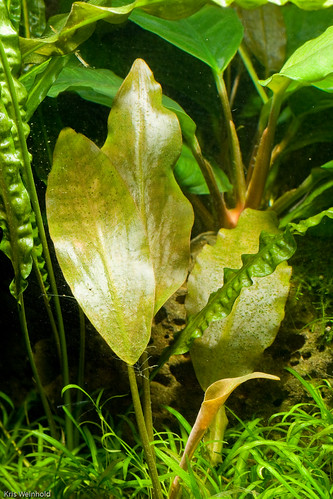
Initially, the plant grew pretty slowly, but I think it just takes a little while for the root system to get established. The leaves can melt, just like crypts, when being introduced to a new tank. Just leave them alone for a little bit, and eventually new leaves will fill in. The leaves themselves unfold from inside out, like the picture below, before forming the flat adult leaves.
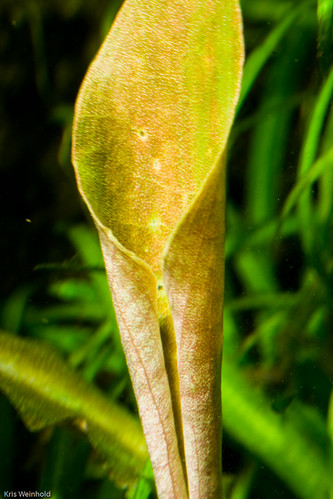
I believe this plant is still quite rare in the hobby, but if you have the opportunity to grow Lagenandra meeboldii sp. ‘pink’ , or any Lagenandra, be sure to try it out.
Posted in Plant Profiles | 1 Comment »
March 4th, 2008
At the last GWAPA meeting, a couple of bags of Limnophila aquatica were up for auction, and at one point, I think it reached market saturation, as no one was bidding on it. I decided to grab it for a $1.00, despite not really wanting it, but I’m glad I did.
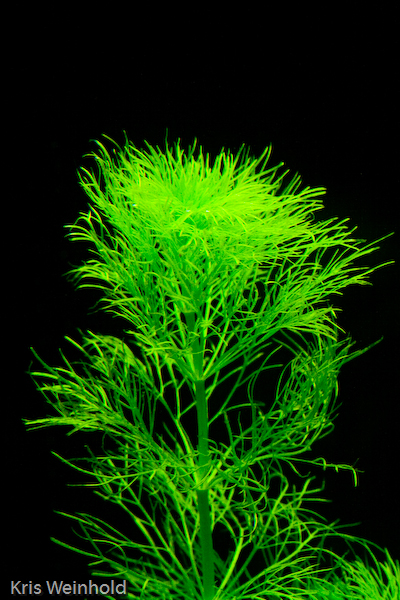
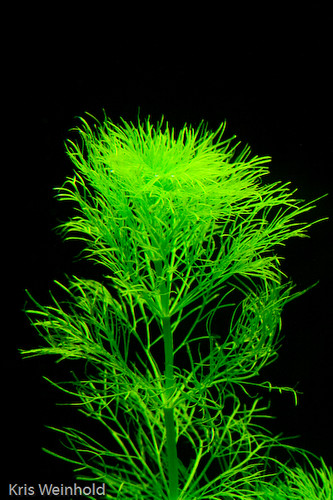 Limnophila aquatica, or Asian Ambulia as it is commonly known, has been in the hobby for a number of years. Its fine, feathery, leaves add a much softer texture to the tank that other, more solid bodied, plants cannot.
The plant is a bright green stem plant that is likely to be the brightest plant in your aquarium. Originally from Southeast Asia, Ambulia requires moderate high to have nice bushy growth. It can also grow very quickly with proper fertilization and CO2, and will reportedly grow out of the water with small blue flowers. I hope to see those flowers at some point!
Asian Ambulia can be propagated like any other stem plant, by cuttings or through side-shoots. So far for me, it’s been a rather fast grower.
Despite not originally having plans to add Limnophila aquatica to my 40G aquarium, it has really added a nice focal point for my aquascape. I’ll post updated pictures of the 40G, once the new plants grow in a little bit more.
Posted in 40G Tank Log, Plant Profiles | 2 Comments »
March 3rd, 2008
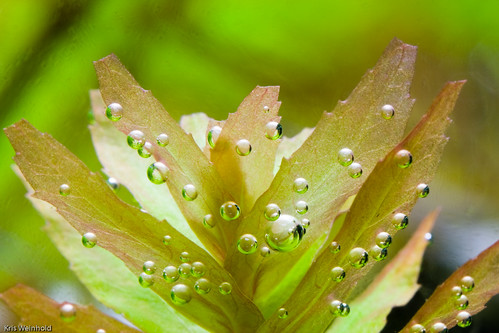
You may remember this picture that I took of Rotala macrandra var. ‘Green’ last year at my friend Aaron’s house. He had it growing beautifully in his ADA 90P aquarium. Notice how the leaves are slight, with some hooked edges, and somewhat transparent.
Now, take a look at the picture below. This is the same plant in my 40G tank. The leaves are rounder, thicker, and lacking the spiked edges. Why the difference? Well, about 2 months ago, I got lazy, and didn’t trim this tank, allowing the R. macrandra var. ‘Green’ to grow emersed from the water. Then, I finally performed a water change, raised the water levels, and replanted the tops of the stems, submersing them.
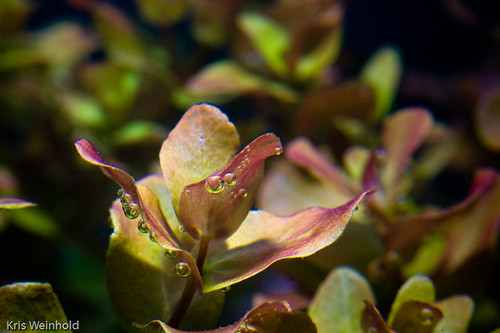
This also coincided with a significant increase of light when I upgraded to the AHSupply 2x96W kit. Since then, the emersed growth form of the Rotala has continued, even though it has been persistantly submersed. I would have figured that the lesser CO2 levels of the water verses the atmosphere would have triggered the plant to convert to its’ submersed form, but apparently not.
I’m still deciding which form I like best. Has anyone else experienced this phenomenon before?
Posted in 40G Tank Log, Plant Profiles | 1 Comment »
February 16th, 2008
Last fall, two GWAPA members, Jim and Ghazanfar, traveled to Europe to attend the European Cryptocoryne Society’s (ECS) annual meeting. Armed with all of the proper phytosanitary documents, they were able to bring back a number of species of plants from the meeting. One of these plants is a currently unidentified Microsorum species that is quite different than any of the other Microsorum (Java Fern) species we’re currently keeping in the United States.
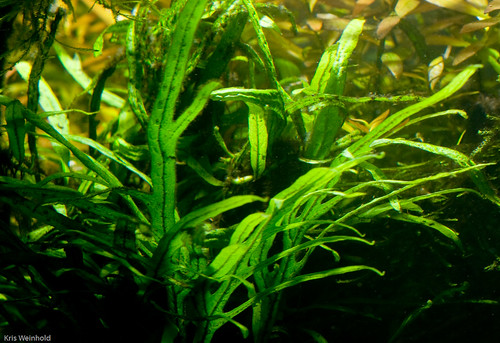
This particular specimen has a many more branches than your typical Java Fern. At first, we thought it might be the Tropica cultivar, Microsorum pteropus ‘Tropica’ ,but after comparing multiple pictures, that seems to have a fatter fern with my smaller saw-like edges coming off. The species Ghazanfar & Jim brought back looks much more like a hand with multiple fingers, or a trident’s staff, with narrower leaves.
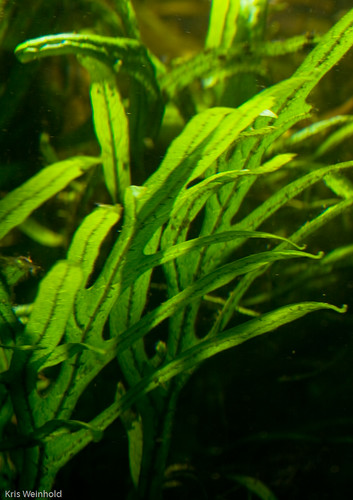
It grows just as quickly as your regular Java Fern, but unlike the Windelev variety, the irregular leaf shape appears to be present on plantlets forming on the end of leaves, in addition to new leaves from the rhizome. I think it’s a little bit prettier, as the narrower leaves bend down slightly, creating a cascading effect that you don’t usually get from a much more upright Microsorum pteropus.
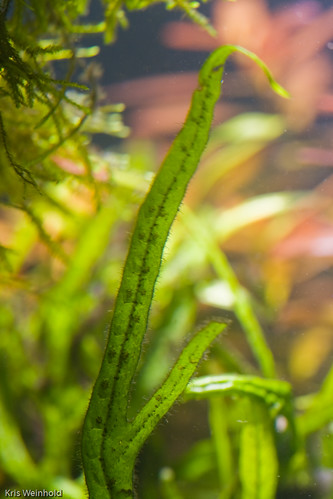
I’m hoping that eventually the folks in Europe will help us identify exactly what this fern is. But until then, I’m going to enjoy it as a centerpiece in my 75G aquascape. More info/pictures can be found on APC.
Posted in 75G Tank Log, Plant Profiles | 12 Comments »
January 29th, 2008
I’ve been growing Ranalisma rostrata in my 40G tank as the foreground for some time. When I originally setup my 20H, I decided to also plant it in there. As the 20H progressed, I realized that I had too much light, too little CO2, and too little desire to maintain the tank as I really wanted. Therefore, I removed the 55W PC light from overtop, and replaced it with an ordinary 15W fluorescent light strip. Over the past few months, besides being considerably darker than it was before, I’d noticed a huge change in the form of the Ranalisma rostrata in that tank.
Witness how the grassy plant looks in my 40G. Compact growth, overlapping each other, where each blade is thin and relatively uniform.
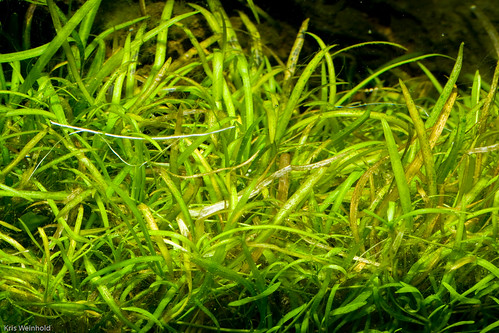
In my 20H, the growth is quite different (below), with blades more resembling a sword plant, than grass. The blades are longer and the growth is much slower. I suspect that the plant is sending out broader leaves to try and soak up more light since less is available. The color is also slightly different, with the broader leaves being a bit more pale, with a yellowish tint, where the regular form is a bright green.
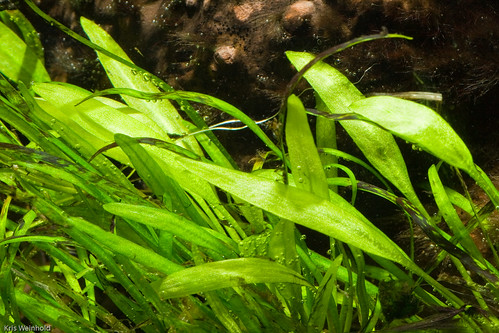
I’m sure that this same phenomenon is present in a wide variety of plants, which is why it’s difficult to say exactly how a plant will grow in another person’s tank. I’m often asked at GWAPA meetings whether a plant is high light or not. In general, I can usually only respond that I’ve only ever grown it in high light, but that they should try it out, and see if it survives in their tank. Now, I can’t even guarantee that it’ll look the same!
Posted in 20L Tank Log, 40G Tank Log, Plant Profiles | 3 Comments »