January 21st, 2008
Back in June 2007, a few GWAPA members went down to Florida to see what kinds of plants/fish we could find for our aquariums. One plant that was absolutely everywhere was a Hydrocotle species that mixed into the grass of people’s lawns, and existed in virtually every roadside ditch we visited. I grabbed a small amount, expecting it to completely take over my tank.
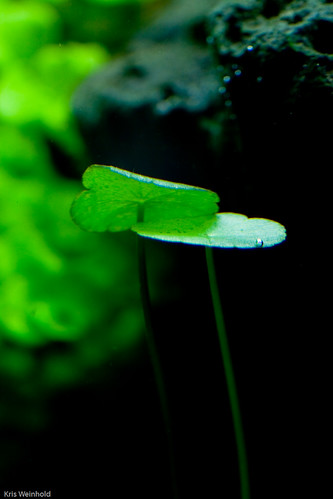
I couldn’t have been more wrong. This small plant has been living in my 40G tank for over 6 months, while only throwing up a single new stem. Recently, I upgraded my lighting to a 2x96W setup from AHSupply and I’ve noticed that the Hydrocotle sp. has started to grow, sending up a new stem and leaf in just the last week. Right now, the stems are approximately 6 inches tall, which is slightly taller than I’d prefer them. I’ll be sure to post if it evens out, and becomes a nice accent plant in my aquascape.
Posted in 40G Tank Log, Florida, Plant Profiles | 2 Comments »
January 9th, 2008
Bolbitis species have long been regarded as a low-light, undemanding plant, that survives in most aquariums. It’s a nice looking fern, adds a deep green to the tank, and can be attached to driftwood, or other hardscape materials. A couple months ago, a species of Bolbitis showed up at a GWAPA meeting that our club hadn’t seen before. This is what I’m calling Bolbitis sp., since I don’t know the proper name.
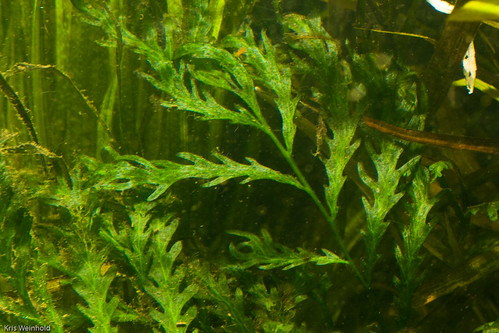
At first, we suspected that it was a terrestrial fern, but due to the quantity brought to auction, it was clear that it grow just fine underwater. It was sent to the club by a rainbowfish breeder and collector, who happened to order it from an order source. The leaf form has many more indentations than the usual type. I’ve been keeping it in my 75G aquarium, and growth has been quite slow, but it is growing nevertheless. If anyone can identify the species of this bolbitis, please leave a comment.
Posted in 75G Tank Log, Plant Profiles | 3 Comments »
January 7th, 2008
My new favorite accent in the 75G aquarium is Rotala macrandra, a beautiful, but delicate red stem plant. Notorious for being a more difficult plant to grow, I can understand its’ reputation. The plant doesn’t seem to have much of a problem growing, but if I go too long without a water change, I start to notice little holes in the leaves.
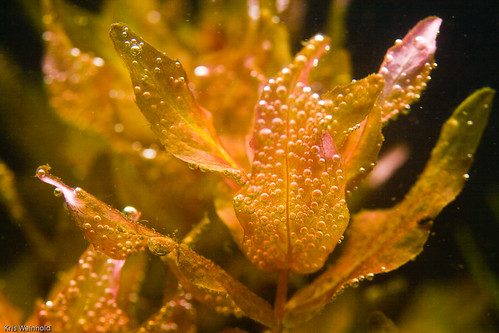
Additionally, leaves that reach the surface, appear to easily get holes, or fall apart, instead of converting to emersed growth. That may also be due to the heat from the light as they get rather close to them. Nevertheless, it is a gorgeous plant, with striking orange and red tones. I started with a single stem, and in just a month or two, I’ve now got a decent sized bush of R. macrandra. I’m hoping to grow it out even further, as I need more red in my 75G to offset the large number of green plants in there.
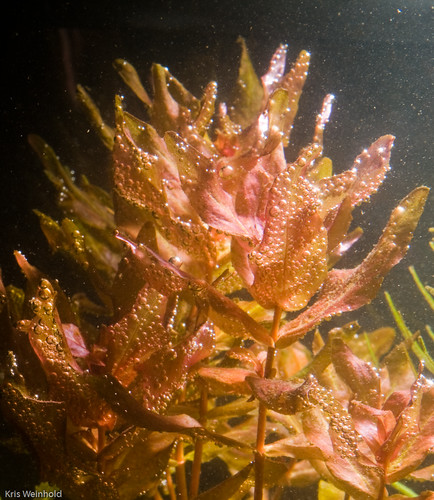
Fortunately, R. macrandra has been in the hobby for some time, so it often shows up in some of the more ambitious fish shops. It you have the chance to buy it, do. However, make sure that you have adequate lighting, CO2, and fertilizers, or the plant won’t stand a chance.
Posted in 75G Tank Log, Plant Profiles | 9 Comments »
January 1st, 2008
A couple of weeks ago, I got some shrimp from another GWAPA member, and in the bag, he sent along a nice new species of Hygrophila for me to try out. We don’t know the exact species name, but it’s being referred to as Hygrophila sp. ‘Low grow’, due to the way that it grows compared to some other Hygro’s.
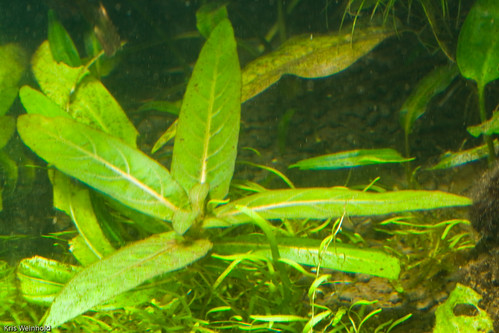
The plant seems to creep along the substrate, even in more high light conditions. I’ve grown the common Hygrophila polysperma in this same fashion before, but it requires constant trimming to maintain it low to the ground. This ‘Low grow’ does not appear to need the same. In addition, I’ve found it to be a much slower grower than other species of Hygrophilia which can be outright weeds if left unchecked. The leaves are larger than that of H. polysperma, and contain more pronounced (prettier) vains.
Due to the leave size, I may not use it in many of my aquascapes, but it might be perfect for some larger scapes. I’m going to wait to to let it further grow out before I fully decide that, however.
Posted in 75G Tank Log, Plant Profiles | 1 Comment »
December 8th, 2007
The Utricularia graminifolia is starting to grow in in the 75G tank. It’s still not really that full, but you can start seeing some little leaves pop up from the aquasoil substrate. My theory is that this plant takes longer than others to get going because it requires a more mature tank with more microorganisms to get caught in its bladders. Of course, I can’t say that I’ve grown it predictably enough to have it fully understood at this point.
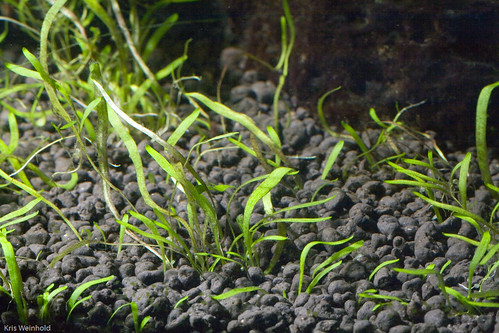
What I know is that that once I start seeing “trailers” like the ones below, that that plant is well on its way to filling in. I’ve also had a number of “trailers” growing up into the water column, making the foreground look too tall and shabby, but I’ve gradually cut those off and replanted them in the bare areas to try and get them going.
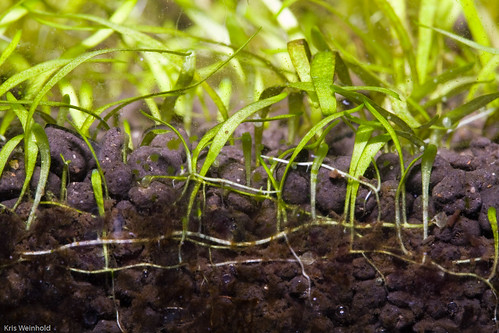
Additionally, the Nannochromis nudiceps seem to have gotten over their digging fascination, so they’re no longer pulling up, or covering up, the Utricularia graminifolia directly in front of their “underground lair.”
Posted in 75G Tank Log, Plant Profiles | Comments Off on Utricularia graminifolia