February 16th, 2008
Last fall, two GWAPA members, Jim and Ghazanfar, traveled to Europe to attend the European Cryptocoryne Society’s (ECS) annual meeting. Armed with all of the proper phytosanitary documents, they were able to bring back a number of species of plants from the meeting. One of these plants is a currently unidentified Microsorum species that is quite different than any of the other Microsorum (Java Fern) species we’re currently keeping in the United States.
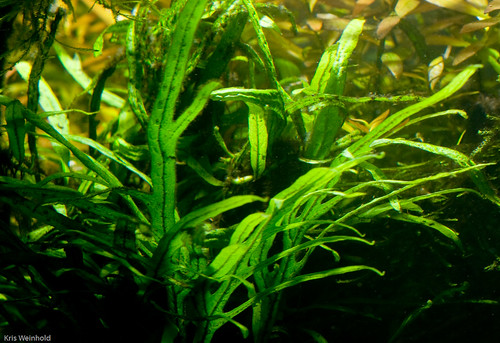
This particular specimen has a many more branches than your typical Java Fern. At first, we thought it might be the Tropica cultivar, Microsorum pteropus ‘Tropica’ ,but after comparing multiple pictures, that seems to have a fatter fern with my smaller saw-like edges coming off. The species Ghazanfar & Jim brought back looks much more like a hand with multiple fingers, or a trident’s staff, with narrower leaves.
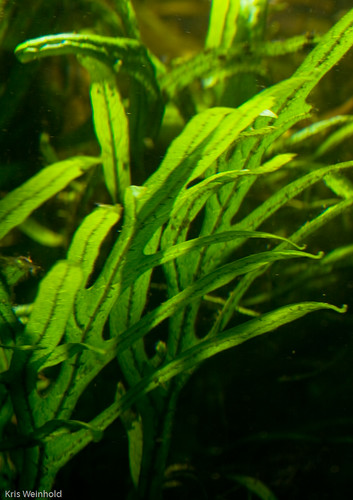
It grows just as quickly as your regular Java Fern, but unlike the Windelev variety, the irregular leaf shape appears to be present on plantlets forming on the end of leaves, in addition to new leaves from the rhizome. I think it’s a little bit prettier, as the narrower leaves bend down slightly, creating a cascading effect that you don’t usually get from a much more upright Microsorum pteropus.
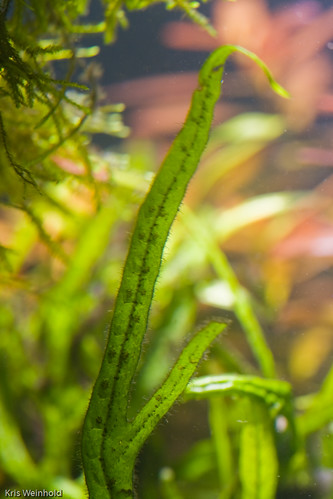
I’m hoping that eventually the folks in Europe will help us identify exactly what this fern is. But until then, I’m going to enjoy it as a centerpiece in my 75G aquascape. More info/pictures can be found on APC.
Posted in 75G Tank Log, Plant Profiles | 12 Comments »
February 5th, 2008
It’s been about a month since my last update on this tank. I recently pulled out a large number of plants for the GWAPA auction, harvesting plenty of Utricularia graminfolia in particular. I’m pleased that the tank is growing well, despite measuring 0ppm nitrates yesterday (prior to dosing more), but some parts are growing out of my favor. Largely, the Anubias heterophylla on the right side is getting a bit unwieldy.
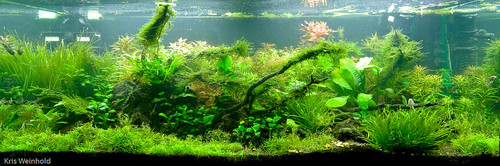
Also, the Pogostemon stellatus in the back right has gone in and out of looking great to looking like crap. So, I got some Ludwigia inclinata var. verticillata ‘Cuba’ and Eriocaulon sp. ‘Type 3’ at the last GWAPA auction that will hopefully replace the P. stellatus in the back right. My problem is that I haven’t found the best transition plant for the right mid ground. On the left, I have the Utricularia graminfolia in front, with Hygrophila sp. ‘Low Grow’ and Crypt. affinis behind that, stepping up to Blyxa aubertii. That’s a nice transition. On the right, it’s the Utricularia to Crypt. willisii to the stems. Unfortunately, the stems usually look like crap after a trim, messing up the transition. I’ve thought about moving some Eriocaulon sp. ‘Type 2’ over there, but that plant may then be repeated too closely together.
Maybe I’m thinking too much?
Posted in 75G Tank Log | 5 Comments »
January 9th, 2008
Bolbitis species have long been regarded as a low-light, undemanding plant, that survives in most aquariums. It’s a nice looking fern, adds a deep green to the tank, and can be attached to driftwood, or other hardscape materials. A couple months ago, a species of Bolbitis showed up at a GWAPA meeting that our club hadn’t seen before. This is what I’m calling Bolbitis sp., since I don’t know the proper name.
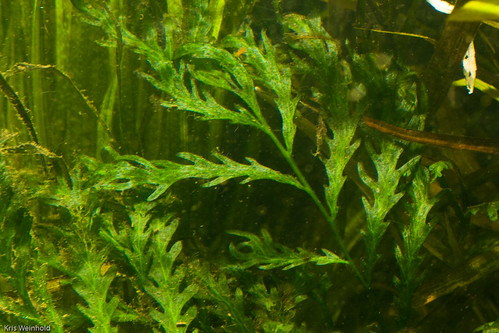
At first, we suspected that it was a terrestrial fern, but due to the quantity brought to auction, it was clear that it grow just fine underwater. It was sent to the club by a rainbowfish breeder and collector, who happened to order it from an order source. The leaf form has many more indentations than the usual type. I’ve been keeping it in my 75G aquarium, and growth has been quite slow, but it is growing nevertheless. If anyone can identify the species of this bolbitis, please leave a comment.
Posted in 75G Tank Log, Plant Profiles | 3 Comments »
January 7th, 2008
My new favorite accent in the 75G aquarium is Rotala macrandra, a beautiful, but delicate red stem plant. Notorious for being a more difficult plant to grow, I can understand its’ reputation. The plant doesn’t seem to have much of a problem growing, but if I go too long without a water change, I start to notice little holes in the leaves.
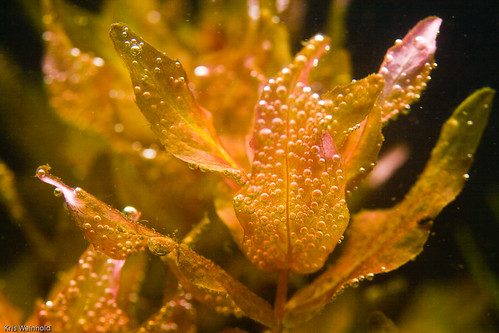
Additionally, leaves that reach the surface, appear to easily get holes, or fall apart, instead of converting to emersed growth. That may also be due to the heat from the light as they get rather close to them. Nevertheless, it is a gorgeous plant, with striking orange and red tones. I started with a single stem, and in just a month or two, I’ve now got a decent sized bush of R. macrandra. I’m hoping to grow it out even further, as I need more red in my 75G to offset the large number of green plants in there.
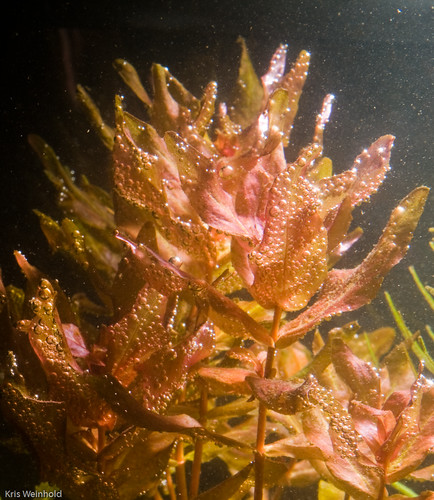
Fortunately, R. macrandra has been in the hobby for some time, so it often shows up in some of the more ambitious fish shops. It you have the chance to buy it, do. However, make sure that you have adequate lighting, CO2, and fertilizers, or the plant won’t stand a chance.
Posted in 75G Tank Log, Plant Profiles | 9 Comments »
January 1st, 2008
A couple of weeks ago, I got some shrimp from another GWAPA member, and in the bag, he sent along a nice new species of Hygrophila for me to try out. We don’t know the exact species name, but it’s being referred to as Hygrophila sp. ‘Low grow’, due to the way that it grows compared to some other Hygro’s.
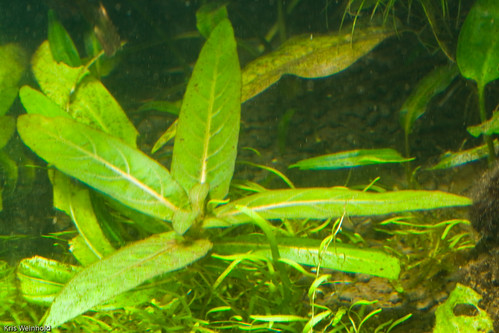
The plant seems to creep along the substrate, even in more high light conditions. I’ve grown the common Hygrophila polysperma in this same fashion before, but it requires constant trimming to maintain it low to the ground. This ‘Low grow’ does not appear to need the same. In addition, I’ve found it to be a much slower grower than other species of Hygrophilia which can be outright weeds if left unchecked. The leaves are larger than that of H. polysperma, and contain more pronounced (prettier) vains.
Due to the leave size, I may not use it in many of my aquascapes, but it might be perfect for some larger scapes. I’m going to wait to to let it further grow out before I fully decide that, however.
Posted in 75G Tank Log, Plant Profiles | 1 Comment »