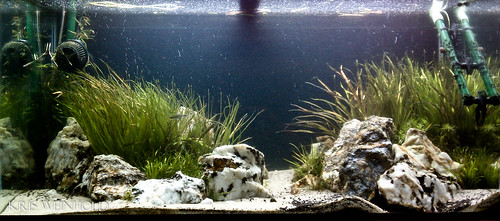
I spoke at the Northeast Council of Aquarium Societies 2011 Convention back in March, and have received several requests from those who could not attend to list out some of the tips I gave at the AGA member meetup there. I hope that there may be a few things in this list for everyone to benefit from. This list is by no means comprehensive, so if you have other tips that you’ve found invaluable to your aquarium hobby, please list them in the comments:
1. Do Your Water Changes – There is nothing more important, or more beneficial, to maintaining the health of your livestock and aquarium eco-system then to do regular large water changes.
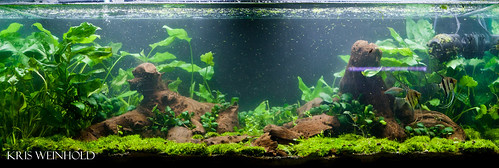
2. Respect Ratios – When aquascaping, be sure to use the Golden Ratio to layout your hardscape.
3. Green Spot = Add P – If you have green spot algae on your glass or slow-growing leaves, it’s more than likely that your phosphorus levels are zero. Often, simply adding more phosphate in your dosing regimen will resolve the problem.
4. Tools – Never underestimate the value of tools in the hobby. From expensive stainless-steel aquascaping tools for trimming/planting to DIY items like protractors (leveling substrate), credit cards (scraping the glass), toothbrushes (removing algae), and spray bottles (moistening leaves when planting dry), these items make your life easier.
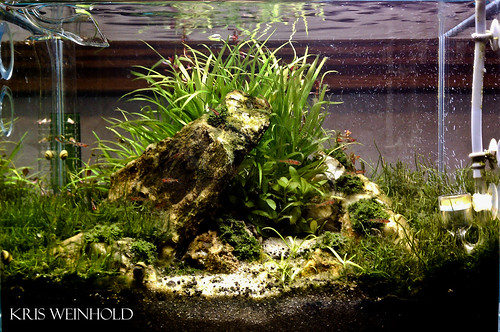
5. Fill in the Gaps – Reserve a little substrate to use after you’ve positioned your hardscape. By filling in the gaps between your hardscape pieces, you take what was just a pile of rocks/wood, and integrated them into the landscape.
6. Rocks: Buy Big, Make Small – It’s really hard to find perfect rocks for aquascaping. I’ve had good results buying large boulders for landscaping, then breaking them down into smaller pieces. Be sure to use the properly attire and safety precautions when breaking up the rock.
7. Excel is More than Carbon – Did you know that Seachem Excel can be used as an algae preventative or to spot treat particularly troublesome patches of algae? H2O2 can also be used similarly, and is cheap at your local drugstore.
8. Try EVERYTHING – The best way to learn about anything is to immerse yourself in it. Rather than wondering whether that new plant will survive in your tank, try it and see for yourself! Try DIY methods. Experiment!
9. Flower Aquatic Plants – Aquatic plants often look completely different out of water than they do submersed. In addition, they have some fantastic flowers, and make great pond plants.
10. Enter Aquascaping Contests – By working toward the goal of submitting your aquascape to a contest, you often find the discipline to see a particular layout through to the end. In addition, the AGA contest judges provide feedback on your scape, which can help you grow as an aquascaper.
11. Compress Your Foreground – A big mistake by first-time aquascapers is to make the foreground too large, leaving very little room to create depth in the mid-ground and background. Try compressing your foreground to just an inch or two, and you’ll be amazed how much more depth your aquascape has.
12. Match Hardscape & Substrate – In nature, the substrate is often composed of a mixture of materials that has broken down from the surroundings. Therefore, if you have a dark substrate, don’t use white rocks or vice versa. By using materials that look like they belong together, your aquascape will look more natural.
13. Use Negative Space – Don’t cram every single inch of your aquarium with hardscape or plants. Leave some open areas, which will help you establish focal points in the aquascape.
14. Trim to Rhizome – Anubias, Java Fern, and Bolbitus all have thick rhizomes from which the leaves grow. You can often train these plants to produce thick growth by simply removing all or most of the old leaves from the rhizome. Soon, the rhizome will send out new compact growth.
15. Mayaca fluviatilis & Fe – Certain plants are great indicators of nutrient deficiencies in your aquarium. Mayaca fluviatilis in particular turns nearly white when there are shortages of iron (Fe) in the water column. Solution: Dose more iron!
16. Flow – Water flow is very important in a planted aquarium to ensure that there are no nutrient dead zones, where algae can creep in. Particularly in heavily planted aquariums, extra powerheads are needed to supplement flow provided by the filter.
17. Spirogyra Sucks – Spirogyra algae can be an extremely frustrating algae to eliminate because it thrives in conditions similar to aquatic plants. One way that I’ve found to be successful is to 1) remove all inhabitants from the tank, 2) turn off all flow, 3) dump in a significant amount of standard drugstore H2O2 into the aquarium, 4) let sit for 15 minutes, 5) do massive water change, 6) add in algae eating crew such as Amano shrimp to finish off the weakened algae.
18. Aquascape with Friends – By aquascaping in groups, you’re able to benefit from the multiple sets of eyes on the aquascape from the get-go. Not only is it a good excuse for a party, but your aquascape will mature more quickly.
19. Aquascape with a Camera – Particularly if you plan on sharing your aquascape online or in contests, be sure to take some snapshots while you are in the process of designing your hardscape and plant groups. You’ll likely find that the layout/depth looks vastly different through the lens, than in person. Therefore, you may want to optimize the layout for photography from the aquascape’s genesis.
20. Try Natives – It’s all to common to ignore the local species in favor of fish and plants from across the world. You may be surprised that North America has beautiful species of plants such as Proserpinaca palustris and Ludwigia palustris. In addition, there are very interesting native fish like dwarf sunfish, killifish, and darters that can do well in a planted aquarium.