40G – Wormstrate Aquascape!

July 22nd, 2008

After my previous soil vs. earthworm casting experiment, I decided that it was time to really give one of the methods a chance in a “real” setup. For this, I decided to tear down my ailing 40G aquascape, and start anew, using an earthworm castings mixture as the base for this substrate. Following a mixture of Vladimir Simoes’ method and the soil substrate method used by many GWAPA members, I setup the tank.
Miracle Mud

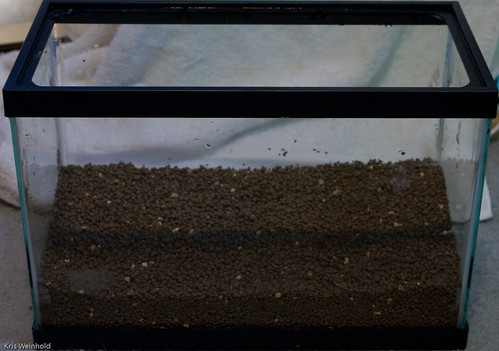
Earthworm castings, Sand, 1 lb Clay

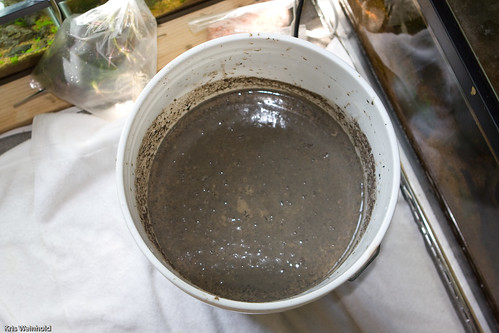
Vladimir Simoes’ method is basically just a mixture of earthworm castings and sand in a 50/50 ratio. As I did more research, I found that several of the past successful aquascapers that used this method, also used a clay source with a high CEC ratio. For this, I decided to follow much of the soil method by liquifying a pound of clay into the EC and sand mixture.

Dolomite, Potash, and Traces

Dolomite, Potash, and Traces on bottom. Aquasoil around edges.

Also borrowing from the soil substrate method, I added a handful of dolomite, potash, and CSM+B traces to the bottom of the tank prior to adding the earthworm castings mixture. The purpose of these minerals is to provide a nutrient source while the neccessary bacterial colony builds up in the substrate to make these same nutrients available to the roots longterm. Additionally, my final modification is to reuse the spent ADA Aquasoil that was in my 40G previously as the top layer of the substrate. For aethestics, I used aquasoil exclusively around the visible borders of the tank.
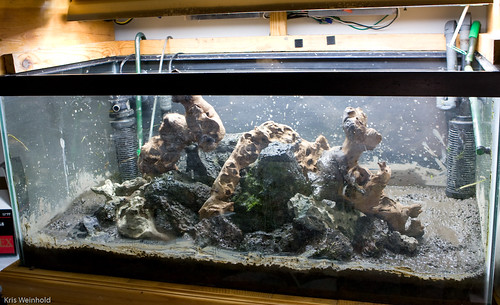
40G Hardscape

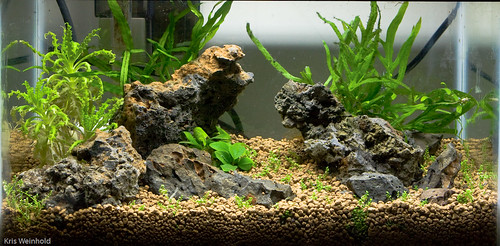
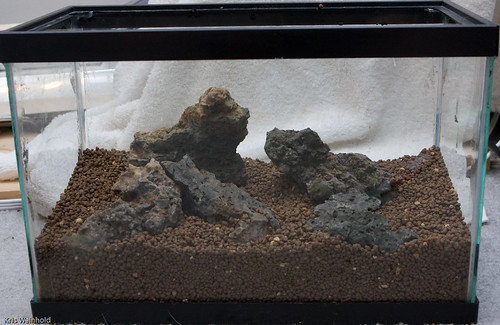
Basalt and African bogwood

After adding the earthworm casting mixture, and topping it with the Aquasoil, it setup my hardscape. I’ve never really attempted a “mound” style aquascape before, so I decided to give it a try. I used a combination of the porous mossy rock (basalt) and African bogwood for my hardscape. I left plenty of space behind the hardscape to plant my background plants.
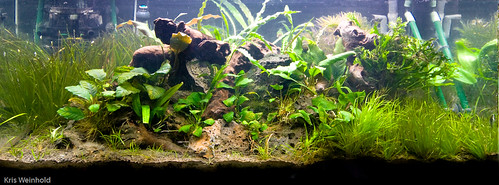
40G - Just Planted

Finally, the planted scape is above. At this point, I’m not entirely pleased with the result. I need the plants to grow in a bit more, and I need the background plants to fully crest over top of the mound. I suspect that I may have placed the mound too far to the front of the tank, but am willing to let things play out for awhile to see how it looks. I basically just reused the plants that I had in this tank previously, but I did add some Echinodorus angustifolius ‘Vesuvius’, Pogostemon stellatus, and Ludwigia sp. ‘Cuba’ to the tank, removing Rotala rotundifolia and Eriocaulon sp. ‘Type 2.‘ My goal for this tank is to have a successful aqauscape while having the earthworm casting substrate provide all of the minerals needed so that I do not have to add supplemental fertilization. Comments welcome!
Business Broker

2.5G Aquascape – 3 Weeks

July 20th, 2008

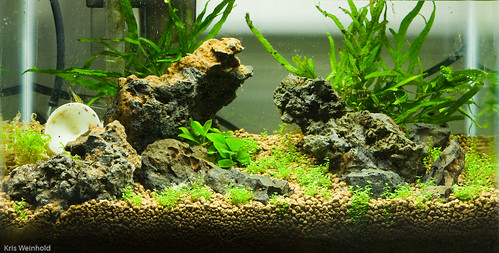
Three weeks ago, I setup this 2.5G aquascape, and if you compare it with my previous update, you can see that some progress has been made. The HC has grown tremendously, largely due to the injection of pressurized CO2. The java fern in the background as stayed largely the same, but that’s about how I want it to be.

2.5G - 3 Weeks

Aquascape, 3 weeks after initial setup.

Unfortunately, the downoi has all but melted. I suspect that the combination of the buffers in the ADA Aquasoil and the added CO2 has made the water a bit too acidic for its taste. I think the tops have started growing again, so hopefully in a few more weeks it will grow back, obscuring the ugly CO2 reactor on the left side. (Sorry, I don’t remove equipment when taking incremental shots. Note, however, that if you ever enter a contest to do so because some judges view a perfect aquascape, but see a filter intake, and act as if a mortal sin has been committed. End rant.) Comments welcome on what I can do to improve this scape.

Business Broker

Blackworms in the Substrate!

July 17th, 2008

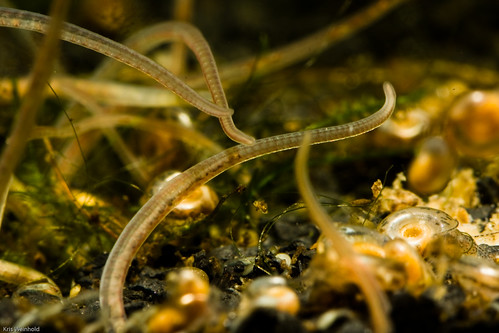
I try to feed my fish a varied diet of commercially prepared foods, as well as, live foods when I have the extra time to obtain and care for them. A couple months ago, I was cycling a 10G tank, and when I was feeding blackworms to the rest of my tanks, I inadvertantly threw some in the 10G as well.

Blackworms

Blackworms in the 10G Substrate

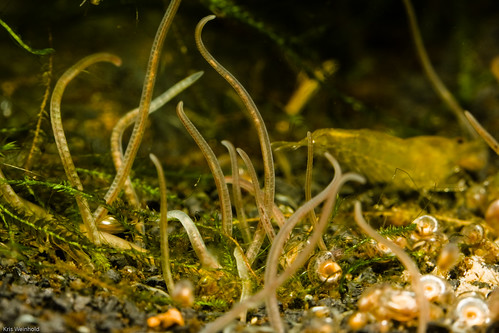
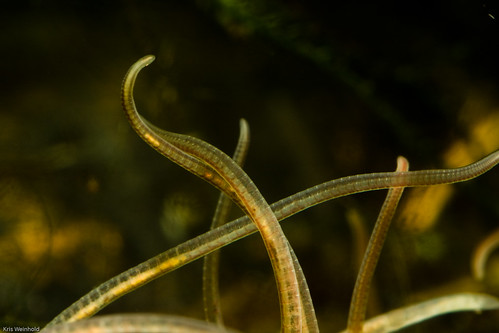
As you can see, the worms have taken up residence in the substrate, and have actually multiplied quite readily. This is now the tank that I have my yellow shrimp in, and thus far I don’t think the worms are causing a problem. In fact, they’ve done a pretty good job of cleaning up any extra vegetable matter or algae wafers that the shrimp let be.

Blackworms

Blackworms looking for food.

It is a little bit disturbing, however, when you look in the tank, and you see a series of worms waving themselves from the substrate, presumably to filter the water overhead. In some ways, I probably should consider this a boon because I am now culturing my own source for blackworms, verses having to depend on my LFS for fresh shipments.

Blackworms

Just hanging around.

Unfortunately, I have not yet been able to figure out how to adequately harvest them from the tank. I have to be awfully quick with tweezers to snag one because when I get close, they speedily retreat down into the substrate. I may be able to siphon the substrate, through a sieve, and get them that way. Any suggestions? Anyone think they’ll be a problem long term?

Business Broker

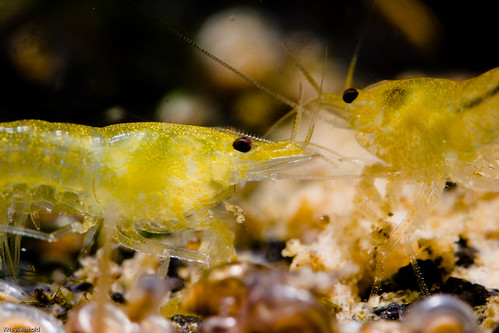
Yellow Shrimp – Neocaridina heteropoda var ‘Yellow’

July 16th, 2008

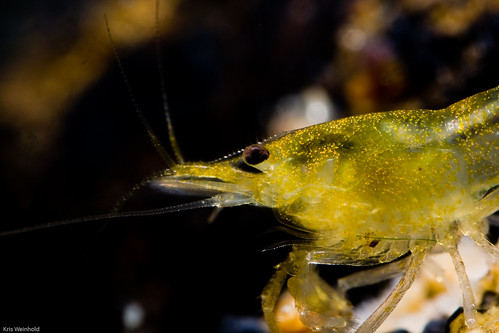
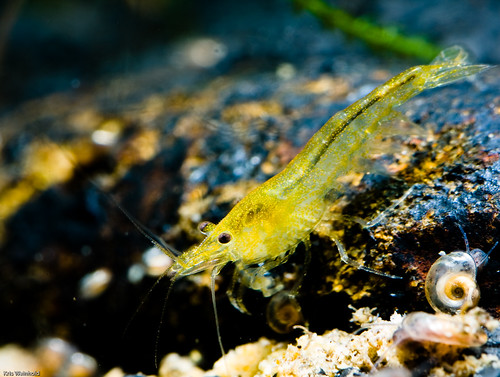
After much anticipation, today I received a dozen Yellow Shrimp, Neocaridina heteropoda var ‘Yellow,’ via a trade with another aquarist. I’ve seen some pictures of these guys online, and knew that I must have them. Yellow Shrimp are the same species as Cherry Red Shrimp, but they have been selectively bred to exhibit a striking yellow coloration.

Yellow Shrimp

As soon as I put them in their own dedicated 10G tank, they went to town exploring the space. I added an algae wafer, which they quickly dismantled, and readily absorbed. The shrimp that I have are not full grown adults. Like cherry reds, when full grown their exoskeleton can become much more opaque in color, making them an incredibly bright yellow.

Yellow Shrimp

The best thing about these shrimp is that they’re supposed to be just as easy to breed as the Cherry Reds. This makes sense since they’re the same species, but that isn’t always the case. While some of you may be wondering, “if you crossed a yellow shrimp with a cherry red, would you get an orange shrimp?” The answer, apparently, is no — they would revert back to their drab natural coloration, brown.

Yellow Shrimp

It’s a shame that I’ve already stocked my pond with Cherry Red Shrimp, otherwise I would probably have put these guys outside. Last year, I pulled hundreds of Cherry Reds out of the pond in the fall after only having them outside for 3-4 months. I’m hoping to be as lucky with these guys, albeit, inside. If anyone has kept these shrimp themselves, I’d love to hear your experiences.

Business Broker

Quarantine Your Fish

July 14th, 2008

I’m going to share an embarrassing story about something that I neglected to do, and am continuing to pay the price for. A couple weekends ago, I was at my favorite local fish store, and decided to pickup a dozen Neon Rainbowfish, M. praecox, to add to 7 others I had, in order to form a nice school in my 75G aquarium. The store has a good reputation for properly quarantining their fish for sale, and they all looked extremely healthy and vibrant. So, against my good judgement, I decided to acclimate them directly into my 75G.

Melanotaenia praecox

Well, the next day, I noticed that 2-3 of the fish were off by themselves, some of them having discolored patches on their bodies. The next day, those fish were dead, and over the next 4-5 days, all 12 of the others continued to follow suit. I contacted the store owner, and he had received similar reports from the other customers who bought the fish, and agreed to fully replace them once he got a healthy batch in. That’s fine, and had I quarantined them, that would be the end of a very sad incident.

Red Lizard Catfish

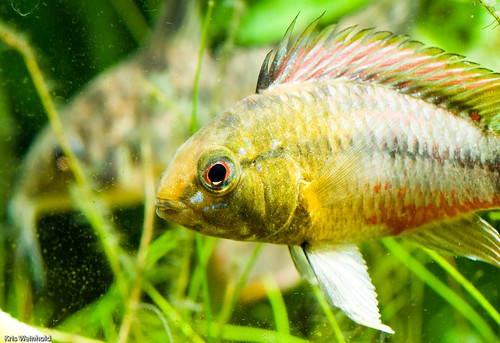
Instead, I’ve lost one of my other M. praecox in the 75G, all five of my beloved Red Lizard Catfish, and my newly bought and favored Apistogramma hongsloi sp. ‘Super Rostrich.’ The corydoras, L729 plecos, and Nannochromis nudiceps so far seem to be unaffected, but I’m not considering myself out of the water yet. In addition, I’ve also incurred the extra expense of having to medicate the entire 75G tank, instead of just a 10G quarantine tank.

Apistogramma honglsoi 'Super Rostrich'

So, please, learn from my mistake, and quarantine your fish. Even if you just keep an empty 10G aquarium lying around, you can fill it with water from your main tank, throw in a sponge filter (preferably a used one), and be setup for 2 weeks prior to introducing the fish to your main aquarium. I usually follow this advice, and wish I did in this instance, as well.

Business Broker

AGA 2008 Convention – Register Now!

July 11th, 2008

The Aquatic Gardener’s Association’s 2008 Convention will be held in Atlanta, Georgia later this year on November 14-16. Showcasing one of the best speaker lineups ever, I can’t wait to attend this meeting. Takashi Amano will make his third appearance at the convention, while other former speakers such as Jeff Senske, Karen Randall, and Greg Morin (Seachem president) will present.

New speakers include Benito Tan, who will talk about aquatic mosses and Michael Kane, who will discuss tissue culturing for the aquarist. They’ll do a live Iron-Aquascaper competition, and of course have one of the best aquatic plant auctions on Sunday. Don’t miss it!

Business Broker

Tree Frog Visit!

July 9th, 2008

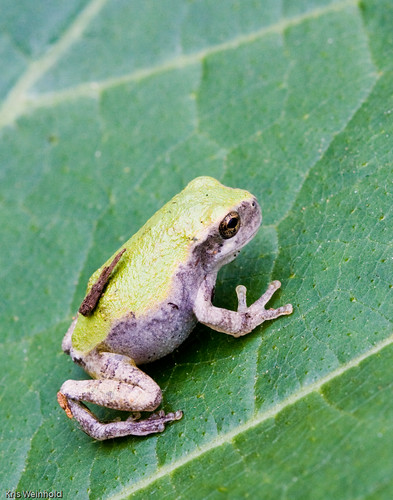
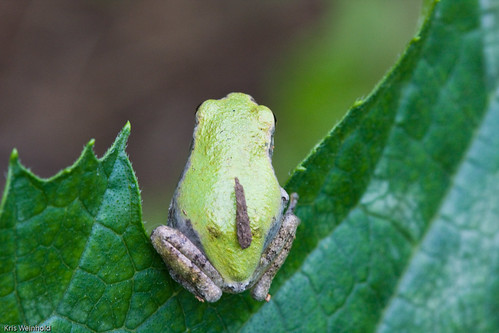
I was inspecting my beast of an Amish Squash plant the other day, and on one of the neighboring zucchini leaves, I noticed that a tiny little frog had taken refuge. In past years, I’ve always had bullfrogs and common pond frogs take residence in my raised brick pond, but I’ve never seen a tree frog in my backyard before.

Gray Tree Frog

Doing some research online, I suspect that this is Hyla versicolor which is supposed to be one of the most common tree frogs in my area. The common name is the Gray Tree Frog.

Gray Tree Frog

He wasn’t particularly fond of my camera, and kept inching away from me. Quite typically, he had to have a piece of mulch stuck to his back, so that I couldn’t get an unencumbered picture.

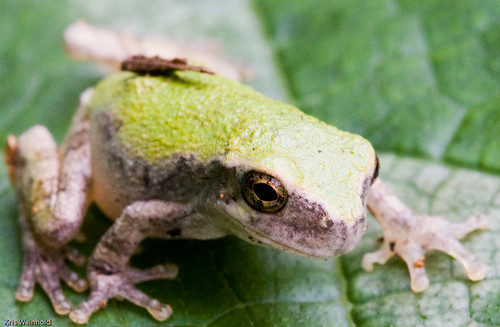
Gray Tree Frog

I love the pads of tree frog’s feet, when spread out, gripping the surface of the leaf. It’s amazing how similar these local frogs are to their Amazon counterparts that I photographed last summer. Of course, the coloration of those frogs were a bit brighter in many cases.

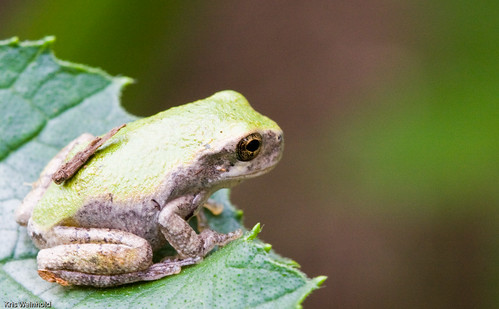
Gray Tree Frog

After chasing this guy across a few zucchini leaves, I decided to leave him be. I hope he stays around for awhile, as a small army of frogs might come in handy once the squash bugs and cucumber beetles arrive!

Business Broker

2.5G Scape – 1 Week In

July 7th, 2008

My 2.5G aquascape is now planted, and a week old. I haven’t really seen a ton of growth yet, but I’m hoping that the plants are just getting themselves acclimated to the conditions. I am running pressurized CO2 into the aquarium in hopes that it will speed things along.

2.5G - 1 Week

The plants are pretty bread and butter type plants for a nano tank. From left to right, in the back I’ve got Downoi, Narrowleaf Java Fern, and Java Fern ‘Trident/Fingers’. In the foreground, there’s Hemianthus callitrichoides (HC) and Anubias barteri var. ‘nana petite’ in the midground. I’m going to need to thicken up the downoi a little bit, and let the HC grow in, but otherwise, if those two things happen, I’m pretty happy with this aquascape. As always, I would love some comments/critiques.

Business Broker

2.5G – Start of a Winner!

July 2nd, 2008

I’ve finally gotten around to setting up my 2.5G tank for the GWAPA MemberĀ  Nanoscape Contest. I tore down the soil experiment tank, and loaded it up with a small 3L bag of ADA Malaya Aquasoil that I had on the shelf for over a year. I ordered a bag of Malaya and Africana awhile ago to compare them to ADA’s Amazon, but haven’t had the opportunity to until now.

2.5G

Malaya is a bit lighter in coloration than that of Amazonia, and has little flecks throughout. For the hardscape, I’m sticking with a porous mossy rock only composition, largely because I don’t have any pieces of driftwood small enough with the amount of character that I’d like.

2.5G

This is my first attempt in terms of positioning the rocks. I haven’t fully determined what plants I’m going to use yet, so I’m going to have to update this more once I figure that out! In any case, any suggestions on the hardscape?

Business Broker

Wormstrate/Soil – Winners and Loser

June 30th, 2008

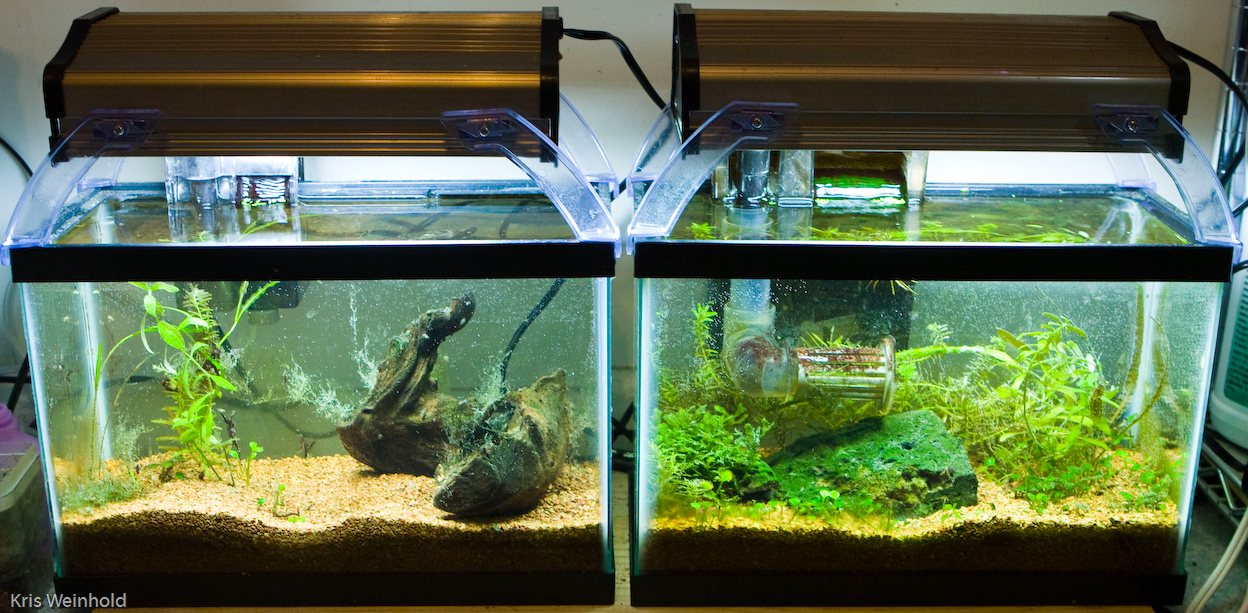
I am concluding my comparison of the soil and worm-casting-based substrates. The picture below sums it all up — neither tank met or exceeded my expectations. Now, in this case, the winner appears to be the wormstrate, but in truth, there is no winner, and the biggest loser is me.

2.5G Soilstrate/Wormstrate Aquraiums

Unfortunately, I wasn’t able to really conduct a fair experiment for these two tanks. I rarely dosed any Excel, and the lights themselves probably made the tanks too warm to successfully grow many plants. Factor in my travels recently, and it adds up to a lot of neglect. I’m amazed that the wormstrate was able to maintain a growing carpet of Marsilea quadrifolia. The soil tank on the other hand, saw nearly all of the plant life disappear. The only plant that really did well in that tank was Limnophila aquatica (now removed), which grows in just about anything. I want to make clear that this is not an indictment of soil substrates because I know many GWAPA members who have absolutely amazing results with soil. It’s only a failure of execution on my behalf. So, I’m tearing down the soil substrate tank, and am finally going to set up my 2.5G aquascape for the GWAPA contest. I have until October 1st to make it into something fabulous!

Business Broker

« Previous Entries   Next Entries »